



Anti-Tailgating Speed Gates: Enhancing Access Security
2025-10-27


Picture this: an employee badges into your secure building. As the door opens, a person behind them (perhaps holding two coffees) says, "Oh, could you hold that? I forgot my badge at my desk." Being polite, your employee holds the door. In that two-second act of courtesy, your entire multi-million dollar digital security system—your servers, your access control, your encryption—is defeated.
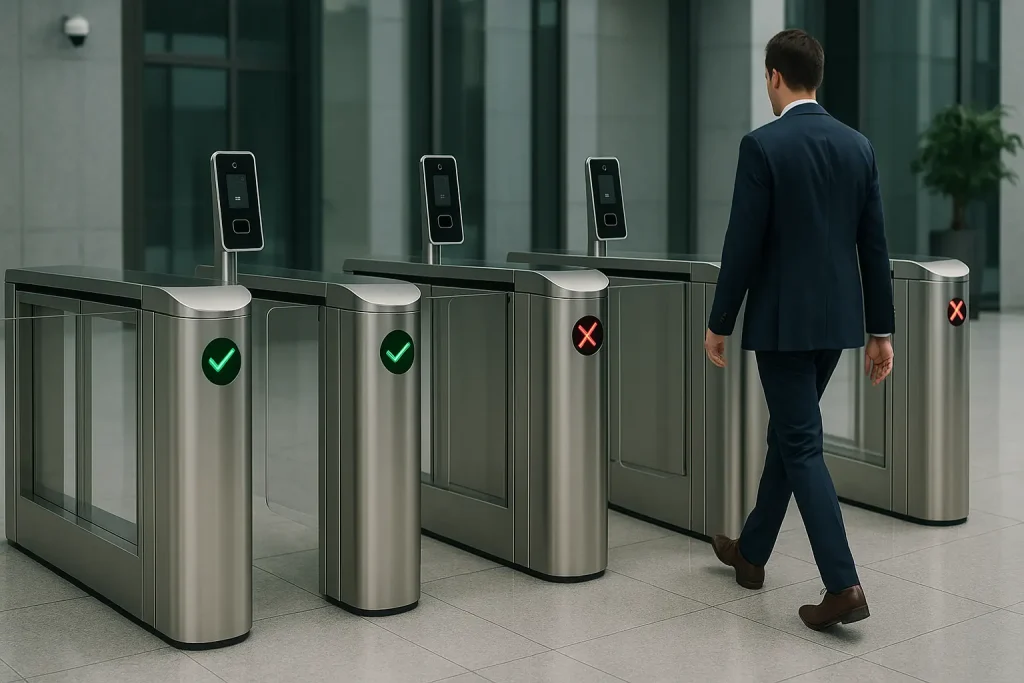
This is tailgating (or "piggybacking"), and it is, without question, the single most common and effective way that physical security is breached.
It's a problem of human nature. But the solution is one of smart engineering: the anti-tailgating speed gate.
This is not just a "gate" or a "turnstile." It is an intelligent, high-tech sentinel designed specifically to detect and prevent this exact threat. It is the critical physical enforcer for your digital access policy. This guide is a comprehensive, practical look at how this technology works, why it's the new standard for building security, and how to choose the right system for your facility.
What Exactly Is an Anti-Tailgating Speed Gate?
An anti-tailgating speed gate is an advanced access control barrier that uses a sophisticated array of optical sensors to detect and prevent more than one person from passing through per valid credential. Its primary job is to enforce a "one person, one valid credential" rule, thereby stopping unauthorized followers.
Unlike a simple door with a card reader, which is "dumb" (it only knows if a card is valid, not how many people walk through), an anti-tailgating gate is "smart." It creates an invisible, intelligent security field within its lane.
When an employee presents a valid card, the gate's "brain" says, "OK, I will authorize one person to pass." The gate's "eyes" (its sensors) then take over, monitoring the lane to make sure that only one person passes through before it closes and re-secures the lane. It's a core component of all modern speed gate systems.
How Does the Anti-Tailgating Technology Actually Work?
The technology works by using a dense grid of infrared (IR) sensors—often called a "light curtain"—to create a 3D profile of the object passing through. The gate's internal logic controller analyzes this profile in real-time. It knows what "one person" looks like, and it will sound an alarm or close the barriers if it detects an "unexpected shape," like two people.
This is where the real "character" and intelligence of the gate lie. Let's break down the step-by-step logic of a breach attempt:
- Idle State: The gate is closed and secure. Its internal "light curtain" of dozens of cross-hatched sensor beams is active.
- Credential Presentation: An authorized user presents their credential (e.g., at an RFID speed gate system).
- Validation: The building's main high-speed access-control-system (the "central brain") validates the card and sends an "open" signal to the gate.
- Authorized Passage: The barriers open. The user walks through. The gate's sensor array (the "eyes") tracks them, noting their size, speed, and direction. It confirms, "This is one person."
- The Breach Attempt (Tailgating): A second, unauthorized person tries to follow the first person through the still-open lane.
- Detection (The "Gotcha" Moment): The sensor array instantly detects this second object. The gate's local logic controller (its "local brain") analyzes this: "My sensors see a second person, but I only received one 'open' signal." This is a security violation.
- The Response: The gate immediately goes into alarm mode:
- A loud, local audible alarm sounds, drawing immediate attention to that specific lane.
- Bright visual alarms (often flashing red LEDs) pinpoint the violation.
- The barriers will (depending on the model and setting) close quickly to physically block the second person.
- An alarm signal is sent to the security desk or VMS, logging the breach event.
This entire sequence happens in a fraction of a second. It is a level of detection that a human guard, distracted by 1,000 other things, simply cannot match.
What's the Difference Between a "Dumb" Gate and a "Smart" Anti-Tailgating Gate?
The key difference is sensor density and logic. A "dumb" gate has minimal sensors (e.g., 2-4 beams) that are only there for safety—to prevent the barrier from closing on a person. A "smart" anti-tailgating gate has a high-density array (20-60+ sensors) specifically designed for security—to profile, analyze, and count what is passing through.
As a security consultant, this is the first thing I look at. Many clients have bought what they thought was a security gate, but all they really bought was an automated door.
- "Dumb" Gate (Safety Sensors): Its logic is simple: "Is something in the lane? Yes? OK, I won't close." To this gate, one person, two people, or a person with a piano all look like one big "something." It cannot detect tailgating at all.
- "Smart" Gate (Security Sensors): Its logic is sophisticated: "What is this object? It's human-sized. It's moving at a walking pace. It's cleared the last sensor. OK, close. ... WAIT. Another object has entered the lane, but I received no new signal. ALARM."
This "smart" logic is what makes it a true automatic speed gate. It can make its own security decisions in real-time. The difference in security is not 10% or 20%; it's the difference between having no anti-tailgating security and having an effective, active system.
What Kinds of Tailgating Can These Gates Detect?
A high-quality anti-tailgating speed gate is tuned to detect a variety of breach scenarios, not just one. Its sophisticated logic can identify different methods of unauthorized entry, each triggering a specific alarm.
Here’s a breakdown of what a high-end system can catch:
- Simple Tailgating (Follow-Through): This is the most common. Person A badges and passes. Person B (the tailgater) walks through right behind them before the barriers can close. The gate detects Person B entering the lane without a corresponding credential and alarms.
- Piggybacking (Side-by-Side or "Buddy System"): Two people try to shuffle through the lane at the same time, often walking shoulder-to-shoulder. The sensor array detects a "shape" that is too wide or has too much "volume" to be a single person, triggering the alarm.
- Wrong-Way Detection: The sensors know the authorized direction of travel (e.g., "in" during the morning). If someone tries to enter through an "exit" lane, or if someone tries to "double back," the gate detects the wrong direction of movement and alarms. This is a key feature of a bidirectional speed gate.
- Crawl-Under Attempts: Many high-end gates have their lowest sensors just inches off the floor. If someone tries to crawl under the beams, the sensors detect this low-profile object and trigger a specific "crawl" alarm.
- Jump-Over Attempts: While the glass barriers are the physical deterrent, some systems integrate pressure sensors in the top lid or overhead sensors to detect if someone tries to vault over the gate, triggering yet another alarm.
How Do Anti-Tailgating Gates Balance Security with Speed (Throughput)?
This is the core design challenge. A 100% secure system (like a "mantrap" portal) is extremely slow. A 100% fast system (like an open lane) is 0% secure.
An anti-tailgating speed gate balances this by operating on a "trust but verify" model. It trusts the user is alone and uses a high-speed motor to open quickly, allowing for high throughput. It then verifies the user is alone with its sensors. Security (the alarm) only "kicks in" when a violation is detected.
This is what allows the gate to be a high-throughput speed gate, processing 30-40 people per minute. It doesn't slow down every user with a complex check. It only "flags" the violators.
This "alarm-on-violation" model is the perfect compromise. It allows the vast majority of honest employees to pass through as a fast-access-turnstile, creating a seamless and efficient lobby. But it provides an instant, loud, and unavoidable alert the moment a violation occurs.
What Are the Limitations? (What Can Fool an Anti-Tailgating Gate?)
While highly effective, no optical system is 100% infallible. Being honest about limitations is key to building a truly robust security plan. The main challenges are "false positives" (annoying alarms) and "false negatives" (missed breaches).
- False Positives (The "Annoying" Alarm):
- The Problem: A user is pulling a large, rolling suitcase. Or they're carrying a guitar case. The gate's sensors see one "human" shape and a second "large" shape following closely. It misinterprets the bag as a tailgater. ALARM.
- The Experience: As an installer, this is the #1 complaint we get post-installation. The system is "too sensitive."
- The Solution: High-end gates have adjustable sensitivity and "luggage" or "object" detection. The logic can be "taught" to ignore objects that are rolling or are below a certain height, reducing these false alarms.
- False Negatives (The "Real" Breach):
- The Problem: Two people who are extremely determined. They walk "as one"—perhaps with one person directly in front, fully obscuring the person behind. Or they shuffle through side-by-side in perfect unison.
- The Reality: They might fool the sensors by presenting a single, contiguous "shape."
- The Solution: This is why you must have a human guard. The speed gate is not a "set it and forget it" replacement for a security officer. It is a "force multiplier" tool for that officer.
What Is the Role of Staff in an Anti-Tailgating System?
The gate is a detection tool, not a replacement for staff. A human guard must be present to act as the responder. The gate's alarm (the "alert") draws the guard's attention only when a violation occurs, allowing them to provide the human-level response: "Excuse me, sir, can I see your badge?"
Think of it this way:
- Without a gate: A guard must monotonously watch 1,000 "good" entries, making it highly likely they will miss the one "bad" one.
- With a gate: The automatic speed gate watches all 1,000 entries. The guard is free to observe the lobby, manage visitors, and only intervene when the gate's alarm tells them to.
The gate automates the detection. The human provides the intelligent response. This layered approach is the new standard.
How Do You Choose the Right Anti-Tailgating System?
When you are buying an anti-tailgating speed gate, you are not buying stainless steel and glass. You are buying sensors and software.
- Focus on Sensor Density (The "Eyes"): This is the most important specification. Ask the manufacturer for a sensor diagram.
- Low-End (Not True Anti-Tailgating): 4-8 sensors. These are for safety only.
- Mid-Range (Basic): 16-24 sensors. Can detect simple tailgating.
- High-End (High-Security): 30-60+ sensors. This dense "light curtain" can detect piggybacking, crawling, and has fewer false alarms. This is what you want.
- Focus on the Logic (The "Brain"):
- Does it have adjustable sensitivity?
- Does it have a "luggage" or "object" detection mode?
- Can its firmware be updated as new threats emerge?
- How quickly does it process and close?
- Focus on Integration:
- How easily does it integrate with your existing access control? A high-end high-speed access-control-system needs to "handshake" with the gate instantly.
- Can it be paired with advanced credentials, like a biometric speed gate turnstile (facial recognition), for a full, high-security, hands-free setup?
- The Physical Barrier: The barrier itself (swing, flap, or sliding) is more of a deterrent. Taller barriers (e.g., a full-height speed gate) are a stronger psychological deterrent against jumping, even if the sensors are the same.
The Future: AI-Powered "Sensor Fusion" for Perfect Detection
The future of anti-tailgating is moving beyond just IR sensors. The next generation of systems uses "sensor fusion."
This is where the gate's "brain" takes the data from its IR light curtain and "fuses" it with data from an overhead video camera. An Artificial Intelligence (AI) program then analyzes this combined feed.
- The AI can see the difference between a person and a suitcase.
- It can see two heads and know it's a piggybacking attempt.
- It can see someone's face is obscured and flag them as high-risk.
This AI-driven approach will all but eliminate false positives and create a nearly infallible detection system. It's the next evolution of the speed lane gate, turning it from a simple sensor-tripwire into a proactive, intelligent security agent.
The Final Verdict: The Non-Negotiable Layer of Security
An anti-tailgating speed gate is no longer a luxury "nice-to-have." It is the single most effective and efficient tool to combat the #1 threat to physical security.
It acts as a 24/7, high-speed, automated sentinel that enforces your "one person, one credential" rule without error and without slowing down your building.
When you invest in a true anti-tailgating system, you aren't just buying a barrier. You are buying a highly intelligent "detection" and "deterrent" system that makes your entire security posture trustworthy.
