


Bidirectional Speed Gates: Managing Two-Way Pedestrian Traffic
2025-10-27


The modern building lobby is a complex ecosystem. It’s not just an entrance; it’s a high-traffic hub for people moving in multiple directions at all times. You have the predictable 9 AM rush of employees entering and the 5 PM rush of them exiting. But you also have the constant, chaotic "tidal flow" in between—people leaving for lunch, couriers arriving with deliveries, visitors heading to meetings, and employees stepping out for coffee.
For facility managers and security directors, this creates a massive challenge. How do you secure your lobby without creating a permanent, frustrating bottleneck? If you install a bank of "entry-only" gates and a separate bank of "exit-only" gates, you might solve the security problem, but you've just consumed a huge amount of valuable lobby space and created a system that is inefficient for most of the day.
This is where the bidirectional speed gate provides an intelligent, flexible, and efficient solution. It's not just a barrier; it's a "smart" traffic cop for your lobby, capable of managing two-way flow within a single, compact footprint. This guide is a comprehensive, practical look at how this technology works, its critical benefits, and how to implement it effectively.
What Is a Bidirectional Speed Gate?
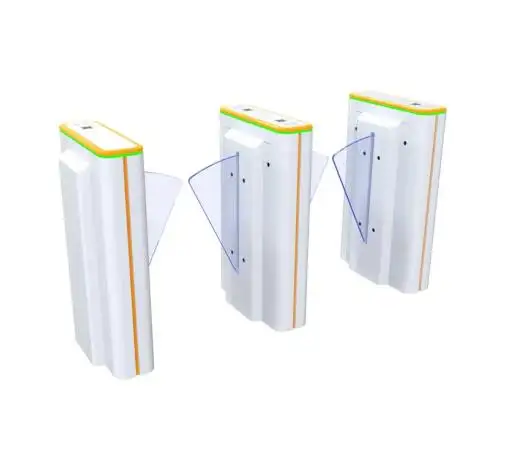
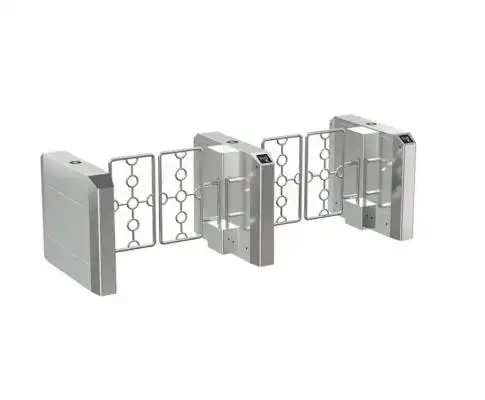
A bidirectional speed gate is an advanced access control barrier that can manage and control pedestrian traffic in both directions (entry and exit) through a single lane. Its logic and sensors are designed to enforce different access rules for each direction, all within one physical unit.
The concept is simple but powerful. Think of a bidirectional current in electronics, which can flow in two directions. This gate applies the same principle to people. Unlike a simple "unidirectional" turnstile (like a "push-to-exit" bar), a bidirectional gate is intelligent. It can be an "entry" gate one moment and an "exit" gate the next, all based on the credentials it receives and the rules you set.
This isn't some niche, separate category. This bidirectional capability is a core feature of most high-quality, modern speed gate systems. It’s about how you program the gate’s logic to take full advantage of its hardware.
How Does Bidirectional Technology Actually Work?
A bidirectional speed gate works by using two sets of access readers (one for entry, one for exit) and a sophisticated logic controller. The gate's sensors can detect the direction of passage, allowing it to apply different rules (e.g., "card required for entry," "free pass for exit") to each user, even in rapid succession.
This "smart" functionality is a perfect marriage of hardware and software.
- Dual-Sided Hardware: A true bidirectional lane has an access control reader integrated on both sides of the pedestal. There's a reader on the "public" side for entry and a reader on the "secure" side for exit.
- Directional Sensor Logic: This is the "magic." It does this by tracking the sequence in which a person breaks its dozens of infrared beams. It knows if you are moving from A to B (entering) or B to A (exiting).
- The "Local Brain": The gate's own logic controller manages these rules. It receives commands from your building's main speed gate access control panel (the "central brain"), but it executes the pass-through and sensor monitoring locally.
Let's walk through a real-world scenario:
- Employee A (Entering): Approaches from the outside. They tap their card on the outside reader. The gate's logic validates them, the barriers open, and the sensors track them moving in. The barriers close.
- Employee B (Exiting): Two seconds later, Employee B approaches from the inside to go to lunch.
- Scenario A (Free Exit): They hit a "push-to-exit" button. The gate opens, and the sensors track them moving out.
- Scenario B (Card-Out): They tap their card on the inside reader. The gate validates them, opens, and the sensors track them moving out.
This ability to rapidly process users in opposite directions is the core of a modern high-speed access control system.
What Are the Main Benefits of Using Bidirectional Gates?
The main benefits are maximum spatial efficiency (using one lane for two jobs), cost savings (needing fewer total gates), and unparalleled flexibility. They allow a facility to dynamically change lobby flow to adapt to different times of the day, like the "tidal flow" of morning entry or evening exit.
Benefit 1: Massive Space Savings (The #1 Driver)
This is the most common reason for choosing a bidirectional system. In a narrow building lobby, a tight elevator vestibule, or a historic building with unchangeable architecture, you simply may not have the space for separate banks of entry and exit gates. A bidirectional lane does two jobs in one footprint, effectively cutting your space requirement in half.
I've personally consulted on projects in older buildings where a bank of wide, bidirectional gates was the only solution that could provide secure, high-speed, and ADA-compliant access within the existing structural constraints.
Benefit 2: Cost Efficiency
Fewer gates mean lower costs. Instead of buying, installing, and maintaining eight lanes (e.g., four for entry, four for exit), you might be able to service the same number of people with just five or six bidirectional lanes. This saves significant capital on the hardware itself, the installation labor (which involves core drilling and cabling), and long-term maintenance contracts.
Benefit 3: Unmatched Flexibility (The "Tidal Flow" Solution)
This is the "killer feature" for smart building management. Your building's traffic isn't static; it's "tidal."
- Morning Rush (8-9 AM): 90% "in," 10% "out."
- Lunch Rush (12-1 PM): 50% "in," 50% "out."
- Evening Rush (5-6 PM): 10% "in," 90% "out."
A bank of unidirectional gates is incredibly inefficient during these tides. In the morning, your "exit" lanes sit empty while a queue forms at your "entry" lanes. With bidirectional gates, you can use software to dynamically change the lane configuration. A bank of six lanes can be set to "4-in, 2-out" in the morning and "2-in, 4-out" in the evening. This is the key to managing a true high-throughput speed gate environment.
Benefit 4: The Perfect ADA & Delivery Solution
Every entrance speed gate system must have at least one wide, ADA-compliant lane. This lane is a constant logistical challenge: it must be wide enough for wheelchairs, but it's also the default lane for wheeled deliveries, luggage, and strollers.
Making this single, wide lane a bidirectional speed gate is the perfect, most efficient solution. It can be used for:
- ADA-compliant entry.
- ADA-compliant exit.
- Guard-controlled entry for a delivery.
- Guard-controlled exit for moving equipment.
It becomes the "multi-tool" lane that handles every exception, all within one footprint.
What Are the Common Use Cases for Bidirectional Speed Gates?
The most common use is for ADA-compliant or handicap-accessible lanes, which must serve both entry and exit. They are also ideal for multi-tenant buildings, gyms, or any facility with limited space that cannot accommodate separate banks of entry-only and exit-only gates.
- Use Case 1: The ADA/Accessible Lane (The "Must-Have"). As mentioned above, this is the most common and non-negotiable use. Almost every modern speed gate installation will feature at least one wide, bidirectional lane.
- Use Case 2: Space-Constrained Lobbies. This includes historic buildings, high-rise towers with small ground-floor lobbies, or narrow elevator vestibules.
- Use Case 3: Gyms and Fitness Centers. Members need to badge in to verify membership. They also need to badge out (or have free exit) through the same set of gates.
- Use Case 4: Secondary Entrances. Think of an employee entrance from a parking garage. It's a lower-traffic area but still needs to securely handle both entry and exit. A single bidirectional lane is far more cost-effective than installing two separate gates.
- Use Case 5: Multi-Tenant Buildings. When a central lobby serves multiple companies, the traffic flow is less predictable. Bidirectional gates provide the flexibility to adapt to changing needs.
How Are Bidirectional Access Rules Programmed?
Access rules are programmed within the main access control software (the "brain"). An administrator can set each direction to a different mode, such as "Card to Enter, Free Exit," "Card to Enter, Card to Exit," or "Locked." These modes can even be scheduled to change automatically based on the time of day.
This is where the gate gets its "character." The gate is the "muscle," but your software is the "brain." Here are the most common modes:
- Mode 1: "Card In / Free Exit" (The Standard)
- Entry (Public Side): Requires a valid credential (card tap, biometric scan).
- Exit (Secure Side): Requires no credential. The gate's sensors detect an approaching person and simply open automatically. Alternatively, the user hits a "push-to-exit" button.
- Best For: Most corporate lobbies. It's secure against intruders but highly convenient for employees.
- Mode 2: "Card In / Card Out" (The High-Security)
- Entry: Requires a valid credential.
- Exit: Also requires a valid credential.
- Best For: High-security environments like data centers, labs, or government facilities. It also prevents an employee from "passing back" their card to an unauthorized friend.
- Mode 3: "Locked / Locked" (The Lockdown)
- The gate is locked in both directions. This is typically used overnight or during a security alert.
- Mode 4: "Free Passage" (The Open House)
- The gate is set to "open" in both directions (barriers remain retracted). This is used during building-wide events or in a fire-alarm-triggered emergency.
The real power of this automatic speed gate is that you can schedule these modes.
- Example Schedule:
7 AM - 6 PM:Set to "Card In / Free Exit."6 PM - 12 AM:Set to "Card In / Card Out" (for higher after-hours security).12 AM - 7 AM:Set to "Locked / Locked."
This dynamic, automated flexibility is a cornerstone of a modern speed gate access control strategy.
What Are the Limitations or Challenges of Bidirectional Gates?
The main challenge is managing simultaneous "head-to-head" traffic, where two users try to enter from opposite directions at the exact same time. This can cause a brief "standoff" as the gate's logic prioritizes one user. High-quality gates have logic to resolve this quickly.
Challenge 1: The "Head-to-Head" Priority Problem
- The Scenario: User A (Entering) and User B (Exiting) tap their cards at the exact same millisecond.
- What Happens? The gate's logic has a "priority" rule. It will grant access to one user (e.g., "first tap wins" or "entry direction has priority").
- The Result: User A's reader flashes green, and User B's flashes red. User A walks through. The gate closes. User B then has to tap their card again.
- The Takeaway: This is not a failure; it's a 2-second pause. But it's precisely why, for extremely high-traffic lobbies (like a stadium or a 5,000-person HQ), you would still want dedicated entry and exit lanes if you have the space.
Challenge 2: Sensor "Confusion"
- The Scenario: In a basic, cheaper system, the "exit" is set to "free passage." A person entering the lobby walks too close to the exit sensor and accidentally triggers the gate to open (in the wrong direction).
- The Solution: This is a problem of quality. High-end gates use "directional" sensors that know the person is on the "entry" side (based on which beams they broke first) and won't be "fooled" by the "exit" side. This is why sensor quality is paramount.
Challenges 3: Security on "Free Exit"
- The Scenario: If the exit is free, what stops an intruder from quickly walking in through the "out" gate as an employee is exiting?
- The Solution: Again, directional logic. The gate's sensors are still active. If the gate opens for a free exit (B-to-A), and the sensors detect someone moving in (A-to-B), it knows this is a "wrong-way" violation. It will immediately sound a loud, local alarm to alert security.
How to Successfully Implement a Bidirectional Gate Strategy
A successful strategy involves more than just the gate; it requires clear, visible signage to guide users. It also demands high-quality gates with sophisticated, directional sensor logic to prevent confusion and ensure user safety.
- Signage is EVERYTHING.
- Anecdote: I've seen a $30,000 bidirectional gate cause absolute chaos in a lobby because the signage was terrible. People didn't know where to tap to get out. They'd wave their card at the wrong spot, get frustrated, and try to force the gate.
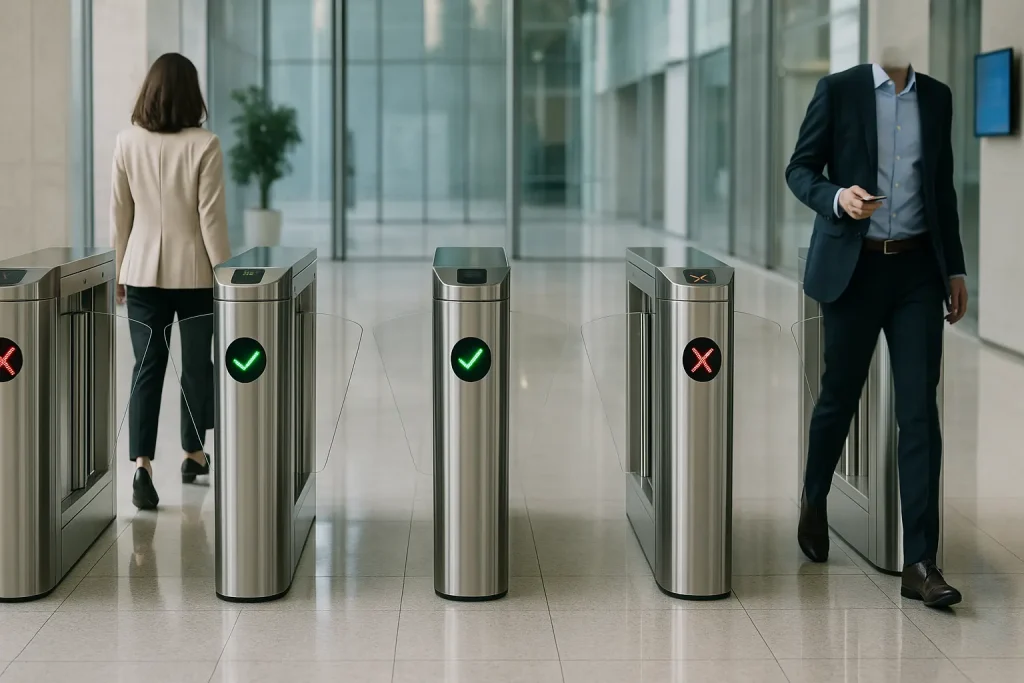
- Your system is useless if it's not intuitive. You need crystal-clear, illuminated signage:
- An illuminated Red 'X' (Lane Closed) and Green 'Arrow' (Lane Open).
- "TAP CARD HERE" (on the entry reader).
- "PUSH TO EXIT" (if using a button) or "TAP CARD TO EXIT" (if card-out).
- Invest in Quality (Sensors & Logic).
- This is not the place to save money. A cheap bidirectional gate with a "dumb" sensor array will be a constant source of frustration, false alarms, and user standoffs. You must invest in a system with high-density, directional sensors. This is the heart of a good fast-access-turnstile.
- Integrate with Your "Brain" and Staff.
- The gate is only as smart as the speed gate access control panel programming it. Ensure your integrator programs the schedules and modes you need.
- Train your front-desk staff. They need a remote console to open the gate in either direction for deliveries or visitors.
The Future: AI-Powered Dynamic Load Balancing
The future of bidirectional flow is intelligent, dynamic "load balancing." AI-powered systems will analyze real-time video feeds of lobby traffic and automatically change the direction and priority of lanes before queues can even form, creating a truly autonomous and efficient lobby.
We're moving beyond scheduled changes (e.g., "at 5 PM, switch to exit-priority"). The future is real-time adaptation.
- Imagine a video camera (the "eye") watching the whole lobby.
- An AI (the "brain") sees a long entry queue forming, but the exit lanes are empty.
- The AI will instantly command two of the bidirectional "exit" lanes to switch to "Entry-Mode" to help clear the queue.
- This is "dynamic load-balancing" for people. It's the ultimate high-throughput speed gate system—a lobby that thinks for itself.
The Final Verdict: The Smart, Flexible Standard
The bidirectional speed gate is no longer a niche product; it's an essential, flexible, and intelligent solution for modern building management. It solves the complex, two-way flow of a real-world lobby, saving space, money, and time.
It is the "multi-tool" of the modern entrance speed gate system, providing the perfect balance of security, efficiency, and flexibility. For any new installation—and especially for ADA compliance or space-constrained areas—a bidirectional gate is the new, definitive standard.
