



Speed Gate Access Control: Secure and Seamless Entry Management
2025-10-27


In the world of building management, security and flow are often opposing forces. A fortress-like security posture—locked doors, checkpoints, and manual verifications—creates friction, frustration, and bottlenecks. On the other hand, a completely open, free-flowing environment is a massive security liability. This is the central challenge for any facility manager, IT director, or head of security. How do you stop the wrong people from getting in without slowing the right people down?
The answer lies in an integrated system: speed gate access control. This isn't just about installing a "gate." It's about creating an intelligent, responsive, and robust system where the "brain" of your access control platform works in perfect harmony with the "muscle" of a physical speed gate.
When implemented correctly, this system is what allows a lobby to process hundreds of people in a 10-minute rush hour, all while ensuring every single entry is authorized, validated, and secure. It's the technology that makes a secure building feel effortless.
This guide will provide a definitive, expert look at the concept of speed gate access control. We'll explore how these components integrate, the massive security and efficiency benefits they provide, and the practical, real-world steps for planning a system that delivers both security and seamlessness.
What Is Speed Gate Access Control?
Speed gate access control is the integrated system that combines physical speed gates (the "muscle") with an electronic access control system, or ACS (the "brain"). This system validates a user's credentials (like a card or biometric) and then commands the physical gate to open, ensuring only one authorized person can pass, all at high speed.
This is the most critical concept to understand. You don't just buy "speed gate access control" as a single product. You create it by integrating two distinct, specialized components:
- The Access Control System (ACS): This is the "brain." It's the software, the server (or cloud), the database, and the control panels (like those from manufacturers such as Lenel, Genetec, Brivo, or AMAG). This system is what stores the rules:
- Who is allowed? (Employee A, Visitor B)
- Where are they allowed? (Lobby, 3rd Floor, Data Center)
- When are they allowed? (Mon-Fri, 9-5)
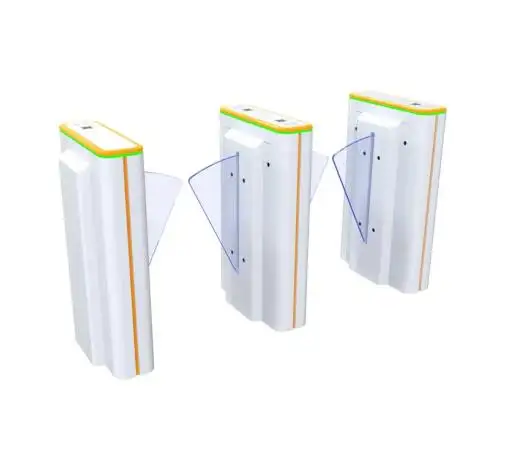
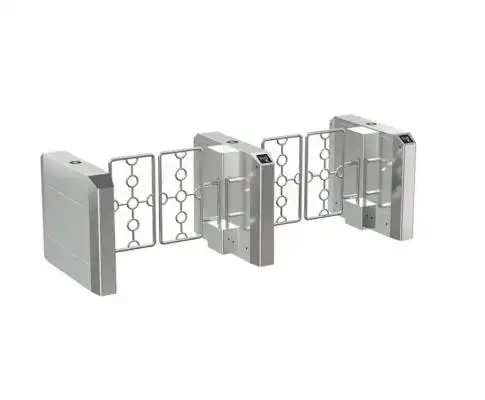
- The Speed Gate: This is the "muscle" or the "enforcer." This is the physical hardware you see in the lobby—the speed gate turnstile or pedestrian speed gate—with its stainless steel chassis, glass barriers, and optical sensors. The gate on its own knows nothing about who you are. Its job is simply to wait for an "open" command and then execute its own logic: "Open barriers, monitor person passing, close barriers."
Speed gate access control is the marriage of these two. The ACS makes the decision, and the speed gate enforces that decision, adding a layer of physical security (anti-tailgating) that the ACS alone cannot.
How Does the Integration Between Speed Gates and Access Control Work?
The integration works via dry-contact signals, often called a "handshake." An access reader (like RFID) sends data to the main access control panel. The panel validates the credential and, if authorized, sends a simple "open" signal (a voltage pulse) to the speed gate's logic controller, which then operates the barriers.
As an integrator, this "handshake" is where the magic happens. A poorly configured handshake results in lag, user frustration, and security gaps. A well-configured one is the secret to a seamless experience.
Here is a practical, step-by-step breakdown of the integration:
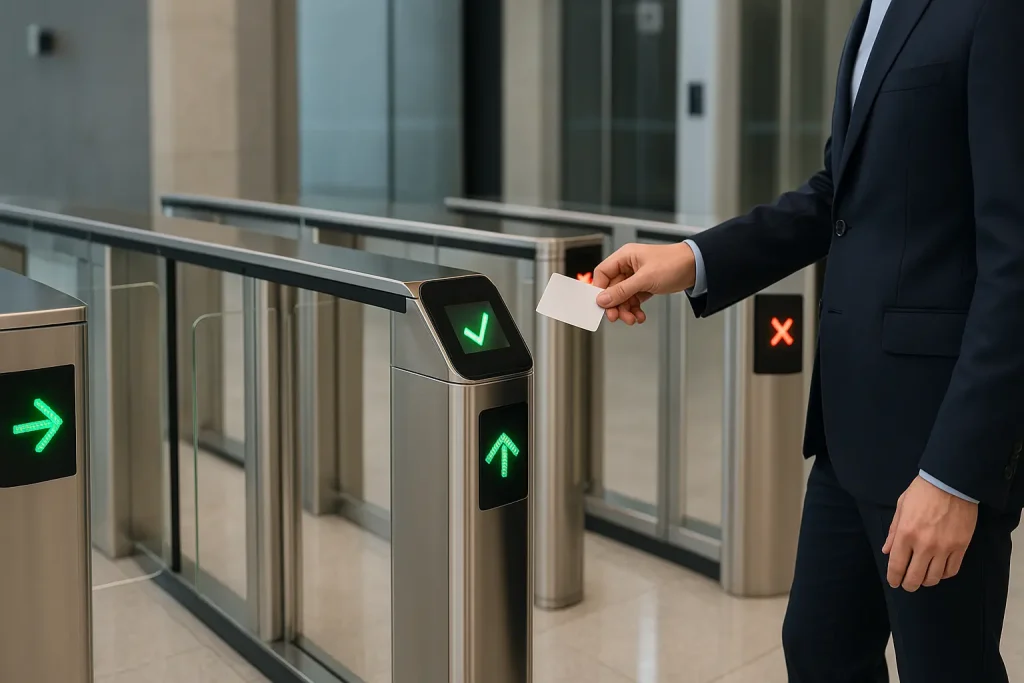
- User Presents Credential: An employee walks up to the entrance speed gate system and presents their credential. This could be tapping an RFID card, scanning their face at a biometric speed gate turnstile, or using a mobile app.
- Reader Sends Data: The reader (which is physically mounted on the gate) is not wired to the gate itself. It is wired to the building's main access control panel (ACP), which might be in a secure IT closet hundreds of feet away.
- ACS Makes Decision: The ACP receives the credential data (e.g., "User #4157"). It checks its database in milliseconds: "Is User #4157 authorized for the 'Main Lobby' entry point on a Sunday at 3:00 PM?"
- "Open" Signal Sent (The Handshake):
- If YES: The ACP sends a simple, low-voltage "dry contact" signal to the speed gate's dedicated logic board (inside the gate's chassis). This signal is just a pulse that says, "Open."
- If NO: The ACP does nothing. The reader on the gate might flash red, but no signal is sent to the gate, and the barriers remain closed.
- Gate Takes Over: The instant the speed gate receives the "open" signal, its own logic controller takes over. It no longer needs the ACP. Its job is now to:
- Activate its high-speed motor to open the barriers.
- Monitor its internal infrared sensors to ensure one person passes through.
- Detect any tailgating, alarming if a second person tries to follow.
- Close the barriers immediately after the authorized person is clear.
This modularity is a massive advantage. It means you can pair a best-in-class speed gate systems manufacturer with any best-in-class access control software, giving you total flexibility.
What Are the Primary Security Benefits of This Integrated System?
The main benefit is high-fidelity tailgating prevention. The system's sensors enforce the "one person, one valid credential" rule that the access control software alone cannot. It also provides a strong physical deterrent and creates a detailed, enforceable audit trail of all passages.
A simple card reader on a wall next to a door is a weak security solution. It's easily defeated. An integrated speed gate access control system provides layered, intelligent security.
- Benefit 1: Physically Stopping Tailgating & PiggybackingThis is the #1 job. Tailgating—an unauthorized person following an authorized one—is the single most common way physical security is breached. A door can't stop this. A guard might miss it. An optical speed lane gate with a dense sensor array will not miss it. It's designed to sound an alarm and, in many cases, close the barriers to prevent the second entry.
- Benefit 2: Enforcing ACS Rules 100% of the TimeYour access control system has the rules, but the speed gate is the 24/7, non-distractible enforcer. It cannot be "socially engineered" with a "Hey, I forgot my badge" story. It doesn't get tired or look away. The automatic speed gate ensures the policy set in your software is the policy enforced in your lobby.
- Benefit 3: Creating an Undisputed Audit TrailWith a simple door reader, your log shows "User A badged at 9:01 AM." You hope one person went through. With an integrated speed gate, your log shows "User A badged at 9:01 AM," and the gate's internal log confirms "One passage event occurred." If an alarm was triggered, you have a log of that, too. This data is invaluable for investigations and compliance.
- Benefit 4: Acting as a Physical & Psychological DeterrentThe visible presence of a sleek, modern speed gate turnstile signals that security is taken seriously. It discourages opportunistic, casual intruders who are looking for an easy-access building.
How Does Speed Gate Access Control Create a "Seamless" Entry Experience?
A seamless experience is created by automating the validation process. When integrated with fast credentials like RFID or biometrics, the system allows users to pass through at a normal walking pace without stopping, eliminating lobby bottlenecks and daily friction.
This is the "other side of the coin" and why these systems are so popular. They increase security while also increasing speed and convenience.
- The "Walk-Through" Experience: The goal of a modern high-speed-access-control-system is to be "frictionless." In a perfect install, an employee walks toward the gate. A long-range reader or facial recognition scanner (like a biometric speed gate turnstile) identifies them before they arrive. The barriers open, they walk straight through without breaking stride, and the barriers close behind them. This is the "character" of a high-end system: it feels invisible and effortless.
- Massive Throughput Advantage: This frictionless experience translates to hard numbers. A security guard checking badges is slow, maybe 10-15 people per minute (PPM). A high-throughput speed gate can process 30-40+ PPM per lane. A bank of four lanes can handle the 8:55 AM rush of 120+ people, eliminating the daily lobby queue.
- Improved Employee Satisfaction: That daily queue? It's a source of friction, a "pebble in the shoe" that starts every employee's day with a minor frustration. Removing it has a tangible, positive impact on company culture and perception of the facility.
What Types of Credentials Can Be Integrated with Speed Gates?
Virtually any electronic credential can be integrated because the reader is a separate component from the gate itself. Common types include RFID/NFC cards, mobile credentials (Bluetooth or NFC on phones), biometric scanners (facial, fingerprint), and QR code readers for visitor management.
The flexibility of a speed gate access control system is one of its greatest strengths. The speed gate is "credential-agnostic"—it just waits for the "open" signal. You can choose any reader technology that works with your main ACS.
Here are the most common credential types used today:
- RFID/NFC (The Corporate Standard): These are the plastic cards that make up the vast majority of systems.
- Prox (Proximity): Older, less secure 125kHz technology.
- Smart Cards (MIFARE, iCLASS): Newer, more secure, encrypted 13.56 MHz technology. These are the standard for most new installs.
- Biometrics (The High-Security & Convenience Future): This category eliminates the "I forgot my badge" problem. A biometric speed gate turnstile validates you, not a token you carry.
- Facial Recognition: The fastest, most frictionless option. Users just look and walk.
- Fingerprint/Palm Vein: Extremely secure, but requires the user to stop and touch or hover their hand, slightly slowing throughput.
- Mobile Credentials (The New Standard): This uses an app on an employee's smartphone to act as their badge, using either Bluetooth (for "hands-free" long-range) or NFC (to tap like a card).
| Credential Type | Typical Speed | Security Level | User Convenience |
| RFID Card (Tap) | High (2-3 sec) | Good (High w/ Smart Card) | Good |
| Mobile (Tap) | High (2-3 sec) | High (with phone PIN/Face ID) | Good (no card to carry) |
| Mobile (Bluetooth) | Very High (1-2 sec) | High | Excellent (phone stays in pocket) |
| Biometric (Face) | Very High (1-2 sec) | Very High | Excellent (truly hands-free) |
| Biometric (Finger) | Medium (3-5 sec) | Very High | Medium (requires stop & touch) |
| QR Code (Visitor) | Medium (3-5 sec) | Good (time-limited) | Excellent (for visitors) |
How Do You Plan a Speed Gate Access Control Installation?
A successful plan involves coordinating three key elements: the physical gates for your throughput needs, the access control software, and the life-safety system (fire alarm). This requires a site survey, throughput analysis, and tight coordination between your security integrator, electrician, and IT department.
As someone who has seen this process go both right and wrong, I can tell you that "planning" is 90% of the success. You are not just "buying gates"; you are engineering a system.
- Step 1: Conduct a Real-World Throughput Analysis.Do not guess. Do not just use your total employee count. Get a clicker and stand in your lobby. Count the number of people who enter during your busiest 15-minute period. This "peak load" number is the only number that determines how many lanes you need. A high-speed-pedestrian-turnstile is fast, but you'll still get a queue if you only install two lanes when your peak load demands four.
- Step 2: Define Your Security & User Needs.
- Step 3: Confirm the "Big 3" Integration Compatibility.This is the coordination part I see people fail at most often.
- Step 4: Plan the Physical Installation.These gates are heavy and need power and data from under the floor. This is a construction project. It requires:
- Core drilling or trenching your lobby floor to run conduits.
- Level flooring. The optical sensors on optical turnstiles need a level, reflective surface to work correctly.
- Coordination between the electrician (power) and the data cabling team (network for readers).
What Are Common Challenges in Speed Gate Integration?
Common challenges include failing to properly integrate with the building's fire alarm system, poor sensor tuning (causing false alarms or "clipping" users), under-speccing the number of lanes for peak traffic, and a disjointed user experience where the reader and gate are not in sync.
- Challenge 1: The Fire Alarm Failure.I've seen this in audits. The gates were installed, but the critical fire alarm integration was "postponed" or done incorrectly. In a fire, the gates would have failed-secure, trapping people. It's a massive liability and a complete failure of the project.
- Challenge 2: Bad Sensor Tuning (The "Clipping" Gate).This is the "character" of the gate. The optical sensors need to be tuned to your environment. If they are too sensitive, they'll false-alarm all day. If they're not sensitive enough, they'll allow tailgating or, worse, "clip" a user by closing too early. This requires an expert technician post-install.
- Challenge 3: The "Reader-Gate Lag."This is a classic user-experience-killer. The client buys a super-fast high-speed-pedestrian-turnstile, but pairs it with a slow, old RFID reader. The user taps, the gate is ready, but the ACS takes 2 seconds to send the "open" signal. The user is left standing there, and the "speed" is lost. The system is only as fast as its slowest component.
- Challenge 4: Forgetting the "Other" Traffic.The system is designed for employees, but what about the catering delivery? Or the new furniture being brought in? Forgetting to plan for an ADA-compliant bidirectional speed gate or a separate service entrance creates a massive operational problem on day one.
The Future: Intelligent, Predictive, and Invisible Access
The future of speed gate access control is intelligent, frictionless, and data-driven. Systems are moving toward AI-powered facial recognition, long-range Bluetooth credentials, and cloud-based management, allowing for a "walk-through" experience with predictive analytics.
The speed gate access control system is becoming a key data-gathering point in the "smart building" ecosystem.
- Truly Frictionless Access: The credential will be invisible. You won't tap, scan, or stop. Your phone in your pocket (Bluetooth) or your face (biometrics) will be your key, allowing a true "walk-through" experience.
- AI-Powered Analytics: The gate's sensors will be paired with video cameras and AI. The system won't just detect tailgating; it will detect "suspicious behavior," "a person under duress," "an object left behind," or "a person trying to crawl through." It will move from reactive to predictive security.
- Total Smart Building Integration: Your entry at the lobby gate will become a trigger for a sequence of events. The entrance speed gate system will tell the elevator to call a car for your default floor, tell your lights to turn on, and even book your hot-desk.
The Final Verdict: Why an Integrated System is Non-Negotiable
A "speed gate" by itself is just a piece of motorized metal and glass. An "access control system" by itself is just software. It's only when you combine them into an integrated speed gate access control system that you solve the fundamental challenge of the modern building: balancing security and speed.
This integrated approach is the only way to physically stop tailgating without creating frustrating bottlenecks. It automates your security policy, frees your staff for higher-value work, and provides a secure, seamless, and modern experience for every person who enters your facility. For any organization serious about its security and its people, this system is no longer an upgrade—it's the standard.
