



What Is a Speed Gate Turnstile and How It Improves Access Control
2025-10-27


Walk into any modern corporate lobby, secure government building, or high-tech campus, and you'll likely encounter them: sleek, glass-and-steel barriers that open and close with quiet, efficient precision. These are speed gate turnstiles, and they represent one of the most significant evolutions in building security and access control in the last two decades.
For facility managers, security directors, and architects, the daily challenge is a balancing act. How do you secure a building from unauthorized access without creating a frustrating, inefficient bottleneck for hundreds or even thousands of employees? Traditional security, like a guard at a desk or a clunky tripod turnstile, often fails at one of these. It's either too slow or not secure enough.
This is the exact problem the speed gate turnstile was designed to solve. It's not just a barrier; it's an intelligent flow management system. This guide will provide a definitive explanation of what a speed gate turnstile is, how its technology works, the different types available, and how it fundamentally improves your building's access control far beyond what traditional methods can offer.
What Is a Speed Gate Turnstile?
A speed gate turnstile is an advanced access control barrier that uses sophisticated optical sensors and fast-moving physical barriers (like glass wings or flaps) to manage pedestrian flow. It is specifically designed to provide high security—primarily by preventing tailgating—while simultaneously processing a high volume of people quickly and efficiently.
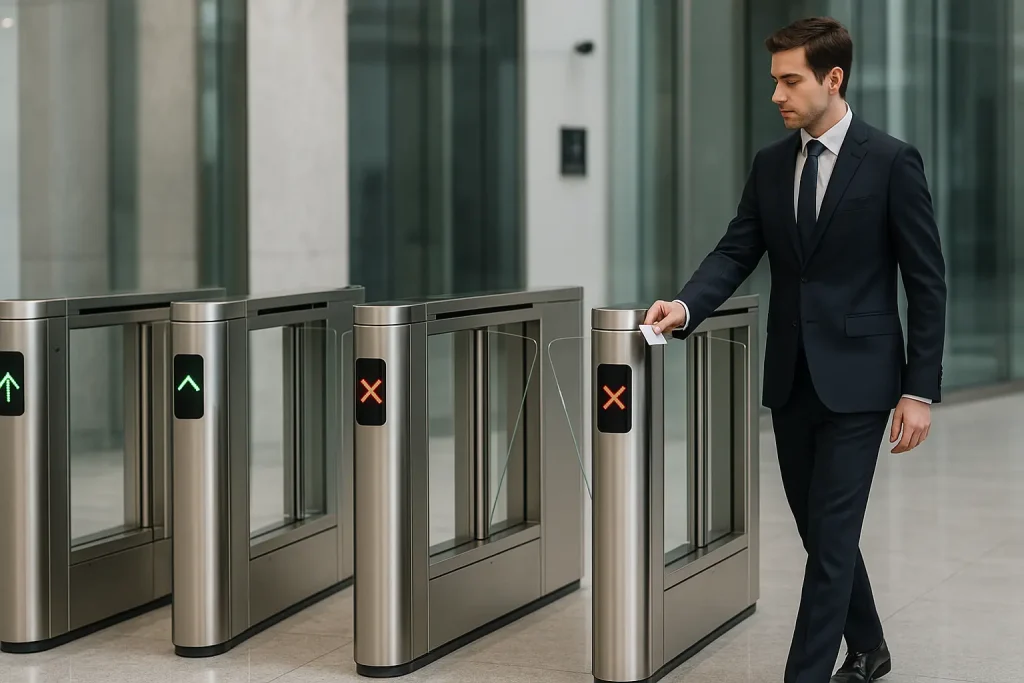
Unlike the traditional turnstiles you might see at a stadium, which are purely mechanical and slow, a speed gate is an electronic, motorized, and intelligent device. It forms a key part of modern speed gate systems, integrating directly with a building's access control to validate credentials (like RFID cards or biometrics) before granting entry. Its core purpose is to enforce a "one person, one valid credential" rule, all while maintaining a natural walking pace for authorized users.
How Does a Speed Gate Turnstile Actually Work?
A speed gate turnstile works by creating a "lane" of infrared sensors that detect a person's presence. When a user presents a valid credential (like a card), the system's "brain" validates it and signals the motorized barriers to open. The sensors then track the person as they pass through, ensuring only one individual enters, and then signal the barriers to close immediately.
This process seems simple to the user, but it's a high-speed coordination of multiple components. Here is a step-by-step breakdown of what happens in those two or three seconds:
- Idle State: The gate is closed, and a matrix of infrared (IR) sensors is active, scanning the lane for any obstructions.
- Credential Presentation: A user approaches and presents their credential. This could be tapping a card on an RFID speed gate system reader, or in more advanced setups, having their face scanned by a biometric speed gate turnstile.
- Validation: The reader sends the credential's data to the building's main access control panel (the "brain").
- Open Signal: If valid, the access control panel sends a simple "open" signal (a dry contact) to the speed gate's own logic controller.
- Barrier Operation: The gate's motor activates, smoothly swinging or retracting the glass barriers to open the lane.
- Sensor Monitoring (The "Light Curtain"): As the user walks through, they pass through the dense array of sensors.
- Tailgating Detection: This is the most critical step. If a second person tries to follow the first one closely (tailgating), they will break the sensor beams in an unauthorized pattern.
- Closing Signal: Once the authorized user is clear of the final sensor, the logic signals the barriers to close, making the lane secure and ready for the next person.
What Are the Core Components of a Speed Gate Turnstile?
The core components of a speed gate turnstile include the main chassis (pedestal), the motorized barriers (glass wings, flaps), a sophisticated sensor array (IR beams), a logic controller, and an integrated access control reader (like RFID or biometric).
Understanding these parts helps you understand why some gates are more secure or faster than others.
- Chassis or Pedestal: This is the body of the turnstile, typically made of high-grade stainless steel. It houses the motor, logic board, and sensors. The quality of the chassis determines the unit's durability, especially in high-traffic environments.
- Motorized Barriers: These are the physical "gates." They are almost always made of tempered glass (for aesthetics and safety) and come in different shapes and sizes. The motor itself is designed for millions of cycles and is the key to a fast access turnstile.
- Optical Sensor Array: This is the "secret sauce." Cheaper gates might only have 6 or 8 sensors. High-security gates can have 30+ sensors, creating a dense "light curtain" that is extremely difficult to fool. This array is what enables the gate to be a true anti-tailgating speed gate.
- Logic Controller: This is the local "brain" inside the turnstile. It receives the "open" command from the main access control panel and then takes over, managing the sensors, motor, and alarms for that specific lane.
- Access Control Reader: This is the user-facing part, which is integrated into the chassis. It's the card reader, biometric scanner, or QR code scanner that the user interacts with.
Speed Gate Turnstiles vs. Traditional Turnstiles: What's the Real Difference?
The key difference is intelligence and speed. Speed gate turnstiles use sensors to manage flow and stop tailgating at high speed. Traditional turnstiles (like tripods) use a slow, mechanical-only barrier for basic entry blocking, lacking sensor-based security.
As someone who has seen clients try to "save money" with a tripod turnstile in a corporate lobby, I can tell you the regret is almost immediate. The "clack-clack-clack" and the physical push-through are fine for a gym, but they create an industrial and restrictive feel in a professional environment.
A speed gate turnstile is an automatic speed gate that welcomes authorized users. A tripod blocks everyone until they physically push their way through.
Here’s a side-by-side comparison:
| Feature | Speed Gate Turnstile | Traditional Tripod Turnstile |
| Security Focus | Anti-tailgating & access validation | Access validation only |
| Security Level | High (detects and deters tailgating) | Low (easy to jump over or crawl under) |
| Throughput (Speed) | Very High: 30-40+ people per minute | Low/Medium: 20-25 people per minute |
| User Experience | Touchless, seamless, fast, modern | Physical push, clunky, slow, dated |
| Operation | Motorized, quiet, and automatic | Mechanical (user-pushed) or basic motor |
| Aesthetics | High (stainless steel, glass, lighting) | Low (industrial, painted or basic steel) |
| Alarms | Intelligent (specific to tailgating, etc.) | Basic (e.g., forced rotation) |
| Common Use | Corporate lobbies, data centers, banks | Stadiums, theme parks, factories, gyms |
What Are the Main Types of Speed Gate Turnstiles?
The main types are defined by their barrier movement: optical (barrier-free), flap barriers (retracting wings), swing barriers (swinging glass arms), and sliding gates (sliding glass panels), each offering different security and aesthetic levels.
Choosing the right type depends on your security needs, space, and desired user experience.
Optical Turnstiles (Barrier-Free)
This is a unique category. An optical turnstile consists of two pedestals that create a lane of sensors, but there are no physical barriers.
- How it works: It visually and audibly alarms when a person walks through without a valid credential.
- Pros: The absolute highest throughput (up to 60 PPM) and a completely open, welcoming feel.
- Cons: Provides zero physical security. It only detects a breach; it doesn't prevent it. It must be monitored by a security guard 24/7.
- Best for: Lobbies that are always staffed and where flow and aesthetics are the top priorities.
Flap Barrier Turnstiles (Retracting Wings)
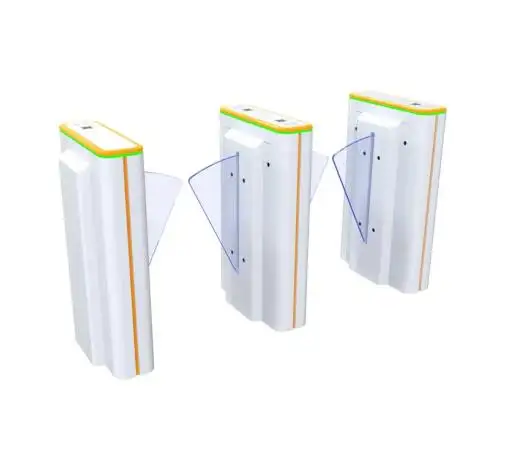
These are often called "angel wings." They feature two glass (or acrylic) wings that retract into the chassis of the pedestal to open the lane.
- How it works: The wings slide back quickly, creating a clear walking path.
- Pros: Extremely fast operation and a very small footprint, as no space is needed for barriers to swing open.
- Cons: The barriers are often shorter, making them easier to jump over than other models (though the sensors will still detect this and alarm).
- Best for: High-traffic areas like subway stations, convention centers, and building lobbies where processing speed is the #1 concern.
Swing Barrier Turnstiles (Swinging Arms)
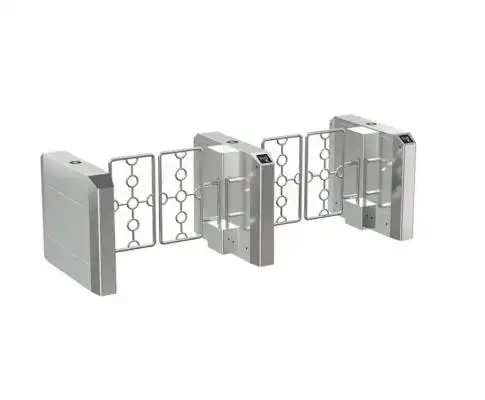
This is the most popular type for corporate environments. It features taller glass barriers that swing open in the direction of travel, like a futuristic saloon door.
- How it works: The glass arms pivot from the base, swinging open to allow passage.
- Pros: Feels very welcoming and intuitive. The taller barriers offer a greater physical deterrent. This is the easiest model to get in a wider, ADA-compliant lane. This is the classic pedestrian speed gate design.
- Cons: The swinging arms require physical clearance in front of or behind the pedestal.
- Best for: Corporate lobbies, executive floors, and any area balancing high aesthetics with solid security.
Sliding Gate Turnstiles (High-Security)
These are the most secure "speed gate" option. They use taller, more robust glass panels that slide open horizontally, like a miniature elevator door.
- How it works: The barriers slide apart, offering a secure lane that is very difficult to compromise.
- Pros: Offers the highest security in this category. The tall panels (sometimes 5-6 feet high) are extremely difficult to climb over or crawl under.
- Cons: They are physically larger, more expensive, and slightly slower than flap or swing gates.
- Best for: High-security areas like data centers, government facilities, and critical infrastructure control rooms.
How Do Speed Gate Turnstiles Improve Building Access Control?
Speed gate turnstiles improve access control by reliably enforcing the "one person, one credential" rule, eliminating tailgating, automating visitor management, and dramatically increasing pedestrian throughput, all while reducing the workload on security staff.
The impact of a well-implemented entrance speed gate system is felt across the entire organization.
They Virtually Eliminate Tailgating
This is their number one job. A simple locked door can't stop a tailgater. A busy guard will miss it. An anti-tailgating speed gate won't. The sensor logic is designed specifically to detect this and will sound a loud, localized alarm while flashing lights to alert staff. This "public alarm" is often a powerful enough deterrent to stop the behavior completely.
They Massively Increase Throughput (Goodbye, Lobby Bottlenecks!)
This is the "experience" benefit. I've seen lobbies where, at 8:55 AM, the line to get through security snakes out the door. This is a daily frustration for employees and a waste of productive time. A high-throughput speed gate can process a person every two seconds. A bank of four lanes can handle over 120 people per minute, effectively dissolving lines as fast as they form. Studies show that employee satisfaction is directly linked to a frictionless office environment.
They Automate and Secure Visitor Management
Speed gates integrate beautifully with modern visitor management systems. Instead of a guard having to check a list and buzz a visitor in, the visitor can be pre-registered and receive a QR code on their phone. They simply scan the code at the gate for a one-time, time-limited entry. This is professional, secure, and highly efficient.
They Reduce the Burden on Security Staff
A speed gate turnstile acts as a "force multiplier" for your security team. It frees your guards from the monotonous, low-skill job of "checking badges" and allows them to focus on high-value tasks: greeting visitors, identifying real threats, responding to incidents, and providing a human touch. The automatic speed gate handles the repetitive enforcement.
They Enhance Your Corporate Image
Aesthetics matter. A sleek, modern entrance speed gate system communicates that your company is modern, secure, and efficient. A clunky, industrial turnstile communicates the opposite. It's the first physical interaction an employee or high-value client has with your building, and it sets the tone.
They Provide Valuable, Actionable Data
Because every passage is logged, your speed gate access control system now has a perfect record of who is in the building and when. This data is invaluable for everything from fire safety mustering and compliance audits to understanding building usage patterns for energy management.
How Do You Integrate a Speed Gate Turnstile with Existing Security Systems?
Integration is done via dry-contact signals. The speed gate turnstile's controller connects to your main speed gate access control panel. The panel handles the credential check and sends a simple "open" command to the gate, making it compatible with most systems.
This is a critical point: the speed gate is not your access control system. It's an enforcement device for it. This modularity is a huge advantage.
- Access Control Integration: You can keep your existing access control provider (like Lenel, Genetec, Brivo, etc.). The speed gate simply plugs into it. The readers on the gate are wired back to your existing panels, and a single "open" wire is sent to the gate.
- Fire Alarm Integration: This is a mandatory, life-safety integration. The speed gate system must be wired into your building's fire/life-safety panel. In the event of a fire alarm, a signal is sent that automatically and permanently opens all gate barriers, allowing for free and fast egress. This is non-negotiable.
- Elevator Destination Dispatch: In smart buildings, the integration can go even deeper. When you badge at the gate, the system can simultaneously call an elevator and pre-select your default floor.
What Should You Consider Before Installing a Speed Gate Turnstile?
Before installing, you must analyze your peak pedestrian throughput (people per minute), the required security level (deterrence vs. prevention), ADA compliance needs (wider lanes), and the physical space (corridor width) and aesthetics of your lobby.
Don't just buy a gate. Plan an access solution. Ask these questions:
- What is my true "peak load"? Don't just count your total employees. Stand in your lobby from 8:30 AM to 9:15 AM and count the entries per minute. This number determines how many lanes you need. A single high-speed pedestrian turnstile is fast, but you'll likely need a bank of them to create a true, high-flow speed lane gate setup.
- What is my real security risk? Are you trying to stop casual tailgating in a friendly office? Or are you protecting a data center with sensitive information? The answer determines if you need a standard swing gate or a high-security sliding gate.
- How will I handle ADA/DDA compliance? You are legally required to provide an accessible lane for wheelchairs and deliveries. This lane is typically 32-36 inches wide and is often a bidirectional speed gate to handle multiple uses. This must be part of your initial floor plan.
- What are the installation logistics? Speed gates require power and data to be run under the floor. This means you will need to core-drill your lobby floor. This is a construction project, not just a delivery.
- What is the total cost of ownership? These are high-precision machines. They need a preventive maintenance plan. Factor in an annual service contract to keep the sensors clean and the motors calibrated. A well-maintained gate can last over a decade.
The Future of Speed Gate Turnstile Technology
The future is "invisible" and "intelligent." Speed gate turnstiles are integrating AI-powered facial recognition, long-range credentials (like Bluetooth), and data analytics to become fully touchless, predictive, and a source of building intelligence, not just an access point.
We're already seeing this shift. The next generation of biometric speed gate turnstile doesn't even require you to stop. You just keep walking, and a camera identifies you and opens the gate seamlessly. This is the "frictionless" access everyone wants.
Furthermore, AI-powered analytics will monitor the lanes, not just for tailgating, but for suspicious behavior, abandoned objects, or even duress. The gate will become a proactive part of your security team. The global market for this technology is expected to grow significantly, with some reports projecting a market value of over $25 billion by 2030.
The Final Verdict: Is a Speed Gate Turnstile Worth It?
Absolutely. A speed gate turnstile is no longer a luxury "nice-to-have"; it is a foundational component of a modern building's security and operational strategy.
It is the only solution that effectively solves the core conflict between security and speed. It enhances your security posture by reliably stopping unauthorized access, it improves your operational efficiency by automating a repetitive task, and it elevates your building's image by providing a seamless, modern experience for every person who walks through your doors.
