


Speed Lane Gates: Fast, Secure, and Efficient Entry Control
2025-10-27


For decades, the lobby of almost every commercial or government building has been defined by a fundamental conflict: the battle between security and speed. On one side, you need robust security to protect people and assets. On the other, you have the 8:55 AM rush hour, where hundreds of legitimate employees need to get to their desks. A slow, restrictive security process creates a daily bottleneck, frustrates employees, and wastes productive time. An open, fast process is a massive security liability.
This is the exact paradox that the modern speed lane gate was engineered to solve.
A speed lane gate isn't just a "turnstile" in the old, clunky sense. It's not a dumb, mechanical barrier. It is an intelligent, high-speed channel for managing pedestrian flow. It's a core component of a modern speed gate system that is designed to be fast, secure, and efficient, all at the same time.
For facility managers, security directors, and architects, understanding this technology is no longer optional. It's the new standard for building entry control. This guide will provide a definitive, expert look at what a speed lane gate is, how it works, what makes it so efficient, and how you can plan a system that finally solves the speed-versus-security dilemma.
What Is a Speed Lane Gate?
A speed lane gate is a single passageway within an advanced access control system that uses optical sensors and motorized barriers to manage pedestrian flow. It's designed to provide high-speed, high-security entry by validating one person at a time and preventing unauthorized follow-through.
The key word here is "lane." You will typically see a "bank" of these gates—perhaps two, four, or even eight in a row. Each individual passageway is a speed lane gate.
These lanes are the physical "enforcers" for your building's digital speed gate access control policy. The access control system (the "brain") decides who is allowed in. The speed lane gate (the "muscle") enforces that decision by opening for the right person and, just as importantly, staying closed for the wrong one.
This technology is a massive leap beyond older turnstiles. It's the modern evolution of the high-speed pedestrian turnstile, designed with a "walk-through" philosophy that prioritizes a seamless user experience.
How Does a Speed Lane Gate Actually Work?
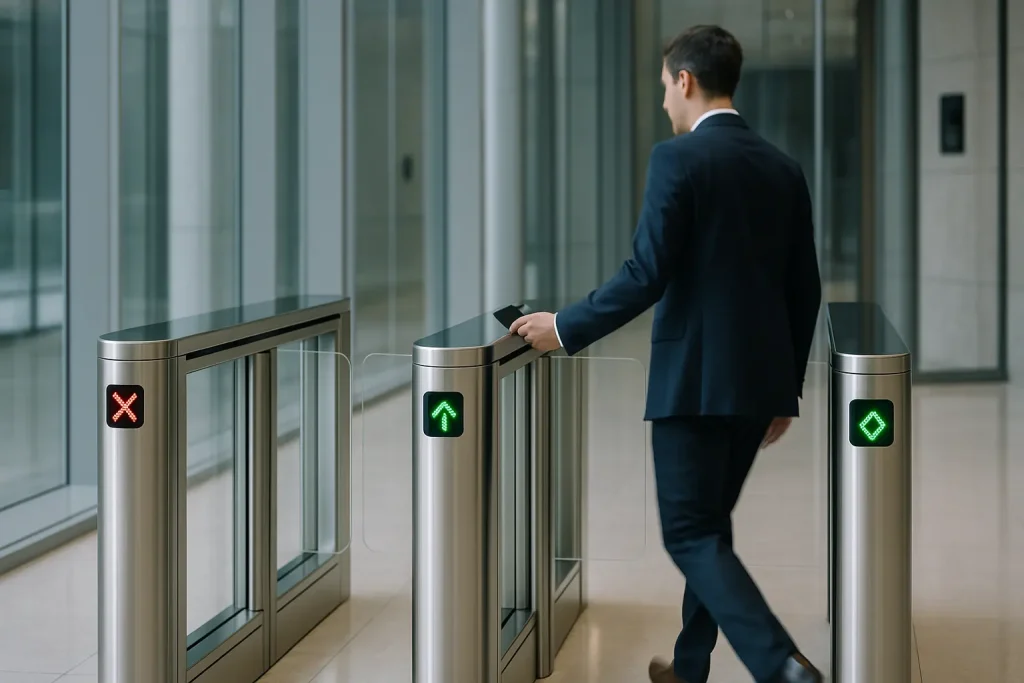
A speed lane gate works by receiving an "open" command from an access control system after a valid credential (like a card) is presented. Its internal sensors then track the person passing through the lane, and its high-speed motor closes the barriers immediately behind them to prevent tailgating.
From the user's perspective, the process should feel effortless. But in that two-second span, a high-speed coordination of technology takes place. As an integrator, this is the "ballet" we work to perfect.
Here is a step-by-step breakdown of a single passage:
- Idle State: The gate is closed, and its barriers are secure. A "light curtain" of dozens of infrared sensors is active, scanning the lane to ensure it's empty.
- Credential Presentation: A user approaches and presents their credential. This could be tapping an RFID card, scanning a QR code on their phone, or, in advanced systems, simply looking at a facial recognition camera.
- Validation (The "Brain"): The reader (which is mounted on the gate) sends the credential data to the building's main Access Control Panel.
- "Open" Signal (The "Handshake"): If the user is valid, the Access Control Panel sends a simple "open" signal (a dry contact) to the speed lane gate's own logic controller.
- Barrier Actuation (The "Muscle"): The gate's internal logic controller receives the "open" signal and instantly activates its high-speed motor, which swings or retracts the glass barriers.
- Sensor Tracking (The "Eyes"): As the authorized user walks through the lane, they pass through the array of sensors. The gate's logic "watches" them, tracking their size, speed, and direction.
- Anti-Tailgating Logic: This is the core security function. If a second person (who did not present a credential) tries to follow, the sensors detect an "unexpected" shape or a second object in the lane.
The Core Components of a High-Speed Lane
A speed lane gate's performance isn't just about the glass barriers. Its speed and security come from a set of high-performance components working in unison.
The core components of a speed lane gate are its high-speed motor (for barrier movement), a dense optical sensor array (to detect passage and tailgating), a logic controller (the "local brain"), and the physical barriers themselves (typically glass wings or flaps).
- Brushless DC Motors: This is the heart of the machine. Cheaper systems use standard motors that wear out. A true high-speed lane uses a brushless DC motor. These are built for high-cycle environments (millions of passages), are whisper-quiet, and can actuate the barriers in as little as 0.3 seconds. This is the technology that powers a true fast access turnstile.
- Optical Sensor Array: This is the gate's "eyes" and the true source of its security. It's not just one or two beams. A high-quality lane uses dozens of sensors to create a "light curtain"—a dense, cross-hatched grid of infrared beams.
- Logic Controller: This is the "local brain" inside the gate's chassis. It takes the "open" command from the main access control system and then takes over, managing the motor and all the sensor data.
- Physical Barriers: These are the most visible part. They are typically made of tempered glass for safety and aesthetics and come in several forms (which we'll cover next).
- Chassis and Reader Integration: This is the stainless steel body that houses all the components. It's designed with a space for an access control reader (RFID, biometric, etc.) to be seamlessly integrated.
What Makes a Speed Lane "Fast" and "Efficient"?
A speed lane is "fast" because it processes a high throughput of 30-40 people per minute, eliminating queues. This efficiency comes from its high-speed motor, instant credential validation, and sensor logic that closes the barrier immediately after a user passes, making the lane instantly ready for the next person.
The "fast" and "efficient" labels are not just marketing terms; they represent three distinct, tangible benefits.
Massive Pedestrian Throughput
This is the most obvious win. "Throughput" is the metric that matters, measured in People Per Minute (PPM). A speed lane gate is a high-throughput speed gate by design.
Here’s a real-world comparison:
| Entry Method | Typical Throughput (PPM) | Experience |
| Security Guard (Manual Check) | 10-15 PPM | Very slow, high human error, bottleneck |
| Tripod Turnstile (Mechanical) | 20-25 PPM | Slow, physical push, "clunky" feel |
| Speed Lane Gate (Motorized) | 30-40+ PPM | Fast, touchless, seamless walk-through |
A single speed lane gate can process twice as many people as a manual guard. A bank of four lanes can handle 120-160 people per minute, effectively dissolving the morning rush hour line.
A Frictionless User Experience
This technology is the heart of an automatic speed gate. For an authorized user, the experience is seamless. They don't have to stop. They don't have to push.
This "frictionless" experience is a powerful, daily positive reinforcement for employees. It communicates that the building is modern, efficient, and values their time.
Automation of Security Staff
This is the "force multiplier" benefit. A speed lane gate automates the low-skill, monotonous, and error-prone job of "badge checking." This frees up your highly-trained security guards to do what they are best at:
- Managing exceptions (e.g., visitors, a person with a problem).
- Identifying real threats (watching for suspicious behavior around the lanes, not at the lane).
- Responding to incidents.
The gate becomes the 24/7/365 enforcer, and the guard becomes the intelligent responder. This is a far more efficient and secure model.
What Are the Main Types of Speed Lane Gates?
The main types are defined by barrier movement. Flap barrier lanes use retracting wings for maximum speed. Swing barrier lanes use pivoting glass arms for a balance of aesthetics and security. Sliding lanes use tall, sliding panels for high-security applications.
Choosing the right type depends entirely on your goals for speed, security, and aesthetics.
Flap Barrier Lanes (The "Speedster")
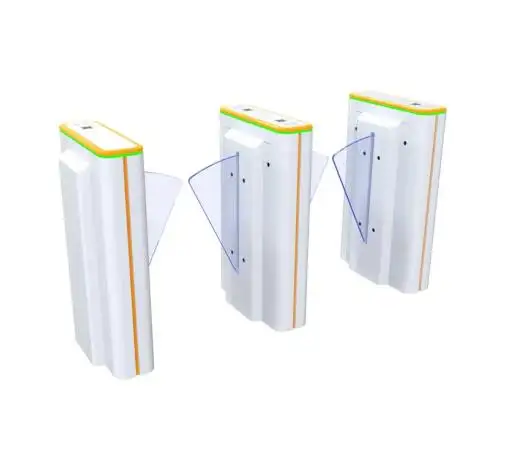
These are the "angel wing" style gates. They feature two (often triangular) glass or acrylic wings that retract into the chassis of the pedestal.
- Pros: The fastest possible operation (highest PPM). The barriers disappear completely, creating a very open, futuristic look and a minimal footprint.
- Cons: The barriers are often shorter, which can be perceived as a lower security deterrent (though the sensors will still detect anyone trying to jump over).
- Best For: High-traffic zones where speed is the #1 priority, like subway stations, convention centers, and massive corporate HQs.
Swing Barrier Lanes (The "Welcomer")
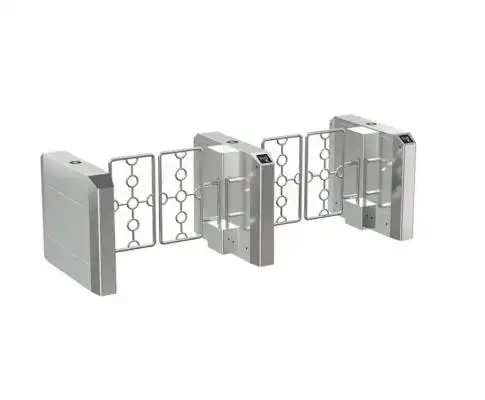
This is the most popular type for modern corporate lobbies. It features one or two taller glass arms that pivot from the base, swinging open in the direction of travel.
- Pros: Feels very elegant, intuitive, and welcoming. The taller glass barriers (from waist-high to near full-height) offer a stronger physical and psychological deterrent. This is the classic design for a modern entrance speed gate system.
- Cons: The swinging arms require physical clearance space in front of or behind the pedestal, so they take up a bit more room.
- Best For: Class-A office lobbies, executive floors, and any building wanting to perfectly balance high-end aesthetics with strong security.
Sliding Barrier Lanes (The "Fortress")
These are a more robust, high-security solution. They function like miniature elevator doors, with tall, sturdy glass panels that slide horizontally to open the lane.
- Pros: Offers the highest level of security in the "speed gate" category. The tall, robust panels (often 4-6 feet high) are extremely difficult to climb, crawl under, or force open.
- Cons: They are physically larger, more expensive, and slightly slower in operation than flap or swing gates due to the mass of the glass being moved.
- Best For: High-security areas like data centers, government facilities, financial institutions, and critical infrastructure control rooms.
Optical Lanes (Barrier-Free)
This is a special category that consists of the pedestals and sensors, but no physical barriers.
- Pros: The absolute highest throughput possible, as there is nothing to slow a person down.
- Cons: Provides zero physical security. It can only detect and alarm on an unauthorized entry; it cannot prevent it. It must be monitored by a security guard 24/7.
- Best For: Lobbies that are always staffed and where a welcoming, open-concept feel is the top priority.
How Do Speed Lane Gates Enhance Security?
Speed lane gates enhance security by using a dense array of optical sensors to physically detect and prevent tailgating—the most common security breach. They enforce the "one person, one credential" rule from the access control system, sound local alarms, and act as a strong physical deterrent.
This is their primary security function. A card reader on a wall can be defeated by seven people following one authorized person. A speed lane gate is specifically designed to stop this.
- Defeating Tailgating: The sensor "light curtain" is incredibly precise. It's tuned to recognize the size and shape of one person. When two people (or a person trying to "piggyback") enter the lane, the sensors detect an unexpected profile and trigger an alarm.
- Enforcing Access Policy: The gate is the 24/7 enforcer of your speed gate access control rules. It doesn't get tired, it can't be distracted, and it can't be "socially engineered" by a clever story. If the credential isn't valid, the barrier doesn't open. Period.
- Deterrence (Physical & Psychological): The visible presence of a modern, functioning
speed lane gatesystem signals to any potential intruder that your facility is secure. It's not a "soft target." This psychological deterrent stops many attempts before they even happen. The local alarm, which draws immediate, unwanted attention, stops most of the rest.
How Do You Determine How Many Speed Lanes You Need?
To determine the number of lanes, you must conduct a "peak load analysis." Count the maximum number of people who enter in your busiest 15-minute period and divide that number by 15. This gives you your "peak people per minute" (PPM), which you can use to calculate the required number of lanes.
This is the single most important step in planning your system. As an expert, I can tell you that this is the step most people get wrong. They guess, or they buy based on aesthetics, and they end up with a very expensive new bottleneck.
Do not guess. Follow this 3-step process:
- Step 1: Get the Data. Stand in your lobby with a clicker or use your security camera footage. Count every single person who enters during your absolute busiest 15-minute window (e.g., 8:45 AM to 9:00 AM on a Tuesday).
- Step 2: Calculate Your Peak PPM.
[Total People in 15 Min] / 15 = Peak People Per Minute (PPM)- Example: You count 300 people in 15 minutes.
300 / 15 = 20 Peak PPM.
- Step 3: Calculate Your Lanes.
[Your Peak PPM] / 30 = Number of Lanes Needed- (We use 30 PPM as a safe, realistic throughput average for a high-speed lane).
- Example: Your Peak PPM is 20.
20 / 30 = 0.66. You must always round up. You need 1 lane. - Better Example: Your Peak PPM is 100.
100 / 30 = 3.33. You must round up. You need 4 lanes.
What Is Involved in a Speed Lane Gate Installation?
Installation is a construction project requiring core-drilling or trenching the lobby floor to run power and data conduits. It involves bolting the pedestals to the sub-floor, integrating with the access control and fire alarm systems, and finally, tuning the optical sensors for the environment.
This is not a "plug-and-play" device. The installation is precise and critical.
- Floor Preparation: This is the messiest part. Conduits for power (for the motors) and data (for the readers and "open" signal) must be run under the floor. In a concrete floor, this requires core-drilling or cutting a trench.
- Mounting and Leveling: The pedestals are heavy and must be securely bolted to the sub-floor. They must also be perfectly level and aligned with each other. If one pedestal is even a fraction of an inch off, the infrared beams won't align, and you'll have constant false alarms.
- The "Big 2" Integrations (Mandatory):
- Access Control: The security integrator wires the readers to the main speed gate access control panel and then runs the "open" signal from that panel to the gate's logic board.
- Fire Alarm: This is a non-negotiable life-safety requirement. A signal must be run from your building's Fire Alarm Control Panel (FACP) to the gates. In a fire, this signal forces all barriers to open and stay open, allowing for free and fast egress.
- Sensor Tuning: This is the final, expert step. A certified technician must "tune" the gate's sensors to your lobby's specific environment, including the ambient light. Bright sunlight, for example, can contain infrared light and "blind" the sensors if not properly calibrated.
What Is the Future of the Speed Lane Gate?
The future is "frictionless" and intelligent. Speed lane gates are integrating with AI-powered facial recognition and long-range mobile credentials to become completely touchless. They are also becoming data-gathering tools for smart buildings, providing insights on occupancy and flow.
We are already seeing this shift. The speed lane gate is becoming a key data point in the "smart building."
- Invisible Credentials: The credential will disappear. No more tapping. You will just walk toward the lane. A biometric speed gate turnstile (using facial recognition) or a reader sensing your mobile phone's Bluetooth/UWB signal will validate you from 10 feet away.
- AI-Powered Sensor Fusion: The next generation will "fuse" the data from the IR sensors with an overhead video camera. An AI will analyze this combined data to move beyond simple tailgating. It will be able to detect "a person under duress," "an abandoned object," or "a person crawling."
- The Smart Building "Check-In": Your passage through the
speed lane gatewill become the central trigger for your entire building experience. As part of a complete high-speed access control system, your entry will tell the elevator to call a car for your floor, tell the lights at your desk to turn on, and book your hot-desk for the day.
The Final Verdict: Why a Speed Lane is a Core Infrastructure Investment
The speed lane gate is no longer a futuristic luxury. It is a core infrastructure investment for any modern building, just like your HVAC or your network.
It enhances your security by providing a reliable, 24/7 enforcer that physically stops tailgating. And finally, it elevates your building's image by providing a seamless, modern, and efficient experience for every employee and visitor.
If your building is still relying on a simple card reader, an overwhelmed guard, or a clunky mechanical barrier, it's time to invest in the system that defines the modern, secure, and efficient lobby.
