


UAE Speed Gate Access Control Turnstiles: Innovation in Entry
2025-10-27


The United Arab Emirates (UAE) stands as a global beacon of ambition, architectural marvel, and technological advancement. From the breathtaking skyline of Dubai, punctuated by the world's tallest buildings, to the sophisticated infrastructure of Abu Dhabi, the nation consistently pushes the boundaries of innovation. Central to this vision is the creation of smart, secure, and seamlessly efficient environments – whether in iconic commercial towers, sprawling luxury hotels, cutting-edge government facilities, or world-class event venues.
In these high-profile, often high-traffic spaces, managing the flow of people is not merely a logistical necessity; it's an integral part of the user experience and the overall security posture. Traditional methods of access control simply cannot meet the demands. This is where the UAE speed gate access control turnstile takes center stage.
This is not a generic, off-the-shelf solution. Speed gates deployed in the UAE are often at the forefront of Regional Markets, reflecting the nation's unique blend of stringent security requirements, a penchant for cutting-edge technology (especially biometrics), demanding environmental conditions, and an unwavering commitment to luxurious aesthetics and unparalleled user experience. This guide provides an expert, in-depth look at these specialized systems, tailored for the unique landscape of the United Arab Emirates.
What Defines a "UAE Speed Gate Access Control Turnstile"?
A UAE speed gate access control turnstile is an advanced automated pedestrian barrier system specifically designed and configured to meet the high standards of security, technology, aesthetics, and environmental resilience demanded by facilities within the United Arab Emirates. Key characteristics often include premium materials, sophisticated biometric integration, high throughput capability, robust construction to withstand heat and dust, and seamless integration with smart building platforms.
While built upon globally recognized speed gate technologies, solutions implemented in the UAE often feature specific adaptations that distinguish them:
- Emphasis on Innovation: Higher adoption rates for cutting-edge technologies like facial recognition and touchless mobile credentials.
- Premium Aesthetics: Strong focus on high-end materials, custom finishes (sometimes including gold or bronze plating), and bespoke designs to match luxurious interiors.
- Environmental Hardening: Designs must account for extreme heat, humidity, and airborne dust/sand, requiring robust sealing and potentially enhanced cooling for electronics.
- Security Integration: Deep integration with sophisticated security command centers and building management systems (BMS) is common.
- Smart City Alignment: Systems often need to align with broader smart city initiatives prevalent in cities like Dubai and Abu Dhabi.
Why Are Advanced Speed Gates Crucial for UAE Facilities?
Advanced speed gates are crucial in the UAE due to the concentration of high-value assets and iconic buildings, a strong national focus on security and safety, the need to manage large flows of international visitors and residents efficiently, the extreme environmental conditions, and the cultural expectation of high-tech, seamless, and luxurious experiences.
The "character" of development and operations in the UAE necessitates this level of sophistication:
- Securing Iconic Landmarks: World-renowned towers, malls, hotels, and government buildings require best-in-class physical security solutions to protect assets and ensure public safety.
- National Security Focus: Security is a top national priority. Robust access control is a fundamental layer in protecting critical infrastructure and maintaining order.
- Managing High Visitor & Resident Flows: As a global hub for tourism and business, UAE facilities (airports, hotels, event venues) must efficiently process large, diverse groups of people. Automated gates are essential for managing this volume smoothly. A solution like a Dubai high-speed speed gate is designed precisely for these demanding flow requirements.
- Climate Resilience: Standard electronic and mechanical systems can fail under the UAE's extreme summer heat and pervasive dust. Access gates must be specifically engineered or adapted for reliable operation in these conditions.
- The "Wow" Factor & Seamless Experience: In a market synonymous with luxury and cutting-edge technology, building entrances must reflect this. Slow, clunky, or aesthetically poor access control detracts from the premium experience expected by tenants, residents, and visitors. Compared to potentially more utilitarian needs elsewhere, UAE projects often demand a higher level of design integration.
How Do These Systems Operate in the UAE Context?
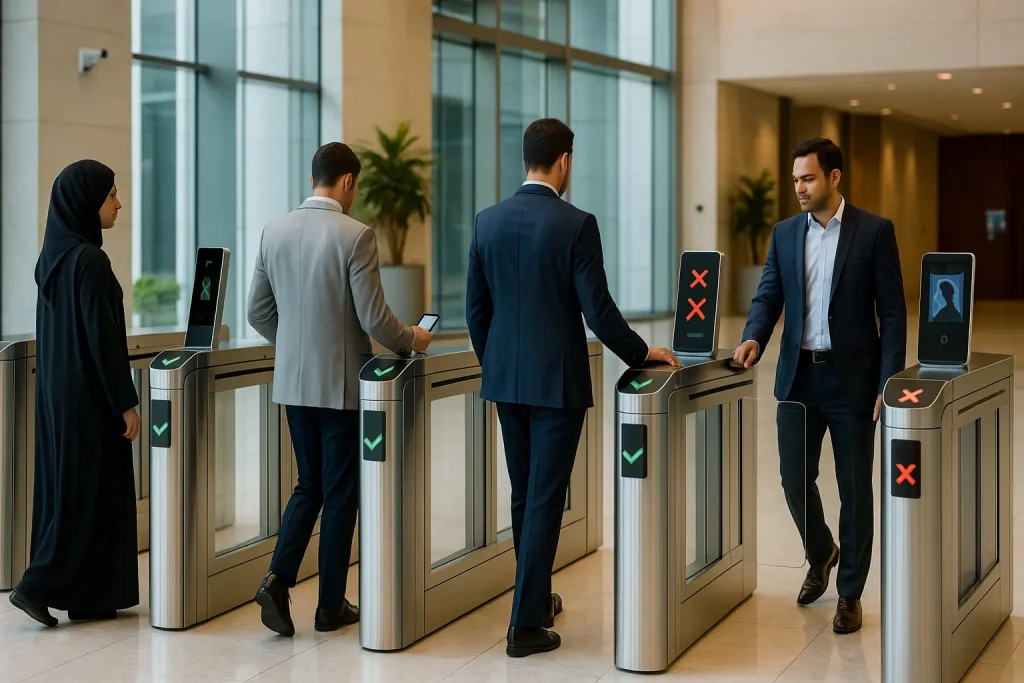
UAE speed gate systems operate by validating credentials – frequently using advanced biometrics like facial recognition or secure smart cards/mobile apps – via integration with sophisticated access control platforms. High-speed motors and intelligent sensors facilitate rapid passage while ensuring security against tailgating, all managed within the framework of local regulations and smart building ecosystems.
The typical user journey is designed for speed and often, a touchless experience:
- Approach: User approaches the sleek speed gate.
- Credential Presentation: This often involves:
- Facial Recognition: Looking briefly at an integrated high-resolution camera. Biometric acceptance tends to be higher than in regions like Europe, allowing for more widespread deployment.
- Mobile Credential: Using a smartphone app (via BLE for hands-free or NFC tap).
- Secure RFID Card/Fob: Tapping a high-frequency (13.56 MHz) encrypted card. Emirates ID integration is also sometimes explored.
- Ultra-Fast Validation: The reader/scanner communicates instantly with the building's Access Control System (ACS), often a modern IP-based or cloud-enabled platform. Verification happens in milliseconds.
- Integrated Command: If authorized, the ACS sends the "open" command. In smart buildings, it might simultaneously trigger elevator calls or personalized settings.
- Rapid Barrier Actuation: High-torque, quiet brushless DC motors open the barriers (swing or flap) smoothly and quickly.
- Intelligent Passage Monitoring: High-density sensors track the user, prevent tailgating, and ensure safety, often utilizing AI-enhanced logic to minimize false alarms from traditional attire (like abayas) or luggage.
- Secure Closure & Data Logging: Barriers close immediately after passage. The event is securely logged for auditing and potential integration with security or BMS platforms.
My Experience: "Deploying facial recognition gates for a new corporate HQ in Dubai was fascinating. Unlike projects I'd done in Europe where privacy was the dominant concern, the UAE client's focus was purely on achieving the fastest, most seamless, 'VIP' entry experience possible. The expectation was 'walk through without stopping.' This required careful camera placement, powerful backend matching servers, and integration with their elevator system – a true smart building approach."
Key Technologies Driving Innovation in UAE Speed Gates
The UAE market often embraces and demands the latest access control technologies. Key drivers include advanced biometrics, seamless mobile access, high-level smart building integration, and robust sensor systems enhanced by AI.
Advanced Biometrics (Especially Facial Recognition)
- High Acceptance: Generally higher cultural and governmental acceptance allows for wider deployment compared to regions with stricter privacy laws like the EU (consider the contrast with needs for a
Germany high-throughput speed-gate-pedestrian-accesssystem). - Frictionless Experience: Facial recognition offers the ultimate "hands-free" convenience, aligning perfectly with the UAE's focus on luxury and efficiency.
- Accuracy & Speed: Modern AI-powered algorithms provide high accuracy and sub-second matching times, essential for high-throughput environments.
Mobile Credentials (BLE & NFC)
- Smartphone ubiquity: High smartphone penetration makes mobile access highly desirable.
- Convenience: Eliminates the need for physical cards. BLE allows "phone-in-pocket" access.
- Security: Mobile credentials leverage the phone's own security features (PIN, biometrics) and use strong encryption.
Cloud-Based Platforms & Smart Integration
- Scalability: Cloud platforms easily manage large, multi-site portfolios common in the UAE.
- Remote Management: Allows facility managers to control access across properties from a central point or mobile app.
- Open APIs: Essential for integrating gates with the sophisticated BMS, VMS, elevator, and even smart city platforms prevalent in new UAE developments. This level of integration is often a core requirement.
AI-Enhanced Sensor Technology
- Accuracy in Diverse Conditions: AI helps sensors perform reliably despite varying light levels or diverse passenger attire/luggage. It significantly reduces false alarms, which is crucial for maintaining flow and user confidence.
- Predictive Capabilities: AI analyzes sensor data for behavioral anomalies (loitering, attempts to tamper) and monitors gate mechanics for predictive maintenance alerts.
Premium Materials and Customization Tech
- Beyond Standard: Use of premium materials (e.g., 316L stainless steel for coastal humidity, architectural bronze, stone inlays) and advanced finishing techniques (PVD coatings for gold/rose gold looks) reflects the market's aesthetic demands.
- Integrated Lighting: Sophisticated LED lighting for status, ambiance, and wayfinding is often standard.
Popular Gate Types and Design Trends in the UAE
While functionality is key, aesthetics play an exceptionally large role in the UAE. Swing barrier and flap barrier speed gates with high-end finishes and customization are dominant. Bespoke designs incorporating luxury materials are common in flagship projects.
- Swing Barriers (The Elegant Choice): Often favored for their smooth, perceived 'gentle' motion and the ability to incorporate taller glass barriers. Their design lends itself well to premium customization (stone tops, special finishes).
- Flap Barriers (The High-Tech Choice): Chosen for maximum throughput and a modern, fast-paced feel, particularly suitable for busy commercial hubs or airports like those requiring a Dubai high-speed speed gate.
- Customization is King: Unlike more standardized markets, requests for custom dimensions, unique material inlays (marble, wood, decorative metals), PVD coatings (gold, rose gold, black), and intricate lighting designs are frequent. The gate is often treated as a signature architectural element.
- Minimalism vs. Ornate: Design trends can vary, but generally lean towards clean, modern lines executed with extremely high-quality materials and precision manufacturing.
- Optical turnstiles may be used in highly monitored luxury hotel or corporate lobbies where physical barriers are deemed intrusive, but always require dedicated staff.
Security Considerations Specific to the UAE
Security is a top priority. UAE speed gate access control turnstile systems are expected to provide robust physical deterrence, highly accurate anti-tailgating, seamless integration with central security monitoring (often government-linked in sensitive areas), and potentially support for national ID card integration.
- Physical Robustness: Gates must be resistant to tampering and casual forced entry attempts. Taller barriers might be specified more often than in other regions.
- High-Accuracy Anti-Tailgating: Zero tolerance for unauthorized passage. Systems need the most advanced sensor packages available, potentially with AI enhancement.
- Centralized Monitoring Integration: Gates often need to report status and alarms in real-time to sophisticated Security Operations Centers (SOCs) or building command centers.
- Emirates ID Integration (Potential): While not universally implemented for physical access, the capability to integrate with national ID card systems for verification is sometimes explored or required for specific government or high-security applications.
- Event Security: For the numerous large-scale events hosted in the UAE, temporary or rapidly deployable gate systems with high throughput and robust security are often required.
Addressing Environmental Challenges: Heat, Dust, Humidity
The UAE's climate poses significant challenges for electronic and mechanical systems. Speed gates must be engineered or specifically selected for reliable operation in conditions of extreme heat, high humidity (especially coastal), and airborne dust or sand.
My Experience: "I worked on a project for a beachfront luxury resort in Dubai. The lobby gates, while indoors, were near large open entrances constantly exposed to humid, salty air and fine windblown sand. We had to specify gates with a high IP rating (IP54 or better), use marine-grade 316L stainless steel to prevent corrosion, and ensure all electronics housings were tightly sealed with enhanced cooling considerations. Standard 'indoor-only' gates would have failed within months. You absolutely cannot ignore the environment here."
Key Environmental Considerations:
- High Temperature Ratings: All electronic components (controllers, power supplies, readers) must be rated for high ambient operating temperatures (often up to 50°C or 55°C).
- Sealing (IP Rating): Pedestals and component housings need high Ingress Protection ratings (e.g., IP54, IP65) to protect against dust and moisture ingress.
- Corrosion Resistance: Use of high-grade stainless steel (316L), appropriate coatings, and sealed bearings is crucial, especially in coastal areas.
- Cooling: For electronics in tightly sealed enclosures operating in high heat, passive heat sinks or even active fan-based cooling might be necessary.
- Cleaning & Maintenance: Design should facilitate easy cleaning of sensors and external surfaces to prevent dust buildup from impairing performance.
Integration with UAE's Smart City and Building Ecosystems
The UAE, particularly Dubai and Abu Dhabi, are leaders in smart city development. UAE speed gate access control turnstile systems are expected to be "good citizens" in this ecosystem, offering open APIs and connectivity to integrate with central building management platforms, smart parking, visitor systems, and potentially broader city-wide initiatives.
- BMS/BAS Integration: Essential for sharing occupancy data for energy optimization, HVAC control, and centralized monitoring.
- API-First Approach: Systems should offer robust Application Programming Interfaces (APIs) to allow seamless data exchange with other smart building applications (tenant experience apps, room booking systems, etc.).
- Smart City Data: Anonymized flow data from major building complexes might potentially feed into city-level traffic management or planning platforms.
- Interoperability: Emphasis on using open standards to ensure different systems can communicate effectively.
Installation, Compliance, and Support in the UAE
Installation requires technicians experienced with high-end systems and knowledgeable about local regulations (Civil Defence for fire safety, municipality codes). Given the sophistication of the technology, reliable, responsive local technical support and readily available spare parts are critical for minimizing downtime.
- Local Regulations: Adherence to UAE Civil Defence codes regarding fire alarm integration and emergency egress pathways is mandatory. Electrical installations must meet DEWA/ADDC standards.
- Skilled Technicians: High-tech systems require properly trained local technicians for installation, commissioning (especially sensor tuning), and maintenance.
- Logistics: Managing imports, customs clearance, and on-site logistics for large projects requires experienced partners.
- Local Support: Due to the critical nature of these systems, having access to fast, reliable technical support and spare parts within the UAE is crucial for ensuring uptime. Relying solely on remote international support is often insufficient. Choosing vendors with a strong local presence or highly capable local partners is vital.
Future Trends: AI, Biometrics, and Hyper-Personalization
The future of UAE speed gate access control turnstile solutions will likely see even deeper integration of AI for predictive security and flow management, wider adoption of seamless biometrics, hyper-personalized building interactions triggered by access events, and potentially integration with autonomous systems.
- AI-Driven Operations: AI will move beyond sensor enhancement to actively manage lobby flow, predict congestion, optimize elevator calls based on real-time gate data, and provide sophisticated behavioral security alerts.
- Ubiquitous Frictionless Biometrics: Facial recognition is likely to become even more dominant, potentially augmented by other contactless biometrics (like gait or voice) for a completely seamless identity verification experience.
- Hyper-Personalization: Your authenticated passage through the gate could trigger a highly personalized environment – adjusting lighting, temperature, digital signage, and even pre-ordering your coffee based on your known preferences and schedule.
- Integration with Robotics/Autonomous Systems: Gates might need to intelligently interact with delivery robots or autonomous cleaning vehicles operating within secure facilities.
The Final Verdict: Intelligent Gateways for an Innovative Nation
The UAE speed gate access control turnstile is a reflection of the nation itself: ambitious, technologically advanced, security-conscious, and focused on delivering world-class experiences. These systems are far more than simple barriers; they are intelligent, connected gateways engineered to meet the unique demands of the region's iconic architecture, demanding climate, and forward-thinking vision.
Balancing cutting-edge technology like biometrics with luxurious aesthetics, robust environmental hardening, and deep integration into smart building ecosystems is key. For facilities in the UAE aiming to provide seamless, secure, and sophisticated access, investing in high-quality, regionally-adapted speed gate solutions is not just a necessity – it's a statement of commitment to innovation and excellence, setting a standard distinct from other Regional Markets, whether comparing to the privacy-focused needs of Europe commercial building speed gate solution deployments or the volume-driven requirements seen in Asia-Pacific speed gate access control solution markets.
