


Speed Gate Turnstile: The Future of High-Speed Access Control
2026-01-28


Secure, Intelligent, and Efficient Pedestrian Flow Management
In today’s world of advanced buildings and smart infrastructure, controlling access while maintaining seamless pedestrian throughput is crucial. Whether in airports, corporate headquarters, transit stations, shopping malls, or university campuses, security solutions must combine speed, accuracy, design, and functionality. That’s where the Speed Gate Turnstile — a high-performance access control product — becomes essential in modern access control systems.
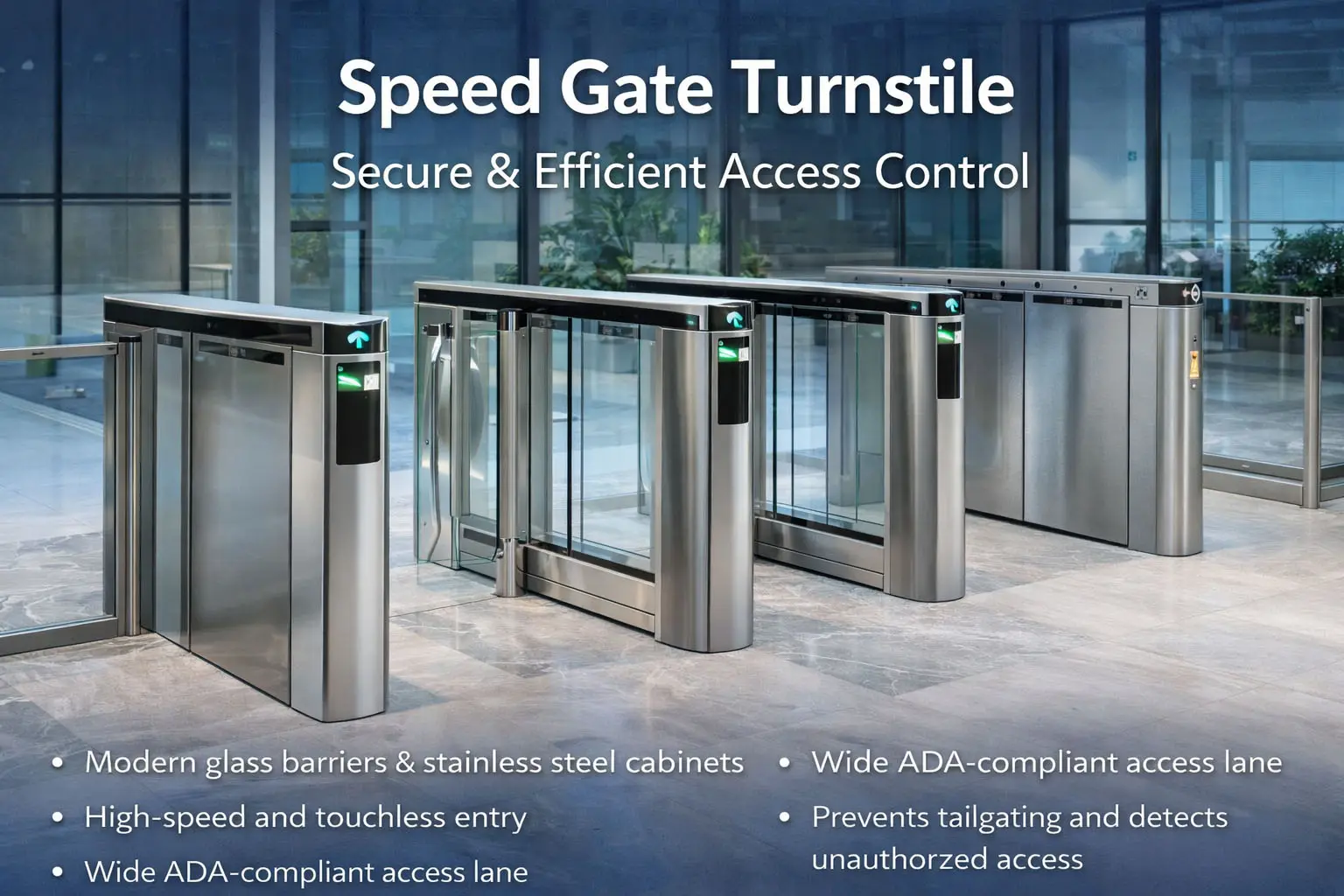
A speed gate turnstile is a sophisticated access control barrier designed to manage high volumes of people efficiently while providing enhanced security and an improved user experience compared with traditional turnstiles or gates.
What Is a Speed Gate Turnstile?
A speed gate turnstile is an intelligent pedestrian access control solution that controls traffic flow using fast response mechanisms, sensor arrays, and integrated authentication methods. It represents a next-generation evolution of conventional turnstiles, replacing slow mechanical barriers with electronically driven systems that open and close within fractions of a second.
Unlike older swing, tripod, or full-height turnstiles, speed gates are optimized for high throughput — typically processing between 30 and 45 people per minute, with opening speeds as fast as 0.3–0.8 seconds per cycle. This responsiveness significantly reduces queuing and congestion, even in peak periods.
The modern design of speed gates — often featuring slim profiles and glass barriers — enhances architectural integration and visual appeal, making them ideal for contemporary lobbies, corporate environments, and high-end public spaces.
Key Features and Benefits
⚡ Fast and Efficient Traffic Flow
High throughput is one of the defining advantages of speed gates over traditional barriers. With rapid opening/closing cycles and continuous card swipe capabilities, they handle large streams of users quickly. This is particularly beneficial in environments with high pedestrian volume, such as airports, transit hubs, and busy corporate lobbies.
By contrast, older mechanical turnstiles often require manual pushing and can only handle about 20–25 entries per minute, making them inefficient for modern demand.
🛡️ Enhanced Security and Tailgating Prevention
Security is a top priority in access control, and speed gates excel in this area thanks to advanced sensing technologies and intelligent logic controllers. These systems use multiple sensors — including infrared (IR) arrays — to track entry and exit in real time, detecting unauthorized access attempts such as tailgating (when a second person closely follows an authorized user).
Additional safety features often include:
-
Anti-pinch and anti-collision technology
-
Automatic reset after obstruction or impact
-
Alarm triggers for forced entry or misuse
Together, these elements ensure that unauthorized users cannot easily bypass the system, enhancing perimeter security without slowing flows.
🤖 Versatile Authentication and System Integration
Speed gate turnstiles are designed to work with a wide range of authentication methods, including:
-
RFID / Proximity cards
-
QR codes and mobile credentials
-
Biometric systems (fingerprint, facial recognition)
-
Bluetooth and NFC credentials
This flexibility makes speed gates suitable for both traditional credential systems and modern contactless access architectures.
Integrating with existing access control platforms — such as visitor management systems, attendance tracking, or security monitoring tools — ensures centralized management and real-time visibility across facilities.
📐 Intelligent Control and Safety Logic
Modern speed gates incorporate programmable logic and intelligent management functions that extend beyond simple openings:
-
Memory functions that support continuous card swipes
-
Fire-alarm linkage for automatic emergency opening
-
Remote control and network integration
-
Humanized voice prompts and clear visual indicators
These features enhance both user experience and operational safety, while also improving manageability for security teams.
🏢 Aesthetic and Customizable Design
A key advantage of speed gates like those offered by Mairs is their contemporary design, which blends well with modern architectural environments.
-
Sleek stainless steel construction enhances durability and aesthetics
-
Glass swing or flap barriers create an open, welcoming feel
-
Customizable color and finish options support visual branding
This makes speed gates a powerful combination of form and function — supporting both access control and visual design goals.
How Speed Gate Turnstiles Work
Understanding the basic operation of a speed gate helps clarify why they outperform traditional systems:
-
A user approaches the lane and presents authorized credentials.
-
The access control reader communicates with the access system to verify authorization.
-
Upon validation, the controller signals the gate to open.
-
Sensors track movement to ensure only one person passes through per authentication.
-
Barriers close quickly to prepare for the next user.
This automated sequence supports a fast and intuitive user experience while maintaining a high level of security.
Types of Speed Gate Turnstiles
Speed gates come in several variations, depending on specific application needs:
🪟 Flap Barrier Speed Gates
Flap barrier gates use sliding glass or acrylic barriers that retract into the chassis to open the passage. Their speed and minimal footprint make them ideal for high-traffic indoor locations like transit stations and commercial lobbies.
🚪 Swing Barrier Speed Gates
Swing barrier gates use pivoting glass arms that swing open to allow entry. They are especially suitable for corporate environments and high-aesthetic spaces due to their clean motion and intuitive design.
⬅️ Sliding Speed Gates
Sliding gates provide a secure entry lane with larger glass panels that slide horizontally. They offer stronger physical barriers and are suited to higher-security scenarios, such as secure floors or restricted access areas.
Different gates can also support ADA-compliant wide lanes for wheelchair access and accessibility requirements.
Where Are Speed Gate Turnstiles Used?
Speed gate turnstiles are extremely versatile and are found in a variety of settings around the world. Their combination of security, speed, and aesthetics makes them suitable for both public and private facilities.
✈️ Airports
At international and regional airports, speed gates help manage thousands of passengers daily, reducing bottlenecks in check-in areas and secure access zones.
🚆 Transit Stations
Train, metro, and bus terminals benefit from speed gates that manage peak rush-hour crowds efficiently while preventing unauthorized access to platforms.
🏢 Corporate Headquarters
Large office buildings leverage speed gates to ensure only authorized employees and visitors enter secure zones, improving both safety and professionalism.
🛍️ Retail and Malls
Shopping centers incorporate speed gates near VIP spaces, secure zones, or staff entrances to streamline access while enhancing the retail experience.
🧑🎓 Universities and Campuses
Academic institutions use speed gates at dorms, labs, libraries, and student centers for enhanced access control combined with a welcoming user experience.
In each of these GEO contexts — whether in major cities, business districts, or transportation corridors — speed gates balance local security needs with global best practices in access design.
Speed Gate Turnstiles vs Traditional Turnstiles
One of the core reasons speed gates have surged in popularity is their fundamental advantage over older mechanical turnstiles:
| Feature | Speed Gate Turnstile | Traditional Turnstile |
|---|---|---|
| Traffic Speed | High (30–45 people/min) | Medium (20–25 people/min) |
| Security | Tailgating detection & sensors | Basic physical barrier |
| User Experience | Touchless and fast | Physical push required |
| Aesthetics | Modern, slim, glass design | Industrial or bulky |
| Integration | Seamless with tech systems | Limited sensor integration |
Overall, speed gates provide a superior combination of efficiency, aesthetics, and intelligent access control for modern facilities.
Installation and Integration Best Practices
Installing speed gates should be planned as part of a comprehensive access control system. A few best practices include:
🧭 Evaluate Traffic Demand
Understand peak entry rates to determine how many lanes are necessary. For example, a building with heavy foot traffic during morning rush hours may need multiple parallel lanes.
🛠 Electrical and Network Setup
Speed gates require both power and network connectivity for control signals and integration with access databases.
🔌 Fire Safety Integration
Ensure gates are linked to the building’s fire alarm system to automatically unlock during emergencies — an essential safety compliance requirement.
📊 System Compatibility
Work with access control providers to ensure compatibility with credentials, visitor systems, and attendance tracking tools.
By following these steps, facilities can ensure optimal performance and improved security return on investment.
Maintenance and Longevity
Speed gate systems are engineered for longevity, but regular maintenance helps sustain high performance:
-
Monthly cleaning of sensors and chassis
-
Periodic lubrication of mechanical parts
-
Checking electronic boards and connections
-
Annual professional service checkups
These measures prevent performance degradation and help avoid downtime in critical access points.
Conclusion: Why Speed Gate Turnstiles Matter
Speed gate turnstiles represent a modern, intelligent, and efficient solution for pedestrian access control. With their high throughput, advanced security capabilities, sleek design, and compatibility with modern access systems, they are fast becoming the standard choice for public and private facilities across sectors and regions.
Whether you are designing a new building or upgrading an existing entry system, investing in speed gate turnstiles enhances security, reduces congestion, and elevates the user experience — while aligning with global best practices in smart facility management.
