



Automatic Speed Gates: Streamlining Entry Management
2025-10-27


In any secure facility, the lobby is a point of natural conflict. It's the "front door" where you must welcome employees and visitors, but it's also the first line of defense where you must filter out unauthorized individuals. For decades, facility managers and security directors have been forced into a frustrating trade-off: prioritize speed (and create security gaps) or prioritize security (and create frustrating bottlenecks).
We've all seen the result: a line of employees snaking out the door at 8:55 AM, or a single security guard trying to manually check IDs while also greeting a VIP and answering the phone. This model is inefficient, inconsistent, and highly prone to human error.
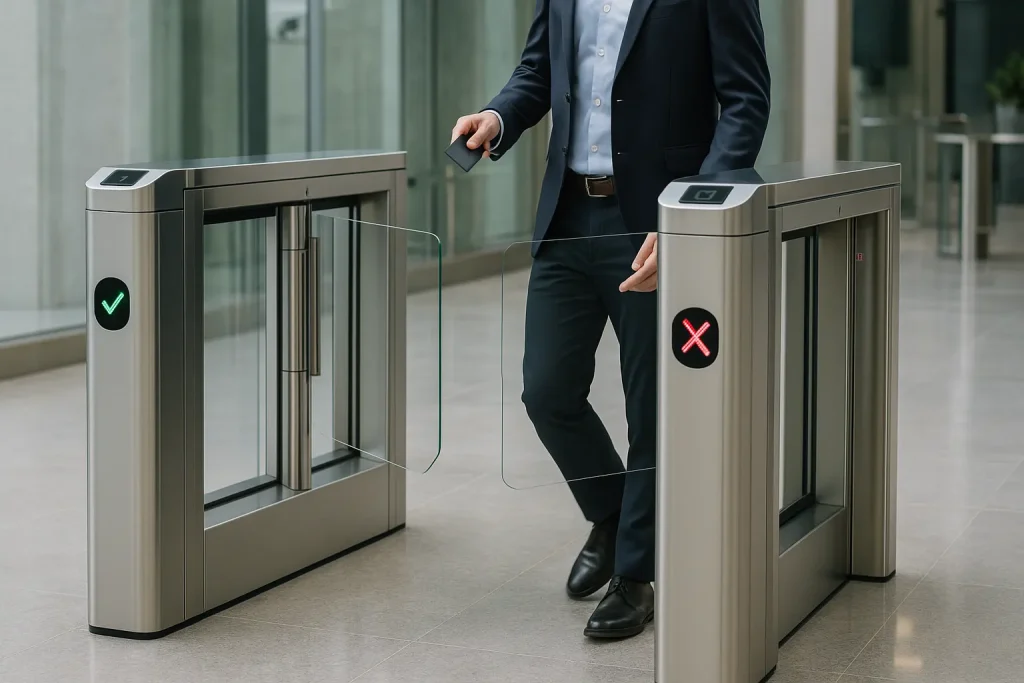
The solution is to take the human error out of the equation. The automatic speed gate is the modern technological answer to this age-old problem. It's not just a barrier; it's an intelligent, automated system designed to streamline the entire entry process. It automates validation, opening, monitoring, and closing, creating a system that is simultaneously faster, more secure, and more efficient than any manual alternative.
This guide provides a comprehensive, expert look at what an automatic speed gate is, how its automation works, the critical benefits it offers, and how to plan a system that truly streamlines your building's entry management.
What Is an Automatic Speed Gate?
An automatic speed gate is an advanced access control barrier that uses a combination of sensors, motors, and software integration to completely automate the process of pedestrian entry. After validating a user's credential, it automatically opens its barriers, monitors the person's passage to prevent tailgating, and then automatically closes, all at high speed.
The key word is "automatic." Unlike a manual gate, a locked door, or a mechanical push-style turnstile, an automatic speed gate manages the entire validation and passage process without human intervention. It is the "enforcer" for your building's security policy, a core part of a modern speed gate system.
This automation is what allows it to be both secure and fast. It doesn't get distracted, it doesn't get tired, and it can't be "socially engineered" with a good story. Its only job is to execute its logic: one valid credential equals one person passing. This simple, automated rule is the foundation of a truly secure and streamlined lobby.
How Does an Automatic Speed Gate Work?
An automatic speed gate works by creating a closed-loop automated process. A user presents a credential, an access control system validates it and sends an "open" signal. The gate's motor opens the barriers, and its optical sensors track the user through the lane, automatically closing the barriers immediately behind them to secure the lane.
From the user's perspective, it should feel seamless, almost like magic. But in those 2-3 seconds, a high-speed sequence of events is being automatically executed. As an integrator, getting this sequence perfect is the "character" of a good installation.
Here is a step-by-step breakdown of the automation:
- Idle State (Automated Monitoring): The gate is closed and secure. Its internal "light curtain"—a dense array of infrared sensors—is active, automatically scanning the lane to ensure it's clear.
- Credential Presentation: A user approaches and presents their credential. This could involve tapping an RFID card, using a mobile phone app, or passing through a fully biometric speed gate turnstile, simply bylooking at a facial recognition camera.
- Automatic Validation (The "Handshake"): The reader sends the credential to the building's main access control panel (the "central brain"). This panel automatically checks the user's permissions against its database in milliseconds.
- "Open" Signal: If valid, the access panel sends an "open" command (a dry contact signal) to the gate's own logic controller (the "local brain").
- Motorized Actuation (The "Muscle"): The gate's logic controller receives the command and instantly activates its high-speed motor, which automatically swings or retracts the glass barriers.
- Sensor Monitoring (The "Eyes"): As the user walks through, the sensor array tracks their progress. This automated monitoring is the core of its security.
What Are the Core Benefits of Automating Your Entry?
The primary benefits of automating entry with speed gates are a massive reduction in human error, 24/7 consistent enforcement of security policies, a dramatic increase in pedestrian throughput, and a significant reduction in staffing costs by freeing guards from the monotonous task of "badge checking."
The "automatic" part of the name is where the real value lies. Let's break down these benefits.
How Does Automation Improve Security?
An automatic gate improves security by replacing inconsistent human enforcement with infallible, 24/7/365 machine logic. It cannot be distracted, tired, or intimidated. Its sensors are more reliable than human eyes for detecting tailgating, and it ensures your access policy is enforced every single time.
- Eliminates Human Error & Inconsistency: A security guard has a difficult, monotonous job. After checking 500 badges, the 501st gets less scrutiny. A guard can be distracted by a question, a phone call, or a fire alarm test. An automatic gate cannot. It provides the exact same level of scrutiny for every single person, every single time.
- Physically Stops Tailgating: This is the most common way physical security is breached. An
automatic speed gateis designed to physically detect and deter this, sounding an alarm and creating a physical barrier. - Creates a Perfect Audit Trail: The system automatically logs every single passage and every single alarm. This creates a detailed, indisputable record for compliance audits or incident investigations.
How Does Automation Improve Efficiency and Speed?
Automation is the engine of speed. By automating the validation-to-passage cycle, a speed gate can process 30-40+ people per minute, a rate a human guard simply cannot match. This eliminates bottlenecks and creates a high-speed, frictionless "walk-through" experience for all users.
- Massive Throughput: This is the "speed" part. A high-throughput speed gate can process a person every 2 seconds. A manual guard might take 5-10 seconds. This is the difference between a line out the door and a smooth, continuous flow.
- The "Fast Access" Experience: The entire system is engineered to be a fast access turnstile. The goal is for the user to not even break their stride. This seamlessness is a hallmark of a modern, efficient building.
- Reduces "Friction": Those small, daily "micro-frustrations"—like waiting in line, fumbling for a badge, waiting for a guard—add up. They impact employee morale and productivity. An automatic system removes this friction.
What Are the Operational and Staffing Benefits?
An automatic speed gate acts as a "force multiplier" for your security team. It automates the low-skill, repetitive task of "badge checking," allowing you to re-allocate your expensive security staff to high-value, human-centric tasks like roving patrols, threat assessment, and visitor assistance.
You aren't replacing your guards; you are making them more effective. Instead of staring at 500 "good" badges, they are free to watch for the one person exhibiting suspicious behavior. You can secure your lobby with one "exceptions manager" and a bank of gates, rather than three "badge checkers."
What Are the Main Components of an Automatic Speed Gate?
The core components that enable the automation are the high-speed motor (the "muscle"), the dense optical sensor array (the "eyes"), the logic controller (the "local brain"), and the integration with the main access control system (the "central brain").
Understanding these parts is key to understanding why some gates are "smarter" and more reliable than others.
- The Motor (The "Muscle"): This isn't a simple motor. It's typically a high-speed, high-torque brushless DC motor. It's designed for millions of cycles, is whisper-quiet, and can actuate the barriers in as little as 0.3 seconds.
- The Optical Sensor Array (The "Eyes"): This is the "smart" part. It's not just one beam. A high-quality gate uses dozens of infrared sensors to create a "light curtain" or a 3D matrix. More sensors = a smarter, safer gate that is better at detecting tailgating and less likely to close on a person.
- The Logic Controller (The "Local Brain"): This is a dedicated computer inside the gate's chassis. It takes the "open" signal and then manages the entire automatic process: "Run motor, check sensors, is the person through? OK, run motor in reverse."
- The Access Control Integration (The "Central Brain"): This is the "handshake" to your building's main security system. The gate must be able to receive the "open" command from whatever access control platform you use.
- The Physical Barriers: These are the visible glass or metal "wings" or "flaps" that open and close. They are the physical deterrent.
What Are the Main Types of Automatic Speed Gates?
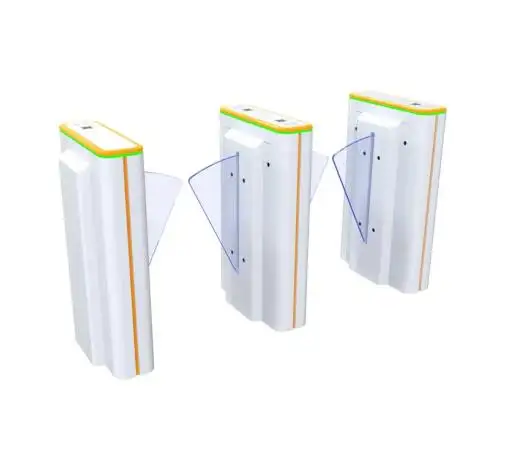
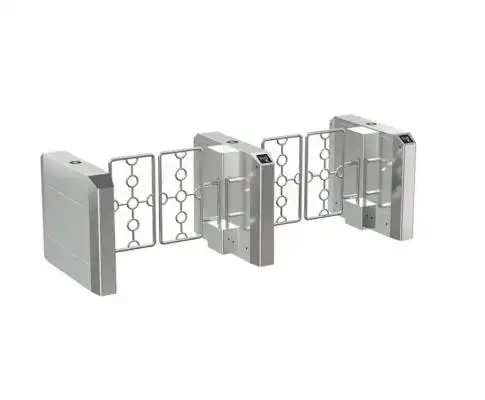
The main types are defined by their barrier movement and are chosen based on your needs for speed, security, and aesthetics. The most common are flap barriers (retracting), swing barriers (pivoting), and sliding barriers (high-security).
Choosing the right type is a critical decision.
| Gate Type | Barrier Motion | Key Benefit(s) | Best For... |
| Flap Barrier | "Wings" retract into the chassis | Maximum Speed: Highest throughput (PPM) | High-traffic HQs, transit stations |
| Swing Barrier | "Arms" pivot (swing) open | Aesthetics & Security: Elegant, quiet, taller barriers | Class-A corporate lobbies |
| Sliding Barrier | Panels slide open (like an elevator) | Maximum Security: Tall, robust barriers | Data centers, government, banks |
| Optical (Barrier-Free) | No physical barrier, sensors only | Maximum Throughput: Completely frictionless | Lobbies with 24/7 guard presence |
Each of these is a type of pedestrian speed gate, but the style of automation you choose depends on your goals. For 90% of corporate lobbies, the "swing barrier" is the top choice, as it offers the best balance of a premium, welcoming feel and strong, visible security. A high-speed pedestrian turnstile with swing barriers is the modern standard.
How Do You Integrate an Automatic Speed Gate with Other Systems?
Integration is key to automation. An automatic speed gate must be integrated with two systems at a minimum: the building's main access control system (to know who to open for) and the building's fire alarm system (to know when to open for safety).
This is a step that requires a professional integrator.
Integrating with Access Control (The "Brain")
The gate itself is "dumb." It doesn't store a list of users. It must be told when to open by your central access control system (the "brain" from a provider like Lenel, Genetec, Brivo, etc.).
- The credential reader (RFID, biometric) is wired to your access control panel.
- That panel makes the "allow/deny" decision.
- If "allow," the panel sends a simple "dry contact" (open) signal to the gate's logic board.
- The gate then takes over and begins its automatic "open-monitor-close" cycle.
The Mandatory Fire Alarm Integration (Life Safety)
This is the most critical integration, and it is non-negotiable. Your automatic speed gates must be tied to your building's Fire Alarm Control Panel (FACP).
- In the event of a fire alarm, the FACP sends a signal to the gates.
- This signal overrides all security and forces the gates to automatically open (or "fail-open") and stay open.
- This allows for free, unimpeded egress, which is a core life-safety requirement.
Integrating with Visitor Management (Streamlining Guests)
The automation shouldn't stop with employees. Modern systems integrate with visitor management platforms. A guest can be pre-registered, and the system automatically emails them a QR code. That QR code is their temporary credential, allowing them to scan it at the gate for one-time, automated entry. This is a core part of a modern entrance speed gate system.
What Credentials Work with Automatic Speed Gates?
Virtually any modern electronic credential will work, because the gate is "credential-agnostic." The gate's automation is triggered by the "open" signal from the access control system. This means you can use RFID cards, mobile credentials on a smartphone, biometric scanners, or QR codes.
- RFID/NFC (Cards & Fobs): The long-time standard. Fast, reliable, and cost-effective.
- Mobile Credentials (Bluetooth/NFC): The new standard. Users carry their credential on their phone. This is highly secure and convenient.
- Biometrics (Face, Fingerprint, Iris): The high-security, high-convenience option. A biometric speed gate turnstile provides the ultimate "hands-free" automation, as the user is the credential.
- QR Codes: The automation champion for visitors. It allows a guest to be processed with zero intervention from your front-desk staff.
How Do You Plan for an Automatic Speed Gate Installation?
A successful installation starts with a thorough analysis of your pedestrian traffic to determine how many lanes you need. This is followed by a site survey to plan for power and data, and a clear plan for ADA compliance and other traffic.
As an expert, I can tell you that "planning" is 90% of the success. Don't just pick a gate from a catalog.
- Step 1: The Peak Load Analysis (The Most Critical Step).You must know your "peak people per minute" (PPM). Do not guess.
- Stand in your lobby with a clicker (or use camera footage).Count every single person who enters during your busiest 15-minute window (e.g., 8:45-9:00 AM).
[Total People] / 15 = Your Peak PPM.[Your Peak PPM] / 30 = Number of Lanes Needed.(Use 30 as a safe PPM-per-gate average, and always round up).
- Stand in your lobby with a clicker (or use camera footage).Count every single person who enters during your busiest 15-minute window (e.g., 8:45-9:00 AM).
- Step 2: The Site Survey (The "Dusty" Part).These gates are not wireless. They are heavy machines.
- Power: Each gate needs power for its motor and logic.
- Data: Each lane needs data cabling for its integrated reader.
- Floor: This cabling must run under the floor. This means you will need to core-drill or trench your lobby floor. This is a construction project.
- Step 3: Plan for All Traffic (ADA & Deliveries).Your automation must account for all users. You are legally required to have at least one wider (32-36 inch) ADA-compliant lane for wheelchair access. This wider lane is also used for rolling luggage and deliveries. It's a critical part of a complete entrance speed gate system.
The Future of Automated Entry: What's Next?
The future of the automatic speed gate is "frictionless," predictive, and completely invisible. The automation will be powered by AI and long-range sensors, moving from a "tap-and-go" model to a "just-walk-through" experience.
- Frictionless Biometrics: The biometric speed gate turnstile will become the standard. You won't even have to look at a camera. Long-range facial recognition or gait analysis will identify you as you approach, and the gates will open seamlessly.
- AI Sensor Fusion: The automation will get smarter. The gate's IR sensors will be "fused" with data from an overhead video camera. An AI will analyze this combined data to move beyond simple tailgating. It will be able to detect "a person under duress," "an abandoned object," or "a person crawling."
- Smart Building Integration: The gate will be a key sensor for the entire smart building. Your passage will be the trigger that automatically calls an elevator to your floor, turns on your office lights, and adjusts your desk's climate control. This is the evolution of the electric gate concept, from a simple barrier to a data-driven checkpoint.
The Final Verdict: Why an Automatic Gate Is a Strategic Investment
An automatic speed gate is far more than just a piece of security hardware. It is a strategic investment in efficiency, security, and user experience. It solves the core conflict between speed and safety by replacing unreliable, inconsistent, and expensive manual processes with infallible, high-speed automation.
By streamlining your entry management, you eliminate bottlenecks, reduce your operational overhead, and provide a modern, frictionless experience for every person who enters your building. For any facility that takes its security and its occupants' time seriously, automation is no longer an upgrade—it's the standard.
