


Biometric Turnstile Gate: Selecting the proper Identification and Passage System.
2026-07-17


A biometric turnstile gate combines two security functions: one who can turnstiles and another who can identify a person. The Terminal is used to determine if the person is a registered identity and the Turnstile determines whether a single passage actually occurs.
That's easily forgottable. The only way to prevent someone from following closely behind in another person's car using a very accurate facial or fingerprint terminal is if they were in perpetual hearing range of the device. Similarly, an advanced turnstile is no solution to poor enrolment process, an inappropriate matching threshold or un-assessed rules where it comes to providing biometric data.
Designed for offices, factories, data centers, laboratories, schools, transportation infrastructures, government security sites, system integrators, and security organizations interested in implementing biometric pedestrian access.
You should start with the Security Decision
Installing biometric access should address what is a definable problem, and should not be set up just because it is a so-called “state of the art” solution to a problem that wasn't significant enough to require it.
A site can make an effort to limit card sharing, confirm the identity of anyone entering an area that requires access, tie together access events with attendance records, or mandate a second factor for highly sensitive rooms.
Start by defining:
- Determine who is going to have entry to the site.Decide who can enter the site.
- How to identify areas where biometric control is needed;How to identify the need for biometric control areas;
- Ask about the necessity of using biometrics.Inquire about the requirement for the use of biometrics.
- Do they require a different credential to be awarded as well?
- How visitors and contractors will come into the building and on site
- What would be the consequences of failing to verify biometrically?
- Manage enrolment and removal.Manage enrolment and removal (who).
- How far the template is away from the computer's track pad image or mask.
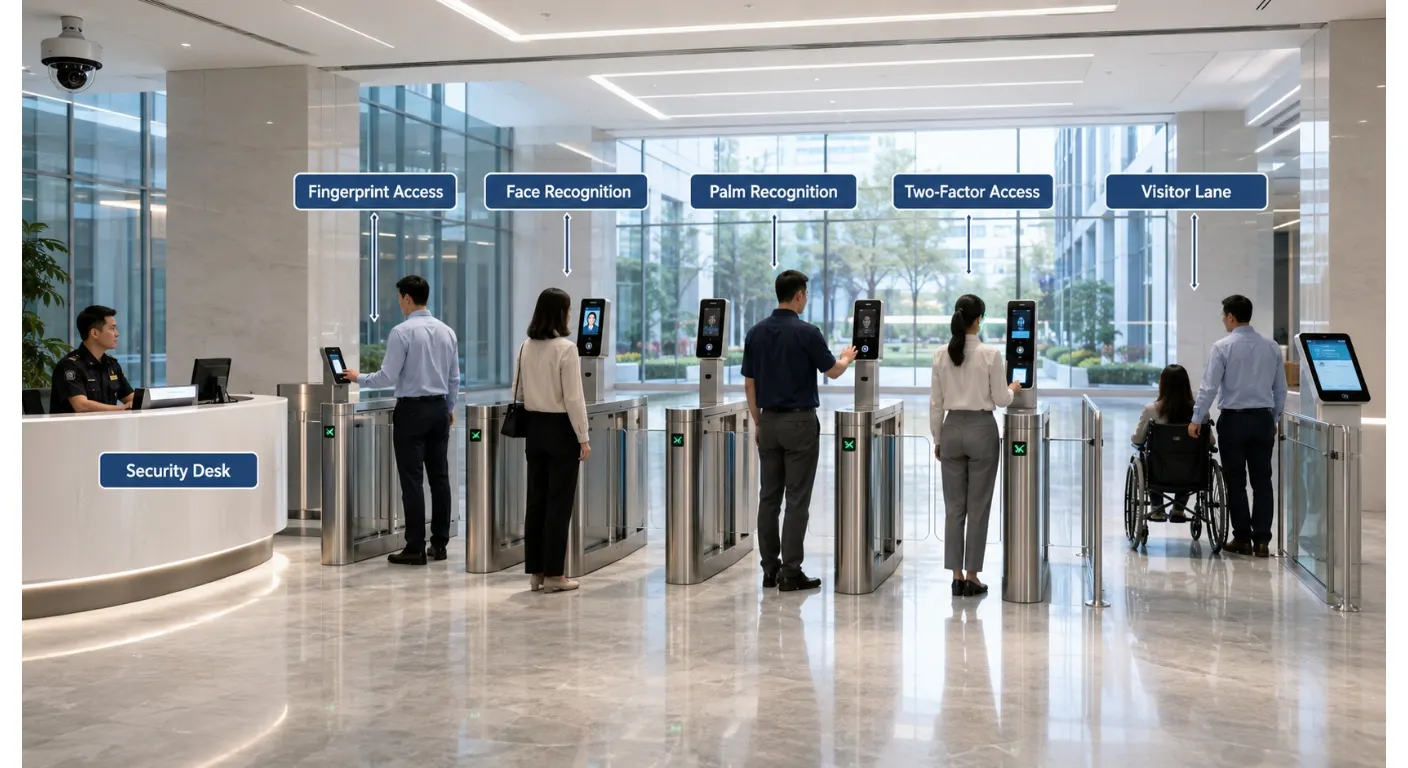
A biometric turnstile gate may include both fingerprint verification or facial (or other biometric) verification with various gate types. The final configuration should be based on the customer security policy, user group, traffic volume or building layout.
Ensure that the biometric method around real users is selected
The choice of the method for biometric measurements depends on the situation.
The fingerprint readers are familiar and compact, but workers can be faced with problems with worn, dirty, wet or injured fingers. Facial recognition allows contactless operation, but may be affected by different lighting conditions, camera angle and the position of the user as well as with facial coverings. Iris recognition is well suited for higher security projects, but typically needs more proactive user interaction. Depending on available terminals and software, there will be another contactless option provided through palm and/or vein recognition systems.
| Biometric Method | Main Strength | Point to Verify |
|---|---|---|
| Fingerprint | Compact and familiar | Finger condition |
| Face recognition | Contactless use | Lighting and camera angle |
| Iris recognition | Strong identity checking | User positioning |
| Palm recognition | Touchless verification | Terminal compatibility |
| Multi-factor access | Higher security | Passage time |
It is not the question of which of these biometric technologies is the best. Which can be done reliably for these users at this entrance?
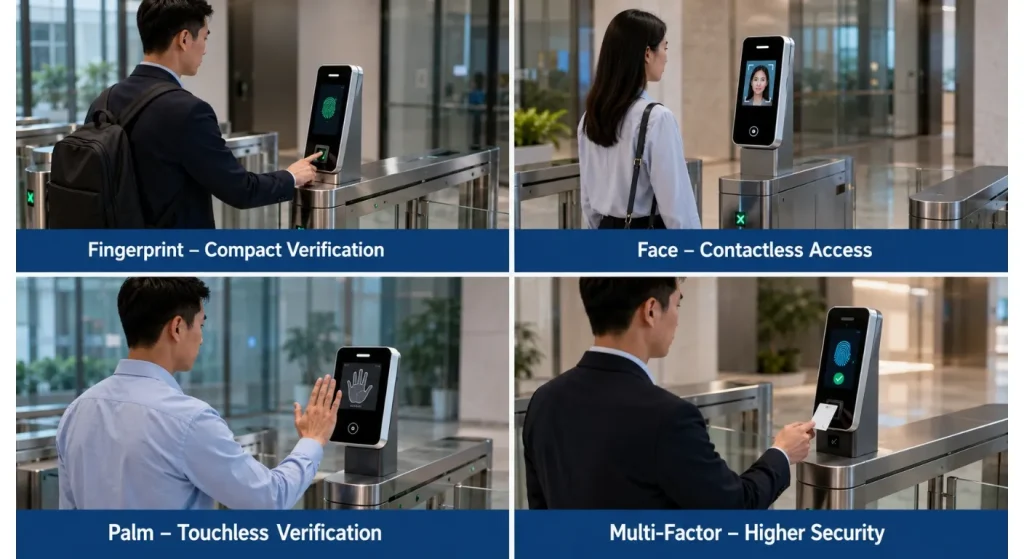
Don't test only a few office staff to determine the validity of the results under ideal conditions.Don't test a selected number of staff just under office conditions to ascertain if the test is valid, and has not been tested by other representative staff with less ideal conditions. The terminal may produce drastically different results for a factory, a laboratory, a hospital and a corporate office.
Understand the concepts of verification and identification
Typical ways to use biometric systems.
Verification is used to confirm if a biometric sample is consistent with an identity. The user can show a card, employee number or mobile credential, and then show a fingerprint or faces.
Identification: Reveals an individual in a larger enrolled database that has a biometric sample.
While verification can be used as a more focussed approach to matching, identification may provide a more comprehensive means to achieve a matching experience. As more users enroll and it's more difficult to identify users - also requires more database processing and performance planning.
The workflow should be agreed by the project team prior to approving terminal, software and network designs.
The figure in the title is not intended to be used for judging the accuracy
There is not just one universal accuracy for biometric performance; it is a selection of more than one measurement.
Supporting false matches (misidentifying someone as a legitimate user) and false matches (rejecting a legitimate user) are part of the considerations of a biometric system, other factors are explained in NIST. How these two errors are balanced depends on the matching threshold which is a function of the complete system, environment and operational risk.
Inquire about the meaning and intentions behind:
- False match rate
- False non-match rate
- Matching threshold
- Enrolment failure
- Average verification time
- Supported database size
- Test conditions
- The latest versions of the terminal and software.The Most Recent Terminal and Software Versions.
- Presentation-attack detection
A statement of “99.9% accurate” of any sort without any conditions and criteria of error loses its meaning.
To identify the appropriate key for the correct door
Biometric verification can be employed on any turnstile design (Tripod, Flap barriers, Swing gate, Speed gate or Full height).
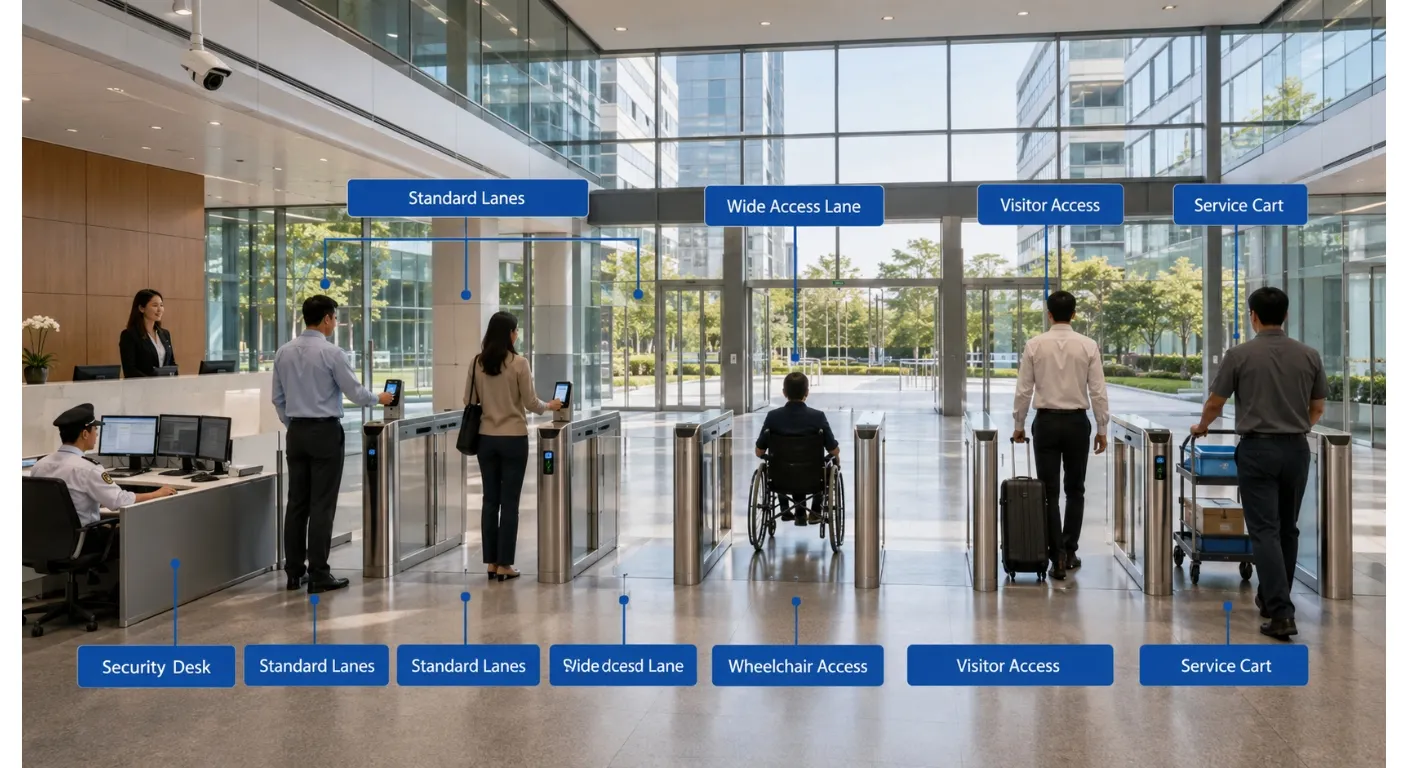
For a small factory gate, a tripod gate might be a great suitable configuration. Divide and conquer through the use of flaps and speed gates are possible for faster flow in indoor office areas. A swing barrier allows for a more spacious clearance for luggage, (mobility) service carts and mobility aids. Full height turnstiles can be used in the event of a stronger perimeter barrier being needed.
The name of the game with access control systems is figuring out how to integrate with turnstile systems; and one of the great lists of ways to do this is offered by Ironman's access-control system information. Physical gates should be chosen based on the security level, user traffic, lane width and/or site environment in addition.
The person's identity is confirmed using the biometric terminal. It will not make things up to a faulty gate or give an easy way round gates on the side.
Teacher: Make One Approval Equal One Passage!
Once a user has been approved for the lane, the lane should regulate 1 clearly defined passage.
The only thing that is essential is that the system should be able to detect:
- Tailgating
- Two-person passage
- Wrong-direction movement
- Entry before approval
- A user stopping in the lane (19186)
- An item that obstructs a closing.A problem encountered at the time of closing.
- Passage timeout
- A redownstream user who is approved.A redownstream user who has been granted access.
Request the arrangement of the sensors and procedure for running the program. The customer is required to be aware of the time the barrier will open, the length of the lane they will have, what will cause the barrier to close and what will create an alarm.
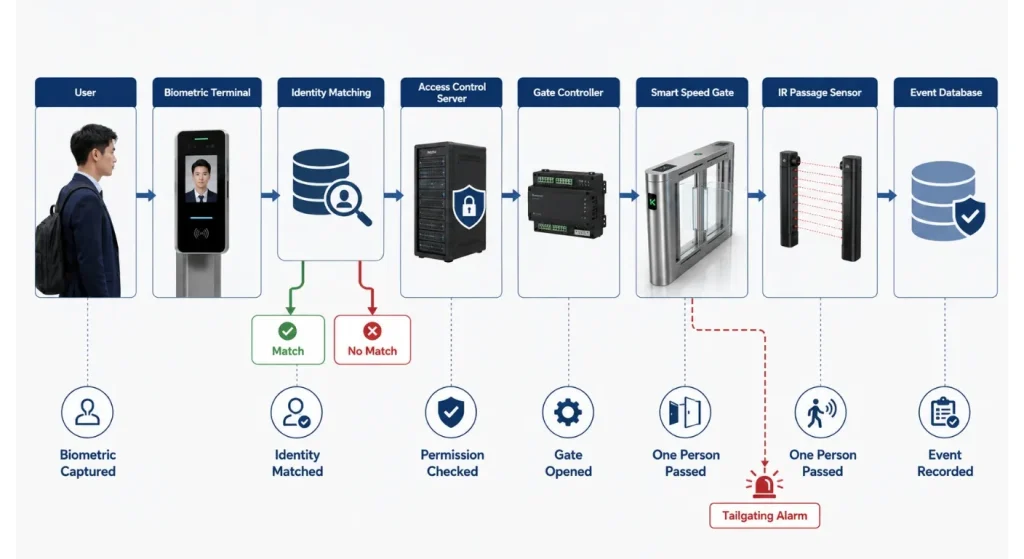
Note: There should not be a delay long enough for multiple people to go through the gate if it is a biometric match. Simultaneously the closing logic should be in harmony with slower users and the true width of passage.
Provide an additional layer of security when it can be offered
Biometrics aren't used for all credentials.
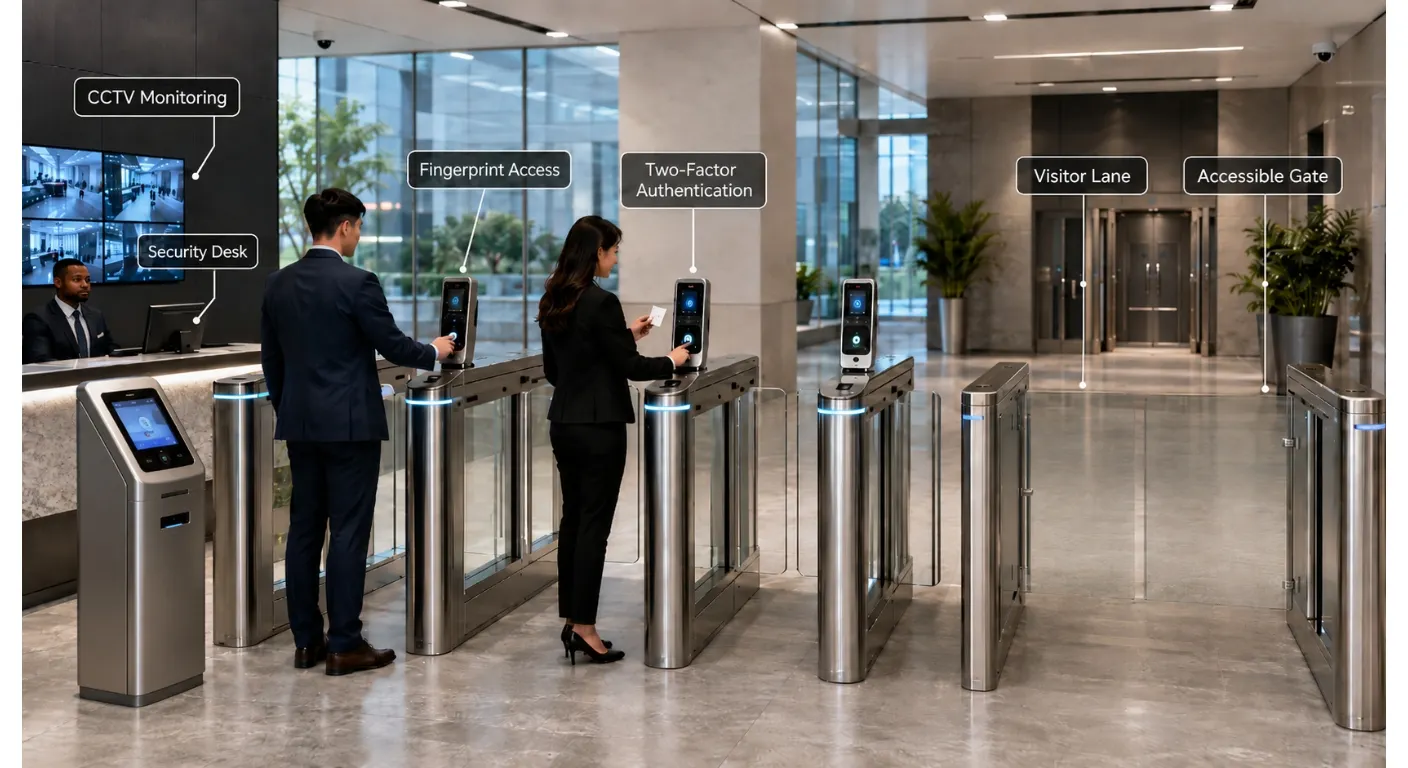
Face recognition can be used at a general employee entrance, card plus fingerprint at a research laboratory or server room. The use of biometrics can also be combined with PIN, mobile credential, anti-passback rules, CCTV events, and/or manual approval.
Multi factor authentication is most beneficial when it would help to provide a level of security that is worthwhile any extra time or effort. It can cause non-essential queues, or support calls at every portal where it is deployed.
The entire process should be taken out for a test with the approved access-control equipment, access-control controller, management platform and gate.
This is a really easy safe way to fall back
Biometric access shouldn't be the weak link.
The user can suffer from an injury, wear a protective outfit, suffer repeated false rejection or not be able to use the method chosen. This could also be due to the unavailability of the terminal, network or server.
Failing to get this one right, they may consider to choose other means such as:
- Ensure that you use a secured RFID card.
- Mobile credential
- Temporary PIN
- An alternative biometric alternative method or technique
- Guard-assisted access
- A managed path for visitors to travel along.
- Time-limited temporary permission
Any fall-back access should be allowed, documented and checked. It should not establish an "easy path" for bypassing the biometric authentication.
Describe Data and Privacy Responsibilities
The biometric template is subject to a greater degree of governance than is a usual card number.
The project owner should be aware of the information collected, if there are raw images being captured and kept, the location of template(s) and who will have access, how the images will be encrypted, and when and by whom they will be deleted.
Administrative action log should also be captured. On termination of an employee, there should be a secure way to clear the access rights and biometric data from the organisation.
The European Data Protection Board also provides information on the use of biometric data, and organisations based in Europe are strongly advised to seek information and advisory services on a project-by-project basis before processing biometric data for employees and visitors before a person in any European country.
The end user is responsible for lawfully collecting and managing data – the turnstile manufacturer's scope of responsibility is to explain its hardware and interface boundaries.
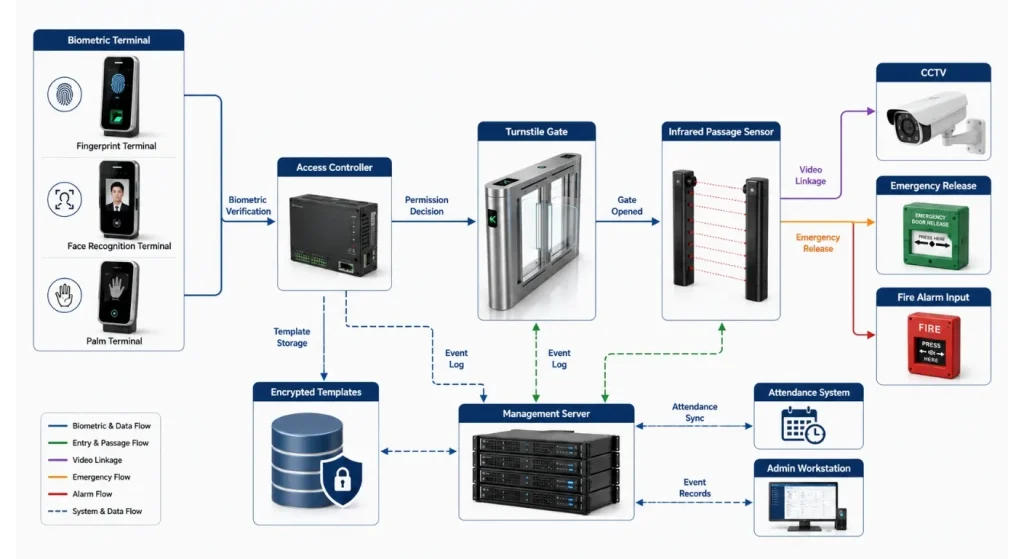
Plan to make your way into the building as a coordinated group
Needs to consider a range of additional factors when designing the final layout including turnstile cabinets, biometric terminals, approach distance, reception desk, cameras, floor conduits, queue barriers, visitor assistance, maintenance access and emergency routes.
Facial recognition cameras have to be at an appropriate height and line of sight. The fingerprint terminals need to be readily accessible (not forced to stand in the passage). A large gate can be needed to pass through with a cart for services or if a mobility device is used to help people move around.
The most up-to-date architectural and electrical drawings should be sent to the manufacturer prior to manufacture. No custom brackets or terminal openings to be determined during installation and should be shown on approved drawings.
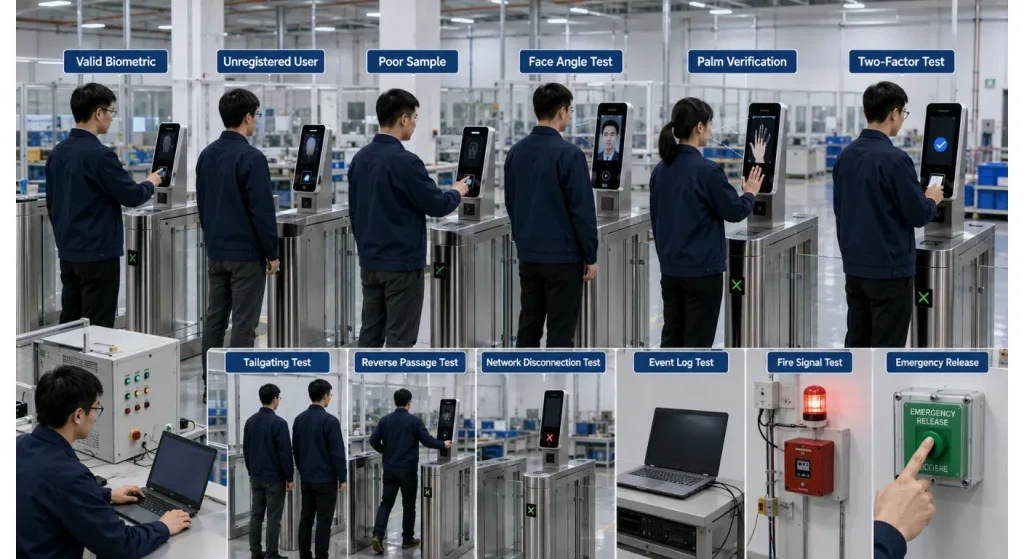
Test the configuration against shipment to ensure that everything is working correctly
When using a Factory Accepted Biometric Terminal, Controller, Gate, and Sensor Settings; as well as software interface wherever possible.
Tests should cover:
- Valid biometric access
- Unenrolled-user rejection
- Poor-quality biometric samples
- Repeated failed attempts
- Multi-factor authentication
- Fallback access
- Tailgating
- Wrong-direction movement
- Network interruption
- Power recovery
- Emergency opening
- Event recording
Test the approach of facial recognition, realistic lighting as situations occur. If using fingerprint projects, use representative users as well as multiple fingerprint to register.
| Test Item | Expected Result |
|---|---|
| Valid biometric | Gate opens once |
| Unenrolled user | Access remains denied |
| Poor biometric sample | Clear retry or fallback |
| Multi-factor access | Both credentials required |
| Tailgating attempt | Alarm is activated |
| Network failure | Approved fallback begins |
| Emergency input | Gate follows approved logic |
| Event recording | Correct data is stored |
Ask for video, test sheets, wiring diagrams, software versions, serial numbers and interface documents. It is not necessarily correct to assume that a demonstration conducted on a different terminal, controller or environment can be a guarantee of the performance in the end system.
This ensures the plan remains current and suitable for the student's needs
Mechanical, electronic and software support are required to develop a biometric entrance.
Verify those who will be enrolling users, set user matching parameters, perform software updates, wipe current people from biometric sensors, reactivate terminals, repair/debug network issues, and restore backup settings.
Inquire about the availability of critical components such as motors, control boards, biometric terminals and more. There should be sufficient information provided in the documentation to enable the local integrator to maintain the entrance upon commissioning.
Complete an RFQ
Give the application, the country of the project, the start/draw entry, the number of lanes, the user groups, the flow of traffic, the nature of the gates, the width of the gate opening, the preferred biometric system, the verification process, the size of the database, multi-factor rules, fall-back mechanism, the system used for access control, the amount of data-store space required, indoor/outdoor facility, emergency control logic, test kit range, installation responsibility, training, spare kit, and delivery time.
Do not contact Ironman only for the biometric gate price – contact them by sending the project package instead.
True understanding of your needs and the user's requirements, accuracy, system adaptability, privacy and maintenance hazards can be understood before manufacturing through a detailed RFQ.
Conclusion
A biometric turnstile gate is more than a camera or scanner fixed on a standard turnstile, and should be considered more of an identity and passage system.
Projects need to consider how they achieve biometric performance, real user scenario, gate type, detection of the passances, fallback access, data governance, system integration, testing and long-term support of the project.
The best one is probably the one that takes into account the practical, 'normal' use of the entrance – even when biometric verification cannot be 100% successful.
FAQs
Technology can handle the various types of biometrics quite well, with turnstile gates being one type on which they can operate.
There are various types such as fingerprint, Face, Iris, Palm or Vein recognition. Compatibility is a consideration of terminal, controller and software as well as project workflow.
Now that you have access to biometric technology, does it make sense to install biometric turnstiles over card turnstiles?
They can help limit sharing of cards and enhance the verification of identity. Eventually, the security will still rely on settings, passage sensors, alternate access and data protection.
Is it possible to use multiple credentials to access a Biometric Gate?
Yes. The biometrics could layer with the use of RFID cards, mobile credentials or PIN numbers for multiple factor authentication for a project.
What If Biometric Verification Fails?
The entrance should offer a secure, initial fallback, e.g., another credential or a credential/approve. There should be an exception to these that is authorised and documented.
To get the quotation, one needs certain information.
Describe the type of the gate, number of people using it, traffic volumes, method by which the person is identified, the software used, what to do if the gate fails, the surrounding and the testing parameters, and then the project schedule.
