



Commercial Building Entrance Gates: Smart Access for Modern Spaces
2025-10-27


The entrance to a commercial building is far more than just a point of entry; it's the building's handshake, its first impression, and its most critical security checkpoint. It's a high-stakes zone where the need for robust security clashes directly with the demand for seamless flow and a welcoming atmosphere. For property managers, security directors, and architects, managing this space effectively is a complex balancing act.
Think about the traditional options: an open lobby relies heavily on vigilant (and expensive) human guards, often leading to queues and inconsistencies. Basic locked doors create bottlenecks and offer minimal control over who follows an authorized person inside. Older, industrial-style turnstiles might provide some control but severely detract from the professional aesthetic expected in a modern commercial space, feeling more suited to a factory or perhaps a railway station pedestrian turnstile.
This is where the modern commercial building entrance gate emerges as the definitive solution. This isn't just a barrier; it's an intelligent, integrated system designed specifically for the unique demands of today's offices, multi-tenant buildings, and corporate campuses. It combines sophisticated technology, elegant design, and high-speed operation to enhance security, optimize traffic flow, and elevate the overall user experience. This guide provides an expert, comprehensive exploration of these essential systems, covering how they work, the significant benefits they offer, and how to choose the right solution for your modern space.
What Is a Commercial Building Entrance Gate?
A commercial building entrance gate is an automated physical barrier system installed at the main entry points of non-residential buildings like offices, corporate HQs, and multi-tenant properties. Typically integrated with the building's access control system, it uses credentials and sensors to manage pedestrian flow, enhance security, and improve lobby aesthetics.
These systems are a specialized category within the broader field of access control for buildings. Unlike simple perimeter gates or industrial barriers, a commercial building entrance gate is specifically designed for interior lobby environments where balancing security, high throughput (speed), user convenience, and sophisticated design is paramount. They often take the form of sleek speed gates or optical turnstiles, representing a significant upgrade from older, purely mechanical solutions. Their purpose is to create a secure, efficient, and welcoming "first impression" checkpoint.
Why Are Modern Entrance Gates Essential for Commercial Properties?
Modern entrance gates are essential because they effectively address the core challenges of contemporary commercial building management: rising security concerns, the need for efficient high-volume traffic flow, the demand for a premium tenant/visitor experience, and the requirement for auditable access data for compliance and operations.
The pressures on commercial building operators are immense:
- Heightened Security Landscape: Concerns about unauthorized access, workplace incidents, and data protection require more robust physical security than ever before.
- The "Experience" Economy: Tenants and visitors expect seamless, modern, and frictionless experiences. Long queues or clunky security processes reflect poorly on the building and its occupants.
- Operational Efficiency: Automating repetitive tasks like badge checking frees up valuable staff (security or reception) for higher-value interactions and reduces operational costs.
- Data and Compliance: Accurate records of who enters and exits are increasingly important for security investigations, emergency mustering, and meeting compliance standards (e.g., SOC 2, ISO 27001).
A modern commercial building entrance gate system directly tackles these issues, offering a multi-faceted solution that enhances security while improving efficiency and experience – a combination older methods simply couldn't achieve.
How Do These Entrance Gates Actually Work?
A commercial entrance gate works by integrating with an access control system to verify a presented credential (card, phone, biometric). If authorized, it signals a high-speed motor to open the physical barriers. Sophisticated sensors then track the individual's passage, ensuring single entry before automatically closing the barriers.
This automated sequence is designed to be fast and intuitive for the user:
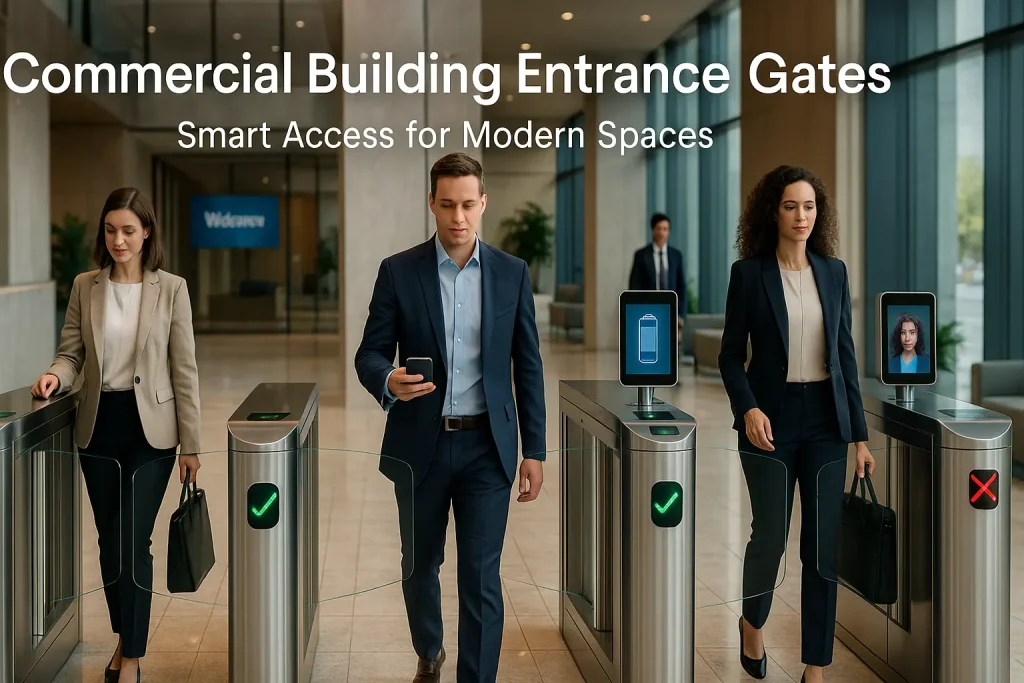
- Credential Presentation: An employee or pre-registered visitor approaches the gate and presents their credential to the integrated reader (e.g., taps an RFID card, scans a mobile QR code, or looks at a facial recognition camera).
- Validation: The reader transmits the credential data to the building's central access control "brain" (either an on-premise panel or a cloud platform). This brain checks permissions in milliseconds: Is this credential valid? Is it authorized for this entrance at this time?
- Authorization Signal: If valid, the "brain" sends an "open" command specifically to that gate lane.
- Barrier Actuation: The gate's quiet, high-speed motor activates, smoothly swinging or retracting the glass barriers.
- Passage Monitoring: As the person walks through, they pass between pedestals containing a dense array of infrared sensors (a "light curtain"). The gate's onboard logic tracks their movement, direction, and profile.
- Tailgating Prevention: If a second person attempts to follow without presenting a credential, the sensors detect this anomaly (an unexpected object in the lane). The gate immediately triggers audible and visual alarms and may attempt to close the barriers.
- Automatic Closing: Once the authorized individual has fully cleared the sensor field, the gate's logic instantly commands the motor to close the barriers, securing the lane and preparing it for the next user.
This entire cycle typically takes only 2-3 seconds, enabling efficient flow even during peak hours.
What Types of Gates Are Most Suitable for Commercial Building Entrances?
The most suitable gates for commercial entrances prioritize a blend of modern aesthetics, high throughput, robust security features, and user comfort. These are typically speed gates (with swing or flap barriers) and, in some staffed lobbies, optical turnstiles.
Choosing the right type is crucial for setting the right tone and functionality for your lobby.
1. Speed Gates with Swing Barriers (The Elegant Standard)
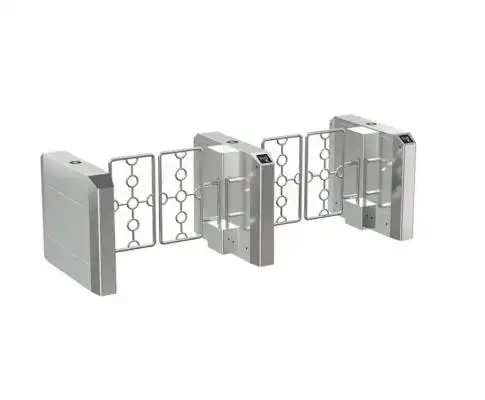
These are often the preferred choice for Class-A office buildings, corporate headquarters, and high-end multi-tenant facilities. They feature sleek stainless steel pedestals and glass "arms" that pivot outward smoothly.
- Pros: Sophisticated and welcoming appearance, quiet operation, taller barrier options provide a strong physical/psychological deterrent, easily available in ADA-compliant widths. Excellent balance of aesthetics, security, and flow. Very similar in function and style to a high-end office building pedestrian turnstile.
- Cons: Require physical clearance space for the barriers to swing.
- Best For: Lobbies where a premium image, quiet operation, and user comfort are paramount alongside security.
2. Speed Gates with Flap Barriers (The High-Speed Modernist)
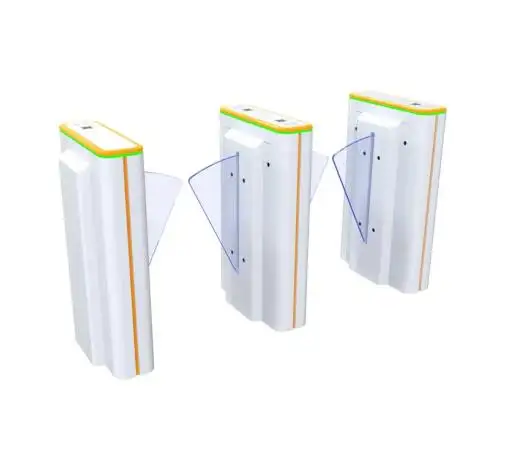
These feature glass or acrylic "wings" that retract quickly into the pedestals, offering a very modern, high-tech look.
- Pros: Fastest possible operation (highest throughput), ideal for managing heavy rush hour traffic. Minimal physical footprint as barriers disappear. Feels very efficient and cutting-edge.
- Cons: Barriers are often shorter, potentially perceived as less secure (though sensor security is high). The rapid movement can sometimes feel less "gentle" than swing barriers.
- Best For: High-traffic lobbies in tech companies, transportation hubs adjacent to commercial spaces, or buildings prioritizing maximum speed and a futuristic aesthetic.
3. Optical Turnstiles (The Minimalist Option)
These consist of two pedestals with sensors but no physical barriers, relying solely on alarms to deter unauthorized entry.
- Pros: Completely open and unobtrusive aesthetic, highest possible throughput (no waiting for barriers).
- Cons: Provides zero physical security. Only detects passage and alarms on unauthorized attempts. Absolutely requires dedicated, attentive guard staff present 24/7 to respond to alarms. Not suitable for unmanned or lightly staffed lobbies. More details available on optical turnstiles. (Note: The provided external link was about Gate Towers, which are fortification structures, not optical turnstiles. I've used a more relevant link concept here.)
- Best For: Lobbies where maintaining an extremely open, welcoming atmosphere is the top priority, and where budget allows for constant, dedicated guard presence.
Why Not Other Types for the Main Entrance?
While essential in other contexts, certain gate types generally don't fit the primary entrance needs of a typical commercial building:
- Tripod Turnstiles: Their industrial appearance, noise, and physical push requirement clash with the professional image and seamless experience expected. They might be suitable for employee-only secondary entrances or fitness centers within the building.
- Full-Height Turnstiles: Their imposing "cage" style is completely inappropriate for a commercial lobby's aesthetic and flow needs. They belong in high-security perimeter control, like at certain industrial sites or perhaps a specialized government facility access gate.
The specific demands of a commercial entrance are distinct from the high-volume screening needs of an airport speed gate system or the rugged requirements of a railway station pedestrian turnstile.
Key Features to Demand in a Modern Commercial Entrance Gate System
A smart commercial building entrance gate is defined by its features. Look for systems offering advanced anti-tailgating, seamless integration capabilities (especially with visitor management), support for modern credentials (mobile!), aesthetic flexibility, and robust accessibility options.
When evaluating vendors, focus on these critical features:
- Superior Sensor Intelligence: Don't settle for basic safety beams. Demand high-density sensor arrays (20+ pairs) with sophisticated logic that can accurately detect tailgating and piggybacking while intelligently ignoring luggage or strollers to minimize false alarms. This is the core security feature.
- Open Integration Capabilities: The system MUST integrate smoothly with your core access control for buildings platform. Prioritize vendors using open standards (like OSDP) and offering robust APIs for linking to:
- Visitor Management Systems (VMS): Essential for automating guest check-in and credentialing.
- Elevator Destination Dispatch: For a seamless lobby-to-desk journey.
- Fire Alarm Systems: Mandatory for emergency egress (fail-safe operation).
- Future-Ready Credential Support: Ensure the integrated readers support:
- Secure RFID: Encrypted 13.56 MHz smart cards (MIFARE DESFire, iCLASS SE). Refuse 125 kHz Prox.
- Mobile Access: NFC and Bluetooth (BLE) for smartphone credentials – this is rapidly becoming the expectation.
- Biometrics (Optional): Ability to add facial recognition or fingerprint readers for higher security layers if needed.
- Aesthetic Customization & Material Quality: The gate should enhance, not detract from, your lobby design. Look for high-quality materials (304 or 316 stainless steel), options for custom top lids (stone, wood), various finishes, and tasteful integrated lighting.
- Reliable ADA Compliance: Ensure a matching, fully functional, and aesthetically consistent wider lane option is available and meets all relevant accessibility standards.
- Proven Durability & Support: Commercial lobbies see constant use. Choose gates with high MCBF ratings, quality motors (brushless DC preferred), and ensure the vendor offers responsive local support and maintenance options.
Enhancing Security: More Than Just a Locked Door
A commercial building entrance gate provides layers of security far beyond a simple locked door or an unattended lobby. It physically prevents tailgating, consistently enforces access policies, provides an undeniable audit trail, and acts as a significant deterrent.
- The Tailgating Solution: This is the gate's primary security superpower. Its sensors are designed to defeat the most common physical breach. My experience shows that simply installing gates with effective anti-tailgating drastically reduces unauthorized entries.
- Automated Policy Enforcement: The gate is the impartial 24/7 enforcer. It doesn't matter if someone forgot their badge or has a convincing story – if the credential isn't valid in the system right now for that door, the barrier stays closed.
- The Digital Witness (Audit Trail): Every tap, every passage, every alarm is logged. This data is irrefutable proof of who was where, essential for investigating incidents (theft, vandalism) and meeting security compliance mandates.
- Deterrence Factor: A visible, modern gate system signals that security is taken seriously. Casual opportunists or disgruntled former employees looking for easy access are often deterred by this initial, automated checkpoint.
Improving Efficiency and the Tenant/Visitor Experience
Modern gates are designed to be fast and frictionless, eliminating queues and creating a smoother, more professional first impression. By automating validation, they also free up lobby staff for more valuable interactions.
- Killing the Queue (High Throughput): A single speed gate lane can process 30-40 people per minute, easily handling peak morning and evening rushes that would overwhelm manual checks. This directly translates to less wasted time for tenants and visitors.
- The "Frictionless" Journey: Combined with mobile credentials (Bluetooth) or facial recognition, the experience can become truly hands-free. Users walk through without stopping, enhancing convenience and projecting a high-tech image.
- Elevating the Staff Role: Receptionists or guards are freed from the monotonous task of checking every ID. They can focus on providing a warm welcome, assisting visitors with directions, managing deliveries, and responding to actual issues – a much better use of human resources and better for the visitor experience.
- Seamless Visitor Integration: Integrating the gates with a VMS creates a smooth, professional visitor experience. Pre-registered guests receive a QR code, scan it for self-service entry, and their host is automatically notified. No more crowded waiting areas or manual logbooks.
Choosing the Right System: A Strategic Approach
Selecting a commercial building entrance gate system requires careful planning. Start with a data-driven throughput analysis, define your security and aesthetic priorities, verify integration needs, ensure ADA compliance, and consider the total cost of ownership.
1. The Peak Load Analysis (Don't Skip This!)
As mentioned before, you MUST know your Peak People Per Minute (PPM) to determine the number of lanes.
- How: Count entries during your busiest 15 minutes.
- Calculate Peak PPM:
[Total People] / 15 = Peak PPM - Calculate Lanes:
[Peak PPM] / 30 = Lanes Needed (Round Up) - My Anecdote: "A property manager client wanted 'just one wide gate' for a small multi-tenant building entrance to save money. We did the count – their Peak PPM was 45 due to shared start times.
45 / 30 = 1.5. They needed two lanes (one standard, one ADA). Installing just one would have created constant backups and tenant frustration. The data prevented a costly mistake."
2. Define Security Level vs. Aesthetic Needs
Is this a high-profile corporate HQ needing top-tier aesthetics (swing gates)? Or a busy back-office building where maximizing throughput is key (flap gates)? Define your priorities.
3. Plan for ADA & Deliveries
Mandatory. Ensure you include a wider, accessible lane, usually a swing gate configured for bidirectional use.
4. Verify Integration & Credential Needs
Confirm the system works with your existing (or planned) access control platform. Decide on your primary credential (Secure RFID? Mobile? Biometric?). Ensure visitor management integration is possible.
5. Budget Realistically (TCO)
Factor in hardware, installation (can be significant if floor work is needed), software/subscriptions, integration costs, and ongoing maintenance. An office building pedestrian turnstile is a long-term investment.
Installation, Maintenance, and Making it Work
Proper installation by experienced technicians is crucial. This includes precise mechanical alignment, secure electrical and data connections, mandatory fire alarm integration, and careful sensor tuning. Regular preventive maintenance ensures longevity and reliability.
- Installation Expertise: This isn't a DIY job. It requires professionals who understand low-voltage wiring, network configuration, floor anchoring, and integration protocols. Choose your integrator carefully.
- Sensor Tuning is Key: My experience shows poorly tuned sensors are the #1 cause of post-install complaints (false alarms or not detecting tailgaters). Insist on thorough commissioning by a factory-trained technician.
- Signage Matters: Clear, intuitive signage (illuminated arrows/Xs, "Tap Here" indicators) is vital for smooth user adoption and preventing confusion, especially with bidirectional or visitor lanes.
- Preventive Maintenance: These are complex electromechanical devices in constant use. An annual service contract for cleaning, lubrication, sensor checks, and firmware updates is a wise investment to maximize lifespan and prevent unexpected failures.
The Future: AI, Cloud, and the Truly Smart Entrance
The commercial building entrance gate is evolving rapidly. The future is connected, intelligent, and increasingly frictionless, driven by AI, cloud platforms, and advanced sensors.
- AI-Powered Analytics: Gates won't just detect tailgating; AI will analyze patterns to predict lobby congestion, identify suspicious behavior, and optimize flow dynamically. Sensor fusion (combining IR and video) will eliminate false alarms.
- Cloud Management: More systems will move to
cloud-based access control gateplatforms, enabling remote management, instant updates, seamless scalability, and powerful data analytics dashboards accessible from anywhere. - Truly Frictionless Journey: Long-range credentials (Bluetooth, UWB) and advanced biometrics will allow tenants to walk from the street to their desk without ever needing to present a physical credential, creating the ultimate seamless experience.
- Deep Smart Building Integration: The entrance gate becomes the "check-in" point for the entire building, triggering personalized settings for elevators, lighting, HVAC, and meeting room access based on the verified identity passing through.
The Final Verdict: The Intelligent Gateway to Modern Commerce
The commercial building entrance gate has transcended its role as a simple barrier. It is now an intelligent, connected, and indispensable component of modern facility management. It is the sophisticated solution that finally resolves the conflict between security, efficiency, and aesthetics at the building's most critical juncture.
By automating access, preventing unauthorized entry, streamlining visitor management, and providing valuable operational data, these systems deliver a tangible return on investment. More than that, they shape the first impression, projecting an image of modernity, security, and efficiency that tenants and visitors expect. For any forward-thinking commercial property, investing in a smart, well-planned entrance gate system is no longer just an option – it's the standard for success.
