


Commercial Turnstile Gate: Types, Costs, and How to Choose the Right One for Your Venue
2026-04-01


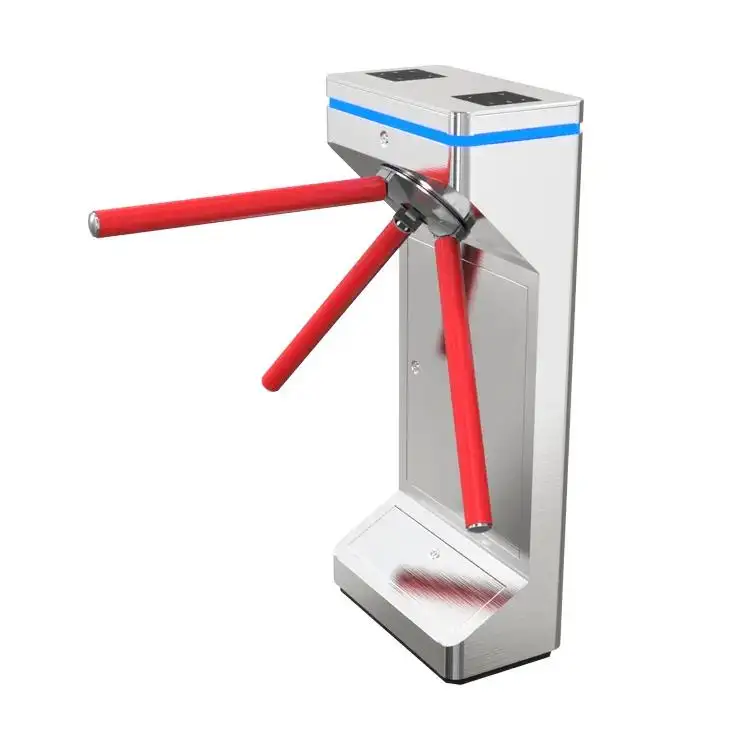
The right commercial turnstile gate depends on your venue type — not just your budget or headcount. Speed gates suit Class A offices and high-traffic commercial lobbies. Flap barriers and swing gates cover standard commercial buildings, retail, and campus deployments. Tripod turnstiles serve secondary entrances. Full height turnstiles protect commercial perimeters and government facilities.
Unit prices range from $150 for a basic tripod to $8,000 for a premium speed gate. Every primary commercial entrance also requires at least one ADA-accessible lane at 900mm clear width or wider.
This guide gives facilities managers, property developers, and system integrators a 7-criteria comparison table, a commercial venue matching section, ADA compliance guidance, anti-tailgating overview, pricing context, and a direct path to a factory-direct quote. For the full Ironman commercial deployment solution overview, start with the commercial entry turnstile solution page.
5 Types of Commercial Turnstile Gates — Compared Across 7 Criteria
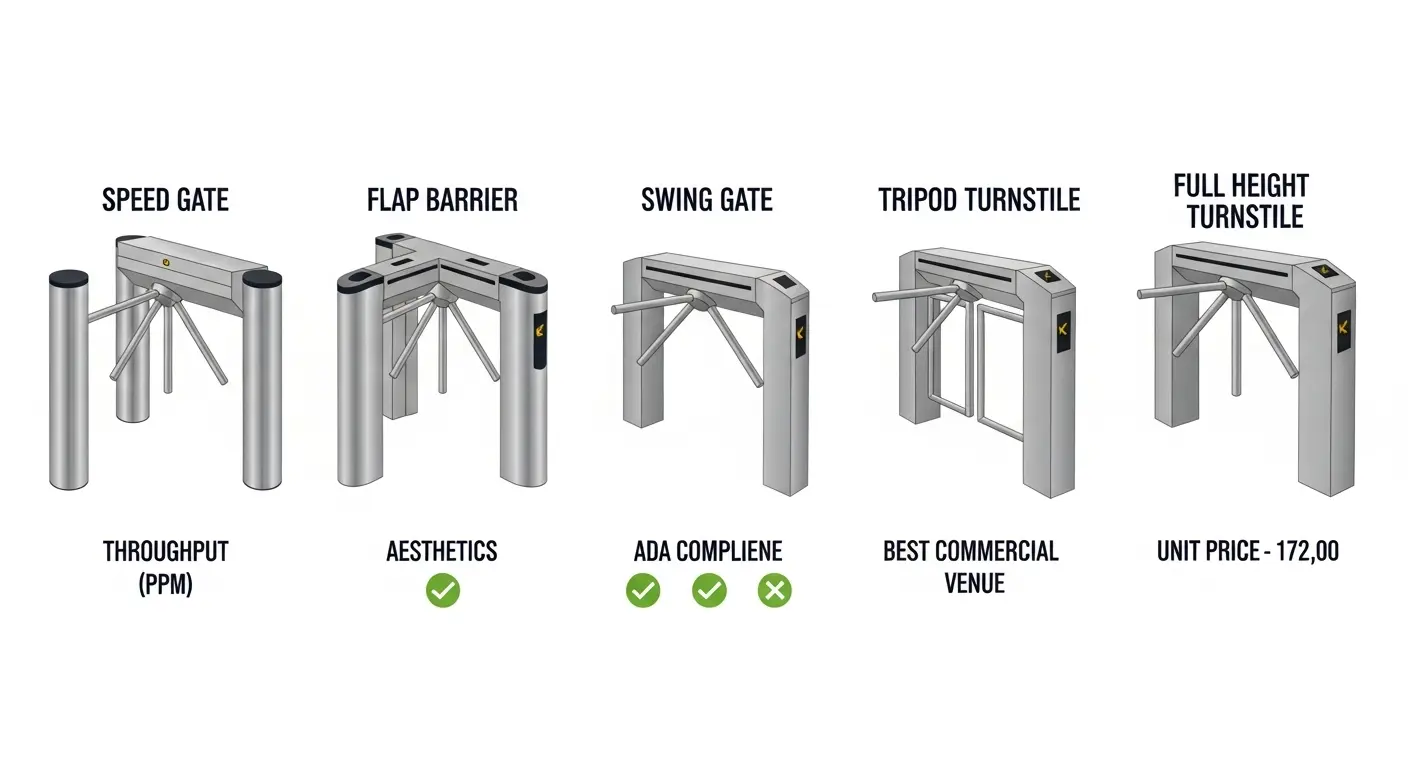
Five gate types serve commercial deployments. Each fits a different venue context, and the table below compares them on the seven criteria that matter for a commercial specification.
| Gate Type | Throughput | Aesthetics | ADA | Security | Anti-Tailgating | Best Venue | Unit Range |
|---|---|---|---|---|---|---|---|
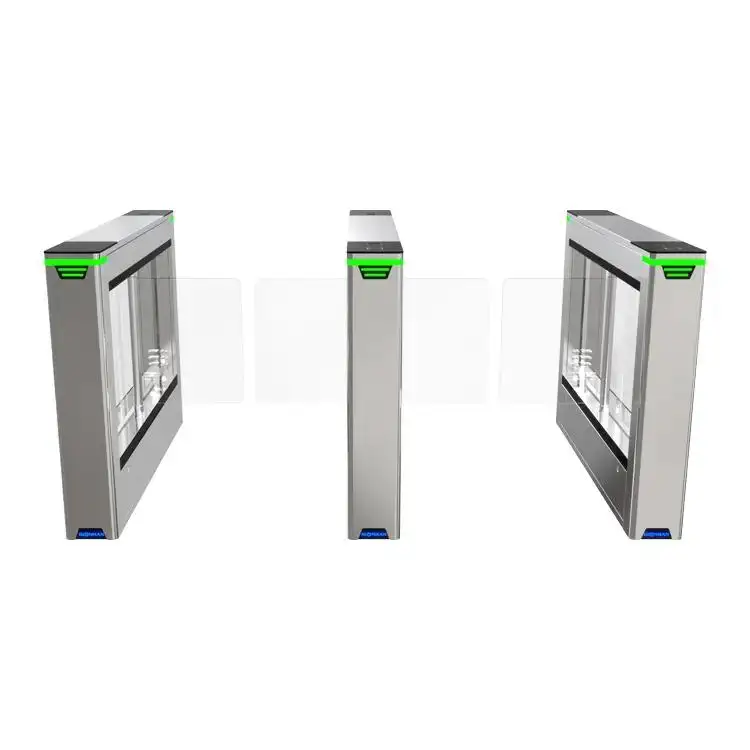
| Speed Gate | 50–80 ppm | Premium — glass, slim SS cabinet | Best | High | Standard + alarm relay | Class A office, premium hotel | $1,300–$8,000 |
| Flap Barrier | 40–60 ppm | Modern, low-profile | Moderate | Medium-high | Standard | Standard commercial, managed building | $450–$6,500 |
| Swing Gate | 30–50 ppm | Flexible, customizable | Good — wide variant | Medium | Optional | Retail, SME office, campus | $400–$2,500 |
| Tripod Turnstile | 15–20 ppm | Functional | Limited | Medium | Not standard | Secondary entrances, gyms, events | $150–$1,400 |
| Full Height | 25–40 ppm | Institutional | Limited | Highest | Built-in | Perimeter, government | $600–$4,000 |
Speed Gate and Flap Barrier — Premium and Standard Commercial
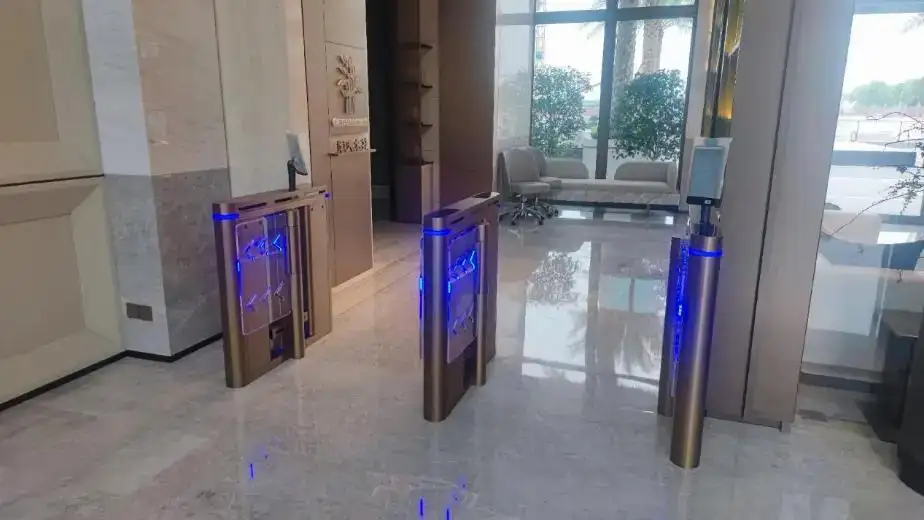
Speed gates lead across all commercial quality criteria. They deliver 50–80 ppm throughput, premium glass-panel aesthetics, a built-in ADA 900mm wide-lane option, and sensor-matrix anti-tailgating as standard. This makes them the default choice for Class A commercial buildings.
Flap barriers deliver comparable throughput at 40–60 ppm and a lower per-lane cost. They suit standard commercial buildings where budget is the primary constraint and a premium aesthetic is not required. Both speed gates and flap barriers open in 0.4–0.5 seconds per cycle.
Swing Gate, Tripod, and Full Height — Retail, Secondary, and Secure
Swing gates suit retail and SME office deployments — lower cost, customizable finish, ADA-compatible wide-lane available, and a physical barrier suited to mixed pedestrian and visitor flow at lower volumes.
Tripod turnstiles are limited to secondary commercial entrances and venues where aesthetics are not a factor. At 15–20 ppm throughput, they are not suitable for any primary commercial entrance with more than 200 daily entries.
Full height turnstiles belong at commercial perimeters, government entrances, and high-security sites. Their floor-to-ceiling barrier prevents all tailgating by design. Their institutional appearance rules them out for client-facing commercial lobbies.
Match Your Commercial Turnstile Gate to Your Venue Type
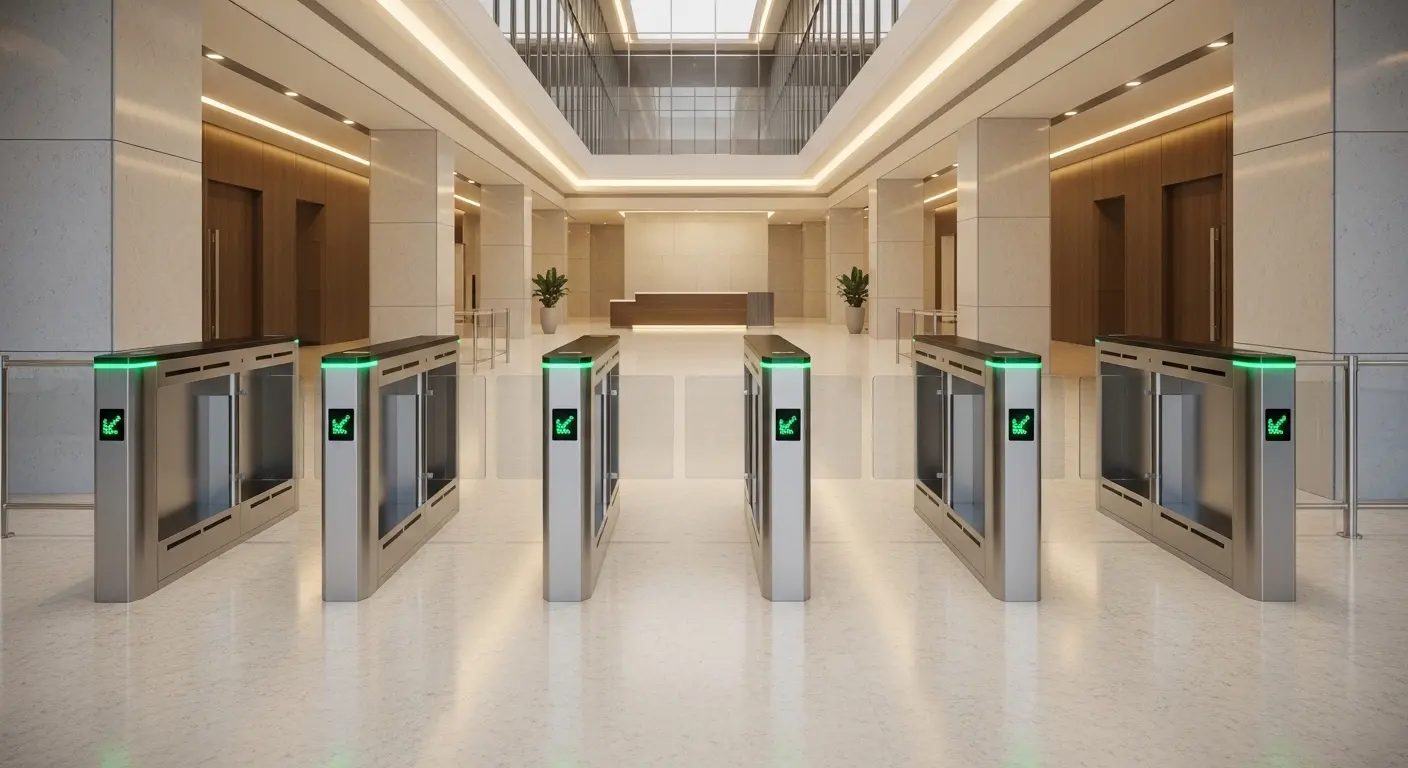
Venue type determines gate type. The table below gives a direct recommendation per commercial venue.
| Commercial Venue | Recommended Gate | Lanes | Primary Reason |
|---|---|---|---|
| Class A office building | Speed gate | 3–8+ | Throughput, aesthetics, ADA, anti-tailgating |
| Standard commercial building | Flap barrier or entry speed gate | 2–4 | Cost/throughput balance, ADA lane |
| Retail complex | Swing gate + barcode/QR | 2–6 | Customer flow, visitor throughput, cost |
| University campus | Speed gate or swing gate | 3–8 | Multi-credential, mixed traffic |
| Government / high-security | Full height + biometric | 2–4 | Maximum physical security, audit trail |
Office and Standard Commercial Buildings
For Class A office buildings, the commercial speed gate is the correct specification. It handles morning peak flow, matches the architect's aesthetic brief, and includes a 900mm ADA-accessible wide lane within the same cabinet family. The Netherlands multi-tenant office tower deployment shows a 4-lane speed gate configuration handling 2,400 daily entries across 20 floors without congestion — a reliable reference for comparable commercial projects.
For standard commercial buildings, a flap barrier at $450–$6,500 per lane delivers 40–60 ppm in a lower-profile cabinet. It is the right choice for buildings with under 1,000 daily entries and a mid-range lobby specification.
Retail and Mixed-Use Commercial Venues
Retail commercial turnstile gates serve a different function than office gates. They manage customer flow and reduce shrinkage at the entrance — not just credential-only access. Swing gates with barcode or QR credential reading are the standard retail configuration. Wide-lane clearance handles shopping bags and trolleys. Fast open cycles preserve customer experience. QR validation covers event access and members-only areas.
For the retail credential configuration using barcode and QR readers, see the barcode turnstile gate page. Mixed-use commercial developments can run speed gates at the main lobby level for tenant access and swing gates at the retail floor separately — different credential types on the same site.
Campus and Government Commercial Deployments
University and corporate campuses require multi-credential commercial turnstile gates. The student and staff population uses RFID cards, mobile NFC, QR visitor passes, and biometric readers across different access points. After reviewing commercial campus deployments for university clients across Asia Pacific, multi-credential compatibility was the primary specification criterion in every case. The campus access control gate covers the multi-credential configuration used in those deployments.
Government facility entrances require the highest physical security level — full height turnstiles with biometric readers and a full entry/exit audit trail. For the biometric gate specification used in government commercial deployments, see the biometric turnstile gate page.
Commercial Turnstile Gate Pricing — What to Budget Per Lane
Price variation within each gate type reflects credential reader type, cabinet finish, ADA lane inclusion, and OEM custom design specification.
| Gate Type | Unit Range | 4-Lane Project Budget | Notes |
|---|---|---|---|
| Speed Gate | $1,300–$8,000 | $5,200–$32,000 | Premium finish, ADA wide lane, anti-tailgating included |
| Flap Barrier | $450–$6,500 | $1,800–$26,000 | Mid-range throughput/cost ratio |
| Swing Gate | $400–$2,500 | $1,600–$10,000 | Best value for retail and SME commercial |
| Tripod Turnstile | $150–$1,400 | $600–$5,600 | Secondary entrances only |
| Full Height | $600–$4,000 | $2,400–$16,000 | Government and high-security perimeter |
Factory-direct OEM pricing removes the distributor and trading company markup. The price difference between a factory-direct quote and a reseller quote typically runs 30–200% on the same gate specification.
For the full product range and factory-direct pricing, see the commercial speed gate product page or browse the full turnstile gate range.
ADA Compliance for Commercial Turnstile Gates
Every primary commercial building entrance must include at least one ADA-accessible lane. Under the ADA Standards for Accessible Design (US), the minimum clear width is 32 inches (813mm) for passage and 36 inches (914mm) for standard approach.
| ADA Requirement | Standard Lane (550–600mm) | ADA Lane (900mm+) |
|---|---|---|
| 32" (813mm) min passing width | ❌ | ✅ |
| 36" (914mm) approach width | ❌ | ✅ |
| Fail-safe egress mode | Required | Required |
| Wheelchair and mobility aid | ❌ | ✅ |
Under NFPA 101 Life Safety Code, any ADA lane on an egress route must operate in fail-safe mode — barriers retract and stay open during a power failure or fire alarm activation.
Speed gates deliver the most architecturally consistent ADA solution for commercial buildings. The 900mm wide-lane variant uses the same cabinet family, finish, and controller as all standard lanes in the gate row. For UK commercial buildings, Approved Document M sets equivalent requirements — 900mm satisfies both US ADA and UK Approved Document M in a single specification.
Anti-Tailgating in Commercial Turnstile Gates
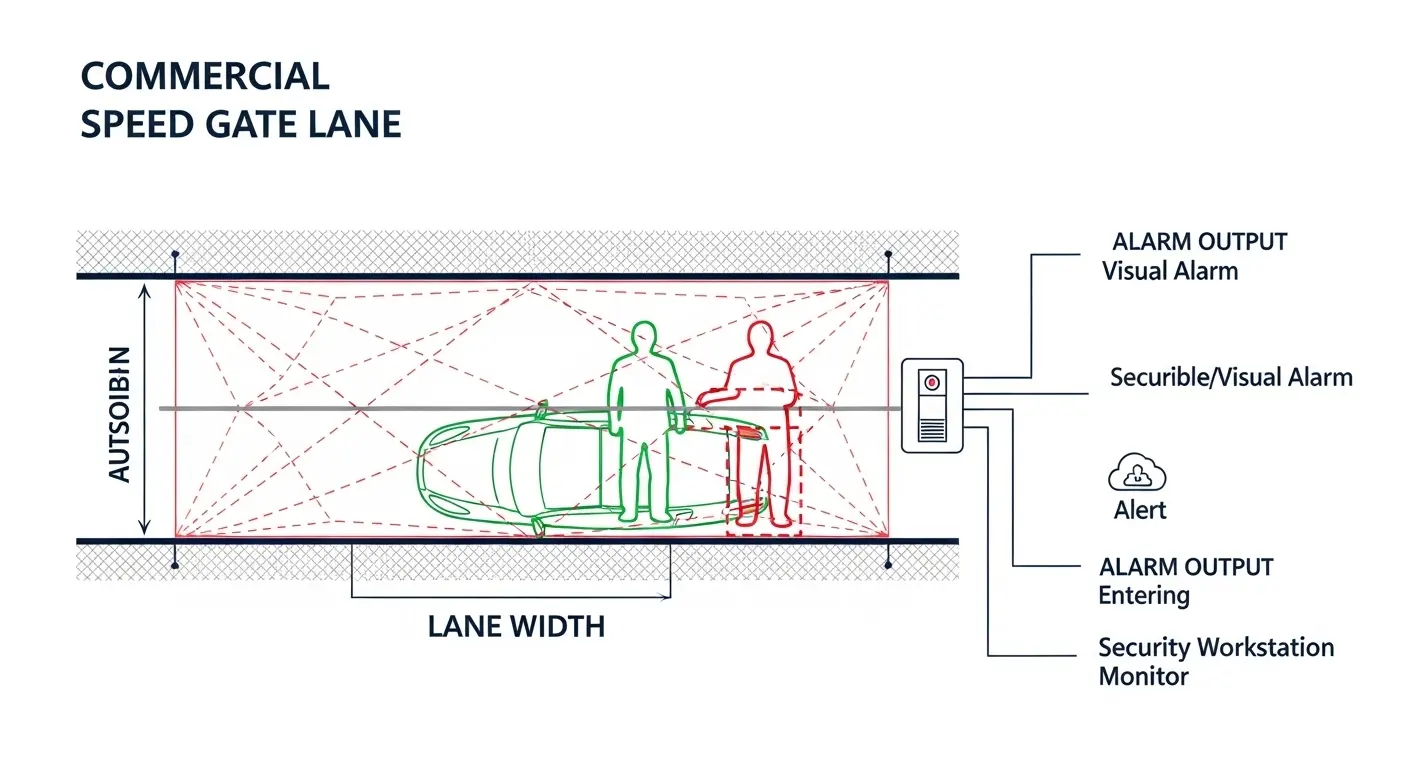
Anti-tailgating is the most underspecified commercial turnstile gate feature. Based on our experience with commercial deployments across offices, retail, and campuses, it is the feature most consistently requested as a retrofit addition within 60 days of installation when not included from the start.
| Anti-Tailgating Feature | Speed Gate | Flap Barrier | Swing Gate | Tripod | Full Height |
|---|---|---|---|---|---|
| Infrared sensor matrix | ✅ Standard | ✅ Standard | Optional | ❌ | N/A |
| Audible + visual alarm | ✅ | ✅ | Optional | ❌ | N/A |
| Security workstation relay | ✅ Optional | ✅ Optional | Optional | ❌ | N/A |
| Cloud alert push | ✅ Optional | ✅ Optional | ❌ | ❌ | N/A |
For commercial office and campus deployments, the infrared sensor matrix creates a detection grid across the full lane length. A second body entering before the barrier resets triggers a visual alarm, an audible alert, and an optional security workstation notification. Full height turnstiles make tailgating impossible by design — the floor-to-ceiling barrier allows only one person per cycle, removing the need for a sensor system.
Credential and Cloud Integration Options
Credential type determines the reader hardware, the access control integration, and the visitor management workflow at each commercial entry point. Confirm your credential types before finalizing the gate specification.
| Credential Type | Commercial Use Case | Protocol |
|---|---|---|
| RFID card (Wiegand 34-bit) | Offices, campuses, managed buildings | ACP panel |
| Mobile NFC | BYOD corporate, modern commercial | TCP/IP |
| QR / barcode | Visitor management, retail, campus events | Cloud + TCP/IP |
| Facial recognition | Premium offices, government | TCP/IP, cloud/on-premise |
| Biometric (fingerprint/iris) | Government, finance, high-security | Wiegand or RS485 |
For cloud-based multi-site commercial deployments — regional office portfolios, retail chains, managed campuses — the cloud-based configuration allows remote access management and audit trail access from any location. See the cloud-based turnstile gate page for the configuration used in multi-site commercial projects.
For commercial venues with a high daily visitor volume, QR code visitor credentials eliminate card management overhead entirely. The credential is generated, delivered, and invalidated without staff involvement at the gate.
Getting a Factory-Direct Quote for Your Commercial Turnstile Gate
Four items are sufficient to receive a full itemized factory-direct quote within 12 business hours.
- Venue type and headcount: office / retail / campus / transit / government + daily entry count
- Gate type selection: use the venue matching table above to confirm your type and lane count
- Credential and ADA requirements: credential type, ADA lane count, anti-tailgating requirement, cloud integration
- Submit your project brief: visit the commercial entry turnstile solution page — CE, ISO9001, FCC, and RoHS certification documents are provided with every first-contact response
Frequently Asked Questions
Q1: What is the best commercial turnstile gate for an office building?
The best commercial turnstile gate for an office building is a speed gate — it delivers 50–80 ppm throughput, premium glass-panel aesthetics, and a 900mm ADA-accessible wide-lane option within the same product family. For standard commercial buildings with tighter budgets, a flap barrier at $450–$6,500 per lane delivers 40–60 ppm in a lower-profile cabinet. The decision between a speed gate and a flap barrier comes down to the lobby's aesthetic brief and the daily throughput requirement. Both types are available with RFID, mobile NFC, QR visitor, and facial recognition credential options.
Q2: How much does a commercial turnstile gate cost?
Commercial turnstile gate prices range from $150 for a basic tripod turnstile to $8,000 for a premium speed gate with custom finish and biometric reader. A standard 4-lane speed gate project budget runs $5,200–$32,000 per lane depending on finish, credential, and ADA configuration. Flap barriers for a 4-lane commercial project typically run $1,800–$26,000. Price variation within each type reflects credential reader type, cabinet finish, ADA lane inclusion, and whether OEM customization is required. Factory-direct pricing from an OEM manufacturer removes the 30–200% reseller markup that applies to trading company quotes.
Q3: What types of commercial turnstile gates are available?
Five types of commercial turnstile gates are available: speed gates (50–80 ppm, glass panels, Class A offices), flap barriers (40–60 ppm, modern, standard commercial), swing gates (30–50 ppm, flexible, retail and SME), tripod turnstiles (15–20 ppm, functional, secondary entrances), and full height turnstiles (25–40 ppm, institutional, perimeter and government). Each type suits a different commercial venue context — gate type selection should start with venue type and daily headcount, not product specification.
Q4: Do commercial turnstile gates need to be ADA compliant?
Yes. Under the ADA Standards for Accessible Design (US), every primary commercial building entrance must provide at least one accessible lane with a minimum 32-inch (813mm) clear passing width and 36-inch (914mm) standard approach width. Any accessible lane on an egress route must operate in fail-safe mode per NFPA 101 — barriers retract and stay open during a power failure or fire alarm. Speed gates provide the cleanest ADA solution for commercial buildings: the 900mm wide-lane variant uses the same cabinet and finish as standard lanes, maintaining visual consistency across the full gate row.
Q5: How many turnstile lanes does a commercial building need?
Calculate lane count using the peak-window method: take total daily entries, divide by 15 (the minutes in the morning peak arrival window), then divide by the gate's throughput per minute. Add one lane for redundancy and one ADA-accessible lane per entrance. For a 600-person commercial office, this gives: 600 ÷ 15 = 40 entries/minute ÷ 55 ppm = 0.73 lanes, rounded up to 2 standard lanes plus 1 ADA lane — a 3-lane configuration minimum. For retail and campus commercial venues with irregular peak patterns, add an additional lane buffer.
Q6: Can a commercial turnstile gate prevent tailgating?
Yes. Speed gates and flap barriers include an infrared sensor matrix that detects a second person entering the lane before the barrier resets after an authorized passage. This triggers a visual alarm, an audible alert, and an optional relay output to a security workstation or cloud monitoring platform. Swing gates can include anti-tailgating detection as an option. Full height turnstiles prevent tailgating entirely by design — the floor-to-ceiling barrier allows only one person per operating cycle, making sensor-based detection unnecessary.
Three Decisions That Define Your Commercial Turnstile Gate Specification
Venue type matching, ADA lane configuration, and anti-tailgating specification — these three decisions determine whether your commercial gate system performs on day one and continues to perform as your building scales. Choosing by product spec instead of venue type is the most common and most costly commercial gate selection error.
Ironman manufactures factory-direct commercial turnstile gates for office buildings, retail complexes, campuses, government facilities, and transit hubs across 50+ countries. Submit your venue type, headcount, and credential brief via the turnstile gate range hub for a full factory-direct itemized quote within 12 business hours.
