


Design & Technology: Innovative Speed Gate Engineering and Aesthetic Designs
2025-10-27


Step into the lobby of any modern Class-A office building, bustling airport terminal, or secure government facility, and you'll likely encounter them: sleek, silent sentinels of glass and steel that manage the flow of people with quiet precision. These are speed gates, the physical embodiment of modern access control. But behind their seemingly simple function lies a sophisticated fusion of cutting-edge engineering and thoughtful industrial design – a true intersection of Design & Technology.
For decades, the concept of a physical access barrier often conjured images of clunky, purely functional turnstiles – necessary evils that prioritized security (often poorly) at the expense of aesthetics and user experience. The modern speed gate represents a radical departure from this past. It is no longer just a "gate"; it's an intelligent, connected device, a carefully crafted piece of architecture designed to enhance, not detract from, its environment.
Understanding the intricate interplay between the advanced technology within these gates and the deliberate design choices that shape their form is crucial for architects, security consultants, facility managers, and anyone involved in creating secure, efficient, and welcoming spaces. This guide provides an expert, in-depth exploration of the innovative engineering and aesthetic principles driving the evolution of speed gate design and technology.
What Defines Speed Gate Design & Technology?
Speed gate design & technology refers to the holistic approach of integrating advanced engineering principles (mechanics, electronics, software, sensors) with considered industrial design elements (materials, aesthetics, ergonomics, user experience) to create effective, reliable, and aesthetically pleasing automated pedestrian barriers.
It's about solving complex problems through a blend of technical prowess and creative thinking, much like the broader field of Design Technology itself, which focuses on practical application and innovation. In the context of speed gates, this means:
- Technology (The Engineering): This encompasses the "how." It's the high-speed motors, the sophisticated sensor arrays, the onboard logic controllers, the network connectivity, the integration with access control systems, and the underlying software that makes the gate function reliably and securely.
- Design (The Aesthetics & Experience): This encompasses the "what" and the "feel." It's the choice of materials (like high-grade stainless steel and glass), the physical form factor (sleek pedestals, elegant barrier motion), the integration of lighting, the intuitive user interface, and how the gate physically fits into and complements the architectural space.
A truly successful speed gate is one where these two elements are inseparable – where the technology enables a beautiful design, and the design enhances the usability and effectiveness of the technology.
The Core Technology Components: What Makes a Speed Gate "Smart"?
Modern speed gates are complex electromechanical devices packed with sophisticated technology. Key components include high-performance motors, advanced optical sensor arrays, powerful logic controllers, and seamless network connectivity, all working in concert.
Let's dissect the technological heart of a modern gate:
1. High-Performance Motors (The "Muscle")
The quiet, rapid movement of speed gate barriers is powered by advanced motors, typically brushless DC motors.
- Why Brushless? Unlike older, noisier brushed motors that wear out, brushless DC motors offer:
- Speed & Torque: Capable of opening or closing barriers in as little as 0.3 seconds.
- Reliability: Designed for millions of cycles, essential for high-traffic environments.
- Quiet Operation: Crucial for maintaining a professional atmosphere in office lobbies.
- Precision Control: Allows for smooth acceleration and deceleration, enhancing user safety and experience.
- My Experience: "I remember replacing old, clunky turnstiles that used noisy AC motors. The constant 'clack-whirr' echoed through the lobby. Switching to modern speed gates with brushless DC motors wasn't just a security upgrade; it transformed the entire acoustic environment of the space. The silence was golden."
2. Advanced Optical Sensor Arrays (The "Eyes")
This is perhaps the most critical technology for both safety and security. Modern gates use a dense "light curtain" of infrared (IR) sensors, far beyond the simple safety beams of the past.
- From Safety to Security: Basic gates have 2-4 beams purely to prevent the barrier closing on someone. Intelligent gates use 20, 40, or even 60+ pairs of cross-hatched IR beams.
- High-Fidelity Profiling: This dense array creates a detailed profile of objects passing through. The gate's logic can analyze this profile to:
- Accurately detect tailgating (two people) vs. one person.
- Intelligently distinguish a person pulling luggage from a piggybacking attempt (reducing false alarms).
- Sense direction of travel (for bidirectional lanes).
- Detect crawl-under or jump-over attempts (in high-security models).
- Beyond IR: Some cutting-edge gates incorporate Time-of-Flight (ToF) sensors or 3D imaging for even more precise volume and shape detection, further enhancing security accuracy.
3. Logic Controllers (The "Local Brain")
Each speed gate lane contains its own powerful microprocessor – a dedicated computer managing its operation.
- Real-Time Processing: This onboard controller instantly analyzes data from all the sensors, controls the motor speed and position, manages the status lights, and communicates with the central access control system.
- Sophisticated Algorithms: It runs complex firmware that includes the anti-tailgating logic, safety protocols, and diagnostic routines.
- Firmware Updates: Being processor-based allows the gate's capabilities to be enhanced over time via remote firmware updates (e.g., improving sensor algorithms to better handle new scenarios).
4. Network Connectivity (The "Voice")
Intelligent gates are connected devices, part of the building's network infrastructure.
- IP-Based Communication: Modern controllers typically communicate over standard Ethernet networks using TCP/IP protocols. This allows for easy integration, remote management, and real-time status monitoring.
- Integration Protocols: Support for open standards like OSDP (Open Supervised Device Protocol) allows secure, encrypted communication between the gate's reader and the central access control panel, replacing older, less secure Wiegand protocols.
- Cloud Connectivity: Many systems now connect directly or via a local gateway to cloud-based management platforms, enabling global remote control and data analytics.
Engineering for Speed, Reliability, and Safety
The technological components must be engineered into a cohesive system that meets demanding performance criteria: high throughput, extreme reliability over millions of cycles, and uncompromising user safety.
Engineering for Throughput (Speed)
The ultimate goal is often to process the maximum number of people per minute (PPM) without queues. This requires optimizing the entire cycle:
- Instant Validation: Fast readers and responsive access control integration are key.
- Rapid Barrier Actuation: High-speed motors open the barriers quickly.
- Intelligent Sensor Logic: Allows the gate to close immediately and safely behind the user, minimizing the "open time" and maximizing the lane's availability. A well-engineered system can achieve throughputs of 30-40+ PPM.
Engineering for Reliability (Durability)
Speed gates in busy locations operate thousands of times a day. They must be built to last.
- Material Science: High-grade stainless steel (often 304 or corrosion-resistant 316) provides the structural integrity. Internal components use durable metals and high-performance polymers.
- Robust Construction: Precision engineering, quality welding, and secure assembly are crucial. Look for manufacturers with strong quality control processes (e.g., ISO 9001 certification).
- High MCBF (Mean Cycles Between Failure): Reputable manufacturers rigorously test components (especially motors and sensors) and provide high MCBF ratings (often in the millions of cycles) as a measure of expected lifespan.
- My Anecdote: "I've seen budget gates installed in a busy transit station literally fall apart within a year – welds cracking, motors burning out. Investing in quality engineering upfront saves a fortune in downtime and replacement costs later. You truly get what you pay for in this industry."
Engineering for Safety
Processing people quickly must never compromise safety. Multiple layers of safety technology are built-in:
- Safety Sensors: Even beyond the security sensor array, dedicated safety beams or sensors prevent the barriers from closing if an obstruction is detected. Logic ensures barriers stop or reverse if they encounter resistance.
- Motor Control: Precise motor control ensures smooth, predictable barrier movement without sudden jerks. Torque limits prevent excessive force.
- Emergency Egress (Fail-Safe): Critically, gates must integrate with the building's fire alarm system. In an emergency, they must automatically open (or allow free push-through) to enable unimpeded evacuation. This fail-safe operation is often a legal requirement.
- Material Safety: Use of materials like tempered glass speed gate barriers ensures that if a barrier were to break under extreme impact, it would crumble into relatively harmless pebbles rather than dangerous shards.
The Art of Design: Integrating Technology with Architecture
A modern speed gate is not just an engineered product; it's a design element within an architectural space. The aesthetic choices – materials, form, lighting – are crucial for creating a welcoming, professional, and intuitive user experience.
Materiality and Finish
The choice of materials significantly impacts the gate's look, feel, and durability.
- Stainless Steel: The dominant material for the chassis due to its strength, corrosion resistance, and modern aesthetic. Different finishes (brushed #4, polished #8, bead-blasted) offer distinct visual textures.
- Glass: Tempered glass speed gate barriers are standard, providing transparency and an open feel while maintaining strength. Options include clear, tinted, frosted, or even custom-etched glass.
- Custom Top Lids: High-end designs allow the top surface of the pedestal to be customized with materials matching the lobby décor, such as marble, granite, wood veneers, or solid surface materials (Corian). This integration makes the gate feel like part of the architecture, not just an add-on.
Form Factor and Visual Impact
The physical shape and movement of the gate influence perception.
- Slim Profiles: Modern design trends favor slimmer pedestals to minimize visual clutter and maximize floor space.
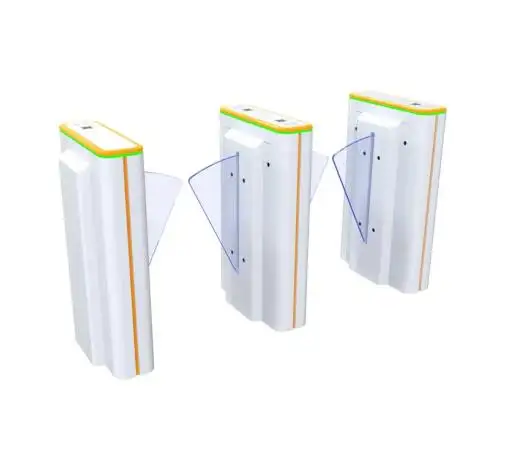
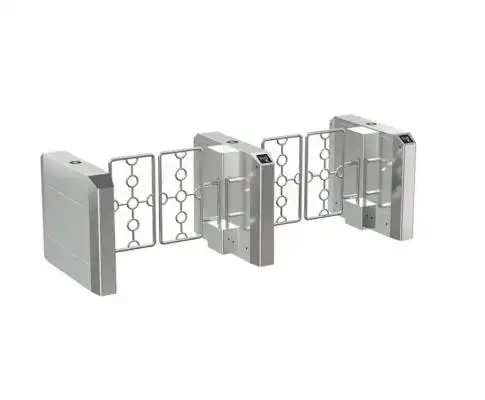
- Barrier Shape: Swing barriers often appear more elegant, while flap barriers convey speed and modernity. Sliding gates project high security. The shape should align with the building's overall design language.
- Ergonomics: Reader placement, passage width, and barrier height are designed for comfortable and intuitive use by a wide range of people.
Integrated Lighting
Lighting is no longer just functional; it's a key design element.
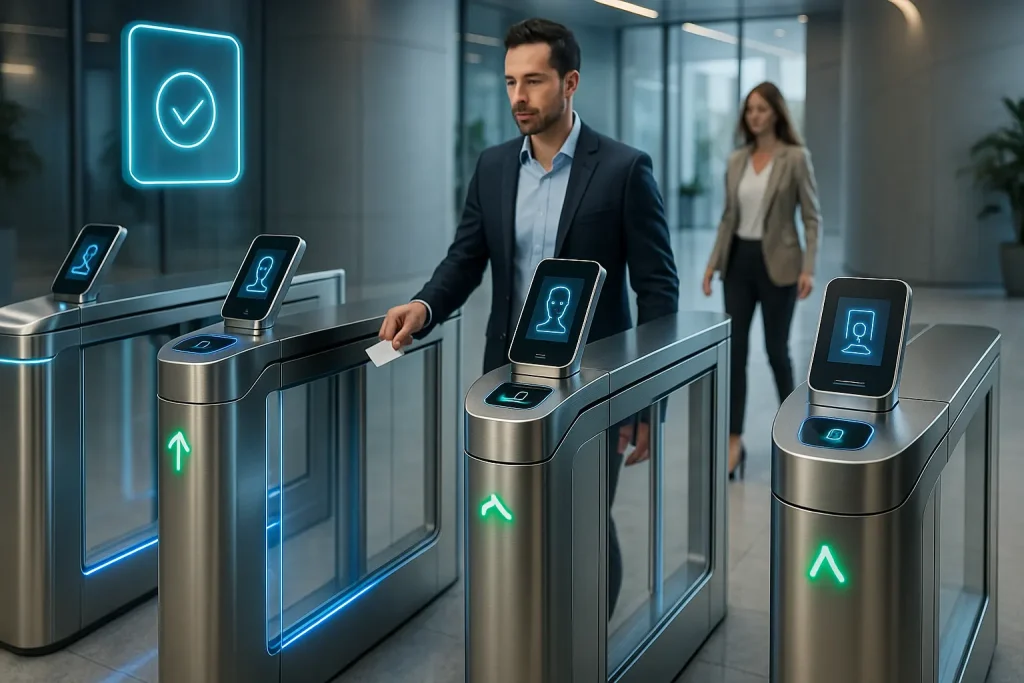
- Status Indication: Integrated LED strips or icons clearly indicate lane status (e.g., solid green arrow for proceed, red X for stop, flashing blue for ADA mode). This intuitive visual communication is vital for high throughput.
- Architectural Ambiance: Subtle under-lid lighting or pathway illumination can enhance the lobby's aesthetic, guide users, and contribute to the building's overall lighting design.
User Interface and Experience (UX)
The goal is a seamless, stress-free passage.
- Intuitive Reader Placement: Readers are positioned for easy presentation of cards, phones, or biometrics without awkward reaching.
- Clear Feedback: Instant visual and often subtle audible feedback confirms successful credential validation.
- Smooth Motion: Barrier movement is engineered to feel smooth, fast but not startling, contributing to user comfort and confidence.
Key Technological Innovations Driving Intelligent Design
The field of speed gate design & technology is constantly evolving, driven by innovations in AI, connectivity, and miniaturization.
- AI-Powered Sensor Logic: AI and machine learning are revolutionizing sensor interpretation. Gates can now learn from their environment to drastically reduce false alarms (e.g., accurately distinguishing luggage from tailgaters) and potentially detect subtle anomalies indicative of security threats.
- Seamless Biometric Integration: Facial recognition cameras and fingerprint scanners are becoming smaller and more seamlessly integrated into the gate pedestal design, rather than being bolted on as afterthoughts. This creates a cleaner look and a more intuitive user experience.
- Mobile Credential Dominance: Gate readers increasingly prioritize Bluetooth (BLE) and NFC for smartphone access, often alongside traditional RFID, reflecting the shift towards mobile-first credentials.
- Cloud Platforms & Data Analytics: Connectivity to cloud platforms enables powerful remote management, predictive maintenance alerts (based on sensor data), and rich analytics on pedestrian flow patterns that can inform building operations.
- Advanced Sensor Fusion: Combining data from multiple sensor types (IR + Video + potentially Radar/Lidar) allows the gate's "brain" to build an even more accurate, reliable picture of the passage lane, enhancing both security and safety.
The Rise of Modular Design Principles
Innovative manufacturers are embracing modular speed gate design. This approach involves designing the gate as a system of interchangeable modules (e.g., drive mechanism, sensor package, reader integration plate, barrier type).
- Benefits of Modularity:
- Customization: Easily configure a gate with specific features (e.g., add a biometric reader later).
- Maintainability: Faulty modules can be quickly swapped out in the field, minimizing downtime. A technician might replace an entire sensor strip module in 15 minutes instead of spending hours troubleshooting individual beams.
- Upgradability: Allows for easier technology refreshes. As sensor technology improves, you might upgrade just the sensor module instead of replacing the entire gate.
- Cost Efficiency: Streamlines manufacturing and reduces the number of unique parts needed for different configurations.
- My Experience: "Modular design is a game-changer for long-term ownership. I specified a modular system for a large corporate campus. Five years later, they decided to upgrade from RFID to facial recognition. Instead of ripping out 40 lanes, we simply ordered new 'reader modules' with integrated cameras and swapped them in over a weekend. The savings in cost and disruption were enormous thanks to that initial modular design choice."
Finding the Sweet Spot: Balancing Design, Technology, Cost, and Security
The "perfect" speed gate rarely exists. Every project involves trade-offs. The key is finding the optimal balance for the specific application.
- High Security vs. Throughput: A mantrap portal offers near-perfect security but is extremely slow. A flap barrier is very fast but offers less physical deterrence than a tall sliding gate.
- Aesthetics vs. Cost: Custom finishes, exotic top lids, and ultra-slim designs cost more than standard models. Is the aesthetic upgrade worth the budget increase?
- Technology vs. Complexity: Cutting-edge features like AI sensor fusion offer benefits but may come with higher initial costs and potentially require more specialized maintenance expertise.
- The Integrator's Role: An experienced security integrator plays a crucial role here, helping clients navigate these trade-offs, understand the implications of different choices, and select a solution that meets their security needs, budget constraints, and aesthetic vision.
The Future of Speed Gate Design & Technology: What's Next?
The evolution continues towards even smarter, more seamless, and more integrated solutions. Expect to see:
- Truly "Frictionless" Experiences: Gates becoming almost invisible parts of the architecture, authenticating users passively via long-range credentials (UWB, advanced BLE) or ambient biometrics without requiring any conscious interaction.
- Hyper-Personalization: The gate becoming the trigger for personalized building experiences (lighting, climate, elevator calls) based on the authenticated user's profile.
- AI-Driven Predictive Security: Gates moving beyond detecting breaches to actively predicting potential threats based on real-time behavioral analysis within the lobby environment.
- Sustainable Design: Increased focus on using recycled materials, reducing energy consumption (e.g., low-power standby modes, more efficient motors), and designing for easier end-of-life disassembly and recycling.
- Haptic Feedback & Advanced Interfaces: Potential for subtle haptic feedback or dynamic e-ink displays integrated into the gate surface for more nuanced user communication.
The Final Verdict: Where Engineering Meets Elegance
Modern speed gates are a testament to the power of integrating sophisticated design & technology. They have evolved from simple barriers into intelligent, connected devices that are essential components of secure, efficient, and aesthetically pleasing buildings.
The careful balance of high-performance engineering – robust motors, intelligent sensors, seamless connectivity – with thoughtful industrial design – premium materials, elegant forms, intuitive interfaces – defines the state-of-the-art. Whether opting for the durability of tempered glass speed gate barriers or the flexibility of modular speed gate design, the focus remains on creating solutions that are both highly functional and beautifully integrated. As technology continues to advance, speed gates will become even smarter, faster, and more integral to the seamless operation and security of the spaces where we work, travel, and live.
