



Entrance Speed Gate Systems for Efficient Access Control
2025-10-27


The lobby of any modern building is a place of inherent conflict. It must be a welcoming "front door" for employees and visitors, projecting an image of openness and efficiency. At the same time, it is the most critical checkpoint for your entire facility, the first line of defense that must filter authorized individuals from unauthorized ones.
For decades, facility managers and security directors have been forced into a frustrating compromise. You could have strong security (like a locked door with a guard) and suffer massive, frustrating bottlenecks at 8:55 AM. Or you could have speed (like an open lobby) and suffer from massive security gaps.
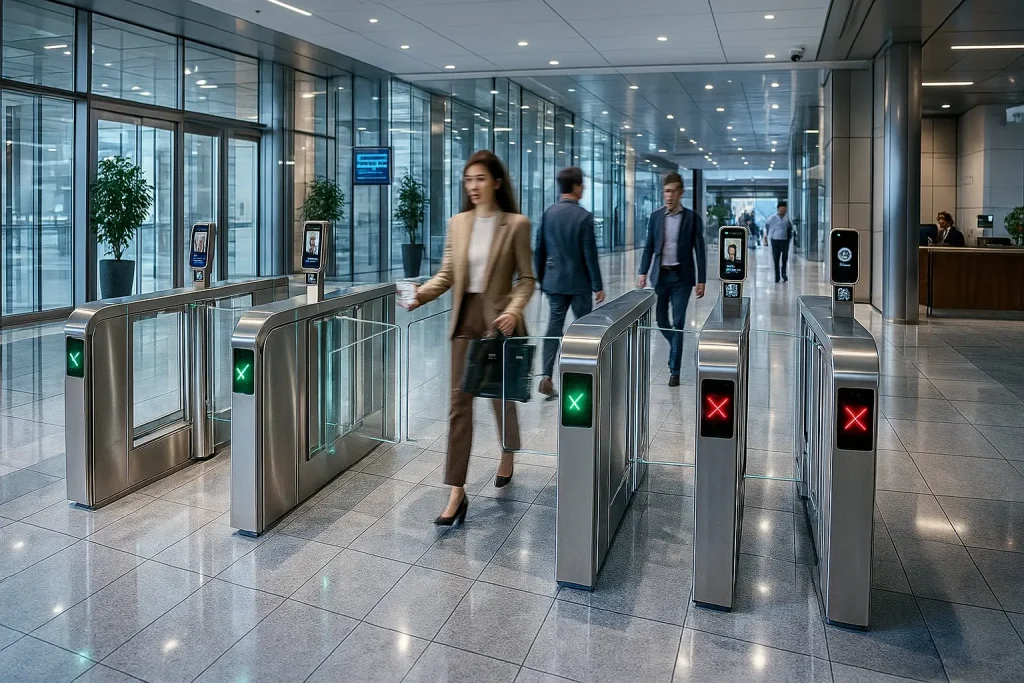
The entrance speed gate system is the modern, definitive solution to this paradox. This is not just a "gate" or a "turnstile." It is a complete, intelligent system designed to automate and streamline the entire entry process. It is engineered to be simultaneously fast, secure, efficient, and welcoming.
If you are a facility manager, security director, or architect, this technology is no longer a luxury upgrade; it's the new standard for building management. This guide will provide a comprehensive, expert look at what an entrance speed gate system is, its core components, the critical benefits it provides, and how to plan one for your facility.
What Is an Entrance Speed Gate System?
An entrance speed gate system is a complete solution that combines physical speed gates (the barriers) with access control technology (readers, software) to manage pedestrian flow. It's designed to automate entry, verify credentials, and prevent unauthorized access at a building's main entrance.
This "system" is more than just the physical barriers you see. It's the entire ecosystem that makes your lobby work. It includes:
- The sleek, motorized gates (the "muscle").
- The access control readers (the "gatekeeper").
- The sophisticated optical sensors (the "eyes").
- The access control software (the "brain").
When you invest in an entrance speed gate system, you are investing in the "first impression" of your building. You're creating an experience that tells every employee and guest that your building is modern, secure, and efficient. It's the most visible and interactive part of your entire speed gate systems strategy, and getting it right is critical.
How Does This System Fundamentally Improve Lobby Management?
An entrance speed gate system improves lobby management by automating the repetitive task of credential checking. This dramatically increases pedestrian throughput, eliminates bottlenecks, enhances security by physically stopping tailgating, and frees up staff for high-value tasks like visitor assistance.
This technology solves the two biggest paradoxes of lobby management: Speed vs. Security and Efficiency vs. Experience.
Solving the "Speed vs. Security" Paradox
1. Massive Throughput (The "Speed")
This is the most visible benefit. We've all seen that 8:55 AM line. An entrance speed gate system is designed to eliminate it. The metric that matters here is People Per Minute (PPM).
- A Manual Guard: A guard who must visually check a badge and greet a person can process 10-15 PPM, at best.
- A Tripod Turnstile: A clunky, mechanical push-turnstile maxes out around 20-25 PPM.
- A Speed Gate: A single speed lane gate can process 30-40+ PPM.
A bank of just four lanes can handle over 120 people per minute, dissolving the morning rush hour line as fast as it forms. This has a direct, positive impact on productivity. [Insert Statistic A: Data on the cost of lost productivity from daily employee queueing].
2. Enhanced Security (The "Control")
This is the "gate" part of the system. Unlike an open lobby or a simple card reader on a wall (which can't stop 10 people from following one badge), a speed gate physically enforces the "one person, one credential" rule. Its sensors are designed for one primary job: to be a world-class anti-tailgating speed gate. If a second person tries to follow, the system knows, and it sounds an alarm.
Solving the "Efficiency vs. Experience" Paradox
1. Operational Efficiency (The "Automation")
Your security staff are one of your most valuable, high-cost assets. An automatic speed gate is a "force multiplier." It automates the low-skill, repetitive, and error-prone job of "badge checking." This frees your guards from that monotony and allows them to become "exception managers." They can now focus on high-value human tasks:
- Greeting VIPs and visitors.
- Managing exceptions (a forgotten badge, a lost guest).
- Watching for suspicious behavior around the lanes, not just at the lanes.
- Responding to incidents.
2. A Professional Image (The "Experience")
The lobby is your building's "handshake." A long line, a clunky metal bar, and a stressed-out guard send a message of inefficiency. A sleek, quiet, stainless steel and glass entrance speed gate system where people glide through sends a powerful, positive message: this building is modern, high-tech, and respects your time. [Insert Statistic B: Impact of workplace environment on employee satisfaction and retention].
What Are the Core Components of an Entrance Speed Gate System?
The core components are (1) the physical speed gates (the barriers and motors), (2) the access control readers (like RFID or biometric), (3) the access control panel (the "brain" that stores permissions), and (4) the optical sensors (the "eyes" that detect passage and tailgating).
Understanding this "ecosystem" is key to planning a successful system.
Component 1: The Physical Gates (The "Muscle")
This is the hardware you see and interact with. It consists of the stainless steel chassis (or pedestal) and the moving barriers, which are typically made of tempered glass.
- The Motor: The "character" of a gate comes from its motor. High-end systems use brushless DC motors, which are whisper-quiet, incredibly fast (opening in as little as 0.3 seconds), and rated for millions of cycles.
- The Barriers: The glass panels themselves. The main types are:
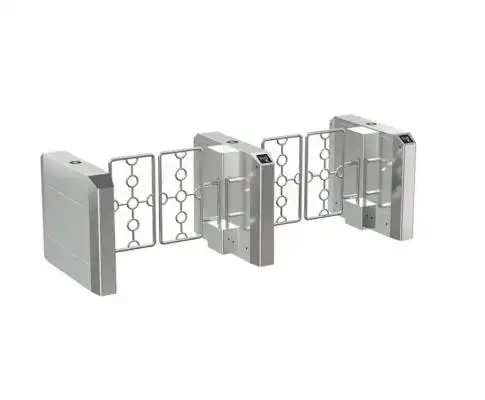
- Swing Barriers: Elegant, pivoting glass arms that swing open.
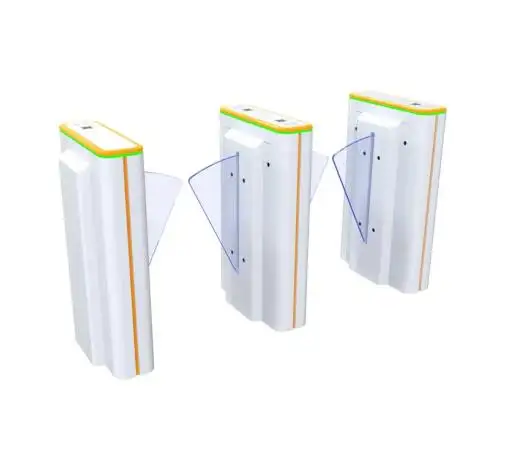
- Flap Barriers: "Angel wing" style flaps that retract into the chassis.
- Sliding Barriers: Taller, high-security panels that slide open.
Component 2: The Access Control Readers (The "Gatekeeper")
This is the user-facing part, the device you present your credential to. It is integrated into the gate's chassis. The options are vast:
- RFID Speed Gate System: The corporate standard. Uses RFID cards or key fobs.
- Biometric Speed Gate Turnstile: The high-security, high-convenience future. This includes facial recognition, fingerprint scanners, or iris scanners.
- Mobile Credentials: Using an app on your smartphone (via Bluetooth or NFC) as your key.
- QR Code Scanners: The champion for visitor management. A guest is emailed a QR code, which they scan for one-time access.
Component 3: The Access Control Panel (The "Central Brain")
This is the most important part of the system, and it's not even in the lobby. It's a control panel, often in a secure IT closet, from a manufacturer like Genetec, Lenel, Brivo, or AMAG.
- This panel is the "database" that stores all permissions.
- It's the "decision-maker" that knows who is allowed, where they are allowed, and when they are allowed.
- This is the heart of your entire high-speed access control system.
Component 4: The Optical Sensor Array (The "Eyes")
This is the "intelligent" part of the gate. It's not just one or two beams. A modern entrance speed gate system uses a dense "light curtain" of dozens of infrared sensors.
- This sensor array is what makes it a true anti-tailgating speed gate.
- More sensors = a smarter, safer gate.
- A high-end sensor array can tell the difference between a person, a person with a rolling bag (which it allows), and two people walking too closely (which it alarms for).
How Do These Components Integrate to Create a "System"?
Integration, often called a "handshake," is key. The reader sends a credential to the control panel ("brain"). The panel validates it and sends an "open" signal to the gate ("muscle"). The gate's sensors ("eyes") then manage the passage and report back, creating a seamless, secure loop.
This "handshake" process is where the expertise of an integrator becomes critical. Here’s a step-by-step of what happens in milliseconds:
- A user taps their RFID card on the reader integrated into the gate.
- The reader doesn't talk to the gate; it sends the card's data to the Access Control Panel (the "brain") in the IT closet.
- The panel checks its database: "Is User #4157 authorized for the 'Main Lobby' at 9:00 AM?"
- If YES, the panel sends a simple "dry contact" (an electronic "open" signal) to the gate's internal logic board.
- The gate's local logic board takes over: "OK, I have the 'open' command. I will now activate my motor, monitor my sensors for one person, and then activate my motor to close."
E-E-A-T (Experience) Anecdote: The "Lag" Problem
I've seen many clients buy the "fastest" gate on the market but pair it with their 15-year-old, slow-as-molasses access control panel. The result? The user taps their card... pauses... waits a full second... and then the super-fast gate opens. The entire "speed" experience is ruined. Your entrance speed gate system is only as fast as its slowest component—and that is often the "brain" (the panel) making the decision.
What Should You Look for When Designing Your Entrance System?
When designing your system, you must first analyze your "peak load" traffic to determine the number of lanes. Then, select the gate type (swing, flap) based on your security and aesthetic needs. Finally, you must plan for ADA accessibility and visitor management.
This planning phase is 90% of the project's success. Do not just pick a gate from a catalog.
1. The Peak Load Analysis (The Most Critical Step)
This is the expert step that most people get wrong. You must know your "peak people per minute" (PPM). Do not guess.
- How to Do It Right: Stand in your lobby with a clicker or use your security camera footage. Count every single person who enters during your absolute busiest 15-minute window (e.g., 8:45 AM - 9:00 AM on a Tuesday).
- The Formula:
[Total People in 15 Min] / 15 = Your Peak PPM- [Your Peak PPM] / 30 = Number of Lanes Needed (Always Round Up)(We use 30 PPM as a safe, realistic throughput for one high-speed speed lane gate).
- E-E-A-T (Experience) Anecdote: I've seen a client with a 1,000-employee office guess that they needed two lanes because it "looked good." Their actual Peak PPM was 85.
85 / 30 = 2.83. They needed three lanes. They installed two, and they still have a line every single morning. They just spent $50,000 to move the bottleneck 10 feet. Don't guess. Use the data. [Insert Statistic C: Industry standards for pedestrian flow calculation].
2. Select the Right Gate Type (Security vs. Aesthetics)
Now that you know how many lanes you need, you can decide what kind of gate to use.
- Need Speed? Flap barriers are the fastest.
- Need Aesthetics? Swing barriers are the most elegant and "welcoming."
- Need High Security? Sliding barriers are taller and more robust.For 90% of corporate lobbies, the swing barrier is the top choice as it provides the best balance of a premium, quiet feel and strong, visible security.
3. Plan for All Users (ADA & Visitors)
Your entrance speed gate system must work for everyone.
- ADA/DDA Compliance: This is a legal requirement. You must have at least one wider lane (typically 32-36 inches) to accommodate wheelchairs. [Insert Statistic D: ADA compliance requirements for doorways/passages]. This wider lane is also used for deliveries, rolling luggage, and any large items.
- Visitor Management: How will guests get in? You must plan for this. Will there be a QR code scanner on one lane? Will a guard at a desk have a button to open a specific gate? This must be part of the initial design. This wider, multi-use lane is often a bidirectional speed gate to handle both entry and exit.
4. Plan the Physical Installation
This is a construction project, not a furniture delivery.
- Power & Data: The system needs power for the motors and data for the readers. This cabling must be run under the floor.
- The "Dusty" Work: This means your installer will need to core-drill or cut a trench in your lobby floor to run conduits. This must be coordinated. [Insert Statistic E: Common challenges in retrofitting security systems].
What Are the Different Types of Speed Gates for an Entrance System?
The main types are swing barriers (sleek, pivoting glass arms), flap barriers (fast, retracting wings), and sliding barriers (tall, high-security sliding panels). Optical turnstiles (barrier-free, sensor-only) are another option for lobbies that are always staffed.
This table breaks down the most common choices for an entrance speed gate system:
| Gate Type | Barrier Motion | Throughput | Security Level | Best For... |
| Swing Barrier | Pivoting Glass Arms | High (30-40 PPM) | High | Class-A Lobbies, Corporate HQs (Best aesthetic balance) |
| Flap Barrier | Retracting Glass Wings | Very High (40+ PPM) | Good | High-Traffic Hubs, Transit, Stadiums (Speed is #1) |
| Sliding Barrier | Sliding Glass Panels | Medium (25-35 PPM) | Very High | Data Centers, Govt. Facilities (Security is #1) |
| Optical Turnstile | None (Sensors Only) | Highest (40-60 PPM) | Low (Detects Only) | Lobbies with 24/7 guard presence, "welcoming" feel |
What About Life Safety and Emergency Egress?
This is a critical, non-negotiable integration. Your entrance speed gate system must be connected to your building's fire alarm control panel (FACP). In an emergency, the FACP must automatically send a signal that forces all gate barriers to open and stay open, allowing for free egress.
This is not a "feature"—it is a core life-safety requirement.
- The "Fail-Safe" Command: The system must be configured to "fail-open" (also called "fail-safe") when it receives the fire alarm signal. This means the barriers open and power is cut to the motors, allowing them to be pushed open freely.
- E-E-A-T (Authority) Anecdote: I've seen installations where the client, in an attempt to be "more secure," requested the gates "fail-secure" (stay locked) during a power outage. This is a massive liability. During a fire (which often cuts power), the gates would trap people. The life-safety signal from the FACP must override all other security commands. This integration must be tested and certified with your fire alarm vendor. [Insert Statistic F: Fire code / NFPA citations for clear egress].
The Future: What's Next for Entrance Speed Gate Systems?
The future is "frictionless" and intelligent. Systems are integrating AI-powered biometrics (like facial recognition) and long-range mobile credentials (Bluetooth). This allows for a "walk-through" experience without ever stopping or tapping a card.
The entrance speed gate system is evolving from a simple barrier to an intelligent data hub for the entire building.
- The "Invisible" Credential: The future is a completely "hands-free" experience. A biometric speed gate turnstile will use facial recognition cameras to identify you as you approach. Or, your phone (using Bluetooth or UWB) will authenticate you from your pocket. The barriers will simply open for you.
- AI-Powered Sensor Fusion: The system won't just detect tailgating; it will predict intent. AI will "fuse" the data from the gate's IR sensors with data from an overhead video camera. This will allow it to detect "suspicious loitering," "a person under duress," "an abandoned object," or "a person crawling." [Insert Statistic G: Growth of AI in physical security market].
- The Smart Building Hub: Your entry at the lobby gate will become the "check-in" for the entire building. It will be the start of a cascade of automated events:
- It will tell the elevator destination dispatch system to call an elevator for your default floor.
- It will tell the building management system to turn on the lights and HVAC at your hot-desk.
- It will log your presence for fire safety and occupancy management.This is the evolution of the basic electric gate concept into a true, data-driven smart building component. [Insert Statistic H: Smart building market growth projections].
The Final Verdict: Why an Entrance Speed Gate System Is a Core Investment
The entrance speed gate system is the definitive, modern solution to the "speed vs. security" paradox. It is no longer a luxury item but a core infrastructure investment for any building that takes its security, efficiency, and professional image seriously.
It provides a reliable, 24/7 automated enforcer that physically stops tailgating. It boosts productivity and employee morale by eliminating the daily frustration of the "lobby line." And it enhances your operational efficiency by freeing your valuable security staff to focus on the human-centric tasks that machines cannot.
For any modern facility, a well-planned, high-quality entrance speed gate system is no longer an upgrade—it's the standard.
