


Factory Entrance Turnstile: Which Gate Type Fits Your Plant, Worker Count, and Shift Schedule
2026-04-02


The right factory entrance turnstile depends on your factory type, daily worker headcount, shift schedule, and entrance environment. Full height turnstiles suit outdoor perimeter gates, chemical plants, and high-security factory zones. Heavy-duty tripod turnstiles cover standard indoor factory entrances. Industrial flap barriers serve high-throughput production facilities where shift-change speed is the primary requirement.
IP54 is the minimum specification for any factory entrance with partial outdoor exposure. The shift-change lane count formula — total workers ÷ peak window minutes ÷ gate throughput = lanes required — determines the correct lane count before any gate type is ordered.
This guide gives HSE managers, plant directors, and EPC contractors a gate type comparison matrix for factory-specific criteria, a factory type scenario matching table, shift-change throughput planning, IP rating guidance, time-and-attendance integration overview, and a path to a factory-direct quote. For the full factory gate product range, start with the Ironman pedestrian turnstile gate for factory page.
Factory Entrance Turnstile Types — Compared on Factory-Specific Criteria
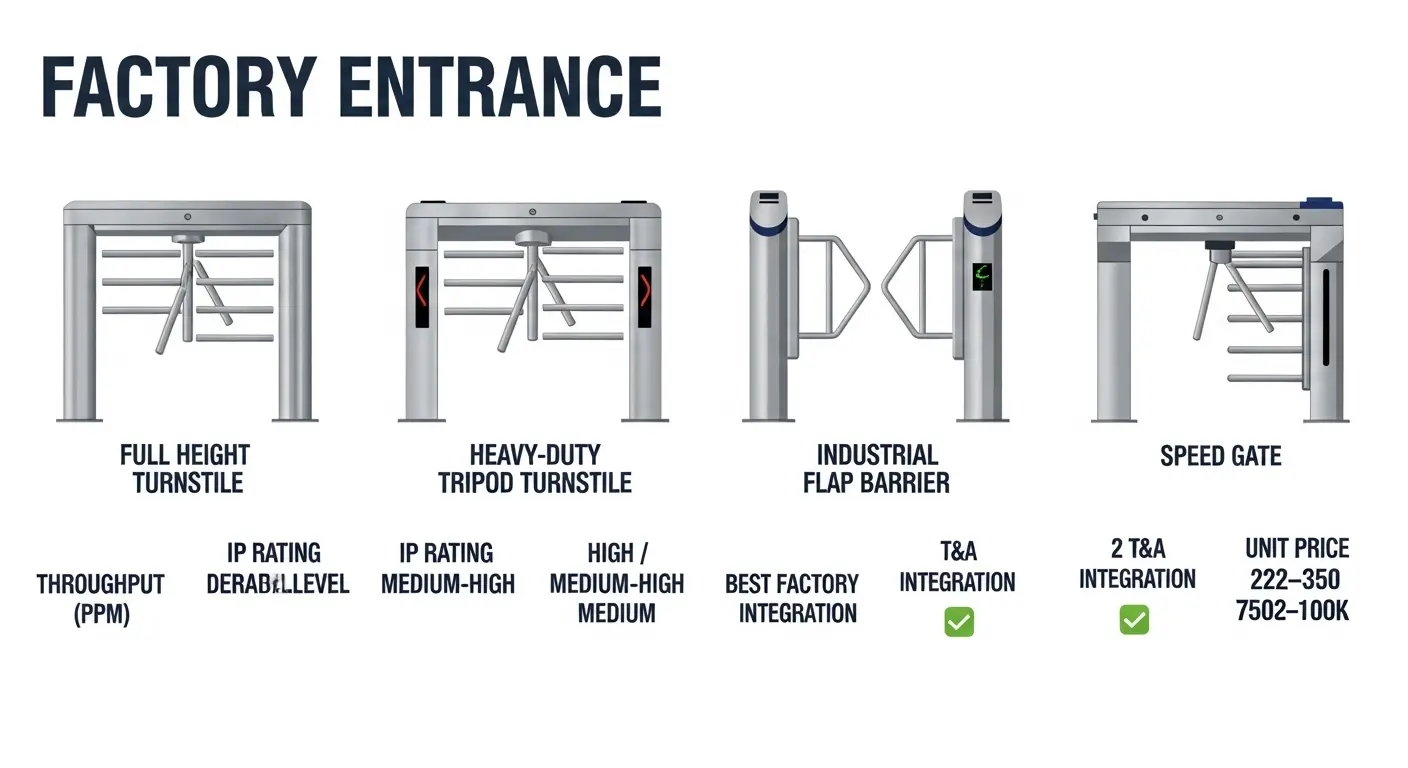
Four gate types appear in factory entrance deployments. Each fits a different factory environment and security level. The table below compares them on the criteria that matter for an industrial specification.
| Gate Type | Throughput | IP Rating | Durability | Security Level | T&A Integration | Best Factory Entrance | Unit Range |
|---|---|---|---|---|---|---|---|
| Full Height Turnstile | 25–40 ppm | IP54–IP65 | High — stainless or powder-coated steel | Highest physical | Yes | Outdoor perimeter, chemical plant, high-security | $600–$4,000 |
| Heavy-Duty Tripod | 20–30 ppm | IP44–IP54 | High — 304/316 stainless arms | Medium-high | Yes | Standard indoor factory, garment, logistics | $200–$1,400 |
| Industrial Flap Barrier | 40–60 ppm | IP44–IP54 | Medium-high | Medium | Yes | High-throughput indoor factory, food processing | $450–$3,000 |
| Speed Gate | 50–80 ppm | IP42–IP44 | Medium | Medium | Yes | Factory admin entrance, HR zone | $1,300–$8,000 |
Full Height Turnstile — Maximum Security Perimeter
Full height turnstiles are the correct choice for outdoor factory perimeter gates, chemical plants, and any factory where physical barrier strength is the primary criterion. The floor-to-ceiling rotating cage allows only one authorized worker per cycle. This makes tailgating physically impossible without any sensor system.
IP65 rating covers fully outdoor factory gate positions — complete dust protection and water-jet resistance, required for tropical or heavy-rain factory sites. Unit pricing runs $600–$4,000 per lane, making full height gates the most cost-effective maximum-security option for factory perimeter control.
Tripod and Flap Barrier — Indoor Factory Entrances
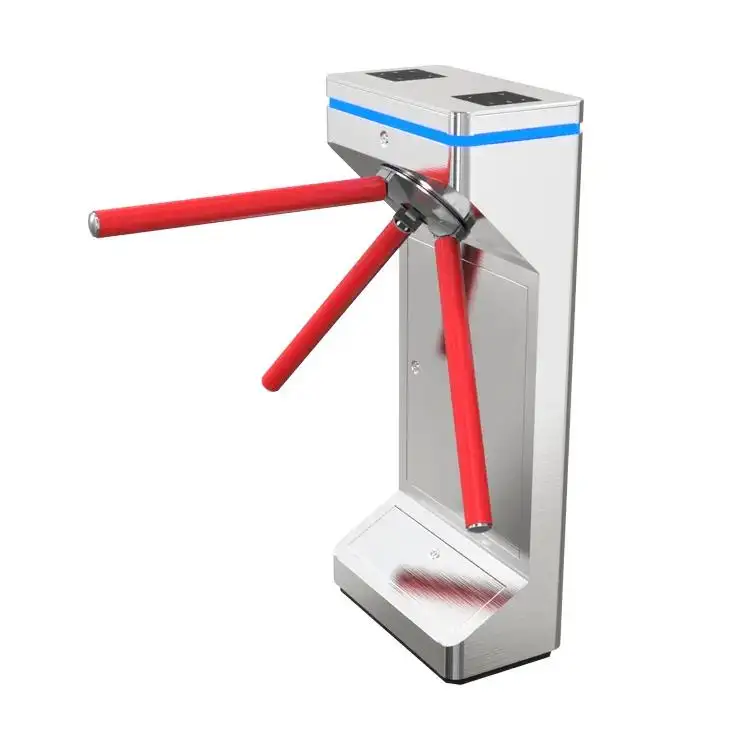
Heavy-duty tripod turnstiles are the standard indoor factory entrance gate for garment factories, assembly facilities, and logistics warehouses. Their rugged mechanical design handles heavy daily use from large worker populations. The three rotating arms physically block unauthorized entry.
For high-throughput indoor factory entrances — food processing, automotive assembly, or any point where shift-change speed is the primary criterion — an industrial flap barrier at 40–60 ppm doubles the per-lane capacity of a tripod turnstile.
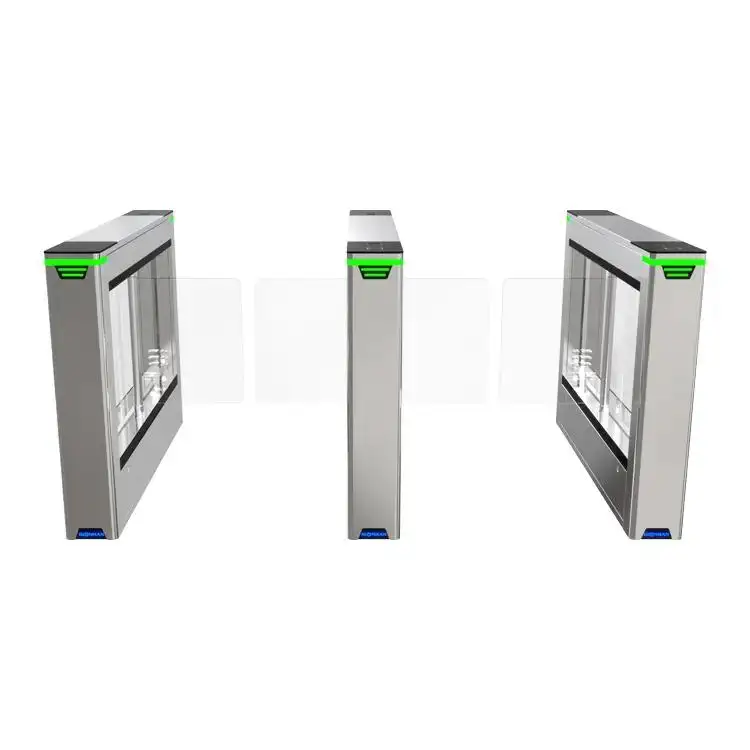
Speed gates belong at the administrative or visitor entrance of a factory campus, not at the production floor gate. Their lower IP rating and glass panel design are not suited to a factory production environment.
Match Your Factory Entrance Turnstile to Your Factory Type
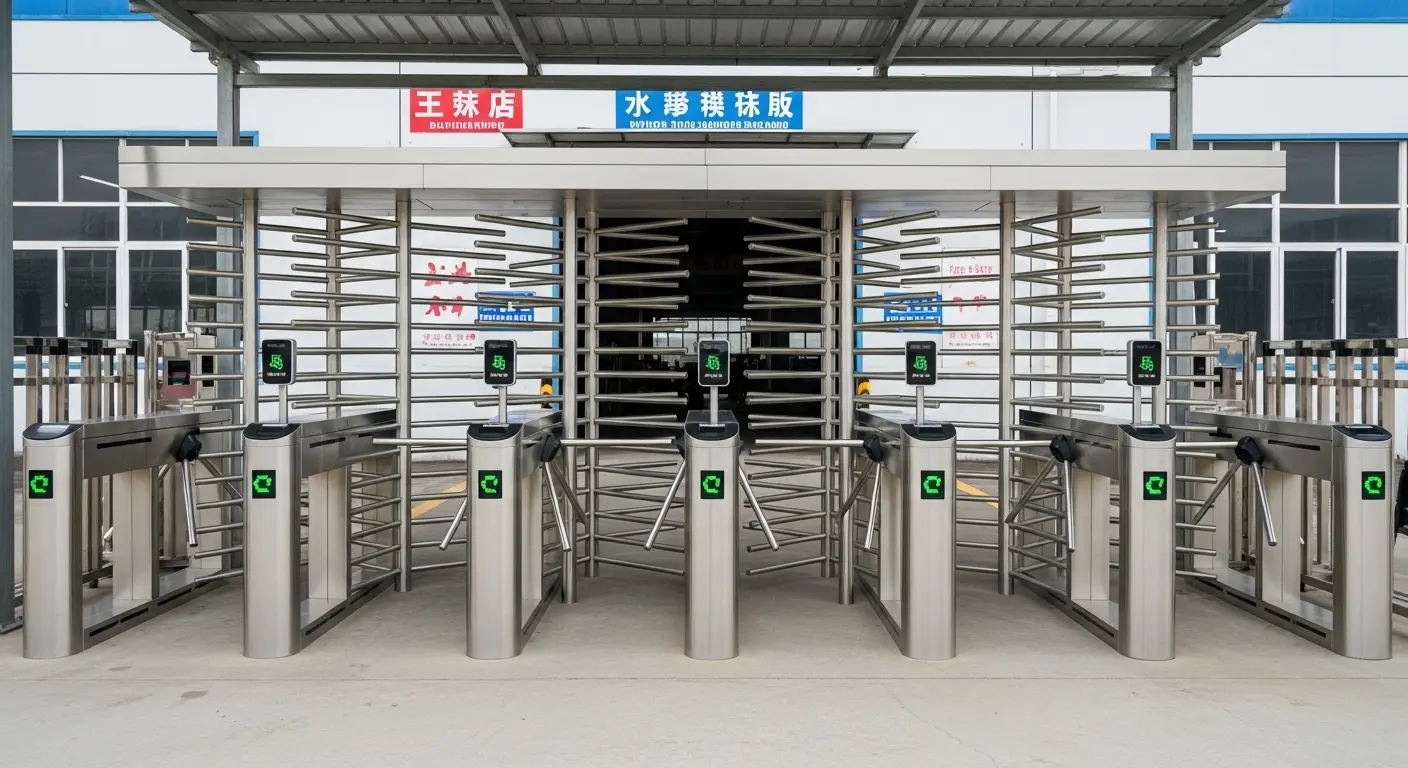
Factory type determines gate type. The table below gives a direct recommendation per industrial venue.
| Factory Type | Recommended Gate | Typical Lane Count | Primary Reason |
|---|---|---|---|
| Garment / RMG factory | Heavy-duty tripod | 2–8 | Large workforce, shift-change peak, cost-effective |
| Automotive plant | Full height + biometric | 2–4 | High-security zone access, contractor control |
| Food processing facility | Industrial flap barrier | 2–4 | High throughput, hygienic stainless steel spec |
| Logistics warehouse | Heavy-duty tripod | 2–4 | Rugged, cost-effective, high daily cycle count |
| Chemical / hazardous plant | Full height + biometric | 2–4 | Authorized-only entry per OSHA, physical barrier |
Garment and Logistics Factories
For garment factories and RMG production facilities, the heavy-duty tripod turnstile is the standard specification. Worker populations range from 500 to 10,000+. Shift changes happen twice daily and the cost per lane drives the budget. Based on our factory deployment experience across Bangladesh, Vietnam, and Southeast Asia, garment facilities consistently specify 4–8 tripod lanes per entrance to clear a 2,000-worker shift change in a 15-minute window.
The Vietnam high-speed factory turnstile deployment shows a reference configuration for a high-worker-count industrial facility with shift-change peak throughput as the primary specification driver. Logistics warehouses follow the same pattern — heavy-duty tripods at $200–$1,400 per lane, RFID card credential, and RS485 connection to the warehouse management system.
Automotive and Chemical Plants
Automotive plants require full height turnstiles at production floor gates. Zone access control separates the general worker population from authorized-zone workers — assembly line, paint shop, engine bay. Biometric readers verify identity before allowing access to restricted zones. This approach satisfies OSHA 29 CFR 1910 requirements for authorized-only access to hazardous industrial areas.
Chemical plants and hazardous production facilities specify full height turnstiles with IP65-rated enclosures at all exterior gate positions. The physical barrier supports the emergency mustering audit trail — a critical requirement for chemical plant emergency procedures. For the biometric integration used in high-security factory deployments, see the factory pedestrian turnstile gate page.
Food Processing Facilities
Food processing factories specify industrial flap barriers over tripod turnstiles where hygiene is a production requirement. The flap barrier cabinet uses 304-grade stainless steel in food-processing configurations — no exposed mechanical arm joints that accumulate contamination.
The 40–60 ppm throughput also supports fast, high-volume shift changes typical of food production lines. For the standard tripod range used in non-food industrial factory entrance configurations, see the tripod turnstile for factory entrance product page.
Shift-Change Throughput Planning for Factory Entrance Turnstiles
Shift-change throughput is the most critical sizing criterion for a factory entrance turnstile. Under-specifying lane count at this stage causes worker bottlenecks at shift start, late production starts, and safety hazards from crowding at the gate.
The Shift-Change Lane Count Formula:
Lanes required = Total shift workers ÷ Peak window (minutes) ÷ Gate throughput (ppm)
| Factory Size | Workers per Shift | Peak Window | Gate Type | Lanes Required |
|---|---|---|---|---|
| Small factory | 200 | 12 min | Tripod (25 ppm) | 1 lane |
| Medium factory | 600 | 12 min | Tripod (25 ppm) | 2 lanes |
| Large garment plant | 2,000 | 12 min | Tripod (25 ppm) | 7 lanes |
| High-throughput plant | 1,000 | 12 min | Flap barrier (50 ppm) | 2 lanes |
| High-security plant | 400 | 15 min | Full height (30 ppm) | 1 lane (+1 emergency) |
After reviewing factory entrance turnstile deployments with shift changes from 200 to 10,000 workers, the most consistent planning error is using a 30-minute peak window. In most factories, 85% of workers arrive within 12 minutes of shift start. Use 12 minutes as the conservative planning figure.
Add one emergency-exit or wide-lane gate per entrance position. This satisfies NFPA 101 fail-safe egress requirements and provides the required evacuation lane for factory emergency procedures.
Factory Environment Durability — IP Rating, Materials, and Operating Conditions
IP rating failure is the most expensive factory entrance turnstile specification error. A gate with the wrong IP rating for its environment fails at the controller board level within 6–18 months in high-humidity or outdoor factory conditions. This means full replacement — not repair.
IP ratings follow the IEC 60529 standard. The first digit covers dust protection; the second covers moisture. IP54 means dust-protected and splash-resistant. IP65 means fully dust-tight and water-jet resistant.
| Factory Environment | IP Rating Required | Recommended Material | Temperature Range |
|---|---|---|---|
| Indoor dry (air-conditioned) | IP42 | 304 stainless or powder-coated | 0–50°C |
| Indoor humid (food processing, textile) | IP54 | 304 stainless steel | 0–50°C |
| Outdoor partial (canopy gate) | IP54 | 304 or 316 stainless | -20–60°C |
| Outdoor fully exposed | IP65 | 316 stainless steel | -20–60°C |
| Chemical / corrosive environment | IP65 + coating | 316 stainless + corrosion-resistant coating | -20–60°C |
In our experience with outdoor factory entrance deployments in Southeast Asia and the Middle East, IP54 is the minimum acceptable rating for a canopy-covered gate. IP65 is required for any fully exposed outdoor position.
Factory entrances with vehicle traffic adjacent to the pedestrian gate also require bollard protection. Vibration from heavy vehicle movement damages standard controller enclosures not rated for that environment.
Time-and-Attendance Integration for Factory Entrance Turnstiles
Factory entrance turnstiles operate as attendance terminals in most industrial deployments. Every credential validation event — worker ID, timestamp, gate number — is written to the factory's time-and-attendance or HRMS system in real time.
| Factory T&A Integration | Protocol | Credential Type |
|---|---|---|
| Standard HRMS panel | Wiegand 26/34-bit | RFID card |
| Cloud-based T&A software | TCP/IP / Ethernet | RFID, mobile NFC, QR |
| On-premise ERP integration | RS485 | RFID, biometric |
| Biometric HRMS | Wiegand or TCP/IP | Fingerprint, face recognition |
For factory workers, RFID card is the standard credential. It is low cost per card, highly reliable in dusty and humid environments, and directly compatible with the Wiegand input on most factory HRMS terminals.
Facial recognition at factory entrances is growing in automotive and food processing plants. Workers keep their hands free — gloves, safety gear — and the gate reads in under 0.5 seconds per person. This is critical for shift-change speed at high-worker-count facilities. For the smart turnstile with facial recognition and cloud T&A integration used at factory administrative entrances, see the smart speed gate turnstile product page.
Contractor access at a factory entrance requires a separate credential lane or time-window restriction. QR code visitor pass or biometric pre-enrollment at the security post limits contractor credentials to daylight hours only. This satisfies the authorized-worker-only requirement under OSHA 29 CFR 1910 for controlled hazardous area access.
Getting a Factory-Direct Quote for Your Factory Entrance Turnstile
Four items are sufficient for a full itemized factory-direct quote within 12 business hours.
- Factory type and entrance environment: garment / automotive / food processing / logistics / chemical + indoor dry / humid / outdoor partial / outdoor fully exposed
- Shift-change lane calculation: workers ÷ peak window (12–15 min) ÷ gate throughput (ppm) = lanes — confirm gate type from the factory type table
- IP rating and T&A integration: select the IP rating for your environment, confirm credential type (RFID / biometric / QR) and HRMS protocol (Wiegand / TCP/IP / RS485)
- Submit your project brief: visit the Ironman pedestrian turnstile gate supplier page — CE, ISO9001, FCC, and RoHS certification documents are included with every first-contact response
Frequently Asked Questions
Q1: What type of turnstile is best for a factory entrance?
For most factory entrances, the choice is between a full height turnstile and a heavy-duty tripod turnstile. Full height turnstiles suit outdoor perimeter gates, chemical plants, and any factory requiring the highest physical security level — the floor-to-ceiling rotating cage prevents tailgating by design and is available in IP65 for fully outdoor positions. Heavy-duty tripod turnstiles are the standard for standard indoor factory entrances — garment factories, logistics warehouses, assembly facilities — where cost per lane and durability are the primary criteria. Industrial flap barriers suit high-throughput indoor factory entrances where shift-change speed is the primary driver at 40–60 ppm per lane.
Q2: How many turnstile lanes does a factory need for shift change?
Calculate lane count using the shift-change formula: total workers ÷ peak window minutes ÷ gate throughput (ppm) = lanes required. Use 12 minutes as the peak window — not 30 minutes — because 85% of factory workers arrive within 12 minutes of shift start in most facilities. For a 1,200-worker factory with tripod turnstiles at 25 ppm: 1,200 ÷ 12 = 100 entries/minute ÷ 25 ppm = 4 lanes minimum. Add one emergency egress lane per entrance position to satisfy NFPA 101 fail-safe egress requirements.
Q3: Does a factory entrance turnstile need to be IP rated?
Yes. IP rating determines whether the turnstile controller and mechanism can survive the factory environment. IP42 is sufficient for indoor air-conditioned positions. IP54 is the minimum for indoor humid environments (food processing, textile) and canopy-covered outdoor gates. IP65 is required for fully exposed outdoor factory gate positions — covering complete dust protection and water-jet resistance per IEC 60529. Specifying a lower-rated gate for an outdoor or humid factory position typically results in controller board failure within 6–18 months in high-humidity climates.
Q4: Can a factory entrance turnstile integrate with time and attendance software?
Yes. Factory entrance turnstiles connect to time-and-attendance and HRMS systems via Wiegand 26/34-bit (most standard HRMS panels), TCP/IP or Ethernet (cloud-based T&A systems), or RS485 (on-premise ERP integration). Every credential validation event — worker ID, timestamp, gate number — is written to the T&A system in real time. RFID card is the standard factory credential. Biometric (fingerprint or facial recognition) is used where hands-free entry is required or where a higher identity verification level is specified. In our experience, factories that skip T&A integration at the point of specification request a retrofit within 90 days at 40–60% higher cost.
Q5: What is the difference between a full height and tripod turnstile for a factory?
A full height turnstile provides a floor-to-ceiling physical barrier — only one authorized person can pass per operating cycle, and the cage structure makes tailgating impossible without a sensor system. It is the correct choice for outdoor factory perimeters, chemical plants, and high-security access zones. A tripod turnstile provides a waist-height three-arm barrier — physically blocking entry at waist level but not covering the full body height. It is the standard choice for standard indoor factory entrances where cost per lane and shift-change throughput are the primary criteria. Full height units run $600–$4,000 per lane; heavy-duty tripods run $200–$1,400 per lane.
Q6: Can a factory entrance turnstile be installed outdoors?
Yes — provided the gate carries the correct IP rating for the outdoor factory environment. A canopy-covered outdoor gate requires IP54 minimum (dust-protected and splash-resistant). A fully exposed outdoor factory entrance gate requires IP65 (dust-tight and water-jet resistant). Material specification must also match the outdoor environment: 304-grade stainless steel for standard outdoor exposure and 316-grade stainless steel for coastal, high-humidity, or chemically corrosive outdoor environments. Ironman manufactures outdoor-rated factory entrance turnstiles in both IP54 and IP65 configurations with 304 and 316 stainless steel cabinet options.
Three Decisions That Define Your Factory Entrance Turnstile Specification
Gate type matched to factory environment, lane count calculated from the shift-change formula, and IP rating confirmed for the installation position — these three decisions determine whether your factory entrance turnstile performs on day one and handles the next 10 years of daily shift changes without a controller failure or bottleneck.
After reviewing factory entrance deployments across garment, automotive, food processing, logistics, and chemical facilities in 50+ countries, those three specification decisions separate the factories that get it right the first time from the factories that retrofit at a premium.
Submit your factory type, worker count, shift schedule, and entrance environment brief via the Ironman tripod turnstile for factory entrance product page for a full factory-direct itemized quote within 12 business hours.
