


Gym Turnstile Gate: Which Gate Type Fits Your Gym Format, Membership Model, and Peak-Hour Traffic
2026-04-03


For most gym entrances, the right gym turnstile gate comes down to two decisions: gate type and credential. Flap barriers suit premium and large commercial gyms at 40–60 ppm per lane. Heavy-duty tripod turnstiles suit budget gyms and smaller fitness studios at 25–35 ppm per lane.
A gym turnstile gate is not just an access control product — it is a membership revenue protection system. Every non-member who walks through an uncontrolled gym entrance without a valid credential reduces the return on the facility's membership base. Peak-hour lane count formula: total members in the class rush ÷ 10-minute window ÷ gate ppm = lanes needed.
This guide gives gym owners, fitness facility managers, and franchise operations directors a gate type comparison table on gym-specific criteria, a gym type scenario matching section, peak-hour throughput planning, membership credential options, software integration overview, and 24/7 unstaffed gym requirements. Start with the full Ironman fitness access configuration range at the gym entrance turnstile supplier page.
Gym Turnstile Gate Types — Compared on Gym-Specific Criteria
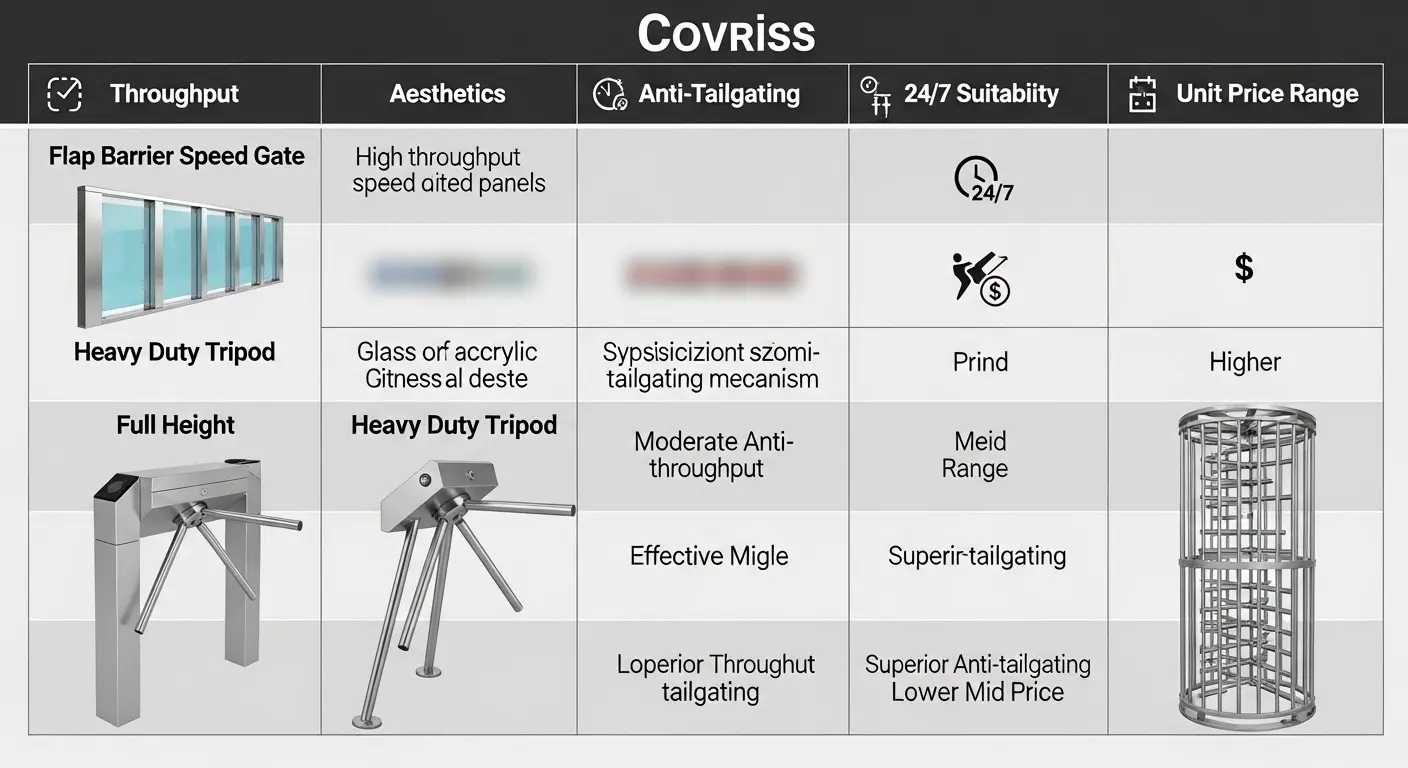
Four gate types cover the main gym entrance requirements. Each fits a different gym format and budget. The table below compares them on the criteria that matter for a gym specification.
| Gate Type | Throughput | Aesthetics | Anti-Tailgating | 24/7 Suitability | Best Gym Type | Unit Range |
|---|---|---|---|---|---|---|
| Flap Barrier | 40–60 ppm | High — glass or acrylic | Sensor + alarm | Yes (+ battery backup) | Premium gym, large chain | $450–$3,000 |
| Speed Gate | 50–80 ppm | Highest — glass column | Sensor + alarm | Yes (+ battery backup) | Luxury fitness club | $1,300–$8,000 |
| Heavy-Duty Tripod | 25–35 ppm | Functional | Mechanical one-per-cycle | Yes | Budget gym, mid-size | $200–$1,400 |
| Full Height | 15–20 ppm | Industrial | Physical cage | Yes | Outdoor sports complex | $600–$4,000 |
Flap Barrier and Speed Gate — Premium and Large Commercial Gyms
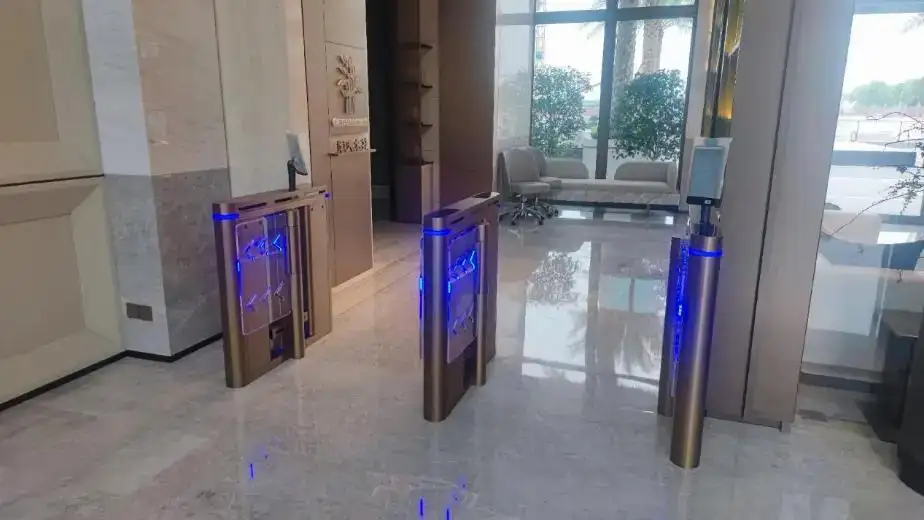
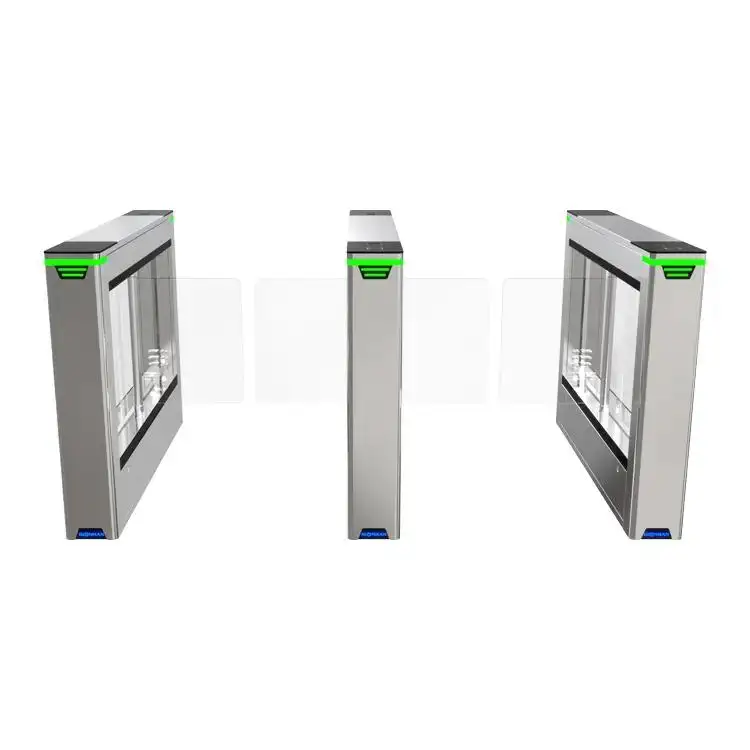
Flap barriers are the standard gym turnstile gate for premium and large commercial gyms. At 40–60 ppm per lane, they clear the pre-class rush without a bottleneck. The glass or acrylic flap panel presents a modern appearance that matches the design brief of most fitness brands.
Speed gates at 50–80 ppm suit luxury gyms and high-end fitness clubs where the gate is part of the brand environment. At $1,300–$8,000 per lane, they represent the premium tier of gym entrance control.
Tripod and Full Height — Budget Gyms and Sports Complexes
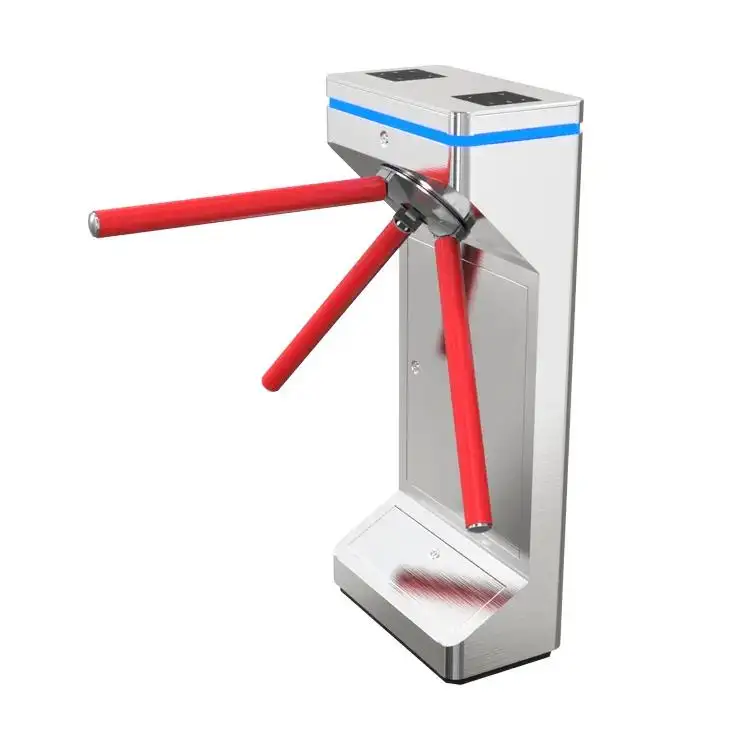
Heavy-duty tripod turnstiles suit budget gyms and standard commercial facilities at $200–$1,400 per lane. They deliver mechanical anti-tailgating, direct RFID membership card compatibility, and low ongoing maintenance. For the Ironman smart gym deployment that used this configuration, see the smart gym access control case study.
Full height turnstiles belong at outdoor sports complexes and university sports facility perimeters — their industrial profile and lower throughput are not suited to an indoor commercial gym main entrance.
Gym Turnstile Gate by Gym Type — Which Gate Belongs Where
Gate type must match the gym format and member experience brief — not just headcount. The table below gives a direct recommendation per gym type.
| Gym Type | Recommended Gate | Lanes | Credential | Key Requirement |
|---|---|---|---|---|
| Boutique fitness studio | Flap barrier | 1–2 | RFID card or mobile NFC | Brand aesthetics, member experience |
| Large commercial gym | Flap barrier | 2–4 | RFID card, QR code | Throughput, software integration |
| Budget chain gym | Heavy-duty tripod | 2–4 | RFID card | Low cost, reliable, mechanical anti-tailgating |
| 24/7 unstaffed gym | Flap barrier or tripod | 1–3 | RFID card, mobile app | Fail-safe, battery backup, remote monitoring |
| Sports complex | Full height + flap barrier | 2–6 | RFID, biometric | Multi-zone, outdoor durability |
Boutique Studios and Large Commercial Gyms
Boutique fitness studios need a gym turnstile gate that fits the brand environment. A glass flap barrier at the studio entrance reinforces the premium positioning of the facility. Based on our gym deployment experience, boutique studios that specified a tripod over a flap barrier received member feedback about the entrance experience within the first 30 days of operation — the visual difference between a clean glass panel and a mechanical arm is noticeable in a brand-sensitive space.
Large commercial gyms need throughput above all else at peak hours. Before-work (06:00–08:00) and after-work (17:00–19:30) windows push 40–80 members through the entrance in 10 minutes at a typical 500–800 member gym. Two flap barrier lanes at 50 ppm each handle 100 entries per minute — sufficient for most commercial gym peak loads.
Budget Gyms and 24/7 Unstaffed Facilities
Budget chain gyms specify heavy-duty tripod turnstiles for their combination of low per-lane cost, mechanical anti-tailgating, and RFID compatibility. Tripods require less ongoing maintenance than flap barriers. They also operate reliably without battery backup at most indoor gym positions.
24/7 unstaffed gyms have the highest requirement for reliable automated gate operation. There is no staff to manually override a gate failure at 03:00. For the 24/7 unstaffed gym specification requirements, see the dedicated section below. For Ironman's 24/7 gym gate configurations, visit the gym entrance turnstile supplier page.
Gym Turnstile Gate and Membership Revenue Protection
A gym turnstile gate's primary business case is membership revenue protection — not access control in the generic sense. Every non-member who enters a gym without paying directly reduces the revenue yield of the facility's membership base.
Three Revenue Leakage Points a Gym Gate Closes
Free-rider tailgating: A non-member follows a paying member through the entrance as their credential validates. A gym gate with sensor-based anti-tailgating detects a second body before the gate resets and triggers an alarm. This closes the gap at the hardware level, without staff monitoring.
Shared membership credentials: Two people use one membership card in alternating shifts. A biometric credential (fingerprint or face recognition) at the gym turnstile ties the entry event to a verified identity. The card cannot be shared because the identity is confirmed at the gate.
Off-peak unstaffed access gaps: In staffed gyms, early morning and late evening shifts are when free-rider entry is highest — staff attention is divided. A turnstile gate operates at the same anti-tailgating standard at 06:00 as it does at 18:00, without any staff presence at the gate position.
The Staffed Check-In Gap
Based on our gym access control deployment analysis, gyms that moved from manual front-desk check-in to a turnstile gate with membership software integration achieved 100% credential validation coverage across all entry events. A staffed front-desk check-in typically achieves 60–75% validation during peak periods — when desk staff manage simultaneous tasks alongside guest check-in. A turnstile gate closes that 25–40% validation gap automatically.
Peak-Hour Throughput Planning for Gym Turnstile Gates
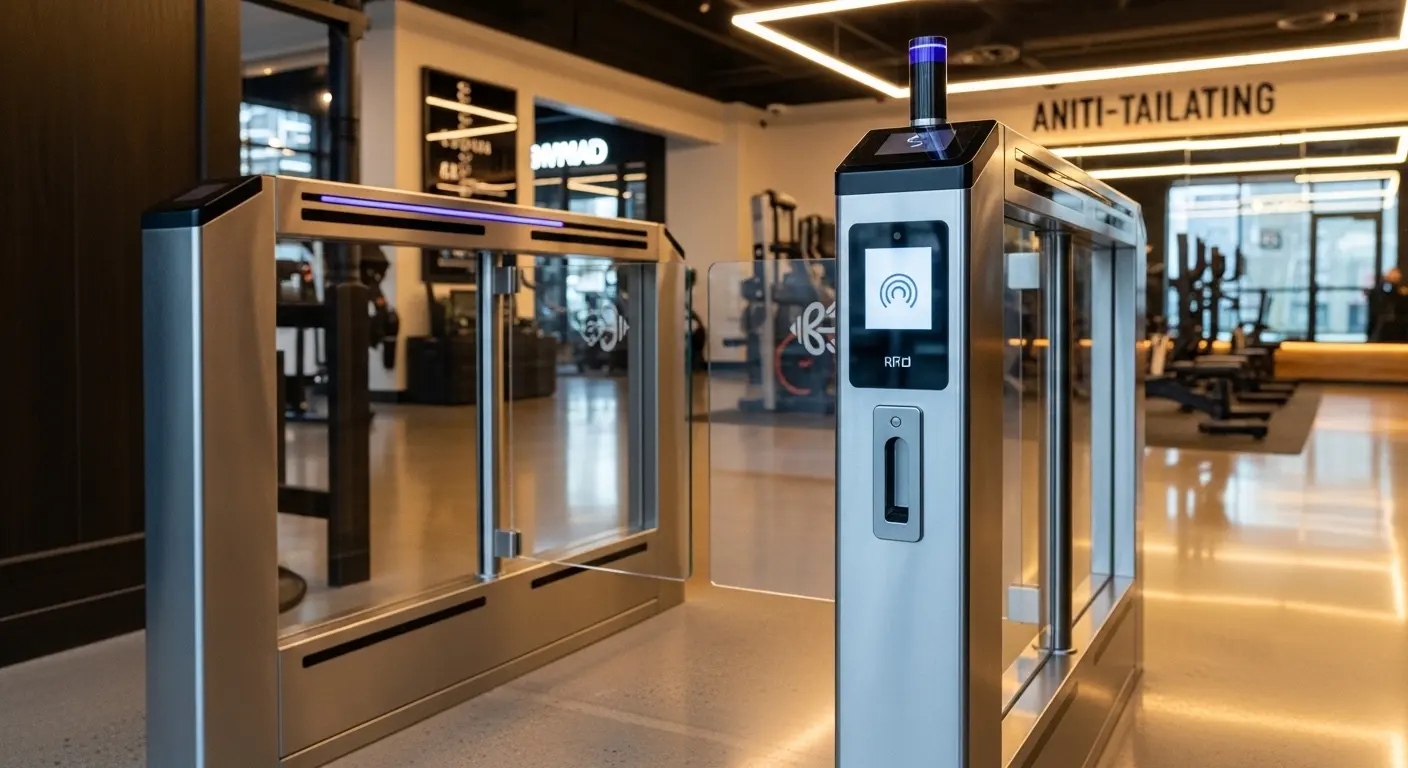
Under-specifying lane count creates the main operational failure point at peak hours — a queue at the gym entrance during the pre-class rush is a direct member experience failure.
Peak-Hour Lane Count Formula:
Lanes = Total members in the class rush ÷ 10-minute window ÷ Gate ppm
Example 1 — Boutique studio class rush, 30 members, 10-minute window, flap barrier at 50 ppm:
30 ÷ 10 = 3 entries/minute. 3 ÷ 50 = 0.06 lanes → 1 flap barrier lane is sufficient.
Example 2 — Large gym open peak, 150 members, 15-minute window, flap barrier at 50 ppm:
150 ÷ 15 = 10 entries/minute. 10 ÷ 50 = 0.2 lanes → 1 lane with one spare for redundancy.
| Gym Size | Peak Members | Window | Gate Type | Lanes |
|---|---|---|---|---|
| Boutique (80 members) | 30 | 10 min | Flap barrier | 1 |
| Mid-size gym (400 members) | 80 | 15 min | Flap barrier | 1–2 |
| Large gym (800 members) | 150 | 15 min | Flap barrier | 2 |
| Budget chain (1,000 members) | 120 | 10 min | Tripod | 2 |
| Sports complex | 200 | 15 min | Speed gate | 2–3 |
Based on our gym deployment analysis, most operators over-estimate their peak load. Confirm the actual peak entry rate from front-desk sign-in records before specifying lane count. A class of 25 members arriving over 10 minutes requires far less lane capacity than a general open-gym evening peak.
Membership Credential and Software Integration for Gym Turnstile Gates
Credential choice and membership software integration must be confirmed at the point of order — not as a post-installation retrofit. Each credential type has a different anti-tailgating risk profile and a different integration protocol.
| Credential Type | Best Gym Type | Anti-Tailgating Risk | Integration Protocol |
|---|---|---|---|
| RFID membership card | All gym types — standard | Medium (shareable) | Wiegand 26/34-bit |
| QR code (mobile or printed) | Large gym, franchise chain | Low (single-use QR) | TCP/IP / REST API |
| Mobile NFC | Premium gym, app-based | Low (phone is personal) | TCP/IP / Bluetooth |
| Biometric (fingerprint, face) | 24/7 gym, premium gym | Zero (identity-linked) | Wiegand or TCP/IP |
For the column speed gate deployment with custom membership software integration used at a premium gym, see the column speed gate turnstile case study. For a fully customized gym speed gate configuration, see the customized speed gate case study.
Most major gym management platforms (ABC Fitness, Mindbody, Gympass/Wellhub, Gladiator) integrate with a gym turnstile gate via TCP/IP REST API for QR/NFC credentials, or via Wiegand output for RFID card credentials. Confirm your platform's integration protocol with the gate supplier before placing an order.
24/7 Unstaffed Gym Turnstile Gate Requirements
A gym turnstile gate for a 24/7 unstaffed gym must operate without any staff intervention across the full 24-hour cycle. Standard staffed-gym gate specifications are not sufficient for an unmanned site.
Five Requirements Specific to 24/7 Unstaffed Gym Gates
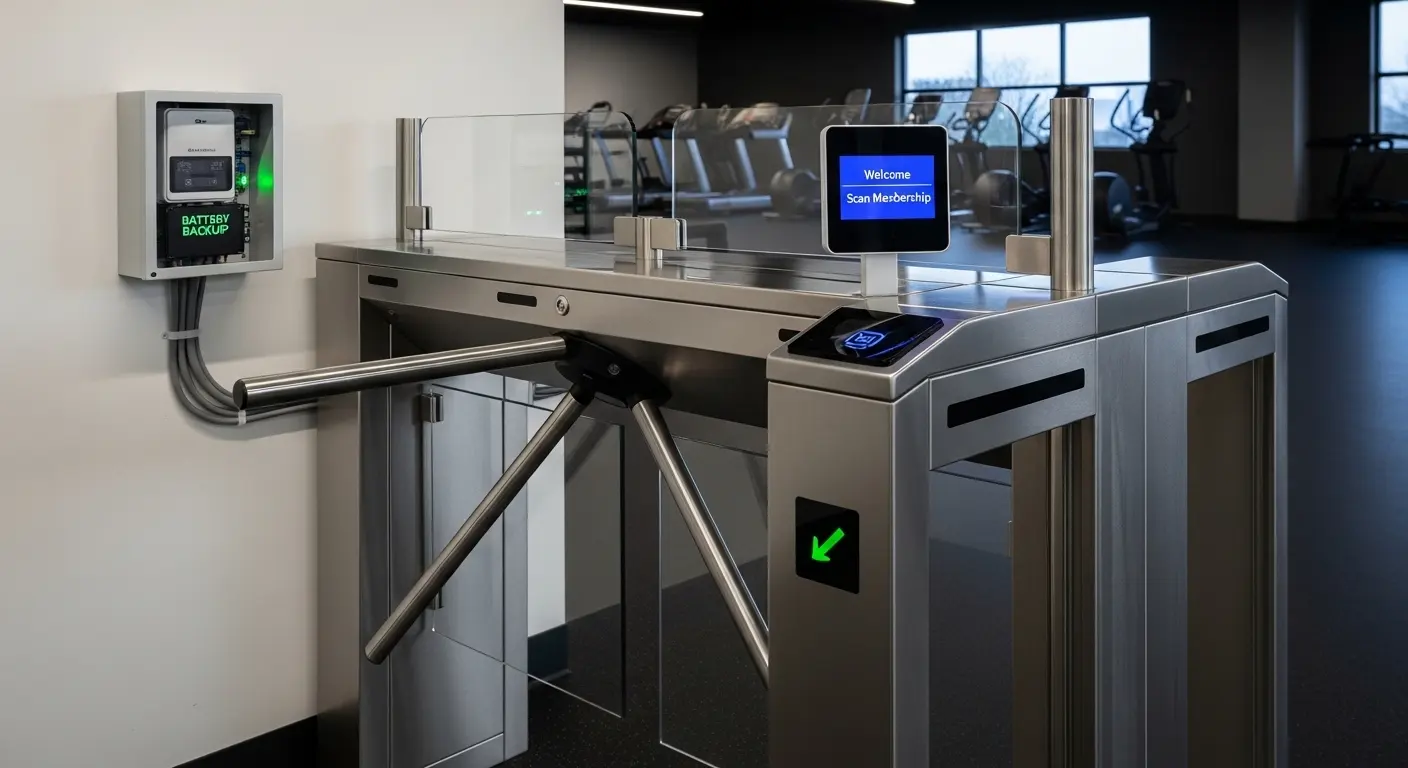
Fail-safe open on power cut or fire alarm: The gate retracts and stays open on the egress route during any emergency event. Per NFPA 101 Life Safety Code, the barrier must not lock a person inside during an emergency. Never specify a fail-safe lock-closed gate for an unmanned fitness facility.
Battery backup (4–8 hours): A UPS battery backup maintains gate operation and alarm function during a mains power outage. This is a specification line item — it is not a default feature on every gate model. Confirm it at the point of order.
Remote monitoring via TCP/IP or GSM: The gate controller connects to the gym's monitoring platform. Any alarm, forced-entry attempt, or power event triggers an immediate alert to the remote monitoring team — the only supervision available at an unstaffed site.
Anti-tamper cabinet: The gate cabinet housing must resist forced-entry attempts during unstaffed hours. Specify a reinforced stainless steel cabinet with a tamper-detection sensor output to the monitoring platform.
Audit trail export to membership platform: Every entry event logs timestamp, credential identity, and gate position to the gym management system. This is the only available evidence trail for any post-incident review at an unstaffed site.
Getting a Factory-Direct Quote for Your Gym Turnstile Gate
Four items are sufficient for a full factory-direct itemized quote within 12 business hours.
- Define your gym type and format: boutique studio / large commercial gym / budget chain / 24/7 unstaffed / sports complex + daily membership count and peak entry volume
- Calculate your lane count: apply the peak-hour formula — peak members ÷ 10-minute window ÷ gate ppm = lanes; confirm whether you need one or two lanes plus a wide ADA-access lane
- Confirm credential type and software integration: RFID card / QR / NFC / biometric — confirm your gym management platform's integration protocol before ordering
- Submit your project brief: visit the gym entrance turnstile supplier page — receive a factory-direct quote within 12 business hours, with CE, ISO9001, FCC, and RoHS certification documents included
Frequently Asked Questions
Q1: What type of turnstile gate is best for a gym entrance?
For a premium or large commercial gym, a flap barrier is the best gym turnstile gate — 40–60 ppm throughput handles the pre-class rush, and the glass or acrylic panel suits the brand environment of most fitness facilities. For a budget gym or mid-size commercial facility, a heavy-duty tripod turnstile delivers mechanical anti-tailgating and RFID card compatibility at $200–$1,400 per lane — the lowest per-lane cost of any gym gate option. For a luxury fitness club where the gate is part of the member experience brief, a speed gate at 50–80 ppm and a slim glass column profile is the correct specification. Full height turnstiles are not suitable for indoor commercial gym main entrances — their throughput is too low and their profile does not fit a member-facing environment.
Q2: How does a gym turnstile gate protect membership revenue?
A gym turnstile gate protects membership revenue by physically stopping three types of unauthorized access: free-rider tailgating (a non-member following a paying member through the gate), shared membership card use (two people alternating on one card), and off-peak unstaffed entry gaps when no staff is present at the front desk. A gate with sensor-based anti-tailgating detects a second body before the barrier resets — triggering an alarm and denying entry. A gate with biometric credential validation (fingerprint or face recognition) ties every entry event to a verified identity, making card-sharing impossible. Based on our deployment analysis, gyms with a manual front-desk check-in validate approximately 60–75% of entries during peak periods. A turnstile gate closes that validation gap to 100% automatically.
Q3: What credential should a gym turnstile gate use?
For most gyms, an RFID membership card (Wiegand 26/34-bit) is the standard credential — low cost per card, direct compatibility with all major gym management platforms, and high operational reliability. For gyms with an app-based membership model, mobile NFC or QR code credentials remove the physical card requirement. QR codes — single-use, generated by the membership platform and sent to the member's phone — have the lowest fraud risk of any non-biometric credential. For 24/7 unstaffed gyms and premium facilities where identity verification matters, biometric credentials (fingerprint or face recognition) provide the highest anti-tailgating protection at the cost of GDPR/UK GDPR compliance requirements for biometric data storage and member consent.
Q4: How many gym turnstile lanes do I need for a pre-class rush?
Use this formula: total members arriving in the class rush ÷ 10-minute window ÷ gate ppm = lanes. For a boutique studio with 30 members arriving for a class in 10 minutes and a flap barrier at 50 ppm: 30 ÷ 10 = 3 entries/minute ÷ 50 = 0.06 lanes — one flap barrier lane handles this comfortably. For a large commercial gym with 150 members arriving in 15 minutes at 50 ppm: 150 ÷ 15 = 10 entries/minute ÷ 50 = 0.2 lanes — one lane with one spare for the peak. Most gyms need fewer lanes than they expect. Confirm your actual peak entry rate from existing front-desk check-in data before placing an order.
Q5: Can a gym turnstile gate work without staff (24/7 unstaffed)?
Yes — a gym turnstile gate specified for 24/7 unstaffed operation must include five specific features: fail-safe open mode (gate retracts on power cut or fire alarm), battery backup of 4–8 hours, remote monitoring via TCP/IP or GSM, an anti-tamper cabinet with a tamper-detection sensor, and a full audit trail exported to the gym's membership management platform. A standard staffed-gym gate specification does not include all five by default. Specify each as a line item at the point of order. The fail-safe open requirement (per NFPA 101 Life Safety Code) is mandatory for any unmanned fitness facility — a fail-safe lock-closed gate can trap a member inside during a power outage or emergency.
Q6: How much does a gym turnstile gate cost?
Gym turnstile gate unit costs range from $200–$1,400 for a heavy-duty tripod turnstile, $450–$3,000 for a flap barrier, and $1,300–$8,000 for a speed gate per lane. Full height turnstiles for outdoor sports complex positions range from $600–$4,000. Most single-site gyms require 1–3 lanes, making the total installed cost range approximately $1,000–$15,000 depending on gate type, lane count, credential reader specification, and membership software integration complexity. Factory-direct pricing from an OEM manufacturer removes the distributor markup from the unit cost — contact the Ironman team for a project-specific itemized quote.
Three Decisions That Define Your Gym Turnstile Gate Specification
Gate type matched to gym format and brand positioning, peak-hour lane count calculated from real entry data, and membership software integration confirmed at the point of order — these three decisions determine whether a gym turnstile gate protects membership revenue, clears the pre-class rush, and operates reliably across the 24-hour cycle.
Ironman manufactures factory-direct gym turnstile gates for boutique fitness studios, large commercial gyms, budget chains, 24/7 unstaffed gyms, and sports complexes across 50+ countries. Submit your gym type, membership count, and peak-hour entry data via the gym entrance turnstile supplier page for a full factory-direct itemized quote within 12 business hours.
