


High-Speed Access Control Systems for Modern Facilities
2025-10-27


In any modern facility, time is a currency, and flow is a critical asset. Yet, for decades, security and speed have been opposing forces. The 9:00 AM rush hour in a corporate lobby is the perfect example: a slow, restrictive security process creates a frustrating, productivity-killing bottleneck. An open, fast lobby, on the other hand, is a massive security liability.
This is the exact paradox that the high-speed access control system was designed to solve.
This is not just about installing a "fast gate." It's about designing a complete, intelligent ecosystem—a "central nervous system" for your building that manages pedestrian flow. It's the seamless integration of a high-speed "brain" (the software), a high-speed "gatekeeper" (the credential), and a high-speed "enforcer" (the physical gate). When these components work in perfect harmony, they create an experience that is both "frictionless" for authorized users and a formidable barrier for unauthorized ones.
This guide is a comprehensive, expert look at this complete system. We'll explore how it achieves high speed, what the critical components are, how it balances that speed with robust security, and the "hidden" bottlenecks that many facilities overlook.
What Is a High-Speed Access Control System?
A high-speed access control system is the end-to-end integration of physical barriers, credential readers, and software, all engineered to process pedestrian traffic at the maximum possible rate. Its goal is to eliminate bottlenecks by making the "authorization-to-passage" cycle nearly instantaneous, often in under a second.
This is the most critical concept to understand: you cannot buy a "high-speed access control system" in a single box. You build one. It's an ecosystem of three parts:
- The "Brain" (The Software & Panels): This is the Access Control software and the physical control panels that store permissions and make the "allow/deny" decisions.
- The "Gatekeeper" (The Credentials): This is the technology used for verification—the "key" that unlocks the gate. This can be a modern RFID card, a mobile phone, or a biometric.
- The "Enforcer" (The Physical Barrier): This is the physical
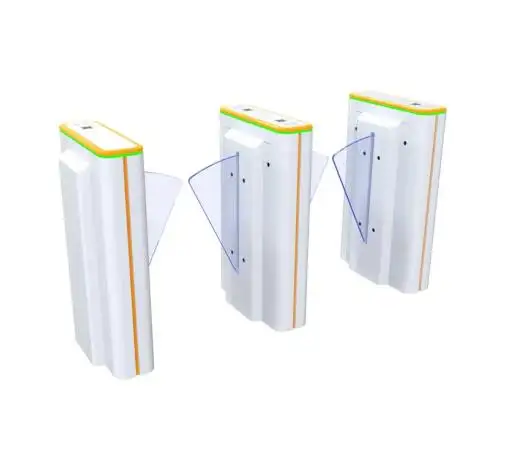
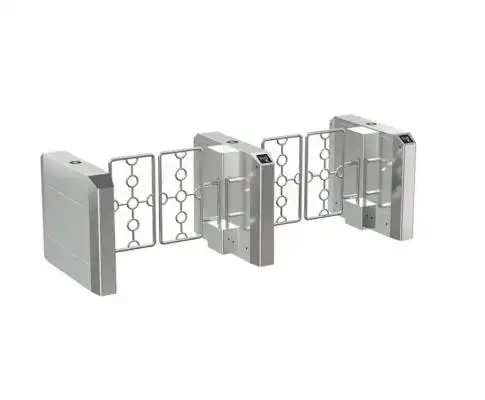
speed gate turnstileorhigh-speed pedestrian turnstile—the motorized, automated barrier that opens and closes.
A system is only "high-speed" when all three of these components are optimized for speed and work in perfect, sub-second synchronization.
How Does This System Achieve "High Speed"?
The "speed" comes from a synergy of components: high-speed motors in the gates, instant-read credentials (like facial recognition or advanced RFID), and a highly responsive access control panel that makes the "allow/deny" decision in milliseconds.
If any one part of this "transaction chain" is slow, the entire system becomes a bottleneck. As an integrator, I can tell you the most common failure I see is what I call "Reader-Gate Lag." A client will spend $50,000 on the "fastest" gates on the market but pair them with their 15-year-old access control panel (the "brain").
The result? An employee taps their card, and... pause. For one full, frustrating second, nothing happens. Then, the "brain" finally makes its decision and sends the "open" signal, and the "fast" gates fly open. That one-second pause, multiplied by 1,000 employees, has completely defeated the purpose.
A true high-speed system optimizes all three parts.
Component 1: The "Enforcer" (The Physical Gate)
The physical gate must be built for speed. This means:
- Brushless DC Motors: These are the heart of a modern
automatic speed gate. Unlike cheaper, louder brushed motors, they are designed for high-cycle, high-speed, and high-torque applications. They can open or close the barriers in as little as 0.3-0.5 seconds. - Advanced Logic Controllers: The "local brain" inside the gate that, once it receives the "open" signal, manages the barrier motion and sensors with zero lag.
Component 2: The "Gatekeeper" (The Credentials)
The time it takes to "read" the key is critical.
- Slow: A fingerprint scanner, where a user must stop, place their finger, and wait, is not high-speed.
- Fast: A modern 13.56 MHz (HF) RFID card "taps" and reads instantly.
- Fastest: A
biometric speed gate turnstileusing facial recognition is the "frictionless" king. It can identify a user as they are walking, with no need to stop or even slow down.
Component 3: The "Brain" (The Panel/Software)
This is the "hidden" bottleneck. This is the physical controller, often in an IT closet, that receives the credential data from the reader and checks it against its database.
- Slow "Brain": An old panel with a slow processor and limited memory can take 1,000-2,000 milliseconds (1-2 seconds) to process a request.
- Fast "Brain": A modern, IP-based controller can make this decision in under 100 milliseconds.
A true high-speed access control system ensures this "Brain-to-Enforcer" handshake is instantaneous.
What Are the Core Benefits of a High-Speed System?
The main benefits are a massive increase in pedestrian throughput (eliminating bottlenecks), a significant boost in security by preventing tailgating, and improved operational efficiency by automating manual guard tasks.
Benefit 1: Solving the Bottleneck (High Throughput)
This is the most visible benefit. "Throughput" is the metric that matters, measured in People Per Minute (PPM). A high-speed system is a high-throughput system.
- Manual Guard: 10-15 PPM
- Tripod Turnstile: 20-25 PPM
- High-Speed System: 30-40+ PPM (per lane)
A bank of four high-speed lanes can process over 120 people per minute, effectively dissolving the 9:00 AM rush hour line. The cost of thousands of employees waiting in that line for 5-10 minutes every day is a staggering, quantifiable loss of productivity.
Benefit 2: Enhancing Security (Balancing Speed with Safety)
But what's the point of speed if it's not secure? A true high-speed access control system does not sacrifice security; it enhances it. It does this by layering two "checks":
- The "Brain" Check: The access control panel verifies who you are (authorization).
- The "Gate" Check: The
speed gate turnstileitself uses its own internal sensors to verify how many you are (enforcement).
This second check is the gate's anti-tailgating speed gate feature. While the gate is opening fast for the authorized user, its "eyes" (the sensors) are watching to make sure only one person passes. If a second person follows, the gate sounds an alarm. This "trust but verify" model is the key.
Benefit 3: Improving Operational Efficiency & ROI
This system is a "force multiplier." It automates the low-skill, monotonous, and error-prone job of "badge checking." This frees your highly-trained, high-cost security guards to do what humans do best:
- Manage exceptions (visitors, lost individuals)
- Respond to incidents (alarms, emergencies)
- Act as high-level observers and ambassadors
You can now secure your lobby with one guard managing a bank of four automated lanes, rather than needing three guards to check badges in three separate lines. The ROI from this staffing efficiency alone is often enough to justify the investment.
What Are the Key Components of a Modern High-Speed System?
A modern system consists of the physical speed gates, the access control readers (credentials), the access control panels (the local "brain"), and the central management software (the server or cloud).
Here’s a breakdown of the full ecosystem.
| Component | Role | What to Look For (High-Speed Spec) |
| 1. The Physical Barrier | The "Enforcer" - Physically stops/allows passage. | Brushless DC Motor: For speed and reliability. High-Density Sensors: For accurate anti-tailgating. |
| 2. The Credential | The "Key" - How the user identifies themselves. | Fastest: Facial/Mobile (BLE). Fast: HF 13.56 MHz RFID. (Avoid 125 kHz Prox). |
| 3. The Control Panel | The "Local Brain" - Makes the allow/deny decision. | IP-Based Panel: With a fast processor. (Sub-100ms decision time). |
| 4. The Software/Server | The "Central Brain" - Manages all users, permissions, and logs. | Cloud or On-Premise: Must be scalable and have a user-friendly interface. |
What Credentials Work Best for a High-Speed System?
Facial recognition and long-range mobile credentials (Bluetooth) are the fastest, offering a "frictionless" walk-through experience. High-frequency (HF) RFID cards are the most common, reliable, and cost-effective high-speed option.
Let's compare the "speed" of common credentials:
Facial Recognition (The "Frictionless" King)
This is the heart of a truly modern biometric speed gate turnstile. The user doesn't stop. They don't even slow down. A camera identifies them as they approach, and the gates are already open by the time they get there. This is the "frictionless" ideal.
Mobile Credentials (The "Convenient" Choice)
This uses your smartphone as your key.
- NFC (Tap): Fast, just like a card.
- Bluetooth (BLE): This is the "hands-free" option. The reader senses your phone from your pocket or bag and opens the gate. It's extremely fast and convenient.
HF RFID (The "Workhorse")
This is the 13.56 MHz "Smart Card" (like MIFARE or iCLASS). The "tap" is nearly instantaneous (sub-second) and highly reliable. This is critically different from the old, insecure 125 kHz "Prox" card, which is slower and can be easily cloned. As an expert, I must state: a true high-speed access control system never uses 125 kHz technology.
Fingerprint/QR Codes (The "Slower" Options)
These are not high-speed. Why? Because they require the user to stop. Stopping breaks the "flow" and is the very definition of a bottleneck. A fingerprint or QR code scanner is a great tool for a high-security inner door (like a data center), but it is the wrong tool for a high-throughput lobby.
How Does a High-Speed System Prevent Tailgating?
The system uses the sophisticated optical sensors built into the speed gate turnstile itself. While the "brain" (the ACS panel) validates who can enter, the gate's own sensors verify that only one person actually passes through, sounding an alarm if a follower is detected.
This is the layered security model that is critical to understand.
- The ACS Brain: Answers "Are you allowed?"
- The Gate Sensors: Answers "Are you alone?"
This is the anti-tailgating speed gate feature. It's what allows the system to be fast for the authorized user (it "trusts" them) but secure against the unauthorized follower (it "verifies" them). The gate doesn't have to be slow to be secure; it just has to be smart.
How Do You Plan and Implement a High-Speed Access Control System?
A successful implementation starts with a "peak load" analysis to determine the number of lanes. This is followed by choosing the right (fast) credential technology and ensuring your network infrastructure and control panels can support the required decision speed.
This is the "how-to" part of the guide. Get this wrong, and your entire investment is wasted.
Step 1: The "Peak Load" Analysis (The Most Critical Step)
This is the expert step that most people get wrong. Do not guess. Do not just use your total employee count.
- My "Clicker" Anecdote: I've seen clients buy two beautiful, expensive
speed gate turnstilelanes for their 1,000-employee office. They still have a line every morning. Why? Because they bought for aesthetics, not data. Their "peak load" (the 15-minute morning rush) was over 100 people per minute, which requires at least four lanes, not two. They just moved the bottleneck. - How to Do It Right:
- Stand in your lobby with a clicker (or use your camera footage).
- Count every single person who enters during your absolute busiest 15-minute period (e.g., 8:45-9:00 AM on a Tuesday).
- Divide that total by 15. This is your Peak People Per Minute (PPM).
- [Your Peak PPM] / 30 = Number of Lanes Needed (Always Round Up)(We use 30 PPM as a safe, realistic average throughput for one speed-lane-gate).
Step 2: Choose Your "Speed Stack" (Credentials & Panels)
Now that you know how many lanes, you must choose the tech.
- My "Car" Anecdote: As I said before, don't put a 1990s "brain" in a 2025 "car." If your goal is high speed, your entire stack must be fast.
- This means telling your integrator: "I need a
high-speed access control system. This includeshigh-speed pedestrian turnstilelanes, a credential technology that supports high throughput (like facial or HF RFID), and modern, IP-based controllers that can make a sub-100ms decision."
Step 3: Plan the Physical Installation & Cabling
This is the "dusty" work. These systems are not wireless.
- Power & Data: Each lane needs its own power and data (network) connection, usually run under the floor.
- The Fire Alarm Link (Mandatory): This is a non-negotiable life-safety integration. A signal must be run from your building's Fire Alarm Control Panel (FACP) to the system. When the FACP alarms, it must force all gate barriers to open and stay open, allowing for free, unimpeded egress.
Step 4: Plan for All Users (ADA & Visitors)
A high-speed system for employees will fail if it doesn't account for all traffic.
- ADA Lane: You must have at least one wider (32-36 inch) ADA-compliant lane. This is typically a
speed-lane-gatewith a swing-style barrier. - Visitor Lane: You cannot enroll a visitor's face for a one-time meeting. This lane must also have a QR/barcode scanner for visitor passes.
What Are Common "Hidden" Bottlenecks in These Systems?
The most common hidden bottleneck is not the gate but the "brain"—the access control panel. An old or underpowered panel can take too long to make the "allow/deny" decision, causing a "lag" between the credential tap and the gate opening.
I see this all the time. A client complains their new "fast" gates are "slow." The problem is almost never the gate. It's one of these hidden bottlenecks:
- The Panel Lag: The most common culprit. The panel is old and slow. Solution: Upgrade your panels to modern, IP-based controllers.
- The Network Lag: If your system is "cloud-based," the "allow/deny" decision is made over the internet. If your internet connection is slow or has high latency, every single badge tap will be slow. Solution: Ensure a rock-solid, low-latency connection or use modern panels that can "cache" credentials locally.
- The "Bad Credential" Lag: Using old, 125 kHz "Prox" cards. These cards are "chatty" and can take longer to read than a modern HF smart card. Solution: Migrate to 13.56 MHz (HF) or mobile credentials.
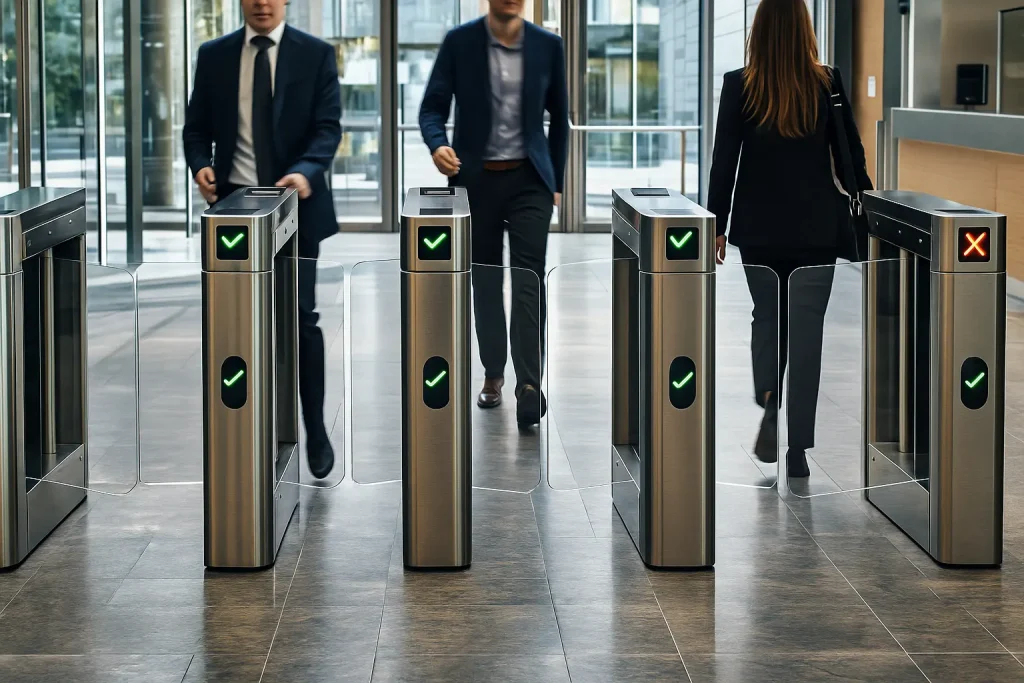
- The "Human" Lag: This is a design failure. The signage is bad. Users don't know where to tap. They get confused. Solution: Clear, intuitive, illuminated signage (green arrows, red X's) is just as important as the technology.
What Is the Future of High-Speed Access Control?
The future is "frictionless" and "intelligent." AI will power predictive analytics and facial recognition, while mobile UWB (Ultra-Wideband) credentials will allow for secure, long-range "walk-through" access, making the system completely invisible to the user.
- AI Sensor Fusion: The gate's "eyes" will get smarter. By "fusing" the data from the internal IR sensors with an overhead video camera, an AI will be able to see the difference between a person with a suitcase and two people tailgating, all but eliminating false alarms.
- Long-Range "Invisible" Credentials: New technologies like Ultra-Wideband (UWB) will know exactly where your phone is, with inch-level precision. As you approach, it will authenticate you, and the gate will open without you ever breaking stride.
- Cloud-Based Management: More "brains" will move to the cloud, allowing for incredible scalability, instant remote lockdowns, and easier integration with other building systems.
- Smart Building Integration: The
high-speed access control systemwill become the true "central nervous system." Your valid entry at the lobby gate will automatically trigger a cascade of events: it will call an elevator to your floor, turn on the lights at your hot-desk, and adjust your climate control.
The Final Verdict: The New Standard for Modern Facilities
A high-speed access control system is no longer a luxury; it's a foundational business tool for any modern facility. It's the critical "first impression" of your building and the bedrock of your physical security.
By intelligently blending a fast "brain" (the panel/software) with a fast "enforcer" (the speed gate turnstile), you can finally solve the age-old "speed vs. security" paradox. You create an environment that is simultaneously secure, efficient, and welcoming—a building that flows.
