



High-Speed Pedestrian Turnstiles for Modern Access Control
2025-10-27


Walk into any high-end corporate office, government building, or university campus at 8:55 AM. You'll almost certainly witness one of two scenes: a frustrating, time-wasting bottleneck of people waiting to be badged in, or a smooth, seamless flow of individuals passing through sleek, modern barriers without breaking their stride.
The difference? Technology. For decades, building security has been defined by a fundamental conflict: the trade-off between speed and safety. A high-security checkpoint is slow. A fast, open lobby is insecure. This is the daily paradox that facility managers and security directors have always battled.
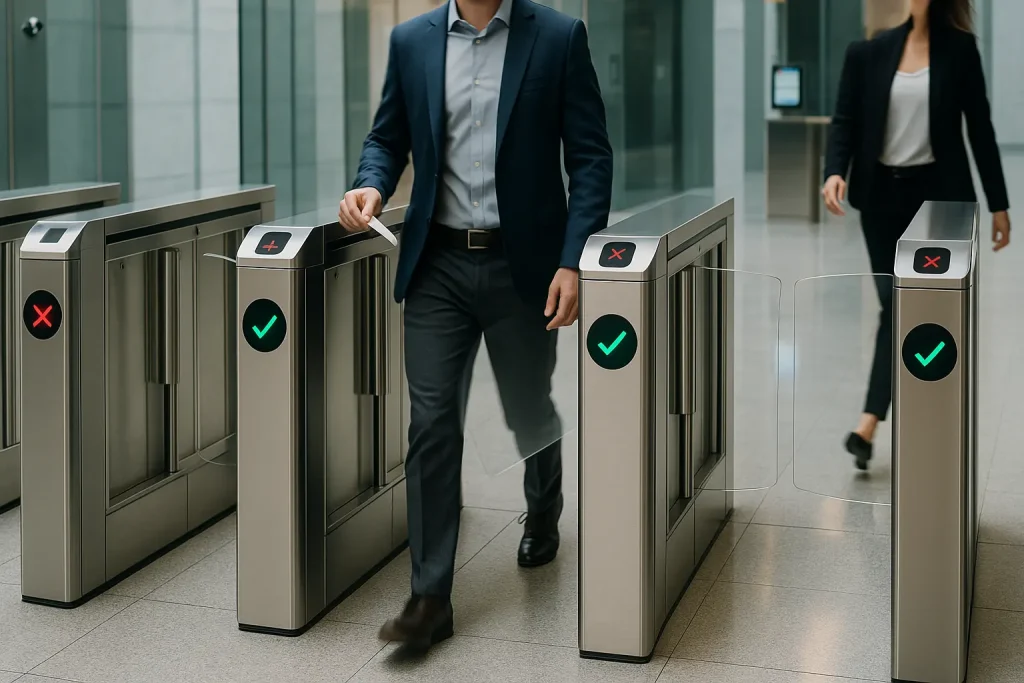
The high-speed pedestrian turnstile is the definitive, modern solution to this paradox. It's not just a "turnstile" in the traditional sense; it's a sophisticated, intelligent flow management system. It's designed from the ground up to provide robust security against unauthorized entry while simultaneously processing a high volume of people with maximum efficiency. This guide is a comprehensive, practical deep-dive into what this technology is, how it works, and why it has become the non-negotiable standard for modern access control.
What Exactly Is a High-Speed Pedestrian Turnstile?
A high-speed pedestrian turnstile is an advanced access control barrier that uses a combination of sophisticated optical sensors and fast-acting motorized barriers (like glass wings or flaps). It is engineered to manage pedestrian flow by blending high-security features, such as tailgating detection, with high-throughput speed, allowing 30-40+ people to pass per minute.
These systems are the workhorses of modern speed gate systems. The "high-speed" part of the name doesn't just refer to how fast the glass barriers move; it refers to the entire user experience. From the moment a credential is read to the second the lane is secure and ready for the next person, the entire process is optimized for speed.
This is what separates it from a traditional turnstile, like the clunky, three-armed tripod you'd see at a stadium. A tripod turnstile is a dumb, mechanical blocker. A high-speed pedestrian turnstile is an intelligent, electronic device that makes sophisticated decisions in milliseconds to keep authorized people moving while identifying and stopping unauthorized ones.
Here’s a quick comparison to put it in perspective:
| Feature | High-Speed Pedestrian Turnstile | Traditional Tripod Turnstile |
| Primary Goal | Flow management & anti-tailgating | Basic, single-file access |
| Typical Speed | Very High (30-40+ PPM) | Low (20-25 PPM) |
| User Experience | Touchless, seamless, "walk-through" | Physical push, "clunky," restrictive |
| Security | High (detects tailgating, alarms) | Low (easy to jump over or crawl under) |
| Operation | Motorized, quiet, sophisticated sensors | Mechanical (user-pushed) or basic motor |
| Aesthetics | High (stainless steel, glass, lighting) | Low (industrial, painted metal) |
| Common Use | Corporate lobbies, data centers, banks | Stadiums, gyms, factories, theme parks |
How Does a High-Speed Turnstile Actually Work?
A high-speed pedestrian turnstile works by using a "handshake" between an access control system and the turnstile's own logic. A user presents a credential, the system validates it and sends an "open" signal. The turnstile's motor then opens the barriers while its optical sensors track the user's passage, closing immediately after they pass to prevent tailgating.
From the user's point of view, it should feel effortless. But as an integrator, I can tell you there's a high-speed ballet of technology happening. Here is the step-by-step breakdown of what happens in that two-second "walk-through" event:
- Idle State: The turnstile is closed and secure. Its internal array of infrared (IR) sensors is active, scanning the passageway to ensure it's clear.
- Credential Presentation: The user presents their access credential—tapping an RFID card, scanning a QR code on their phone, or in advanced setups, simply looking at a biometric facial scanner.
- Validation (The "Brain"): The reader sends the credential's data to the building's main Access Control Panel (the "brain"), which is often in a secure IT closet. This panel checks the user's permissions in milliseconds: "Is this person allowed in this area at this time?"
- "Open" Signal (The "Handshake"): If the credential is valid, the Access Control Panel sends a simple dry-contact (voltage) signal to the turnstile's internal logic board. This signal just says, "Open."
- Barrier Actuation (The "Muscle"): The turnstile's logic board receives the signal and instantly activates its high-speed motor, which retracts or swings the glass barriers open.
- Passage & Sensor Monitoring: This is the "intelligent" part. As the user walks through, they pass through a "light curtain" made of dozens of IR sensors. The turnstile's logic tracks their progress, size, and speed.
- Tailgating Detection: If a second person (who did not present a credential) follows too closely, they will break the sensor beams in an "unexpected" pattern. The system instantly recognizes this as a tailgating attempt. This is the core function of an anti-tailgating speed gate. The system will sound a local, audible alarm and flash lights to alert security.
- Barrier Closing: The instant the authorized user is clear of the final sensor, the logic board commands the motor to close the barriers. This rapid closing is what prevents a second person from sneaking in and what makes the lane immediately ready for the next user, ensuring high throughput.
What Are the Core Components That Make It "High-Speed"?
The "speed" isn't from one part, but from the seamless integration of four key components: a high-speed motor, a fast logic controller, quick-reading credentials, and a dense sensor array. A failure in any one of these creates a bottleneck and defeats the "high-speed" promise.
As an expert, this is what I look for. You can't just put a fast motor in a dumb chassis and call it "high-speed."
- 1. Brushless DC Motors: This is the heart of the machine. Cheaper turnstiles use standard DC motors that are noisy, generate more heat, and wear out. A true high-speed pedestrian turnstile uses a brushless DC motor. These are designed for millions of cycles, are whisper-quiet, and can actuate the barriers in as little as 0.3 to 0.5 seconds.
- 2. Advanced Logic Controller: This is the "local brain" inside the turnstile. It's a dedicated computer whose only job is to read the sensor data and control the motor. A good controller is what allows for "intelligent" features like detecting a rolling suitcase (which it ignores) vs. a person (which it alarms for).
- 3. Fast-Reading Credentials: The turnstile is only as fast as the "OK" signal it gets. If a user has to fumble with a bad reader, the entire lane stops. A fast access turnstile must be paired with fast credentials, like modern RFID/NFC cards, Bluetooth (BLE) mobile apps, or biometric (facial) readers that validate instantly.
- 4. High-Density Sensor Array: This is the secret to both speed and security. A cheap gate might have 6 sensors. A high-end high-throughput speed gate will have 20, 40, or even 60 sensors. This dense "light curtain" gives the logic controller a high-resolution picture of the lane, allowing it to:
- Close the barriers faster and more closely behind the user, increasing security.
- More accurately distinguish between one person, two people, or a person with luggage.
- Increase safety by ensuring the barriers never close on a person.
What Are the Main Types of High-Speed Pedestrian Turnstiles?
The main types are defined by their barrier movement: flap barriers (retracting wings for maximum speed), swing barriers (swinging glass for aesthetics and security), and sliding gates (sliding glass panels for high-security applications). Each offers a different balance of speed, security, and footprint.
Choosing the right type is a critical decision that depends on your building's specific needs.
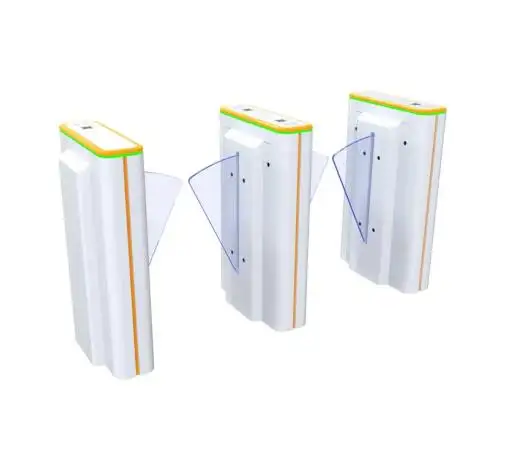
Flap Barrier Turnstiles (Retracting Wings)
These are the "speed demons" of the group. They feature two triangular or wing-shaped barriers (glass or acrylic) that retract into the body of the turnstile.
- Pros: The fastest possible operation (highest throughput). The barriers disappear completely, creating a very open and minimal footprint.
- Cons: The barriers are often shorter, which can be seen as a lower psychological deterrent (though sensors will still detect jumping).
- Best For: High-traffic environments where speed is the #1 priority, such as subway stations, convention centers, and massive corporate HQs.
Swing Barrier Turnstiles (Swinging Arms)
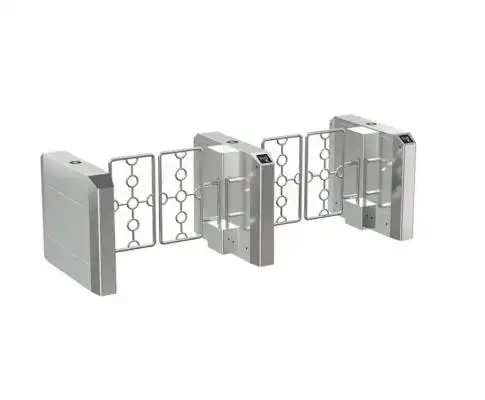
This is the most popular and aesthetically-driven choice for modern corporate lobbies. It features one or two taller glass arms that pivot from the chassis and swing open in the direction of travel.
- Pros: Feels very elegant, intuitive, and "welcoming." The taller glass barriers (from waist-high to near full-height) offer a stronger physical and psychological deterrent. This design is also the easiest to make in a wider, ADA-compliant version.
- Cons: The swinging arms require physical clearance space in front of or behind the pedestal.
- Best For: Corporate lobbies, executive floors, and any building wanting to perfectly balance high aesthetics with strong security.
Sliding Gate Turnstiles (High-Security)
These are a more robust, security-first option. They function like miniature elevator doors, with taller, more durable glass panels that slide horizontally to open the lane.
- Pros: Offers the highest level of security in the "speed gate" category. The tall, robust panels are extremely difficult to climb, crawl under, or force open.
- Cons: They are physically larger, more expensive, and slightly slower than flap or swing models dueD to the mass of the glass being moved.
- Best For: High-security areas like data centers, government facilities, financial institutions, and critical infrastructure control rooms.
Optical Turnstiles (Barrier-Free)
This is a special category. An optical turnstile consists of two pedestals with all the same sophisticated sensors, but no physical barriers.
- Pros: The absolute highest throughput possible, as there is no motor or barrier to slow a person down. Creates a completely open, welcoming, and minimalist look.
- Cons: Provides zero physical security. It only detects and alarms on unauthorized entry; it cannot prevent it. It must be monitored 24/7 by a security guard.
- Best For: Lobbies that are always staffed and where the primary goal is a welcoming feel and an accurate headcount, not physical prevention.
How Do These Turnstiles Improve Building Security?
High-speed turnstiles primarily improve security by reliably detecting and physically preventing tailgating—the most common breach. Their advanced optical sensors enforce the "one person, one valid credential" rule that access control software alone cannot, while also acting as a strong physical and psychological deterrent.
Security is about layers. A simple card reader on a wall is one weak layer. A high-speed turnstile adds multiple new, intelligent layers.
- The #1 Job: Physically Preventing Tailgating. This is their core security function. An anti-tailgating speed gate is designed to defeat this specific threat. The sensors are so precise they can detect the "unexpected" shape of two people (even if they are walking very closely) and sound an alarm, often while closing the barrier on the unauthorized user.
- Enforcing Access Rules 100% of the Time. This is the "enforcement" layer. Your access control system has the rules (who, where, when). The turnstile is the 24/7, non-distractible enforcer. It's an automatic speed gate that can't be "socially engineered" with a "Hey, I forgot my badge" story. It doesn't get tired or look away. It just enforces the policy.
- Creating a Precise Audit Trail. With a simple door, your log shows "User A badged in at 9:01 AM." You hope only one person entered. With a high-speed turnstile, your access control log is paired with the turnstile's event log. You know exactly one person passed for that badge. This data is invaluable for compliance audits and investigations.
- Strong Physical & Psychological Deterrent. The visible presence of a modern, functioning turnstile system signals that security is taken seriously. It deters opportunistic, casual intruders who will simply move on to an easier, "softer" target.
What Are the Efficiency Benefits of High-Speed Turnstiles?
The main efficiency benefit is the dramatic increase in pedestrian throughput (30-40+ people per minute), which effectively eliminates lobby queues and entry bottlenecks. This automation frees up security staff for high-value tasks and creates a frictionless, more professional experience for all building occupants.
This is the "speed" half of the equation, and its impact is felt across the organization.
- Solving the Lobby Bottleneck. That 8:55 AM line? It's gone. A high-throughput speed gate is built for this "peak load." A single lane can process a person every 1.5-2 seconds. A bank of four lanes can handle over 120-150 people per minute, dissolving the queue as fast as it forms.
- Improving Employee Satisfaction. Daily friction, even small "micro-frustrations" like waiting in line to badge in, has a cumulative, negative impact on employee morale and productivity. A seamless, "walk-through" experience is a daily positive reinforcement that the company values their time.
- Multiplying Your Security Staff's Effectiveness. This is a massive operational win. Instead of paying a high-value guard to perform the low-skill, repetitive task of "badge checking," you automate it. The turnstile handles the 99% of "good" entries, allowing your guard to focus on the 1% of "exceptions": managing visitors, identifying truly suspicious behavior, and being ready to respond to an actual incident.
How Do You Choose the Right High-Speed Turnstile for Your Facility?
To choose the right high-speed turnstile, you must first conduct a "peak load" analysis to determine the number of lanes you need. Then, you select the type of turnstile (flap, swing, etc.) based on your specific security requirements, aesthetic goals, and available physical space (including ADA).
As an expert who has seen this go right and wrong, I can tell you: do not just pick a model from a catalog. You must follow this process.
- Step 1: Conduct a Real-World Throughput Analysis. This is the most critical step. Do not guess. Do not just take your total employee count and divide by 8 hours. Stand in your lobby with a clicker (or use camera footage) and count the number of people who enter during your absolute busiest 15-minute window. This is your "peak load." That number, divided by 15, is your "peak people per minute."
- Formula:
Peak PPM / 30 = Number of Lanes Needed (Round Up) - Anecdote: I've seen clients buy two beautiful, expensive lanes when their peak load demanded four. They didn't solve their problem; they just moved the bottleneck 20 feet and spent $50,000 to do it. Measure first!
- Formula:
- Step 2: Define Your Security vs. Speed Profile. What is your primary goal?
- Maximum Speed (e.g., Office HQ): You want flap barriers.
- Balance of Speed & Aesthetics (e.g., Class-A Lobby): You want swing barriers.
- Maximum Security (e.g., Data Center): You want sliding barriers.
- Step 3: Plan for ADA & Deliveries (Non-Negotiable). You are legally and practically required to have at least one wider lane (typically 32-36 inches) for wheelchair accessibility. This wider lane is also used for rolling luggage, deliveries, and moving equipment. This is often a bidirectional speed gate that can be controlled by the front desk.
- Step 4: Assess the Physical Site & Aesthetics. Walk the lobby with a tape measure.
- Footprint: Do you have space for swing gates? Or is the corridor narrow, making retracting flap gates a better fit?
- Floor: Is it concrete? You will need to core-drill it. Is it a raised floor? Cabling is easier, but you'll need a special mounting base.
- Design: Does the turnstile need to match a marble and wood interior? Look for manufacturers who offer custom top-lids and finishes.
What Is Involved in the Installation Process?
Installation is a significant construction project that requires core drilling or trenching the floor to run power and data conduits. It involves securely bolting the pedestals to the sub-floor, integrating the turnstile's logic with the building's access control panel, and—most critically—linking it to the fire alarm system for emergency egress.
This is not a "plug-and-play" device that gets dropped off. The installation is just as important as the hardware.
- 1. Sub-Floor Work: This is the messy part. A trench must be cut or holes core-drilled in your lobby floor to run conduits for high-voltage (power for the motor) and low-voltage (data for the reader and "open" signal). This is typically done overnight or on a weekend.
- 2. Mounting & Leveling: The pedestals are incredibly heavy and must be bolted securely into the concrete sub-floor. The lanes must be perfectly level and aligned for the optical sensors to work correctly. [Anecdote: A slightly un-level floor can cause constant false alarms because the IR beams become misaligned].
- 3. The "Big 2" Integrations:
- Access Control: The security integrator will wire the card reader back to the main access control panel. They will then run a separate wire from that panel's "output relay" to the turnstile's logic board.
- Fire Alarm (Mandatory): This is a life-safety-critical step. The integrator must coordinate with your fire alarm vendor to pull a signal from the Fire Alarm Control Panel (FACP). When the FACP alarms, it must send a signal that forces the turnstiles to open (or "fail-open") and stay open, allowing free egress.
- 4. Sensor Tuning & Commissioning: Once installed, a certified technician must "tune" the sensors to your lobby's specific environment, including ambient light. This tuning is what sets the anti-tailgating sensitivity and ensures the gates are both safe and secure.
What Is the Future of High-Speed Access Control?
The future of the high-speed pedestrian turnstile is "frictionless," predictive, and completely integrated. We are moving away from "tap-and-go" and toward a "just-walk-through" experience, powered by AI, biometrics, and cloud-based smart building platforms.
- The "Invisible" Credential: The high-speed turnstile will remain, but the interaction will vanish. Advanced facial recognition (a type of biometric speed gate turnstile) or long-range Bluetooth/UWB (Ultra-Wideband) credentials on your phone will validate you as you approach, with the barriers opening before you even realize it.
- AI-Powered Sensor Fusion: The next generation of turnstiles will "fuse" the data from the IR sensors with data from an overhead video camera. An AI will analyze this combined data to move beyond simple tailgating. It will be able to detect "suspicious behavior," "a person under duress," "an abandoned object," or "a person crawling." It will move from reactive to predictive security.
- The Smart Building
Entrance Speed Gate System: The turnstile will become the primary "check-in" for the entire building. Your valid entry at theentrance-speed-gate-systemwill trigger a cascade of events: it will call an elevator for your default floor, turn on the lights at your hot-desk, and log you in to the building's network.
The Final Verdict: Why the High-Speed Turnstile Is the New Standard
The high-speed pedestrian turnstile is no longer a luxury upgrade; it is the foundational component of modern building security and efficiency. It is the only solution that definitively solves the age-old conflict between speed and security.
It enhances your security posture by providing a reliable, 24/7 enforcer that physically stops tailgating. And finally, it elevates your building's image by providing a seamless, professional, and modern experience for every employee and visitor.
If your building is still relying on a simple card reader, an overwhelmed guard, or a clunky mechanical barrier, it's time to invest in the system that defines the modern, secure, and efficient lobby.
