


High Throughput Speed Gates: Balancing Speed and Security
2025-10-27


It's 8:55 AM on a Tuesday. In the lobby of your building, a line is forming. It snakes from the security desk, past the elevators, and is starting to creep toward the front door. Your employees, coffee in hand, are checking their watches. Your security guard is visibly stressed, trying to check badges, greet visitors, and manage the growing queue. This daily bottleneck isn't just an inconvenience; it's a drain on productivity, a source of employee frustration, and a poor first impression for your clients.
For decades, this has been the unavoidable conflict of building management: the battle between speed and security. A secure lobby is slow. A fast lobby is insecure.
The high throughput speed gate is the modern, definitive solution to this paradox. This technology is not just a barrier; it's an intelligent flow management system engineered for one primary purpose: to process the absolute maximum number of authorized people in the minimum amount of time, without compromising security.
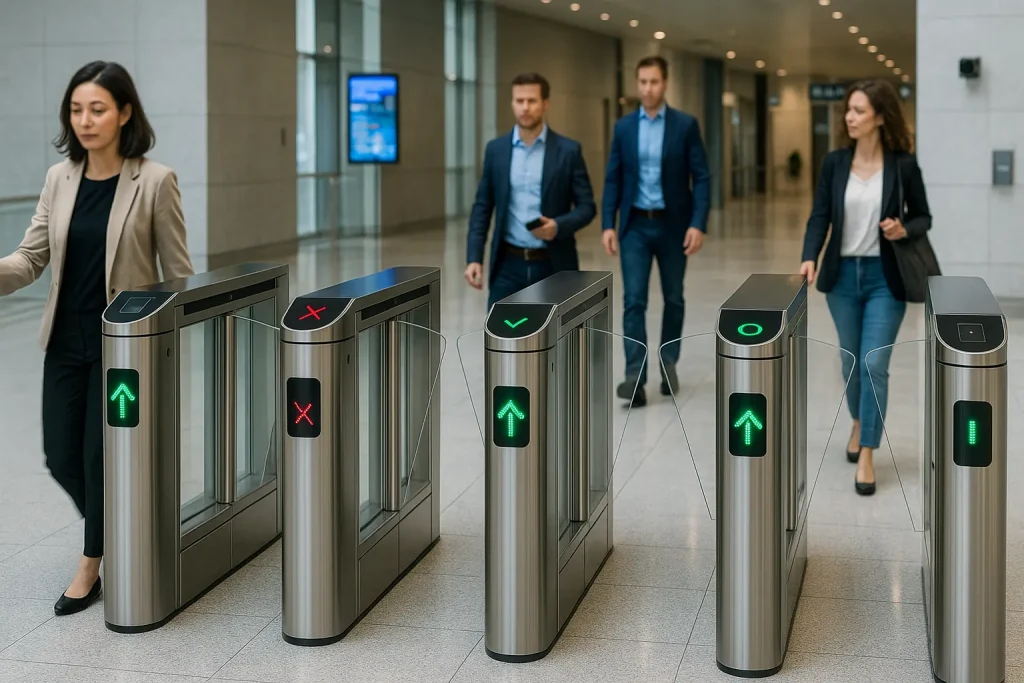
This guide provides an expert, comprehensive look at high throughput technology. We'll explore what "throughput" actually means, how these gates achieve it, how they perfectly balance speed with security, and how to calculate exactly what your facility needs.
What Exactly Is a "High Throughput Speed Gate"?
A high throughput speed gate is an advanced access control barrier specifically engineered to process the maximum number of people per minute (PPM) while maintaining robust security. Unlike standard gates, its design, motor, and sensor logic are all optimized to minimize the time per passage, eliminating bottlenecks.
The key term here is "throughput." In engineering, "throughput" refers to the amount of material or items passing through a system per unit of time. You might hear this in computing, or even in space technology—a High Throughput Satellite, for example, is designed to process vastly more data than its predecessors.
The same concept applies here. A high throughput speed gate is designed for volume. It's not just "fast" in how its barriers move; it's "fast" in its rate of passage. It's a system designed to handle the "data" (in this case, people) of a morning rush hour without crashing, lagging, or creating a queue.
How is "Throughput" Measured and Why Does It Matter?
Throughput is measured in a single, critical metric: People Per Minute (PPM). This number dictates how many people can pass through a single lane in 60 seconds. It matters because it is the key variable that separates a smooth, flowing lobby from a frustrating, crowded bottleneck.
Understanding your PPM needs is the only way to properly design your lobby security. A high PPM rate is the entire goal of a high throughput speed gate.
Let's look at the real-world numbers:
| Entry Method | Typical Throughput (PPM) | Experience & Security |
| Manual Guard (Badge Check) | 10-15 PPM | Very slow. Inconsistent. Prone to human error and tailgating. |
| Tripod Turnstile (Mechanical) | 20-25 PPM | Slow. Restrictive (physical push). Low security (can be jumped). |
| High Throughput Speed Gate | 30-40+ PPM | Fast & Seamless. Touchless. High security (anti-tailgating). |
As you can see, a single high throughput lane can process twice as many people as a manual guard. This is the difference between a 10-minute wait and no wait at all. This matters because that 10-minute wait, multiplied by 1,000 employees over 250 workdays, represents thousands of hours of lost productivity. Data on the cost of lost productivity from daily employee queueing].
How Do These Gates Achieve Such High Throughput?
High throughput is not a single feature. It's a high-speed synergy of three core components: (1) high-speed motors, (2) fast-reading credential systems, and (3) intelligent sensor logic that minimizes the "tailgating gap" between users.
A failure in any one of these components will kill your throughput.
1. High-Speed, High-Torque Motors
This is the "muscle" of the gate. A true high throughput speed gate uses a brushless DC motor, not a standard, cheaper brushed motor. These are engineered to be:
- Fast: They can actuate (open or close) the glass barriers in as little as 0.3 to 0.5 seconds.
- Quiet: They are whisper-quiet, contributing to a professional lobby environment.
- Reliable: They are rated for millions of cycles, which is exactly what's needed for a busy entrance.
2. Fast-Reading, "Frictionless" Credentials
This is the "handshake" part of the process. The fastest motor in the world is useless if it's waiting for a slow "open" signal. The time it takes for a user to present a credential, for that credential to be read, and for the "open" command to be sent is a critical part of the throughput calculation.
- Slow Credentials = Slow Gate: If you pair a $20,000 gate with a 10-year-old access control panel, you'll get a "credential bottleneck." The user taps, but the old panel takes 1.5 seconds to "think" before sending the "open" signal. The user has to pause. Your throughput is destroyed.
- Fast Credentials = Fast Gate: This is why a
high throughput speed gateis part of a complete high-speed access control system. It must be paired with fast-reading technology like a modern RFID speed gate system or, for the ultimate speed, a biometric speed gate turnstile. Facial recognition, for example, can identify the user as they approach, allowing the gate to open before they even stop.
3. Intelligent Sensor Logic (The "Secret Sauce")
This is the "brain" and the true secret to throughput. The gate's logic controller, paired with a dense sensor array, is programmed to minimize the "open time."
- It tracks the authorized user passing through.
- The instant the user clears the last sensor, the logic commands the barrier to close.
- This rapid "close" action minimizes the "tailgating gap"—the physical space and time that an unauthorized person could use to sneak in.
- By minimizing this gap, the gate is secure, and it's also ready for the next user almost immediately. This "recycle time" is the key to high PPM.
How Do High Throughput Gates Balance Speed with Security?
This is the multi-million dollar question. If the gate is focused on speed, doesn't that make it less secure?
A high throughput gate balances speed and security using a dense array of optical sensors. These sensors are fast enough to allow high-speed passage for authorized users but sophisticated enough to instantly detect the "unexpected shape" of an unauthorized user (tailgating) and trigger an alarm.
This is the core design challenge. A slow gate is easy to secure. A fast gate, by definition, wants to be open as much as possible, which creates a security risk.
The solution is the optical sensor array—the "eyes" of the gate.
- This isn't one or two beams: A cheap gate might have 6-8 sensors. A high-end
high throughput speed gateuses a "light curtain" of 20, 40, or even 60+ sensors. - It builds a 3D profile: These dozens of cross-hatched beams build a high-resolution "picture" of the person in the lane.
- The "Intelligent" Logic: The gate's logic is programmed with "valid" profiles. It knows what "one person" looks like. It even knows what "one person + a rolling suitcase" looks like (and allows it). But when two people try to walk through, their combined shape creates an "invalid" profile.
- Instant Alarm: The instant this invalid profile is detected, the logic triggers an alarm (audible, visual, and a signal to security).
This is what makes it a true anti-tailgating speed gate. It uses its intelligence and sensor density to enforce security, allowing the motor to focus on speed. Tailgating is the single most common way physical security is breached, so this feature is non-negotiable.
What Are the Main Types of High Throughput Speed Gates?
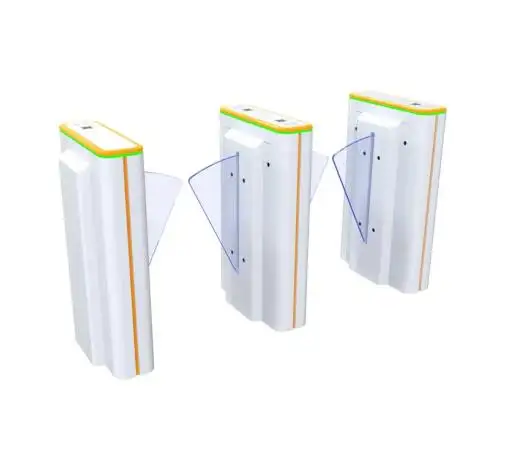
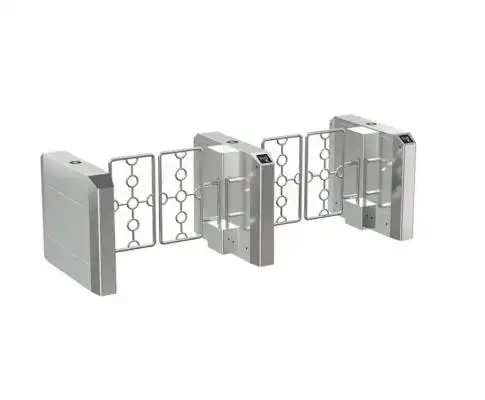
The main types are flap barriers (retracting wings for maximum speed), swing barriers (pivoting glass for a balance of speed and aesthetics), and optical turnstiles (barrier-free for the absolute highest throughput). Each offers a different balance of speed and security.
Choosing the right type of gate is critical.
| Gate Type | Barrier Motion | Typical Throughput (PPM) | Security Level | Best For... |
| Flap Barrier | "Wings" retract into the chassis | Very High (35-45+) | Good | High-traffic hubs, transit stations, HQs (Speed is #1) |
| Swing Barrier | "Arms" pivot (swing) open | High (30-40) | High | Class-A Lobbies, Corporate HQs (Balance of speed & aesthetics) |
| Optical (Barrier-Free) | No physical barrier, sensors only | Highest (40-60+) | Low (Detects Only) | Lobbies with 24/7 guard presence (Welcoming feel is #1) |
- Flap Barriers: These are the "speedsters." Because the wings just retract into the chassis, their open/close cycle is the fastest. This is the ultimate
high throughput speed gatefor pure volume. - Swing Barriers: This is the most popular choice for corporate lobbies. A high-speed pedestrian turnstile with pivoting glass arms is elegant, quiet, and feels "welcoming." The taller glass also offers a stronger psychological deterrent
- Optical (Barrier-Free): This is a "turnstile" with no barriers. It consists of two pedestals with all the same sensors. It's designed to alarm when someone unauthorized passes, but it cannot physically stop them. It relies 100% on a guard's response. It offers the highest possible throughput but the lowest physical security.
How Do You Calculate the Number of Lanes You Need? (The Throughput Analysis)
This is the most important, expert-level step in planning your system. You must perform a "peak load" analysis.
To calculate your required lanes, you must first find your "Peak People Per Minute" (Peak PPM). Count the maximum number of people who enter your lobby in your busiest 15-minute period and divide that number by 15. Then, divide your Peak PPM by 30 (a safe average for one gate).
Do not guess. Do not use your total employee count. It's not relevant. The only number that matters is your peak load.
3-Step:
- Get the Data: Stand in your lobby with a clicker or use your security camera footage. Count every single person who enters during your absolute busiest 15-minute window (e.g., 8:45 AM - 9:00 AM on a Tuesday).
- Calculate Your Peak PPM:
[Total People in 15 Min] / 15 = Your Peak PPM- Example: You count 450 people in 15 minutes.
450 / 15 = 30 Peak PPM.
- Calculate Your Lanes:
[Your Peak PPM] / 30 = Number of Lanes Needed (Always Round Up)- Example 1: Your Peak PPM is 30.
30 / 30 = 1. You need 1 lane. - Example 2: Your Peak PPM is 80.
80 / 30 = 2.66. You must round up. You need 3 lanes.
What Are Common Mistakes When Implementing These Systems?
The most common mistakes are under-calculating the number of lanes needed (the throughput analysis), failing to integrate with the building's fire alarm for emergency egress, and creating a "credential bottleneck" by using slow, old readers with new, high-speed gates.
- The Throughput Miscalculation: As detailed above. This is the #1 mistake. It's fatal to the project's primary goal.
- The Life-Safety Failure: This is the most dangerous mistake. Your
high-throughput speed gatemust be connected to your building's Fire Alarm Control Panel (FACP). In a fire, the FACP must send a signal that forces all barriers to "fail-open," allowing free egress. I've seen audits where this was ignored. It's a massive, indefensible liability. - The Credential Bottleneck: As mentioned before. You cannot pair a high-performance "engine" (the gate) with a "clogged fuel line" (an old reader/panel). The entire high-speed access control system must be fast.
- Bad Sensor Tuning: The gates are installed, but they're "finicky." They "clip" people's heels or bags. Or, the morning sun hits the sensor and causes false alarms. This is the "character" of the gate. It requires an expert technician to tune and calibrate the sensor sensitivity to your specific lobby environment.
The Future of Throughput: "Frictionless" and "Intelligent"
The future of high throughput is "frictionless." It involves AI-powered sensor fusion (video + IR) and long-range "invisible" credentials like facial recognition or mobile Bluetooth. This will allow for high throughput with zero user interaction, making the process even faster and more secure.
We are already seeing this shift. The high throughput speed gate is evolving.
- The "Invisible" Credential: The biometric speed gate turnstile is the next frontier. You won't even have to tap. Facial recognition or gait analysis will identify you as you approach, and the barriers will open seamlessly.
- AI-Powered Sensor Fusion: The gate's "eyes" will get smarter. By combining the IR sensor data with an overhead video camera, an AI will be able to make even better judgments. It will be able to distinguish a person with a rolling bag from two people, or even detect a "person under duress" (e.g., being forced through).
- Data Analytics: The
high throughput speed gatewill become a key data sensor for the "smart building." The passage data will provide real-time, accurate occupancy counts, which can be used to manage HVAC, lighting, and emergency mustering lists automatically.
The Final Verdict: Why a High Throughput Gate Is a Strategic Investment
The high throughput speed gate is the definitive, modern solution to the age-old "speed vs. security" paradox. It is the only technology that can process a high volume of people quickly while also enforcing high-level security against tailgating.
For any modern facility that takes its security and its occupants' time seriously, a well-planned high throughput speed gate solution is no longer an upgrade—it's the new standard for all speed gate systems.
