


Modular Speed Gate Design: Flexible Solutions for Any Space
2025-10-27


Speed gates – the sleek barriers managing pedestrian flow in modern lobbies – represent a sophisticated blend of Design & Technology. They need to be fast, secure, reliable, and aesthetically pleasing. However, traditional approaches to designing and manufacturing these complex machines often resulted in monolithic, integrated units. While functional, this "all-in-one" approach created significant challenges: repairs were complex and time-consuming, upgrades were often impossible without replacing the entire unit, and customization options were limited and expensive.
Imagine a critical component failing – perhaps a sensor board or the drive motor. In a traditional design, a technician might need hours on-site, potentially requiring specialized tools and extensive disassembly, leading to prolonged downtime in a busy lobby. Upgrading from basic card readers to newer biometric technology? That often meant a costly "rip and replace" of the entire gate pedestal.
This inflexibility is a major pain point for facility managers and security directors who need systems that can adapt to changing needs and technologies. The innovative answer to this challenge is modular speed gate design. This approach represents a fundamental shift, moving away from rigid, integrated structures towards flexible, adaptable systems built from interchangeable components. It's about designing for the entire lifecycle – from initial configuration to long-term maintenance and future upgrades. This guide provides an expert, in-depth look at this powerful design philosophy, exploring its principles, benefits, and transformative impact on the world of access control.
What Is Modular Speed Gate Design?
Modular speed gate design is an engineering approach where the speed gate is constructed from distinct, interchangeable functional units or "modules" (e.g., drive system, sensor array, control logic, reader interface). This allows for easier customization, simplified repairs, and straightforward technology upgrades by simply swapping modules.
Think of it like building with high-tech LEGO® bricks. Instead of designing the entire gate as one inseparable piece, engineers break it down into its core functional blocks. Each block, or module, performs a specific task (like moving the barrier or reading a card) and connects to the others through standardized interfaces (both physical and electrical). This concept mirrors the principles of modular design seen in fields ranging from computer hardware to furniture, emphasizing flexibility and adaptability.
How Does Modular Design Differ from Traditional Gate Construction?
Traditional gate construction typically integrates all components tightly within a single chassis, often with custom wiring and non-standardized connections. Modular design, conversely, uses pre-engineered, self-contained functional blocks with standardized interfaces, allowing components to be easily added, removed, or replaced without affecting the entire system.
In a traditional, non-modular speed gate:
- Components are often packed tightly together.
- Wiring might be custom-soldered point-to-point.
- Replacing a single failed part (like one sensor on a board) might require extensive disassembly and component-level repair skills.
- Upgrading (e.g., changing the reader type) could involve cutting, drilling, and significant modification, if it's possible at all.
In a modular speed gate design:
- Key systems (motor, controller, sensors) are housed in distinct, easily accessible modules.
- Connections between modules use standardized plugs and connectors.
- A failed module (e.g., the entire sensor array) can often be unplugged and swapped out with a new one in minutes by a technician with basic training.
- Upgrading involves replacing one standardized module with another (e.g., swapping an RFID reader module for a facial recognition module).
The difference is profound, shifting the paradigm from complex, component-level servicing to simple, system-level module replacement.
What Are the Core Components (Modules) of a Modular Speed Gate?
While specific implementations vary by manufacturer, a typical modular system breaks the gate down into key functional subsystems. Common modules include the drive/motor unit, the sensor package, the logic/controller board, the credential reader interface, the barrier assembly, and sometimes even aesthetic panels.
Let's explore these potential building blocks:
- Drive Module: Contains the high-speed motor (often a brushless DC motor), gearbox, drive belts/linkages, and associated power electronics. This is the "muscle" that moves the barrier. A modular approach allows the entire drive train to be swapped out easily for maintenance or replacement.
- Sensor Module(s): Houses the critical optical sensors (infrared beams) used for safety and anti-tailgating. This might be one long module per side or several smaller, interconnected modules. This allows for easier cleaning, replacement of damaged sensors, or even upgrading to more advanced sensor technology (like 3D or ToF sensors) later.
- Logic/Controller Module: Contains the main microprocessor (the "local brain"), firmware, network interface (Ethernet port), and connections to the central access control system. Swapping this module might be necessary for major firmware upgrades or if the board fails.
- Credential Reader Module/Interface: This is a key area for flexibility. Instead of permanently building in one type of reader, a modular design uses standardized mounting plates and connectors. This allows the same gate chassis to easily accommodate:
- An RFID reader module.
- A QR code scanner module.
- A biometric (fingerprint or facial recognition) module.
- Or even a blank plate for future use.
- Barrier Module: The physical barrier itself (e.g., the glass wing or flap) and its immediate mounting mechanism. Designing this as a module allows for easier replacement if a barrier is damaged (a common occurrence). It might also allow switching between barrier heights or materials (like swapping standard tempered glass speed gate barriers for taller, higher-security ones) on the same chassis.
- Power Supply Module: Often a self-contained unit providing the necessary voltages for all other modules. Easy replacement simplifies troubleshooting power issues.
- Aesthetic/Cladding Modules: Some designs even modularize the outer panels or top lids, allowing for easier customization of finishes or replacement of scratched/dented exterior parts.
What Are the Primary Benefits of a Modular Approach?
The primary benefits of modular speed gate design are significantly increased flexibility for customization, dramatically simplified maintenance leading to reduced downtime, easier and more cost-effective future technology upgrades ("future-proofing"), and potentially lower overall lifecycle costs.
A modular philosophy fundamentally changes the ownership experience of a speed gate system.
Benefit 1: Flexibility & Customization (Tailored Solutions)
Modularity allows manufacturers and integrators to easily configure solutions for specific needs without lengthy custom engineering.
- Mix-and-Match: Need a gate with RFID entry but facial recognition exit? Need taller barriers on some lanes but standard on others? Need integrated elevator displays? Modularity makes combining different features straightforward.
- Adaptable: If requirements change later (e.g., deciding to add visitor QR code scanning), adding the relevant module is often simple.
Benefit 2: Ease of Maintenance & Repair (Reduced Downtime)
This is arguably the most significant operational benefit, especially for facilities where downtime is critical (like airports or busy corporate HQs).
- Faster Diagnosis: Problems can often be isolated to a specific module quickly.
- Rapid Swapping: Instead of complex component-level repair on-site, a technician can simply swap the entire faulty module with a working spare in minutes. The faulty module can then be repaired offline or sent back to the manufacturer.
- Lower Skill Requirement: Module swapping requires less specialized electronic repair skill than component-level troubleshooting, potentially reducing service costs and widening the pool of qualified technicians.
- My Anecdote: "I remember an emergency call for a major bank's lobby – one of their main speed gates was dead during morning rush. With their old monolithic gates, this would have been a 4-hour+ repair, involving taking the whole thing apart. But they had recently installed modular gates. The technician arrived, diagnosed a faulty power supply module in 10 minutes, swapped it with a spare from his van in another 5 minutes, and the lane was back online before the peak rush ended. The difference in impact was incredible – that's the power of modularity."
Benefit 3: Future-Proofing & Upgradability (Lifecycle Extension)
Technology evolves rapidly. A gate installed today might need different capabilities in 5-10 years. Modularity protects this investment.
- Technology Refresh: As sensor technology improves (e.g., AI-powered detection) or new credential types emerge (e.g., next-gen biometrics or mobile tech), you can potentially upgrade just the relevant module(s) instead of replacing the entire expensive gate system.
- Avoiding Obsolescence: This extends the usable lifespan of the core chassis and drive system, providing a much better long-term ROI.
- My Anecdote: "A corporate client installed modular gates with high-end RFID readers five years ago. Now, they want to pilot facial recognition for a truly frictionless experience. Because the gates were modular, we simply developed a new 'reader module' incorporating the facial camera and processing unit. We're swapping these modules into their existing gates over a weekend. Without modularity, this upgrade would have meant ripping out and replacing 20 lanes – a project easily costing hundreds of thousands more."
Benefit 4: Potential Cost Efficiency (Total Cost of Ownership)
While the initial purchase price of a modular gate might sometimes be slightly higher due to the engineering involved, the total cost of ownership (TCO) over its lifespan is often significantly lower.
- Reduced Maintenance Costs: Faster repairs and less downtime save money.
- Extended Lifespan: Upgradability prevents premature obsolescence and replacement costs.
- Inventory Management: Standardized modules can simplify spare parts inventory, especially for large installations.
Benefit 5: Streamlined Manufacturing & Deployment
For the manufacturer, modularity allows for more efficient production lines (building standardized modules) and faster final assembly of custom configurations. This can potentially lead to shorter lead times for customers.
How Does Modularity Enhance Flexibility and Customization?
Modularity enhances flexibility by allowing different pre-engineered functional blocks (like various reader types, sensor packages, or barrier styles) to be easily combined or swapped on a standard chassis. This enables tailored solutions without the cost and time of full custom design for each unique requirement.
Imagine you need to equip a building with speed gates, but different areas have different needs:
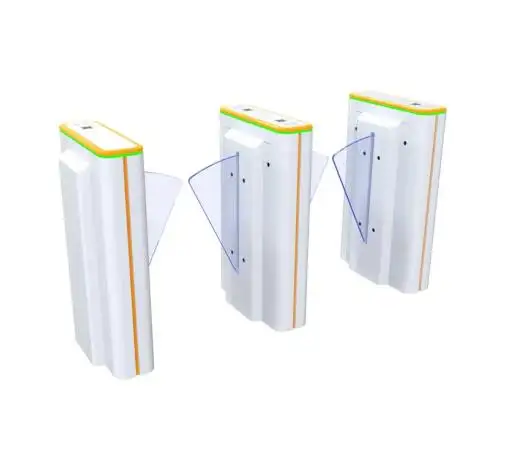
- Main Lobby: Needs high throughput, standard security, RFID for employees, and QR code scanning for visitors. Configuration: Standard chassis + Flap Barrier Module + RFID Reader Module + QR Scanner Module + Standard Sensor Module.
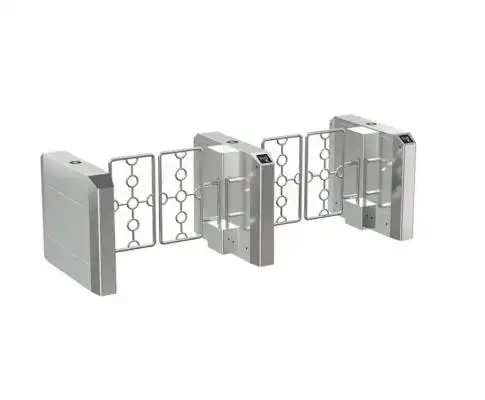
- Executive Floor Entrance: Needs higher security, lower throughput, premium aesthetic. Configuration: Standard chassis + Swing Barrier Module + Biometric Reader Module (Facial) + High-Security Sensor Module + Custom Wood Top Lid Module.
- Data Center Entrance: Needs maximum security, low throughput. Configuration: Standard chassis + Tall Sliding Barrier Module + Biometric Reader Module (Iris) + PIN Pad Module + High-Security Sensor Module.
With a modular speed gate design, the manufacturer can meet all these diverse needs using largely standardized core components, simply assembling the required combination of modules. This drastically reduces engineering time and cost compared to designing three entirely separate custom gates.
How Does Modular Design Simplify Maintenance and Repair?
Modular design simplifies maintenance by enabling rapid fault isolation and "swap-out" repairs. Technicians can quickly identify a malfunctioning module, replace it with a working spare from inventory, and restore operation in minutes, minimizing downtime compared to lengthy component-level troubleshooting on-site.
The impact on Mean Time To Repair (MTTR) is significant.
- Traditional Repair:
- Technician arrives, spends time diagnosing the issue down to a specific faulty component (e.g., a single sensor, a capacitor on a board).
- May need specialized tools or parts not readily available.
- Performs intricate repair on-site (soldering, recalibration).
- Total Downtime: Potentially hours or even days.
- Modular Repair:
- Technician arrives, performs quick diagnostics (often aided by the gate's self-reporting) indicating a specific module failure (e.g., "Sensor Module Fault").
- Unplugs/unbolts the faulty module.
- Plugs/bolts in a replacement module from stock.
- Performs quick function test.
- Total Downtime: Often 15-30 minutes.
This difference is crucial for mission-critical facilities where lobby access cannot be interrupted for long periods. It also makes remote diagnosis more effective, as support can guide on-site staff to identify the likely faulty module before dispatching a tech with the correct spare.
How Does Modularity Future-Proof Your Investment?
Modularity future-proofs the investment by allowing individual technological components (like sensors or credential readers) to be upgraded as advancements occur, without requiring the replacement of the entire gate. This extends the system's relevant lifespan and avoids costly "rip and replace" cycles every few years.
Technology in access control moves fast. Consider the shift over the last 10-15 years: from magnetic stripes, to insecure prox cards, to secure smart cards, to mobile credentials, and now to biometrics. Sensor technology has also improved dramatically.
- Without Modularity: A gate installed 10 years ago with a basic prox reader and simple safety sensors is likely obsolete and insecure today. Upgrading it means replacing the entire unit.
- With Modularity: A gate installed 10 years ago with a modular reader interface and sensor package could potentially be upgraded today:
- Swap the old prox reader module for a modern multi-tech reader supporting secure RFID and mobile BLE/NFC.
- Swap the basic sensor module for a new one with advanced anti-tailgating logic and AI capabilities. The core mechanical chassis and drive system might still have years of life left. Modularity allows you to leverage that existing investment while bringing the gate's intelligence and security up to current standards.
Are There Any Drawbacks to Modular Design?
While generally advantageous, potential drawbacks include a possibly higher initial purchase price due to the R&D and precision required for modular interfaces. There's also a reliance on the manufacturer for compatible future modules, and potentially increased complexity in managing module inventory for spares.
- Initial Cost: Designing robust, standardized, and easily swappable interfaces between modules requires significant engineering effort and precision manufacturing, which can sometimes translate to a higher upfront cost compared to a simpler, integrated design. However, this is often offset by lower lifecycle costs.
- Vendor Lock-in (Potential): While modularity enables flexibility, you are still reliant on the manufacturer to offer new or upgraded modules that are compatible with their specific chassis and interface standards. Choosing a manufacturer committed to long-term support and open standards is crucial.
- Inventory Complexity: For large installations, managing an inventory of spare modules (drive, sensor, logic, etc.) might seem more complex than just stocking individual components. However, the significantly faster repair times usually make this trade-off worthwhile.
What Role Does Design & Technology Play in Modularity?
Effective modularity is a direct result of sophisticated Design & Technology. Advanced engineering is required to create reliable, standardized interfaces between modules, while thoughtful industrial design ensures these modules integrate seamlessly both functionally and aesthetically, allowing for flexibility without compromising the gate's overall form or user experience.
- Engineering for Interchangeability: Creating modules requires precise mechanical tolerances, standardized electrical connectors (often using robust, quick-disconnect types), and well-defined software protocols for inter-module communication. Ensuring that Module A can always talk reliably to Module B, regardless of when they were manufactured, is a significant engineering challenge.
- Designing for Serviceability: The physical design must prioritize easy access to modules for technicians. Quick-release panels, clearly labeled connections, and minimal tool requirements are hallmarks of good modular design.
- Aesthetic Integration: Modules shouldn't look like bolted-on afterthoughts. Good design ensures that different module options (like various reader types or custom top lids) integrate cleanly into the overall aesthetic of the pedestal, maintaining a cohesive and high-end appearance.
How Are Materials Like Tempered Glass Integrated into Modular Barriers?
Materials like tempered glass are typically integrated as part of a dedicated Barrier Module. This self-contained unit includes the tempered glass speed gate panel(s) and their immediate mounting hardware. This modular approach allows for easy replacement of damaged glass or potentially swapping between different barrier heights or styles on the same base unit.
Designing the barrier assembly as a distinct module offers several advantages:
- Damage Replacement: Glass barriers in high-traffic areas are prone to accidental impact and breakage. A modular design allows a technician to quickly unbolt and replace the entire barrier unit, minimizing downtime.
- Style Flexibility: A manufacturer might offer different barrier styles (e.g., standard height flaps, taller swing arms) that can mount to the same modular chassis interface, allowing for aesthetic customization.
- Material Options: While tempered glass is standard for its safety and clarity, a modular interface could potentially allow for swapping to alternative materials like polycarbonate or even solid metal panels for specific security requirements.
How to Choose a Modular Speed Gate System?
When selecting a modular system, critically evaluate the manufacturer's commitment to the modular philosophy. Examine the granularity of the modules offered, the standardization of interfaces, the ease of swapping components, the availability of diverse module options (especially for future upgrades), and their long-term support roadmap.
Ask potential vendors specific questions:
- "Show me the modules." How truly modular is the design? What are the distinct, swappable units?
- "How are modules replaced?" What tools are needed? How long does a typical swap take? Can our own maintenance staff be trained to do it?
- "What interface standards are used?" Are they proprietary or open?
- "What upgrade modules are currently available, and what is your roadmap?" (Especially for readers and sensors). Do you commit to maintaining compatibility for future modules?
- "What is the warranty and availability of spare modules?" How quickly can we get replacements?
Don't just accept the "modular" label at face value; understand how the system implements the concept.
The Future of Modular Access Control: Smarter, More Standardized
The future of modularity in access control points towards increased standardization of interfaces (potentially across manufacturers), enabling greater interoperability. Expect "smarter" modules with built-in AI for self-diagnosis and even greater integration flexibility within smart building platforms.
- Increased Standardization: Industry groups may push for more standardized module interfaces (power, data, physical mounting), potentially allowing mixing and matching modules from different vendors in the future – true "open hardware."
- "Smart" Modules: Modules themselves will become more intelligent. A sensor module might incorporate AI to perform self-calibration or detect subtle degradation before it fails. A drive module could predict motor wear based on vibration analysis.
- Plug-and-Play Integration: Integration with building systems (elevators, VMS, etc.) could become truly "plug-and-play" via standardized software modules or cloud APIs, reducing complex custom programming.
- Sustainability: Modular design supports sustainability goals. Instead of replacing an entire gate, you replace only the failed or obsolete module, reducing electronic waste. Designing modules for easy disassembly and recycling will also become more important.
The Final Verdict: Designing for Adaptability and Longevity
Modular speed gate design is more than just an engineering trend; it's a strategic philosophy that addresses the core challenges of lifecycle management in modern access control. By breaking down complex systems into flexible, interchangeable building blocks, it delivers unparalleled benefits in customization, maintenance, upgradability, and long-term cost-efficiency.
This approach, deeply rooted in the principles of effective Design & Technology, allows facilities to invest in access control infrastructure that is not only effective today but also adaptable to the inevitable changes of tomorrow. Whether ensuring the durability of tempered glass speed gate barriers through easy replacement or enabling seamless upgrades to next-generation credentials, modularity provides the foundation for truly resilient, future-proof security solutions. It represents a smarter way to build, manage, and evolve the critical gateways that protect our modern spaces.
