



Office Building Pedestrian Turnstiles: Smart Access for Workspaces
2025-10-27


The modern office building is more than just a place to work; it's a dynamic hub of collaboration, innovation, and interaction. Its lobby serves as the critical first impression—a space that needs to feel welcoming, professional, and efficient. However, this same space is also the first line of defense, a crucial checkpoint that must secure valuable assets and, more importantly, the people within.
For years, managing this duality was a constant struggle. An open, inviting lobby often meant compromised security. A highly secured entrance inevitably led to frustrating bottlenecks, especially during the morning rush. The traditional image of lobby security might be a simple desk with a sign-in sheet or perhaps a clunky, industrial metal turnstile – neither of which projects the image of a modern, efficient workspace.
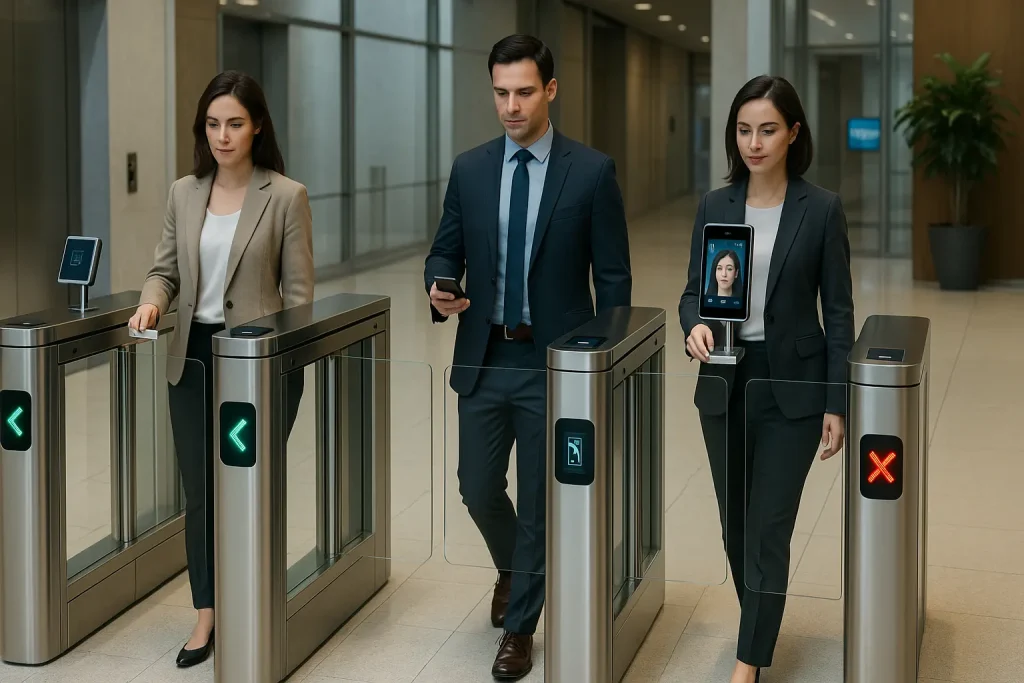
Enter the office building pedestrian turnstile. This is not your grandfather's turnstile. It's a sleek, intelligent, and sophisticated piece of technology designed specifically for the unique demands of the contemporary office environment. It represents the perfect fusion of high-security access control, high-speed throughput, and high-end aesthetics. This guide provides a definitive look at these essential systems, exploring how they work, the benefits they offer, and how to choose the right solution for your modern workspace.
What Is an Office Building Pedestrian Turnstile?
An office building pedestrian turnstile is an advanced access control barrier, typically made of stainless steel and glass, specifically designed for corporate environments. It uses electronic credentials, sophisticated sensors, and motorized barriers to manage employee and visitor flow, ensuring secure, efficient, and aesthetically pleasing entry control.
Unlike the purely mechanical or industrial turnstiles found in stadiums or factories, the office building pedestrian turnstile is an integral part of the building's architecture and technology ecosystem. It's designed to enhance the lobby's look and feel, not detract from it. Its primary functions are to provide robust access control for buildings, prevent unauthorized entry (especially tailgating), and process a high volume of people quickly during peak hours, all while maintaining a professional and welcoming atmosphere.
Why Are These Turnstiles Essential for Modern Office Spaces?
These turnstiles are essential because they uniquely solve the core lobby challenge: balancing security, speed, and aesthetics. They automate entry validation, physically prevent tailgating, eliminate bottlenecks during rush hours, project a modern corporate image, and provide crucial data for building management and compliance.
Modern offices face unique pressures:
- Heightened Security Needs: Protecting sensitive data, valuable equipment, and employees is paramount. Basic entry methods are no longer sufficient.
- Demand for Efficiency: Employees expect a seamless, frictionless experience. Wasting 10 minutes in a lobby queue daily is unacceptable and impacts productivity.
- Emphasis on Aesthetics: The lobby is a statement piece, the "handshake" of the building. Clunky, industrial hardware undermines a Class-A building's image.
- Need for Data: Building managers need accurate data on who is in the building for safety, compliance (like mustering reports during emergencies), and operational optimization (like HVAC usage).
An office building pedestrian turnstile directly addresses all these needs in one integrated solution, acting as a crucial component of the overall strategy for securing a commercial building entrance gate.
How Does an Office Turnstile Work? The Step-by-Step Process
An office turnstile works by receiving an authorization signal after a user presents a valid credential (like a card or phone). Its high-speed motor then opens the barriers, while optical sensors track the user's passage to ensure single entry before automatically closing the barriers securely.
This process, designed to be almost instantaneous for the user, involves a precise sequence:
- Credential Presentation: An employee or visitor approaches and presents their credential to a reader integrated into the turnstile (e.g., tapping an RFID card, scanning a QR code, or using facial recognition).
- Validation: The reader sends the credential data to the building's central access control system (the "brain"). This system verifies the user's permissions in milliseconds.
- Authorization Signal: If valid, the "brain" sends an "open" command to the specific turnstile lane.
- Barrier Actuation: The turnstile's high-speed, quiet motor instantly swings or retracts the glass barriers, inviting the user to pass.
- Sensor Monitoring: As the user walks through, they pass through a "light curtain" of infrared sensors. The turnstile's onboard logic ("local brain") tracks their progress, ensuring it's a single person moving in the authorized direction.
- Tailgating Detection: If a second person attempts to follow without presenting a credential, the sensors detect this unauthorized presence, triggering local audible and visual alarms.
- Automatic Closing: The moment the authorized user clears the final sensor, the logic commands the motor to close the barriers, securing the lane and making it ready for the next person.
This entire automated cycle is designed to happen in just 2-3 seconds, enabling high throughput without compromising the core principles of effective access control for buildings.
What Are the Main Types of Turnstiles Suitable for Offices?
The most suitable types for office buildings prioritize aesthetics and user experience alongside security. These primarily include swing barrier turnstiles (elegant and welcoming) and flap barrier turnstiles (fast and modern). Optical turnstiles (barrier-free) are also an option for lobbies with constant guard presence.
Choosing the right type is crucial for matching the turnstile to your office culture and traffic flow.
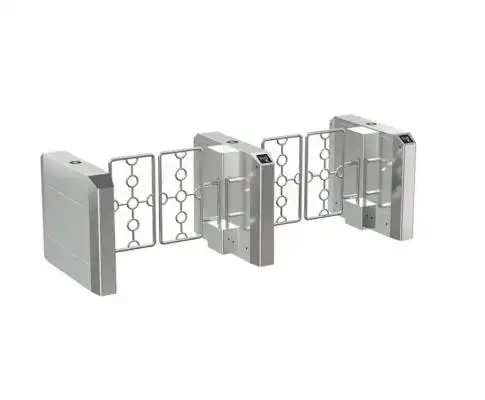
1. Swing Barrier Turnstiles (The Elegant Standard)
These are arguably the most popular choice for modern, Class-A office lobbies. They feature sleek pedestals and glass "arms" or "wings" that pivot smoothly outward in the direction of travel.
- Pros: Very elegant, quiet, and feel "welcoming." The taller glass barriers provide a good physical and psychological deterrent. Easily available in wider, ADA-compliant versions. Excellent balance of aesthetics and security.
- Cons: Require physical clearance space for the barriers to swing open.
- Best For: Corporate headquarters, law firms, financial institutions – anywhere projecting a premium, professional image is key.
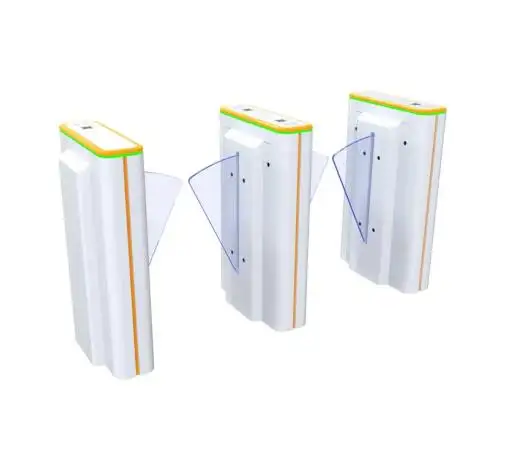
2. Flap Barrier Turnstiles (The High-Speed Modernist)
These feature glass or acrylic "wings" that retract into the body (pedestal) of the turnstile, creating a clear passage.
- Pros: Extremely fast operation, maximizing throughput. The retracting motion feels very modern and high-tech. Minimal physical footprint as barriers don't swing out.
- Cons: Barriers are often shorter, which might be perceived as slightly less secure (though sensors still detect jumping).
- Best For: High-traffic corporate lobbies, tech company HQs, buildings where maximizing speed during rush hour is the absolute top priority.
3. Optical Turnstiles (The Minimalist Option)
These consist of two pedestals creating a lane with sensors, but no physical barriers. They function by alarming loudly if someone passes through without valid authorization.
- Pros: Completely open and unobtrusive look, highest possible throughput (no barriers to slow people down).
- Cons: Provides zero physical security. Only detects unauthorized entry, relies entirely on a nearby guard to respond. Not suitable for unmanned lobbies. Learn more about optical turnstiles.
- Best For: Lobbies that are always staffed by attentive guards and where a completely open, welcoming aesthetic is paramount.
What about other types?
While highly effective in other contexts, certain turnstile types are generally unsuitable for the typical office environment:
- Tripod Turnstiles: Their industrial look and physical "push-through" mechanism clash with the aesthetics and user experience expected in a modern office lobby. They find better application in gyms, factories, or controlling entry at a railway station pedestrian turnstile.
- Full-Height Turnstiles: These "cage-style" turnstiles offer maximum security but are visually imposing and slow. They are completely inappropriate for an office lobby aesthetic and are typically reserved for high-security perimeter control, perhaps more suited to a government facility access gate than a corporate HQ.
The needs of an office building are distinct from those requiring an airport speed gate system or a robust campus access control gate, demanding a specific balance of features.
Key Features to Look for in a Smart Office Turnstile
A modern office building pedestrian turnstile is more than just a gate; it's a piece of integrated technology. Key features include advanced anti-tailgating sensors, seamless integration capabilities, support for modern credentials, aesthetic customization, and robust ADA compliance.
- Advanced Sensor Technology: This is the "intelligence." Look for high-density sensor arrays (20+ pairs) that can accurately detect tailgating, piggybacking, and wrong-way travel, while minimizing false alarms from luggage.
- Integration Capabilities: The turnstile must seamlessly integrate with your building's core access control system. Look for open architecture (like OSDP support) that allows integration with visitor management systems (VMS), elevator destination dispatch, and even fire alarm systems (mandatory for safety).
- Support for Modern Credentials: The integrated reader should support current and future credential technologies:
- Secure RFID: Must support encrypted 13.56 MHz standards (MIFARE DESFire, iCLASS SE), not just insecure 125 kHz Prox.
- Mobile Access: Support for NFC and Bluetooth (BLE) for smartphone credentials.
- Biometrics: Option to integrate facial recognition or fingerprint scanners for higher security.
- Aesthetic Customization: The turnstile should complement your lobby design. Look for options like:
- Different stainless steel finishes (brushed, polished).
- Custom top lid materials (stone, wood, solid surface).
- Integrated LED lighting for status indication (green/red) and architectural effect.
- ADA Compliance: A matching, wider lane (typically 32-36 inches) must be available to meet accessibility requirements. This lane should offer the same aesthetic and security features.
- Durability and Reliability: Office lobbies see heavy traffic. The turnstile should have a high Mean Cycles Between Failure (MCBF) rating, indicating a long lifespan. Look for high-quality motors (brushless DC preferred) and robust construction.
How Do Office Turnstiles Improve Building Security?
Office turnstiles significantly improve security primarily by physically preventing tailgating, the most common way unauthorized individuals gain access. They also enforce access policies 24/7 without error, create an indisputable audit trail of entries, and act as a visible deterrent to casual intrusion attempts.
Security is about layers. An office building pedestrian turnstile adds critical physical and intelligent layers to the overall access control for buildings strategy.
- Stopping Tailgating: This is their #1 security job. A simple card reader on a wall cannot stop someone from politely holding the door for an unauthorized person. A turnstile's sensors are designed specifically to detect this "one credential, two people" scenario and trigger an immediate alarm.
- Consistent Policy Enforcement: The turnstile is the tireless, impartial enforcer of your access rules. It doesn't get distracted, tired, or swayed by a sob story. If the credential is not valid for that time and location, the barrier stays closed. Period.
- Indisputable Audit Trail: Every passage attempt (granted or denied) is logged with a timestamp, user ID, and location. This data is crucial for security investigations and compliance requirements (e.g., SOC 2, ISO 27001 often require physical access logs).
- Visible Deterrence: The mere presence of a modern, functioning turnstile system signals that the building takes security seriously. It deters opportunistic intruders who are looking for an easy target, often causing them to simply move on from your commercial building entrance gate.
How Do Office Turnstiles Enhance Efficiency and Pedestrian Flow?
These turnstiles enhance efficiency by dramatically increasing throughput (processing 30-40+ people per minute per lane), which eliminates lobby bottlenecks. This automation also frees up security or reception staff from manual badge checking, allowing them to focus on higher-value tasks, creating a smoother, faster entry experience.
This is the benefit that employees and building managers feel every single day.
- Eliminating the Morning Rush Bottleneck: "Throughput" is the key metric. A single lane can typically handle 30-40 People Per Minute (PPM). A bank of four lanes can process 120-160 people per minute, effectively dissolving the queue as fast as it forms. Compare this to a manual guard checking IDs (maybe 15 PPM).
- Reducing Staff Workload: The turnstile automates the repetitive, low-skill task of checking every single badge. This allows your front desk or security staff to focus on:
- Welcoming guests and providing assistance.
- Managing visitor check-ins (often integrated with the turnstile).
- Observing the lobby for genuinely suspicious behavior.
- Responding to alarms or incidents. The turnstile becomes a "force multiplier," allowing fewer staff to manage the lobby more effectively.
- Creating a "Frictionless" Experience: For employees, the goal is a seamless "tap-and-go" or even "walk-through" (with facial recognition) experience. No stopping, no waiting, no fumbling for keys. This small, daily convenience enhances employee satisfaction and perception of the workplace.
How Do You Choose the Right Turnstile System for Your Office Building?
Choosing the right system involves a data-driven analysis of your peak traffic flow ("throughput analysis") to determine the number of lanes needed. You must then select the turnstile type (swing, flap) based on security needs, lobby aesthetics, and ADA requirements, ensuring compatibility with your existing access control system.
Don't just pick a model based on looks. Follow this practical, expert process:
Step 1: Conduct the Peak Load Analysis (Crucial Data)
This is non-negotiable. You MUST know your Peak People Per Minute (PPM).
- How: Stand in your lobby with a counter (or use camera footage) during your absolute busiest 15-minute window (e.g., 8:45 AM - 9:00 AM). Count every person entering.
- Calculate Peak PPM:
[Total People in 15 Min] / 15 = Peak PPM - Calculate Lanes:
[Peak PPM] / 30 = Number of Lanes Needed (Always Round Up)(Use 30 PPM as a safe average throughput per lane). - My Anecdote: "I consulted for a firm that installed two stunning, expensive swing gates. They looked great. But their Peak PPM was 70.
70 / 30 = 2.33. They needed three lanes. They still had a queue every morning. They spent $60k to under-solve the problem because they skipped this simple analysis."
Step 2: Define Your Security vs. Aesthetic Balance
- High-End Law Firm: Aesthetics and a quiet, welcoming feel are paramount. Swing barriers are likely the best fit.
- Busy Tech HQ: Speed and a modern look are key. Flap barriers might be preferred.
- Lobby Always Staffed?: An optical turnstile could be an option for a completely open feel, but only if a guard is always present.
Step 3: Plan for ADA and Deliveries
You must include at least one wider (32-36 inch) ADA-compliant lane. This is often a swing barrier gate and is usually configured for bidirectional traffic to handle wheelchairs, deliveries, and luggage easily.
Step 4: Verify Integration Compatibility
Your new turnstiles must "talk" to your existing access control for buildings system. Confirm that the turnstile vendor supports integration with your specific access control software/hardware (e.g., via standard Wiegand or OSDP protocols). Also, plan for the mandatory fire alarm integration for emergency egress.
Step 5: Consider the Budget (Total Cost of Ownership)
Look beyond the initial hardware cost. Factor in:
- Installation (including potential floor work for cabling).
- Integration with existing systems.
- Potential software licenses or subscriptions (if cloud-based).
- Ongoing preventive maintenance contracts (recommended for longevity).
Installation and Maintenance Considerations
Proper installation is critical for performance and safety. This involves careful floor preparation for power and data, precise alignment of pedestals, secure integration with access control and fire alarm systems, and expert sensor tuning. Regular maintenance is essential for longevity.
- Floor Work: Turnstiles need power and data run under the floor. This often requires core drilling or trenching, especially in existing buildings.
- Integration: Requires certified technicians to connect the turnstiles to your access control panel and, crucially, the fire alarm system (for fail-safe emergency exit).
- Sensor Tuning: This is an expert task. The technician must calibrate the sensitivity of the anti-tailgating sensors to your specific lobby environment (lighting, traffic patterns) to maximize security while minimizing false alarms.
- Signage: Clear, illuminated signage (green arrow/red X) is essential for user guidance and smooth flow.
- Maintenance: These are high-precision machines operating millions of cycles. An annual preventive maintenance check by a qualified technician is highly recommended to clean sensors, check motors, and ensure optimal performance and safety.
The Future: Intelligent, Frictionless, and Integrated
The future of the office building pedestrian turnstile is smarter, faster, and more integrated into the overall building ecosystem. AI-powered analytics, truly frictionless biometric and mobile credentials, and deeper smart building integrations are transforming the lobby experience.
- AI-Powered Sensor Fusion: Future gates will combine IR sensor data with video analytics. AI will accurately distinguish between a person with luggage and two people tailgating, eliminating false alarms and enhancing security.
- Truly Frictionless Access: Technologies like facial recognition or long-range Bluetooth/UWB will allow employees to walk through without stopping or presenting anything – the ultimate seamless experience.
- Smart Building Hub: The turnstile becomes a key data point. Passage data feeds into building management systems to optimize elevator dispatch, HVAC, lighting based on real-time occupancy, creating a more efficient and responsive workplace.
Final Verdict
The office building pedestrian turnstile is no longer just a security measure; it's a strategic investment in efficiency, security, and corporate image. It solves the inherent conflict of the lobby, providing a solution that is welcoming yet secure, fast yet controlled.
By carefully selecting the right type, ensuring proper installation and integration, and embracing modern credential technologies, these intelligent gates become the seamless, reliable foundation for managing access in any forward-thinking workspace. They are not just controlling entry; they are enhancing the entire building experience, making them an indispensable part of the modern office landscape.
