



Pedestrian Speed Gates: Enhancing Building Entry Efficiency
2025-10-27


Think about your building's lobby at 8:55 AM on a Tuesday. You see a line of employees, badges in hand, waiting to be processed by a security guard or to push through a clunky, old-fashioned turnstile. This daily bottleneck isn't just an inconvenience; it's a drain on productivity, a source of employee frustration, and a poor first impression for visitors. For decades, building managers have been forced to choose between tight security and efficient flow.
The pedestrian speed gate fundamentally solves this problem. This technology represents a massive leap forward, moving beyond the simple "block/unblock" function of a locked door and into the realm of intelligent, high-speed flow management. It's an access control solution that understands its first-priority user is a person who just wants to get to their desk.
As a facility manager, security director, or architect, your goal is to create a space that is both secure and seamless. You need to understand how these systems work, why they are so much more efficient than other options, and how to choose the right one for your building. This guide provides a comprehensive, practical exploration of how pedestrian speed gates are no longer just a security feature, but a critical tool for enhancing building entry efficiency.
What Exactly Is a Pedestrian Speed Gate?
A pedestrian speed gate is an advanced access control solution that uses motorized barriers (often glass) and sophisticated optical sensors to manage high-volume foot traffic. Unlike traditional turnstiles, it is specifically designed to maximize entry speed and throughput while simultaneously preventing unauthorized access like tailgating.
These gates are a key component of modern speed gate systems, acting as the physical enforcement point for a building's security. When you hear the term speed gate turnstile, it's often referring to these sleek, efficient models.
Their "character" comes from this dual purpose. A traditional turnstile, like the tripod-arm style at a stadium, is a dumb, mechanical barrier. Its job is to be a clunky, physical obstacle. A pedestrian speed gate is an intelligent, high-speed device. Its job is to identify an authorized user, open before they have to break their stride, and close securely right behind them, all in a matter of seconds.
How Do Pedestrian Speed Gates Fundamentally Improve Efficiency?
Pedestrian speed gates dramatically improve entry efficiency by processing people at a rate of 30-40 per minute, eliminating lobby bottlenecks. They automate the validation process, providing a touchless, frictionless experience for authorized users and freeing security staff to manage exceptions rather than every single entry.
This isn't just a minor improvement; it's a complete change in how a building's lobby functions. The efficiency gains can be broken down into three main areas.
Eliminating the Morning Bottleneck: High Throughput Explained
This is the most visible benefit. "Throughput" is the metric that matters, measured in "people per minute" (PPM). A single pedestrian speed gate lane is engineered for this.
- A Human Security Guard: A guard who must visually check a badge and cross-reference a list might process 10-15 people per minute, at best.
- A Tripod Turnstile: A mechanical tripod turnstile, which requires each person to push through, typically maxes out around 20-25 PPM.
- A Pedestrian Speed Gate: A high-end high-throughput speed gate can easily process 30-40 PPM. A bank of just four lanes can handle over 120 people per minute, effectively dissolving a lobby line as fast as it forms.
When you consider that productivity studies show even minor daily frictions can lead to significant employee dissatisfaction [Insert Statistic A: Workplace Productivity Report], eliminating this first bottleneck of the day has a tangible impact on company culture.
Automating Access for a Frictionless Experience
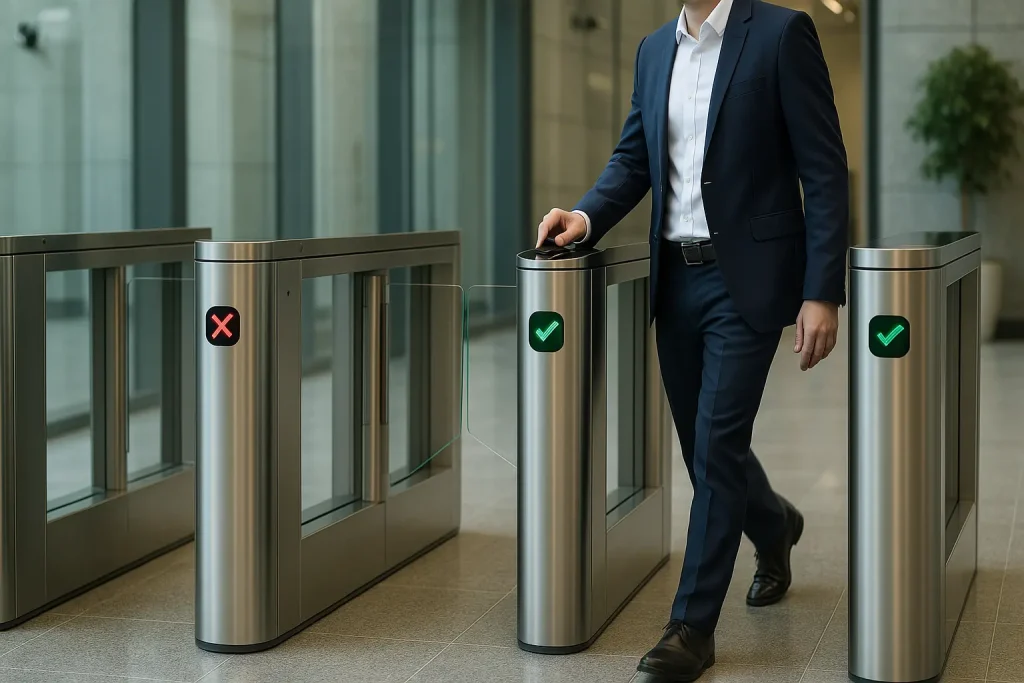
A pedestrian speed gate is, at its core, an automatic speed gate. The experience for an authorized employee is seamless. They present their card or phone, the glass barriers open instantly, and they walk through at a normal pace.
This "frictionless access" is a powerful concept. It removes a point of daily "cognitive load" — the small, annoying tasks that add up. There's no pushing, no swiping multiple times, no awkward "go ahead" nod from a guard. This smooth, automated process communicates respect for the employee's time and makes the entire building feel more modern and advanced.
Reducing the Workload on Security and Staff
This is the "force multiplier" effect. Speed gates automate the low-level, repetitive task of "badge checking." This frees your highly-trained security personnel from a monotonous job and allows them to focus on high-value human tasks:
- Managing Exceptions: Assisting visitors who have an issue.
- Identifying Real Threats: Watching for suspicious behavior around the gates, not just at the gate.
- Providing Customer Service: Acting as a building ambassador and helping people who are lost.
- Responding to Incidents: Being available and alert to respond to an actual emergency.
The gate becomes the first line of defense, and the guard becomes the intelligent observer and responder. This is a far more efficient and secure model for any modern building.
What Are the Key Components That Make a Speed Gate "Fast"?
The "speed" of a pedestrian speed gate comes from the near-instantaneous coordination of its high-speed motor, its sophisticated logic controller, and its fast-reading access control integration. These parts work together to open the gate before the user has to slow down.
Many people think the speed is just in the barrier movement. In reality, that's only part of the story. The perceived speed comes from a system that anticipates the user.
- High-Speed Brushless DC Motors: These are the workhorses. Unlike standard motors, brushless DC motors are designed for high-speed, high-torque, and high-cycle applications. They are what allow the glass barriers to open and close in as little as 0.5 seconds, and they are rated for millions of cycles without failure.
- Advanced Logic Controllers: This is the local "brain" inside the gate's chassis. It takes the "open" signal from the main access panel and then coordinates a flurry of activity. It tells the motor how fast to open, when to start closing based on sensor data, and how to manage the safety sensors to avoid closing on a person.
- Fast Credential Integration: The gate can only open as fast as the credential is read. A slow, old card reader creates a bottleneck before the gate. A modern fast-access-turnstile pairs its fast motor with an equally fast reader, like a modern RFID speed gate system (using MIFARE or prox cards) or an even faster biometric speed gate turnstile (using facial recognition).
- Sophisticated Optical Sensors: Dozens of infrared sensors create a "light curtain" inside the lane. These sensors are what allow the gate to be both fast and safe. They track the user as they pass through, allowing the logic controller to issue the "close" command the instant the person has cleared the lane, making it ready for the next person immediately.
How a Pedestrian Speed Gate Works: A Step-by-Step Walkthrough
A pedestrian speed gate works by receiving an "authorized" signal from an access control system, which triggers a high-speed motor to open the barriers. A dense array of sensors then tracks the person through the lane to ensure only one person passes before signaling the barriers to immediately close.
Here is the step-by-step process of a well-tuned system:
- Idle State: The gate is closed and secure. Its internal sensor array is active, ensuring the lane is clear.
- Credential Presentation: The user approaches and presents their credential (e.g., tapping an RFID card, scanning a QR code, or simply looking at a facial recognition camera).
- Validation: The reader instantly sends this credential to the building's main speed gate access control panel. This central "brain" verifies the user's permissions, all within a fraction of a second.
- Open Signal: The control panel sends a simple "open" command to the specific speed-lane-gate the user is at.
- Barrier Actuation: The gate's high-speed motor activates, swinging or retracting the glass barriers. In a well-configured high-speed-access-control-system, this happens so fast the user doesn't even have to break their walking pace.
- Passage and Sensor Tracking: The user walks through the lane, passing through the "light curtain" of sensors. The gate's logic controller tracks their progress.
- Tailgating/Piggybacking Detection: This is the security check. If a second person (without a credential) tries to follow, the sensors detect their "unexpected" presence. This triggers the logic of the anti-tailgating-speed-gate: a local alarm will sound, lights will flash, and the barriers may attempt to close.
- Barrier Closing: The instant the authorized user clears the last sensor, the logic controller signals the motor to close the barriers. This speed is key to efficiency, as it makes the lane immediately secure and ready for the next user.
What Are the Different Types of Pedestrian Speed Gates?
The main types of pedestrian speed gates are defined by their barrier movement: swing gates, flap barriers, and sliding gates. Each offers a different balance of throughput speed, security level, and aesthetic design to fit specific building needs.
Choosing the right type is the most important decision you'll make. It's a balance of speed, security, and aesthetics.
Swing Barrier Gates (The "Welcoming" Option)
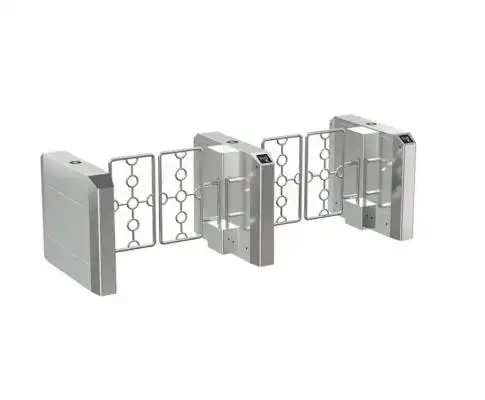
These are arguably the most popular type in modern corporate lobbies. They feature one or two glass arms that pivot from the chassis, swinging open in the direction of pedestrian travel.
- Efficiency: Very high. The motion feels natural and welcoming.
- Security: Good to high. The glass barriers are often taller (from waist-high to near full-height), providing a strong physical and psychological deterrent.
- Aesthetics: Excellent. They are elegant and can be made ADA-compliant with a wider lane using the same design.
- Best For: Corporate lobbies, executive floors, and any building wanting to balance security with a premium, welcoming feel.
Flap Barrier Gates (The "High-Speed" Option)
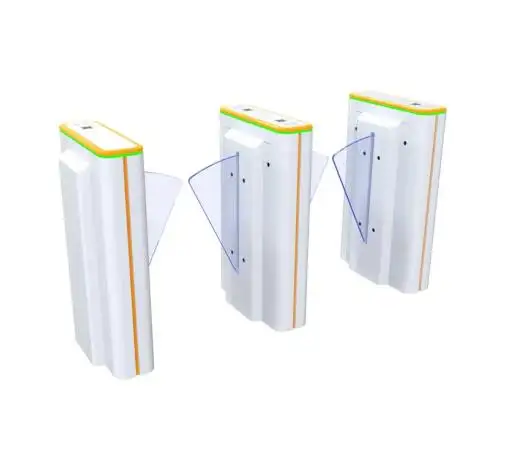
These are the speed demons of the group, often called "wing-style" gates. They feature two (often triangular) glass or acrylic "wings" that retract into the body of the pedestal.
- Efficiency: The highest possible for a physical barrier. Because the wings retract, the opening/closing motion is incredibly fast. This is the ultimate high-speed-pedestrian-turnstile.
- Security: Good. The primary security comes from the sensors, not the barriers. The barriers themselves are often shorter, which can be a psychological "con" as they look easier to jump over (though this will still trigger an alarm).
- Aesthetics: Very modern and high-tech. Their minimal footprint when open is a popular feature.
- Best For: High-traffic environments like subway stations, convention centers, and massive corporate HQs where processing speed is the number one priority.
Sliding Gates (The "High-Security" Option)
These are the most robust option. They function like miniature elevator doors, with one or two glass panels sliding horizontally to open the lane.
- Efficiency: High, but slightly slower than swing or flap models due to the mass of the glass being moved. The difference is minor, but they are built for security first.
- Security: Very High. The glass panels are typically tall (from 4 feet to 7+ feet), making them nearly impossible to climb over or crawl under.
- Aesthetics: Can be very impressive and "vault-like," which may be the desired look for a high-security facility.
- Best For: Data centers, government buildings, financial institutions, and any area where security is non-negotiable but a full-height turnstile is too industrial.
Optical Turnstiles (The "Barrier-Free" Option)
This is a special category. An optical turnstile has the pedestals and the sensors, but no physical barriers.
- Efficiency: The absolute highest possible, as there is no motor or barrier to slow a person down.
- Security: Low (Detection only). It will sound a loud alarm and alert a guard if someone passes without a credential, but it cannot physically stop them.
- Aesthetics: The most open and minimalist design.
- Best For: Lobbies that are always staffed by a guard and where the primary goal is a welcoming feel and accurate headcount, not physical prevention.
Here is a quick-comparison table:
| Gate Type | Typical Throughput (PPM) | Security Level | Physical Footprint |
| Flap Barrier | 35-45 | Good | Small (barriers retract) |
| Swing Barrier | 30-40 | High | Medium (needs swing space) |
| Sliding Gate | 25-35 | Very High | Large (panels must slide) |
| Optical (Barrier-Free) | 40-60+ | Low (Detect only) | Small |
Key Considerations for Implementing a Pedestrian Speed Gate System
When implementing a pedestrian speed gate, you must first conduct a thorough throughput analysis to determine the number of lanes. You must also select the right gate type for your security needs, ensure ADA compliance, and plan for integration with your fire alarm and access control systems.
This is a construction project, not just a purchase. As an expert, I urge clients to "measure twice, cut once." Here are the practical steps to get it right.
1. Conduct a Real-World Throughput Analysis
Do not guess. Do not just take your total employee count and divide. You must stand in your lobby with a clicker (or use camera footage) and count the number of people who enter during your absolute busiest 15-minute window (e.g., 8:45 AM - 9:00 AM). This "peak load" number is the only number that matters. Under-speccing your lanes (e.g., buying two when you need three) will simply move the bottleneck from the front door to the gates.
2. Plan for ADA/DDA Compliance
This is not optional; it's a legal requirement. You must have at least one wider lane (typically 32-36 inches) to accommodate wheelchairs. This lane is also used for deliveries or anyone with luggage. This wider gate is often a bidirectional speed gate to allow for both entry and exit, so plan its location in a central, accessible spot.
3. Plan for the Full Entrance Speed Gate System
You aren't just buying gates. You are building an entrance speed gate system. This includes:
- The Gates: The hardware itself.
- The Readers: The (RFID, biometric, QR) readers mounted on the gates.
- The Software: How the gates talk to your
speed-gate-access-controlpanel. - Visitor Management: How will guests get in? Will they scan a QR code?
- Fire Alarm Integration: This is a life-safety-critical integration. The gates must be wired to your fire alarm panel to open automatically in an emergency.
4. Prepare for the Installation
These gates are heavy and require power and data. The most professional installation involves core-drilling the floor to run conduits. This means you will need to coordinate with an electrician, a data-cabling contractor, and your security integrator. This is a "dusty" project, so plan for it to be done overnight or on a weekend to minimize disruption. [Insert Statistic D: Common installation challenges].
5. Prioritize Maintenance
A pedestrian speed gate is a high-precision machine with moving parts and sensitive electronics. It is not a "set it and forget it" device. To ensure its long life and reliable operation, you must have a preventive maintenance plan. A technician should visit at least annually to clean the sensors, check the motor, and calibrate the system. The #1 cause of false alarms I've seen is simply a dirty sensor lens.
The Future of Pedestrian Entry: What's Next?
The future of pedestrian speed gates is "frictionless" and "intelligent." We are moving away from "tap-and-go" and toward "just-walk-through."
The next generation of biometric speed gate-turnstile technology is at the forefront of this. Advanced facial recognition cameras integrated into the gates will identify authorized users as they approach, opening the barriers without them even needing to take their phone or badge out of their pocket.
Beyond that, AI and machine learning are being added to the sensor logic. Future gates won't just detect tailgating; they'll analyze behavior. They will be able to differentiate between a person with a rolling bag (allowed) and two people walking side-by-side (alarm). They might even detect duress (a person being forced through) or an abandoned object. The gate will become a proactive, intelligent part of the entire high-speed-access-control-system.
The Final Verdict: Why a Pedestrian Speed Gate is an Efficiency Investment
A pedestrian speed gate is one of the single best investments you can make in your building's operational efficiency and security. It directly solves one of the most visible, frustrating, and time-wasting problems in any commercial building: the lobby bottleneck.
By processing people at high speed, automating the validation process, and freeing up your valuable staff, it delivers a daily return on investment. It enhances your security by reliably preventing tailgating, and it enhances your corporate image by providing a seamless, modern, and efficient experience for every employee and visitor who walks through your doors.
If you're still managing your entry flow with a queue or a clunky barrier, it's time to evaluate how a modern speed gate systems solution can transform your building.
