


Smart Transportation Hub Speed Gates: Efficiency in Motion
2025-10-27


Step into any major railway station or metro hub during peak hours, and you witness a complex ballet of human movement. Thousands of passengers converge, each needing to navigate the space, validate their fare, and reach their platform quickly and safely. For transit authorities, managing this "efficiency in motion" is a monumental task, balancing the relentless pressure for speed against the non-negotiable requirements of safety, security, and accurate fare collection.
Historically, this balance often tipped towards manual processes – ticket collectors, platform attendants – creating inevitable bottlenecks and inefficiencies. But the era of the truly smart transportation hub demands a more sophisticated approach. These hubs are evolving into connected, data-driven ecosystems, leveraging technology to optimize every facet of the passenger journey. At the very heart of this transformation lies a critical piece of hardware: the smart transportation hub speed gate.
This is not merely an automated turnstile; it's an intelligent, connected device specifically engineered for the unique, high-stress environment of mass transit. It's the physical embodiment of smart access, designed to process passengers at maximum speed, integrate seamlessly with complex fare systems, provide valuable operational data, and ensure safety – all while withstanding the rigors of constant, heavy use. This guide provides an expert, in-depth exploration of these vital systems, revealing the technology that makes them "smart" and their indispensable role in keeping modern transit hubs moving efficiently.
What Defines a "Smart" Transportation Hub Speed Gate?
A smart transportation hub speed gate is an advanced automated barrier that leverages connectivity, sophisticated sensors, and intelligent processing to manage passenger flow within transit facilities. Beyond basic validation, it offers real-time data communication, predictive maintenance capabilities, enhanced security features, and seamless integration with the broader smart hub ecosystem.
Unlike a standard speed gate which might simply open on command, a smart transportation hub speed gate possesses its own level of intelligence and connectivity. Key characteristics include:
- Deep AFC Integration: Seamlessly processes various modern fare media (contactless cards, mobile QR/NFC, EMV) and communicates bidirectionally with complex Automated Fare Collection systems.
- Real-Time Data Output: Continuously transmits operational data (throughput counts, transaction times, error rates, alarm events) to central management platforms.
- Advanced Sensing & Logic: Employs sophisticated sensor arrays not just for safety and basic tailgating detection, but potentially for more nuanced analysis (e.g., differentiating luggage, detecting unusual passage).
- Predictive Maintenance Features: Often includes onboard sensors monitoring motor torque, vibration, or cycle counts, enabling alerts before a component fails.
- Network Connectivity: Designed for robust, secure integration into the station's network, often enabling remote diagnostics, configuration, and firmware updates.
It's a critical component within the larger strategy for efficient Transportation & Smart Hubs.
Why is "Intelligence" Necessary for Transit Hub Gates?
"Intelligence" is necessary because transit hubs face extreme operational demands: massive passenger volumes with intense peaks requiring very high processing rates, complex fare structures, zero tolerance for downtime, stringent safety requirements, and the need for actionable data to manage congestion and optimize service. A "dumb" gate simply cannot cope effectively.
The unique pressures of a transit environment demand more than basic automation:
- Extreme Throughput Needs: A smart gate's optimized processing and rapid barrier action are essential to handle rush hour surges without creating dangerous queues. The peak processing rates needed at major hubs often exceed several thousand passengers per hour per bank of gates, a level unattainable through manual checks or slower mechanical gates.
- Complex Fare Validation: Transit fares often involve intricate rules based on zones, transfers, time-of-day, and multiple media types. The gate's integrated reader and connection to the AFC "brain" must handle this complexity instantly and accurately.
- Reliability is Non-Negotiable: A gate failure during peak hours can halt thousands of passengers and cascade into train delays. Smart gates with predictive maintenance and remote diagnostic capabilities offer significantly higher uptime, a crucial factor for operational stability.
- Dynamic Flow Management: Smart hubs need real-time data to manage flow. Intelligent gates provide this crucial data stream (how many people are entering/exiting right now), enabling operations centers to react quickly to changing conditions.
- Enhanced Security & Safety: Smart sensors offer better detection of fare evasion attempts (like tailgating) and can integrate more tightly with station security and emergency systems (e.g., triggering specific camera views on alarm).
A simple mechanical barrier lacks the processing power, connectivity, and sensing capabilities to meet these complex, dynamic demands.
How Does a Smart Speed Gate Operate in a Transit Hub?
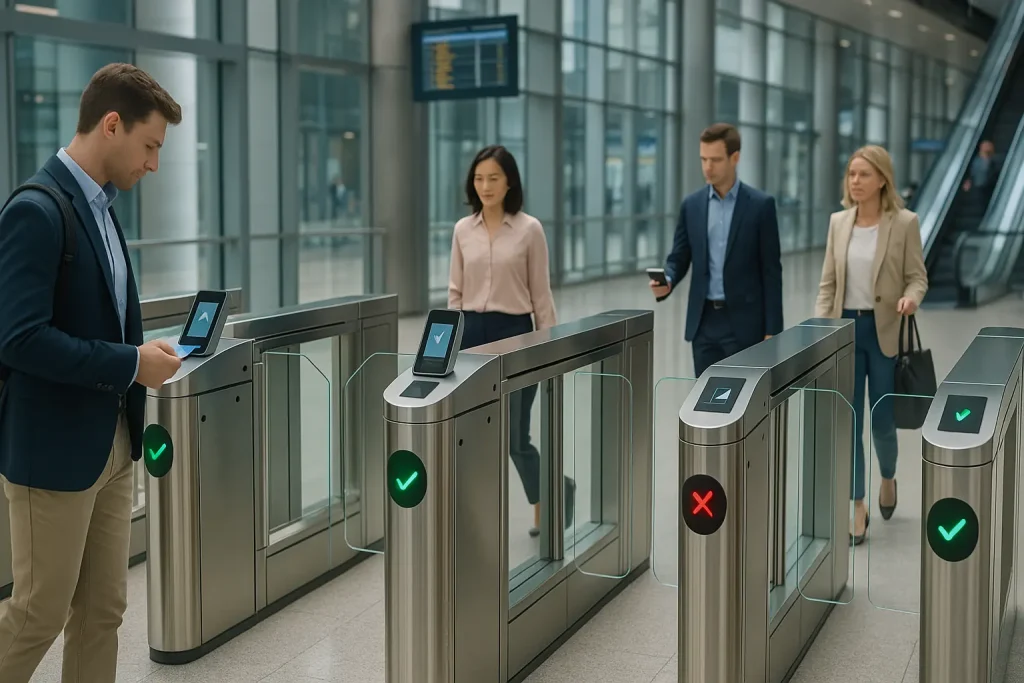
A smart speed gate reads a passenger's fare media, instantly communicates with the central AFC system for validation via a secure network connection, receives an "allow/deny" command, actuates its barriers at high speed, monitors passage with advanced sensors, and transmits operational data back to the hub's management platform.
This highly optimized cycle prioritizes speed and accuracy:
- Fare Presentation: Passenger presents their media (taps smart card, scans QR code, taps bank card) to the multi-format reader.
- Instant Read & Query: The reader captures the data and sends an encrypted query via the station network to the AFC system.
- AFC Validation: The central AFC "brain" applies complex fare rules, checks balances/validity, and determines authorization – often in under 200 milliseconds.
- Secure Command: The AFC system sends an encrypted "Open" or "Deny" command back to the specific gate controller.
- Rapid Barrier Action: If authorized, the gate's high-speed motor retracts or swings the barriers in typically 0.3-0.5 seconds. Simultaneously, passenger-facing displays show relevant information (fare deducted, etc.).
- Intelligent Passage Monitoring: The high-density sensor array tracks the passenger through the lane, verifying single passage and direction. The logic is tuned for speed while still detecting obvious anomalies.
- Immediate Closing & Data Logging: As soon as the passenger clears the sensors, the barriers close rapidly. The entire transaction (time, fare type, entry/exit point, success/failure) is logged and transmitted to the central system.
This entire process for a successful tap-and-go is often completed in well under two seconds, crucial for achieving high throughput.
Key "Smart" Features and Technologies Involved
What elevates a transit gate from merely "automatic" to "intelligent"? It's the integration of specific technologies focused on data, connectivity, and advanced processing.
Feature 1: Advanced Multi-Format Fare Readers
- The Need: Transit users employ a diverse mix of old and new fare media. Smart gates must accommodate this seamlessly.
- The Tech: Readers often combine:
- RFID/NFC: For contactless smart cards (e.g., MIFARE, Calypso) and mobile NFC payments.
- Optical Scanners: High-speed 1D/2D barcode and QR code readers for paper tickets and mobile apps.
- cEMV: Certified readers for direct contactless bank card payments (Visa PayWave, Mastercard Contactless).
- The "Smartness": The reader's firmware is often remotely updatable to support new ticket formats or security standards without hardware changes.
Features 2: High-Density Sensor Arrays with Intelligent Logic
- The Need: Accurately track passengers at high speed, ensure safety, and deter basic fare evasion without causing unnecessary delays or false alarms.
- The Tech: Arrays of 20-60+ infrared beams create a detailed "picture" of the lane. The onboard processor runs algorithms tuned for transit environments – often prioritizing speed and less sensitive to things like rolling luggage compared to high-security corporate gates, but still capable of detecting blatant tailgating or wrong-way passage.
- The "Smartness": Logic can be remotely adjusted based on time of day or traffic conditions. Sensor data contributes to passenger counting and flow analysis.
Feature 3: Real-Time Network Connectivity & Data Reporting
- The Need: Constant communication with central AFC and operational systems.
- The Tech: Robust Ethernet connectivity (often with redundancy), secure communication protocols (e.g., TLS encryption), and standardized data formats for transmitting transaction logs, gate status (online/offline, in/out of service), alarm events, and diagnostic information.
- The "Smartness": This real-time data feed enables immediate operational awareness and fuels the analytics driving the broader smart hub strategy.
Features 4: Predictive Maintenance Sensors
- The Need: Maximize uptime in a 24/7 critical environment.
- The Tech: Onboard sensors monitoring parameters like:
- Motor temperature and current draw.
- Barrier vibration patterns.
- Cycle counts per lane.
- Sensor beam alignment/signal strength.
- The "Smartness": AI algorithms analyze this data to predict potential failures before they happen (e.g., "Motor current has increased 15% over the last week under similar load; recommend inspection"). This allows for proactive maintenance scheduling, drastically reducing unexpected downtime. Industry reports and case studies consistently demonstrate significant uptime improvements achieved through predictive maintenance programs in transit systems.
Feature 5: Remote Diagnostics and Configuration
- The Need: Quickly troubleshoot and manage potentially hundreds or thousands of gates across a network without requiring a technician on-site for every minor issue.
- The Tech: Secure remote access allows technicians to:
- View real-time gate status and error logs.
- Run diagnostic tests on sensors and motors.
- Adjust parameters (e.g., barrier speed, sensor sensitivity).
- Reboot the gate controller.
- Push firmware updates.
- The "Smartness": This dramatically reduces Mean Time To Repair (MTTR) and maintenance costs. My experience confirms that many "gate failures" are minor configuration issues or sensor obstructions that can be diagnosed and often resolved remotely in minutes.
Which Speed Gate Types Excel in Smart Transit Hubs?
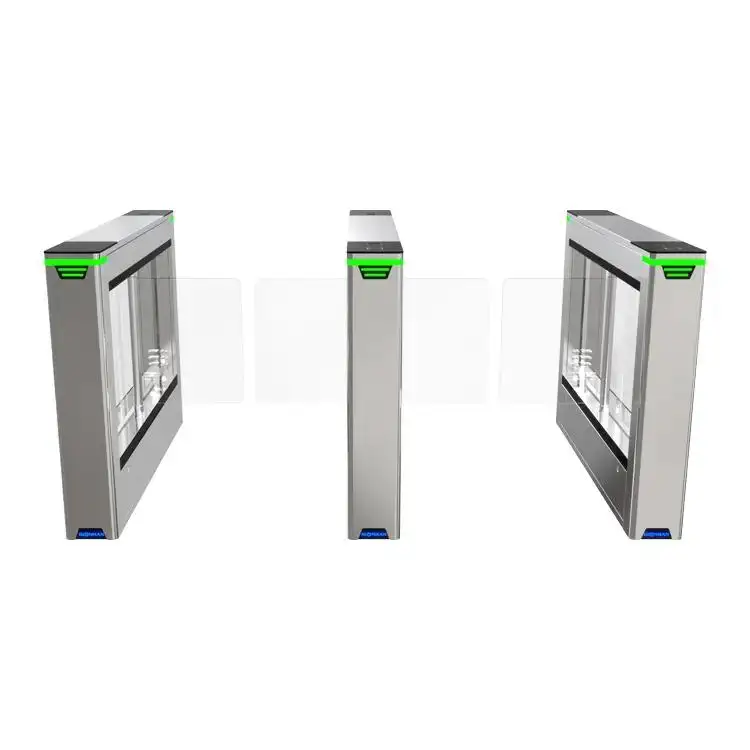
Flap barrier speed gates are overwhelmingly the preferred choice for smart transportation hubs due to their unparalleled throughput speed, essential for managing peak passenger volumes. Their modern aesthetic and touchless operation also align well with the goals of enhancing passenger experience.
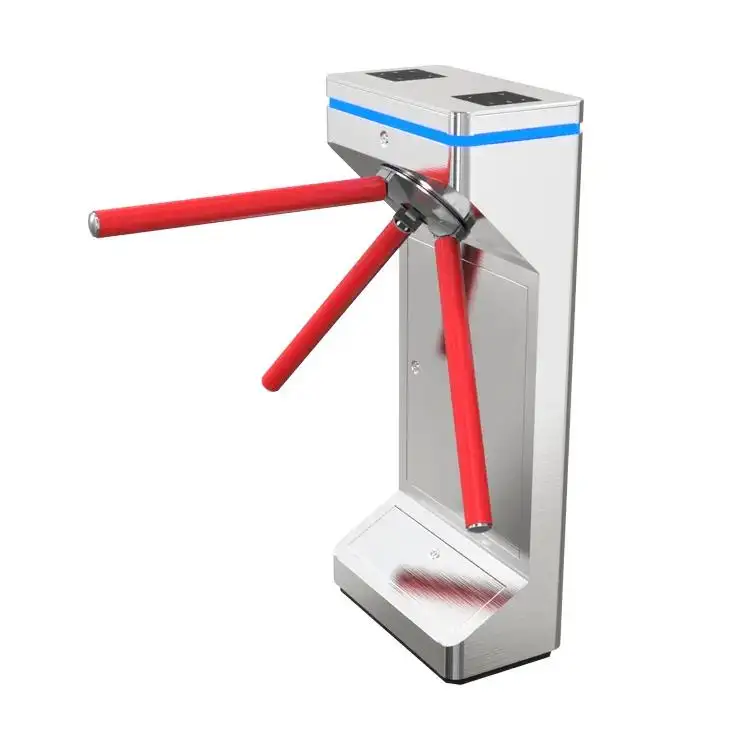
While robust tripod turnstiles still have a role, especially in legacy systems or lower-traffic areas due to their durability and cost, they cannot match the speed required for truly efficient smart hub operation during rush hours.
| Gate Type | Typical Transit Throughput (PPM) | Key Advantages for Smart Hubs | Key Disadvantages for Smart Hubs |
| Flap Barrier | 35-45+ | Highest Speed, Modern Look, Touchless, Good Sensor Integration | Higher Cost, More Complex Mechanics |
| Tripod Turnstile | 20-30 | Lower Cost, Extreme Durability, Simple Mechanism | Lower Speed (Creates Queues), Requires Push, Less Modern |
| Full-Height Turnstile | 15-20 | Highest Security (Fare Evasion) | Slowest Speed, Visually Obtrusive |
| Swing Barrier | 30-40 | Elegant Look, Good for ADA | Slower than Flaps, Wider Footprint |
For the main fare lines in a busy station aiming for smart efficiency, flap barriers are the clear technological choice. Swing gates are typically reserved for the mandatory wider ADA/accessible lanes. Full-height turnstiles are generally only used for perimeter or unmanned control points.
The Critical Role of AFC Integration
The "smartness" of the gate is intrinsically linked to its integration with the Automated Fare Collection (AFC) system. This connection must be fast, secure, reliable, and capable of handling complex fare logic and multiple media types in real-time.
- Speed Requirement: The entire validation loop (gate reads card -> sends to AFC -> AFC validates -> sends command to gate) must happen virtually instantly to maintain high throughput. Network latency and AFC processing speed are critical bottlenecks.
- Security: Communication between the gate and AFC must be encrypted to prevent fare data interception or fraudulent commands being sent to the gate.
- Reliability & Offline Mode: What happens if the network connection to the central AFC server fails? The gate must have a pre-defined, reliable offline mode (e.g., allow passage based on locally cached card lists, store transactions locally for later upload, or deny passage) according to the operator's policy. Undefined behavior leads to chaos.
- Handling Complexity: The gate reader simply passes data; the AFC system handles the inherently complex logic of modern transit fares, including zone calculations, transfer rules, peak/off-peak adjustments, and various concession types. The integration must support the transmission of all necessary data points for these intricate calculations.
Leveraging Gate Data for Smart Hub Analytics
The continuous stream of passage data generated by each smart transportation hub speed gate transaction is a foundational element of the smart hub's intelligence. Analyzing this data provides powerful insights into passenger behavior, operational efficiency, and infrastructure usage.
- Real-Time Flow Monitoring: Operations centers use live gate counts to monitor passenger density at different stations and platforms, identifying potential crowding issues before they become dangerous. Dashboards might show PPM rates per gate line, highlighting bottlenecks or malfunctioning units instantly.
- Origin-Destination (O-D) Analysis: By correlating entry taps with exit taps (using anonymized card IDs), transit planners can understand travel patterns, helping optimize routes, schedules, and even fare policies.
- Predictive Queue Management: Historical throughput data allows the system to predict queue lengths based on time of day and upcoming train arrivals/departures. This can trigger automated alerts for staff deployment or dynamic signage advising passengers of alternative entrances.
- Infrastructure Utilization: Data shows which entrances/exits are most heavily used, informing decisions on where to add more gates, escalators, or signage during station upgrades.
- Fare Media Analysis: Tracking the usage of different ticket types (smart cards vs. mobile vs. paper) helps operators understand user preferences and plan future technology rollouts.
My Experience: "I worked with a transit authority that used gate data to discover a major evening bottleneck at one station exit was caused by passengers avoiding a poorly lit, slightly longer alternative exit route. Improving the lighting and signage at the alternative exit, informed directly by the gate data, significantly reduced congestion at the main exit without needing costly gate expansion."
Durability & Reliability: Non-Negotiable in Transit
Transit hubs are arguably the most demanding environment for any access control hardware. Gates must withstand millions of cycles, constant vibration, potential vandalism, impacts from luggage, dirt, dust, and often weather exposure. Reliability is not just desirable; it's essential for operational continuity.
- Industrial-Grade Construction: Requires heavy-gauge stainless steel (often 304 or 316), reinforced internal frames, and high-quality welding. Components must be rated for extreme duty cycles according to rigorous testing protocols.
- Robust Motors & Mechanisms: Motors must be powerful enough to handle high speeds and potential obstructions, with gearboxes and linkages designed for longevity, often exceeding typical commercial benchmarks for cycle ratings.
- Environmental Sealing (IP Rating): Gates, especially those near entrances or on open-air platforms, need appropriate Ingress Protection (IP) ratings to resist dust, water splashes, and cleaning agents.
- Vandal Resistance: Features like tamper-proof fasteners, durable barrier materials (thick tempered glass or polycarbonate), and potentially impact sensors help withstand casual vandalism.
- Redundancy & Failover: Critical components (like power supplies or network connections) might incorporate redundancy. The ability for a gate line to quickly report a fault and for operations to potentially re-route passengers is key.
Implementation Challenges for Smart Transit Gates
Deploying smart gates in transit hubs is complex, involving high costs, intricate integration with legacy AFC systems, significant physical disruption during installation in operational stations, the need for specialized maintenance, and extensive passenger communication.
- Cost: High-throughput, durable, multi-reader gates are expensive, representing a major capital investment for transit authorities.
- Legacy AFC Integration: Making new IP-based gates talk reliably to older, often proprietary AFC back-end systems can be a significant software engineering challenge requiring specialized expertise.
- Station Retrofitting: Installing banks of gates often requires major civil works (floor cutting, new power/data conduits) in stations that must remain open 24/7. Phasing the work to minimize disruption is crucial but complex.
- Specialized Maintenance: These are not standard IT devices. Maintaining the complex mechanical, electrical, and electronic components requires technicians with specialized training, available for rapid response to minimize service interruptions.
- Passenger Education: Rolling out new gates, especially with new fare media or procedures, requires clear signage, on-site staff assistance during launch, and public information campaigns to ensure passengers understand how to use the system correctly and efficiently.
The Future: AI, Biometrics, and Gateless Possibilities
The smart transportation hub speed gate continues to evolve, driven by AI, the potential of biometrics, and the ultimate goal of a truly frictionless passenger journey, potentially even removing physical barriers in some scenarios.
- AI-Enhanced Sensing: AI analyzing sensor data (IR + video) will become standard, offering near-perfect tailgating detection, differentiating luggage accurately, and potentially identifying security threats based on passage behavior.
- Biometrics for Seamless Travel: Facial recognition holds promise for registered travelers or season pass holders, allowing "walk-through" validation without needing to present any media. Privacy and public acceptance remain key considerations for mass public transit applications.
- "Frictionless" Fare Validation (Beyond the Gate): Technologies like Bluetooth (BLE), Ultra-Wideband (UWB), or GPS tracking via smartphones ("Be-in/Be-out" systems) could automate fare calculation without requiring interaction at a gate. Physical gates might then serve primarily as enforcement checkpoints or for managing specific flows, rather than validating every passenger. These concepts are part of the broader vision for an Intelligent Transportation System.
- Predictive Flow Optimization: AI analyzing real-time gate data, train positions, and external factors (weather, events) will enable hubs to predict congestion and dynamically adjust gate configurations, signage, and even train dwell times to keep passengers moving smoothly.
The Final Verdict: The Intelligent Heartbeat of Smart Transit Hubs
The smart transportation hub speed gate is the intelligent heartbeat that keeps modern transit facilities flowing. It represents a critical convergence of robust engineering, sophisticated sensor technology, complex software integration, and data-driven intelligence, all focused on solving the unique challenges of moving massive numbers of people quickly, safely, and securely.
More than just a barrier or a fare validator, it's a vital data source fueling the analytics that enable truly smart operations. As Transportation & Smart Hubs continue to evolve, these intelligent gates will become even more integrated, predictive, and essential, paving the way for a future of truly seamless, efficient, and passenger-centric public transport.
