



Speed Gate Systems: Advanced Pedestrian Access and Security Solutions
2025-10-27


In any modern building, from a bustling corporate lobby to a secure data center, facility managers face a fundamental paradox: how do you keep your people and assets safe without creating frustrating bottlenecks? Traditional access control, like locked doors or clunky tripod turnstiles, often forces a choice between security and speed. This is where a new standard in building management emerges.
Speed gate systems are no longer just a futuristic accessory for high-tech HQs; they are the intelligent solution to this core problem. They represent a fundamental shift from barring entry to managing flow. These systems are designed to be fast, intuitive, and highly secure, blending sophisticated technology with sleek aesthetics.
If you're a facility manager, security director, or architect, you're not just looking for a gate; you're looking for a solution. You need to know how these systems work, what types are available, how they integrate with your existing security, and, ultimately, if they are the right choice for your space. This guide provides a comprehensive, practical answer to every one of those questions. We'll explore the technology, the applications, and the real-world experience of implementing these advanced access and security solutions.
What Exactly Are Speed Gate Systems?
A speed gate system is an advanced form of pedestrian access control that uses sensors and motorized barriers (like glass wings or panels) to manage entry and exit. Unlike traditional turnstiles, they are designed for high-throughput, security, and aesthetics, blending seamlessly into modern environments while preventing unauthorized access and tailgating.
These systems are the workhorses of modern lobbies. Think of them as the intelligent intersection of a security guard, a turnstile, and a motion detector. They are designed to process a high volume of people quickly—a concept known as high throughput. A typical high-throughput speed gate can often process 30 to 40 people per minute, a significant leap from the congestion caused by other methods. Their primary function is to ensure that only one person gains access for each valid credential presented, effectively stopping tailgating.
How Do Speed Gate Systems Differ from Traditional Turnstiles?
Speed gate systems prioritize speed, sensor-based security, and design, whereas traditional turnstiles (like tripod or full-height) focus purely on creating a physical, often rotating, barrier. Speed gates use sophisticated sensors to detect passage and tailgating, while many traditional turnstiles rely on the mechanical-only action of the user pushing through.
Let's break this down further. When you picture a "turnstile," you might think of the clunky metal arms at a stadium or subway station (tripod turnstiles) or the imposing "cages" at a high-security perimeter (full-height turnstiles). These serve a purpose, but they are slow, industrial in appearance, and can feel restrictive.
A pedestrian speed gate is fundamentally different. It's part of the building's architecture and security ecosystem. It’s a solution that welcomes authorized users while politely and effectively deterring unauthorized ones. The "gate" part is often a sleek panel of glass that swings or retracts, moving with a speed that matches a person's natural walking pace.
Here is a clear comparison:
| Feature | Speed Gate Systems | Tripod Turnstiles | Full-Height Turnstiles |
| Primary Goal | Flow management & security | Basic access control | High-security perimeter control |
| Typical Speed | Very High (30-40+ PPM) | Medium (20-25 PPM) | Low (15-20 PPM) |
| Security Level | High (detects tailgating) | Low (can be jumped over) | Very High (full enclosure) |
| Aesthetics | High (glass, stainless steel) | Low-Medium (industrial) | Low (industrial, imposing) |
| User Experience | Touchless, fast, seamless | Physical push required | Enclosed, restrictive |
| Common Use | Corporate lobbies, data centers | Stadiums, gyms, subways | Factories, prisons, perimeters |
What Are the Core Benefits of Installing Speed Gates?
The main benefits of installing speed gates are a massive increase in security by preventing tailgating, a dramatic improvement in pedestrian throughput, enhanced building aesthetics, and better operational efficiency by automating lobby access control.
Let's dig into each of these four pillar benefits.
1. Enhancing Security: Beyond Just a Barrier
This is the most critical function. A locked door only knows if it's locked or unlocked. A speed gate knows who is passing through and how many are trying. Their sophisticated sensor arrays create a "virtual curtain" of light beams. If one person badges in and two people try to walk through, the system knows instantly. This is the essence of an anti-tailgating speed gate. The system can trigger an alarm, alert security, and in many models, close the barriers to prevent the second person's entry.
2. Maximizing Throughput: Keeping People Moving
In a building with 2,000 employees, the 8:30 AM rush is a serious logistical challenge. Speed gates are built for this. Because they are designed to work with fast credential systems (like tapping an RFID card), the entire process—present credential, open barrier, walk through, close barrier—is completed in seconds. This is what a fast access turnstile is all about: eliminating lines and getting people to their destinations without a frustrating wait. This high-speed processing is a key component of a modern high-speed access control system.
3. Improving Aesthetics: The Modern Lobby Look
First impressions matter. A corporate lobby is the "handshake" of a building. Old, clunky turnstiles communicate a dated, almost punitive environment. Modern speed gate systems are designed to be beautiful. They often feature stainless steel bodies, illuminated light strips, and tempered glass barriers. They complement the design of a Class-A office building, making security feel integrated and sophisticated, not like a bolted-on afterthought.
4. Boosting Operational Efficiency: Reducing Staff Load
Without effective gates, lobby security often falls to a front-desk person who has to visually check badges while also greeting visitors and answering phones. This is unreliable and inefficient. An automatic speed gate automates the validation process. This frees up security and reception staff to focus on high-value tasks, like managing visitors, responding to incidents, and providing a human touch, rather than just acting as a "badge-checker."
How Do Speed Gate Systems Actually Work?
A speed gate system works by combining three core components: (1) a sensor array to detect a person's presence and direction, (2) an integration with an access control reader to verify credentials, and (3) a high-speed motor to open and close a physical barrier, all in sync.
When you walk up to a speed gate turnstile, you are interacting with a highly coordinated piece of technology. Let's break down the step-by-step process.
- Present Credential: The user presents their access card, mobile phone, or biometric (like a fingerprint) to a reader.
- Validation: The reader sends this credential to the building's main speed gate access control panel (the "brain"). This panel checks if the user is authorized for that entry point at that specific time. This all happens in a fraction of a second.
- Signal to Open: If valid, the control panel sends an "open" signal to the specific speed gate lane.
- Barrier Retracts: The gate's internal motor smoothly and quickly retracts or swings the glass barriers open, inviting the user to pass.
- Sensor Monitoring: As the user walks through, they break a series of infrared (IR) sensors. The system's logic monitors these sensors to confirm one person is passing through.
- Detecting Tailgating: If a second person (who did not present a credential) follows too closely, they will break the sensor beams in an incorrect sequence. The system instantly recognizes this as a tailgating attempt.
- Barrier Closes: Once the authorized user is clear of the sensors, the system's logic signals the motor to close the barriers, ready for the next user.
The Role of Sensors: What Is an Anti-Tailgating Speed Gate?
An anti-tailgating speed gate uses a dense matrix of optical sensors to create a high-fidelity "picture" of the person passing through the lane. This allows it to distinguish between one person, a person with luggage, and two people trying to sneak through (tailgating or piggybacking).
This is the "secret sauce" of a modern speed gate. Cheaper systems use just a few sensors, which can be easily fooled. High-end systems use dozens of sensors that are cross-referenced to build a profile of what's in the lane. They can be so precise as to detect the direction of travel, the speed of the person, and even if they try to crawl through. This sophisticated sensor logic is what truly provides security; the glass barrier is just the physical deterrent that acts on the sensor's information.
Are All Speed Gates Bidirectional?
Yes, virtually all modern speed gates are bidirectional, meaning they can be electronically configured to manage traffic in both directions. An administrator can set a bidirectional speed gate to be entry-only, exit-only, or allow free passage in one direction while requiring credentials in the other, making them exceptionally flexible.
For example, in a typical morning setup, you might configure a bank of six lanes to be four-in and two-out. During the evening rush, you can digitally flip that to be two-in and four-out, all from a central software command.
What Are the Main Types of Speed Gate Turnstiles?
The main types of speed gate turnstiles are defined by their barrier movement: swing gates (or barrier-arm gates), flap barriers (or wing-style gates), and sliding gates. Each offers a different balance of speed, security, and physical footprint.
Choosing the right type depends entirely on your environment.
1. Swing Gate Turnstiles (Barrier-Arm)
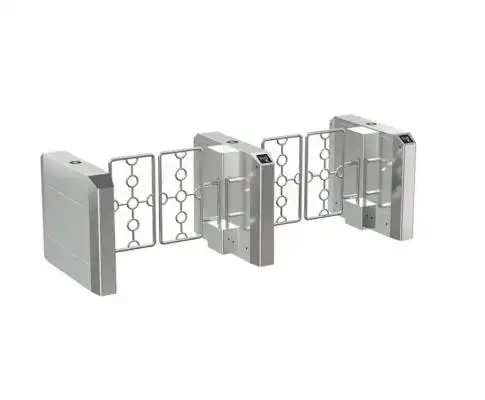
These are one of the most popular types. They feature glass (or sometimes metal) arms that swing open in the direction of travel, much like a saloon door.
- Pros: Very fast, welcoming motion, and most models are easily made ADA/DDA compliant with wider lanes.
- Cons: The swinging arms require physical space in front or behind the unit, which can be a concern in very narrow corridors.
- Best For: Corporate lobbies, executive floors, and areas where aesthetics and a welcoming feel are paramount.
2. Flap Barrier Turnstiles (Retracting/Wing-Style)
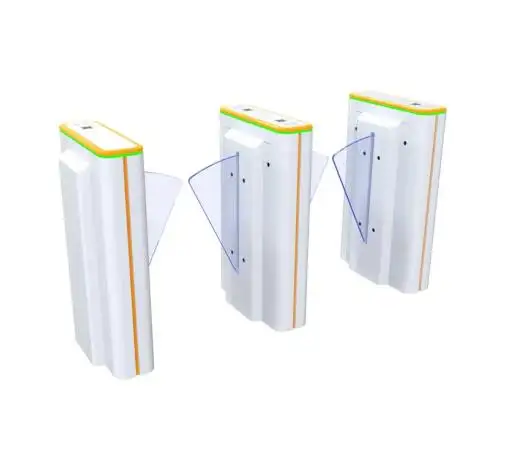
These are the "angel wing" style gates. Two glass wings retract into the body (pedestal) of the turnstile, creating a clear passage.
- Pros: Extremely fast operation, and their "disappearing" act creates a very open, futuristic look. They also have a minimal physical footprint as the barriers don't swing out.
- Cons: Can be perceived as slightly less secure than a swing gate as the barrier is smaller.
- Best For: High-traffic areas like subway stations, convention centers, and major building lobbies where processing speed is the #1 priority.
3. Sliding Gate Turnstiles (High-Security)
These are a more robust solution. Taller glass panels (often full-height or near full-height) slide open horizontally, like a miniature version of an elevator door.
- Pros: Offers the highest level of security among speed gates, as the tall barriers are very difficult to climb over or crawl under.
- Cons: They are physically larger, more expensive, and slightly slower in operation than flap or swing gates.
- Best For: High-security areas like data centers, government facilities, and critical infrastructure control rooms where security is non-negotiable.
4. Optical Turnstiles (Barrier-Free)
This is a special category. An optical turnstile often has no physical barriers at all. It consists of two pedestals that create a lane of sophisticated sensors. It functions by sounding an alarm when someone passes through without a valid credential.
- Pros: Completely frictionless and the highest possible throughput.
- Cons: Offers zero physical security; it only detects unauthorized entry, it doesn't prevent it. Relies on a nearby guard to intervene.
- Best For: Lobbies that are always staffed by a security guard, where the primary goal is flow and tracking, not physical prevention.
A "speed lane gate" is a common term that can refer to any of these types, as it emphasizes the creation of a defined, high-speed lane for pedestrians to follow. You can learn more about the specifics of speed lane gate configurations for your space.
How Do Speed Gates Integrate with an Access Control System?
Speed gates integrate with an access control system via dry contact or "pass-through" signals. The access control reader (card, biometric) is wired to the main access control panel, which makes the "allow/deny" decision. The panel then sends a simple "open" signal to the speed gate's internal controller, telling it to open the barriers.
This is a critical concept to understand. The speed gate access control system is the "brain," and the speed gate itself is the "muscle." They are almost always separate systems from different manufacturers, designed to "talk" to each other.
The beauty of this is its modularity. You can pair a speed gate system from one company with an access control system from another. This allows you to use your existing card readers, software, and credentials, simply adding the gates as the physical enforcement point.
What Are the Most Common Credentials Used with Speed Gates?
The credentials used are determined by the access control reader you choose to integrate, not the gate itself. The most common options include:
- RFID Speed Gate Systems: This is the dominant standard in commercial offices. An RFID speed gate system uses prox or smart cards (like MIFARE or HID iCLASS) that users tap on a reader. It's fast, reliable, and cost-effective.
- Biometric Speed Gate Turnstiles: This is the high-security, high-convenience future. A biometric speed gate turnstile integrates readers for facial recognition, fingerprint scans, or even iris scans. This provides a "hands-free" and highly secure experience, as you can't "borrow" someone's face.
- Mobile Credentials: Using an app on a smartphone (via Bluetooth or NFC) to act as an access card. This is rapidly gaining popularity as it eliminates physical cards.
- QR/Barcode Scanners: Excellent for visitor management. A visitor can be emailed a QR code that is valid for one entry during a specific time, which they scan at the gate.
How Do You Choose the Right Speed Gate System for Your Facility?
To choose the right speed gate system, you must first analyze your peak throughput (people per minute) and required security level. Then, consider the physical (ADA, space) and aesthetic (design) requirements of your location. Finally, confirm the system's compatibility with your existing access control software.
This decision-making process can be broken down into five key steps.
Step 1: Analyze Your Required Security Level
Be honest about your needs. Is your goal simply to stop casual tailgating in a friendly office, or are you protecting a high-value data center?
- Low Security (Deterrence): An optical (barrier-free) system with an alarm may be enough.
- Medium Security (Commercial Standard): Swing or flap barriers are the perfect balance of speed and deterrence.
- High Security (Prevention): You need sliding glass barriers, ideally full-height or near full-height, combined with a biometric reader.
Step 2: Calculate Your Peak Throughput Needs
Don't just count your employees. Calculate your "peak load." If 500 people enter between 8:45 AM and 9:00 AM, you have a peak load of ~33 people per minute.
- One speed gate lane handles ~30-40 people per minute (PPM) with RFID.
- Therefore, for a load of 33 PPM, one lane might be enough, but it would be at 100% capacity. A "bank" of two lanes would be a much safer, more efficient choice to prevent lines.
- A high-speed pedestrian turnstile is specifically engineered to handle these peaks without fail.
Step 3: Consider the Physical Environment and Aesthetics
Walk your lobby with a tape measure.
- Space: Do you have a narrow hall? A flap barrier or sliding gate may be better than a swing gate that needs clearance.
- ADA/DDA Compliance: You will be required by law to provide at least one wider lane (typically 32-36 inches) for wheelchair accessibility. Most manufacturers offer a matching, wider version of their standard lane.
- Design: Does the gate need to match a marble and wood interior? Look for models with customization options like different finishes, top materials (stone, wood), and lighting.
Step 4: Plan for Integration and Future Scalability
What access control system do you have now? Confirm with the gate manufacturer that their product works seamlessly with your system. Also, think about the future. Are you planning to adopt biometric speed gate turnstile technology in five years? Ensure the pedestals have space to mount new readers.
Step 5: Factor in Accessibility (The User Experience)
What is it like to actually use the gate? This is where the "character" of the gate matters.
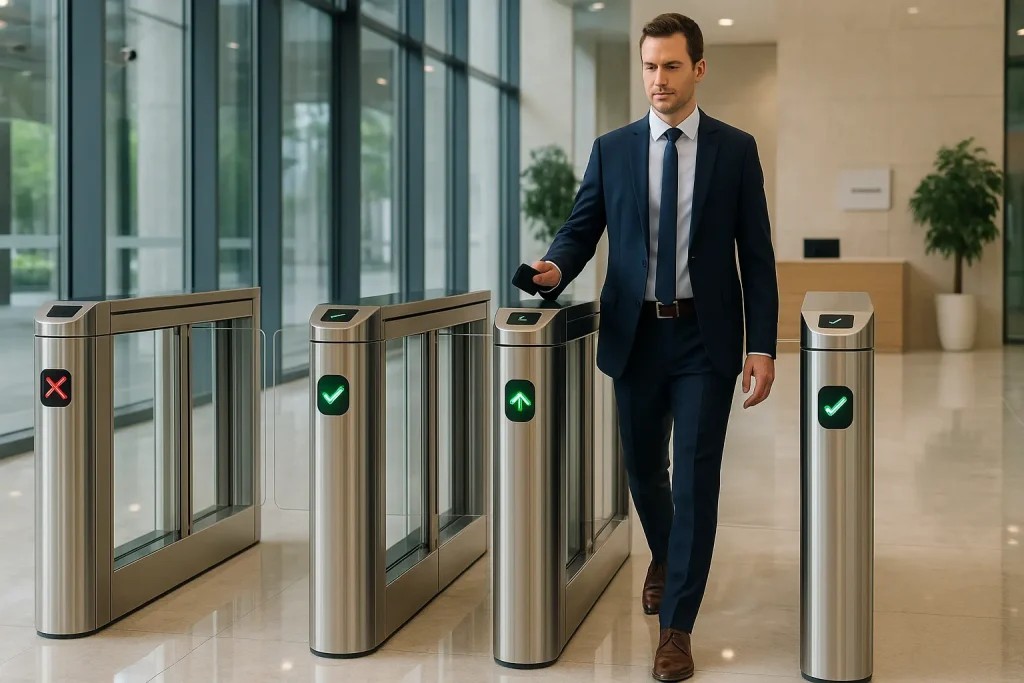
Imagine walking up to a modern entrance speed gate system. You pull out your badge, but as you get close, the reader (perhaps a long-range RFID) has already seen you. Before you've even broken your stride, the glass wings silently retract. A soft green light illuminates your path. You walk straight through, and the gate closes smoothly behind you.
That entire experience feels effortless, secure, and modern. That's the goal. In contrast, a poorly-tuned gate that "clips" your heel or opens too slowly creates a daily frustration for every employee.
What's Involved in the Installation and Maintenance?
The installation of a speed gate system is a precise process that involves core drilling into the floor for power and data, securely bolting the pedestals, and integrating the system with the building's access control and fire safety panels.
This is not a simple DIY project. It requires coordination between electricians, data cabling specialists, and the access control technicians.
- Site Preparation: The floor must be level and solid (typically concrete).
- Cabling: Each pedestal needs its own power and data (Ethernet) connection, which is usually run under the floor.
- Fire System Integration: This is a life-safety-critical step. The speed gates must be tied into the building's fire alarm system. In an emergency, the system must automatically open all gates (in the exit direction or both) to allow for free, unimpeded egress.
- Testing & Commissioning: A technician will spend hours "tuning" the sensors to the specific light conditions and traffic patterns of your lobby to prevent false alarms.
How Much Maintenance Do Speed Gates Require?
Speed gates are reliable, but they are mechanical devices with sophisticated electronics. They require regular preventive maintenance, just like a car.
- Daily: Keep the glass clean and wipe down the sensors. A smudged sensor is the #1 cause of false alarms.
- Quarterly/Annually: A certified technician should perform a service. This includes:
- Cleaning and calibrating all optical sensors.
- Checking the motor, belts, and moving parts for wear.
- Testing the fire-alarm integration.
- Updating firmware.
A well-maintained speed gate from a quality manufacturer can have a lifespan of 10-15 years, handling millions of passages. Industry reports suggest the total access control market, including these advanced gates, is growing by over 8% annually, with a projected market value of over $12.1 billion by 2027 [Insert Statistic A], proving their role as a long-term infrastructure investment.
The Future of Pedestrian Access
The technology inside speed gate systems is evolving as fast as the AI and smart building tech that surrounds it. The next generation of gates is moving beyond simple "open/close" logic.
- AI-Powered Analytics: New systems are using AI to analyze the video feed over the gates. They can detect suspicious behavior (like someone loitering), count tailgating attempts, and even provide anonymous data on building occupancy and flow patterns.
- Deep Biometric Integration: We're moving beyond a separate reader. The gate itself will be the reader. You will simply walk toward a biometric speed gate turnstile, and a facial recognition camera built into the pedestal will identify you and open the gate without you ever slowing down.
- Cloud-Based Control: Facility managers will be able to lock down, open, or change the direction of their gates from a smartphone app anywhere in the world, all through a secure cloud connection.
This technology is a core part of the larger electric gate and automated access evolution, becoming smarter, more connected, and more predictive every year.
The Final Verdict: Are Speed Gates a Smart Investment?
A fast access turnstile is more than just a gate; it's a long-term investment in security, efficiency, and perception. They solve the speed-vs-security paradox by automating the validation process and providing a reliable, sensor-driven defense against unauthorized entry.
By eliminating lobby bottlenecks, reducing the burden on security staff, and enhancing the very look and feel of your building, a modern speed gate turnstile addresses a dozen challenges at once. They are the new standard for any facility that takes its security and its occupants' experience seriously.
If you are ready to move beyond the bottlenecks of traditional access, exploring a tailored speed gate solution is the definitive next step toward a smarter, safer, and more efficient building.
