


Texas Entrance Speed Gate Solutions: Reliable Access Technology
2025-10-27


Texas. The Lone Star State boasts a booming economy, dynamic cities, and a diverse range of industries, from energy giants and cutting-edge tech firms to major healthcare systems and sprawling corporate campuses. As businesses flourish and facilities expand across the state, the need for robust, reliable, and efficient methods of managing building access has become increasingly critical. The days of simple locks or relying solely on front desk personnel are insufficient for the security demands and operational scale of modern Texas enterprises.
Securing these valuable assets and ensuring the safety of personnel requires sophisticated technology. This is where the Texas entrance speed gate solution comes into focus. More than just a generic turnstile, this represents an access control system specifically designed and implemented to meet the unique challenges and opportunities present in the Texas market – balancing security needs with the state's characteristic emphasis on efficiency, accommodating rapid growth, adhering to local regulations like the Texas Accessibility Standards (TAS), and withstanding sometimes demanding environmental conditions.

Understanding the specific considerations for deploying speed gates in Texas is essential for architects, security consultants, facility managers, and developers operating within the state. This guide provides an expert, comprehensive look at these tailored solutions, exploring the technology, benefits, compliance requirements, and implementation strategies relevant to securing modern Texas facilities.
What Defines a "Texas Entrance Speed Gate Solution"?
A Texas entrance speed gate solution is an automated pedestrian access control system, typically comprising speed gates or turnstiles, specifically configured and installed to meet the security, operational, regulatory (including TAS), and environmental needs prevalent in commercial, institutional, and governmental buildings within Texas.
While leveraging globally proven speed gate technologies seen across various Regional Markets, a solution tailored for Texas often emphasizes:
- Reliability & Durability: Built to withstand heavy use and potentially harsh environmental factors (like heat).
- Efficiency & Throughput: Designed to manage the high traffic volumes associated with large corporate campuses and rapidly growing urban centers.
- Compliance: Strict adherence to Texas Accessibility Standards (TAS) for equal access, alongside standard US building and safety codes.
- Scalability: Ability to easily expand systems to accommodate facility growth, a common scenario in Texas's dynamic economy.
- Integration: Seamless connection with modern access control platforms (often cloud-based) and other building technologies favored by Texas businesses.
It's about applying advanced access control principles with a specific focus on the practical realities and expectations within the Lone Star State.
Why Are Speed Gates Increasingly Essential Across Texas?
Speed gates are essential in Texas due to the state's rapid economic and population growth leading to larger, denser facilities, heightened security awareness across key industries (energy, tech, healthcare), the need for efficient management of large workforces and visitor flows, strict accessibility mandates, and the desire for modern, technologically advanced building amenities.
The "Texas Triangle" (Dallas-Fort Worth, Houston, Austin, San Antonio) and other growing areas face unique pressures:
- Managing Growth & Density: New high-rises, expansive corporate campuses, and major institutional facilities require automated systems to handle thousands of daily entries and exits efficiently. Manual methods simply cannot keep up.
- Securing Critical Industries: Texas is home to vital energy infrastructure, major financial centers, cutting-edge technology R&D, and large healthcare networks. Protecting these assets from unauthorized physical access is a top priority.
- Operational Efficiency Focus: Texas businesses often prioritize efficiency and ROI. Automating lobby access reduces staffing costs, eliminates queues, and improves overall productivity – key metrics in a competitive environment.
- TAS Accessibility Mandates: Similar to the federal ADA, the Texas Accessibility Standards (TAS) legally require accessible routes in public accommodations and commercial facilities. Speed gate installations must include compliant accessible lanes.
- Modern Image: In booming cities attracting global talent and investment, buildings need to project a modern, secure, and technologically sophisticated image. Sleek speed gates contribute significantly to this perception.
- Audit & Compliance Needs: Many Texas industries operate under regulations requiring auditable access logs. Speed gate systems provide this data automatically and reliably.
How Does a Typical Texas Speed Gate Solution Operate?
A Texas speed gate solution operates by reading a credential (often a secure RFID card or mobile app), verifying authorization via an access control system (increasingly cloud-based), and rapidly opening physical barriers. Integrated sensors ensure single, safe passage before the gate automatically closes, logging the event.
The process is designed for speed and reliability:
- Credential Presentation: User presents their credential – common in Texas are secure 13.56 MHz RFID cards, key fobs, or mobile credentials (BLE/NFC) favored by tech and corporate sectors.
- Validation: The reader communicates securely (OSDP preferred) with the Access Control System (ACS). Given Texas's large scale and multi-site companies, cloud-based ACS platforms are popular for their scalability and remote management capabilities.
- Permission Check: The ACS verifies the credential against its database based on programmed roles, schedules, and location permissions.
- Open Command: If authorized, the ACS sends an encrypted "open" command to the specific gate lane controller.
- Gate Actuation: The gate’s robust, high-speed motor activates, opening the barriers (often swing or flap types chosen for efficiency). Clear visual indicators (green lights) signal permission.
- Passage Monitoring: High-density sensors track the user, ensuring single passage and preventing tailgating attempts – a key security feature.
- Safe & Secure Closure: Once the user clears the lane and safety sensors confirm it's unobstructed, the barriers close quickly and securely. The entire transaction is logged.
My Experience: "In Texas, reliability is often paramount. I worked on a system for a major energy company's HQ in Houston. They emphasized needing gates that could withstand heavy daily use and wouldn't falter during peak shifts, even with the high humidity. We specified units with robust environmental sealing and brushless DC motors known for their longevity. Downtime wasn't an option for their critical facility."
Key Features Tailored for the Texas Market
Solutions for Texas often emphasize durability against environmental factors (heat), high throughput capacity, strict TAS compliance, integration with prevalent technologies, and sometimes, specific aesthetic considerations reflecting regional styles or corporate identities.
- Durability & Environmental Considerations:
- Heat Tolerance: Electronics within gate pedestals must be rated to operate reliably in potentially high ambient lobby temperatures, especially during Texas summers. Adequate ventilation or even internal cooling might be specified in some designs.
- Robust Construction: Gates need to withstand high traffic volumes and potential impacts in busy environments. Heavy-gauge steel and durable mechanisms are preferred.
- High Throughput Capability: Essential for managing large workforces common in Texas corporate campuses and high-rises. Gates with fast opening/closing cycles (often flap barriers) are frequently chosen for main entrances.
- Texas Accessibility Standards (TAS) Compliance: Non-negotiable. Requires careful planning for accessible routes, ensuring proper lane widths (typically 32-36 inches clear), compliant reader heights, and appropriate sensor timing. Integrators must be knowledgeable about TAS specifics.
- Technology Alignment:
- Credential Flexibility: Support for secure 13.56 MHz RFID (iCLASS, DESFire) is standard. Strong support for mobile credentials (BLE/NFC) is crucial for tech, corporate, and younger demographics. Biometrics might be used in high-security zones, but widespread adoption faces similar privacy considerations as the rest of the US.
- Cloud & Integration: Strong preference for cloud-based ACS platforms and systems with open APIs for integration with VMS, elevator dispatch, and other smart building tech popular in new Texas developments.
- Aesthetics: While diverse, designs often favor clean, modern lines using stainless steel and glass. In some corporate settings, there might be a preference for incorporating materials like wood or stone on top lids to match regional architectural styles, though functionality usually takes precedence.
Popular Speed Gate Types in Texas Facilities
Swing barrier gates are widely adopted in corporate offices across Texas for their balance of aesthetics, security, and ease of TAS compliance. Flap barrier gates are increasingly chosen for high-density buildings and tech campuses where maximizing throughput is critical. Optical turnstiles may be used in prestigious, staffed lobbies.
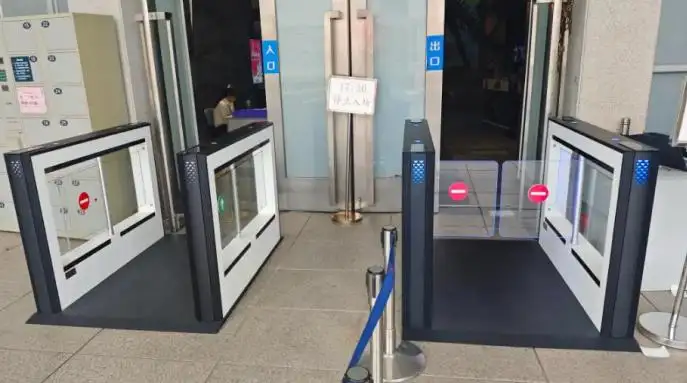
- Swing Barriers (The Professional Standard): Favored in many Dallas, Houston, and Austin office towers. They offer an elegant look, quiet operation, and are the simplest way to implement wide, compliant accessible lanes. Their perceived security is good for typical commercial needs.
- Flap Barriers (The Throughput Maximizer): Ideal for large corporate campuses (like those in Plano or Austin) or buildings with very high peak traffic. Their speed is unmatched, and their modern aesthetic fits well with tech-focused environments.
- Optical Turnstiles (The Open Lobby Look): Used selectively in high-end Class-A+ buildings where maintaining an unobstructed visual flow is a primary design goal, provided that dedicated security staff are always present to monitor access and respond to alarms. Explore more on Optical turnstiles.
- Tripod Turnstiles: While less common in main lobbies, their robustness and lower cost make them suitable for employee entrances from parking garages, fitness centers, or industrial areas within larger facilities.
Enhancing Security: Addressing Texas-Specific Needs
A Texas entrance speed gate solution enhances security by providing a reliable physical barrier against unauthorized entry, critically preventing tailgating common in busy lobbies, consistently enforcing access rules vital for large organizations, and generating essential audit logs for security and compliance purposes relevant to Texas industries.
- Physical Deterrent & Tailgating Prevention: Gates provide a clear physical checkpoint, deterring casual intrusion. More importantly, their sensors actively stop the common vulnerability of tailgating, crucial for protecting corporate assets and data centers prevalent in Texas.
- Consistent Policy Enforcement 24/7: In large Texas companies with thousands of employees and complex access rules, automated enforcement ensures policies are applied correctly every time, regardless of staffing levels or time of day.
- Audit Trails for Accountability: Detailed digital logs provide irrefutable evidence for security investigations (e.g., workplace incidents, theft) and help meet compliance requirements for sectors like energy, healthcare (HIPAA), and finance, all major industries in Texas.
- Managing Visitor Access: Integrated with VMS, gates provide a secure, efficient way to manage the high volume of visitors (clients, contractors, vendors) common in Texas business hubs, ensuring they only access authorized areas for the permitted time.
Boosting Efficiency: Streamlining Flow in Texas Growth Hubs
In Texas's fast-growing cities and large corporate environments, efficiency is paramount. Speed gates drastically increase pedestrian throughput (30-40+ PPM per lane), eliminating lobby bottlenecks, supporting the punctual start times common in many Texas workplaces, and enabling optimization of valuable lobby staff resources.
- Handling High Volume: Gates are essential for smoothly processing the large morning arrivals and evening departures at major corporate campuses or downtown high-rises in cities like Houston or Dallas. Manual checks would result in unacceptable delays.
- Optimizing Staff: Automation allows highly trained security personnel or reception staff to move away from repetitive badge checking and focus on more valuable tasks: visitor assistance, concierge services, proactive security monitoring, and incident response. This improves both service quality and operational cost-efficiency.
- Enhancing the Tenant/Employee Experience: A quick, seamless entry process contributes to a positive perception of the building and the employer. In the competitive Texas job market, providing modern, efficient amenities like frictionless access can be a factor in attracting and retaining talent. The experience should be markedly better than older systems found in less developed Regional Markets.
Texas Accessibility Standards (TAS): A Critical Compliance Point
Compliance with the Texas Accessibility Standards (TAS), which closely aligns with the federal ADA, is mandatory for nearly all public accommodations and commercial facilities in Texas. Any Texas entrance speed gate solution must incorporate fully compliant accessible routes.
My Experience: "Don't underestimate TAS. While similar to ADA, Texas has its own enforcement agency (Texas Department of Licensing and Regulation - TDLR) and plan review processes. Forgetting to submit plans showing compliant accessible routes, including the speed gate layout, can halt your project during permitting. We always ensure our drawings clearly demonstrate TAS compliance for clear passage width, maneuvering clearances, and reader heights before submission."
Key TAS considerations include:
- Accessible Lane: At least one gate per entry point must meet TAS requirements for clear width (typically >= 32 inches, often 36 inches preferred).
- Clear Floor Space: Adequate maneuvering space must be provided on both sides of the accessible gate.
- Reach Ranges: Card readers or activation buttons must be within accessible reach ranges.
- Operational Force: If any manual operation is required, it must meet force limitations.
- Visual/Audible Signals: Clear indication of lane status.
Working with architects and installers knowledgeable about TAS is crucial for avoiding costly compliance issues.
Integration & Technology Trends in Texas
Texas businesses often favor scalable, integrated solutions. Cloud-based access control platforms are popular for managing multiple sites. Integration with VMS, elevator dispatch, and robust support for mobile credentials align with the state's tech-savvy corporate culture.
- Cloud Adoption: Strong trend towards cloud-based ACS (ACaaS) due to scalability (ideal for growing companies), remote management (useful for multi-site Texas operations), and ease of integration via APIs.
- Mobile Credentials: High adoption, particularly in corporate and tech sectors. BLE and NFC support are becoming standard expectations.
- VMS Integration: Essential for efficiently managing the high volume of visitors in commercial hubs.
- Open Standards: Preference for systems using open standards (like OSDP) that allow flexibility in choosing hardware and software components, avoiding vendor lock-in.
- Biometrics: Used selectively for high-security areas (e.g., data centers, energy control rooms), but broader adoption faces similar privacy considerations as the rest of the US, potentially slower than in markets like the UAE speed gate access control turnstile environment.
Installation & Environmental Factors in Texas
Installation requires qualified technicians familiar with Texas building codes. Environmental factors, particularly sustained high temperatures and humidity in many parts of the state, must be considered in hardware selection and placement to ensure long-term reliability.
- Code Compliance: Installation must adhere to local building codes, NEC (electrical), and NFPA (fire safety/egress) requirements. Fire alarm integration is mandatory.
- Heat & Humidity: For gates installed near exterior doors or in non-climate-controlled areas (e.g., parking garage entrances), ensure components (especially electronics) are rated for high ambient temperatures and humidity. Look for appropriate NEMA/IP ratings for enclosures if exposed to dust or moisture. "I've seen controllers fail prematurely in poorly ventilated Texas lobbies during summer peaks because they weren't rated for the sustained heat radiating through glass facades. Specifying components with higher temperature tolerances is wise here."
- Qualified Labor: Use experienced, licensed technicians for installation, particularly for complex integrations and ensuring TAS/code compliance.
- Maintenance: Given the high usage and potential environmental stress, a regular preventive maintenance plan is highly recommended to ensure the longevity and reliability of a
Texas entrance speed gate solution.
Future Outlook: Smart Cities and Integrated Mobility in Texas
The future of entrance gates in Texas will likely involve deeper integration into smart city initiatives, leveraging AI for predictive analytics, adopting more frictionless credential technologies, and potentially integrating with broader transportation and parking systems common in Texas's sprawling urban areas.
- Smart City Integration: As cities like Austin, Dallas, and Houston invest in smart infrastructure, access control data from major buildings could potentially integrate with city-wide traffic management or emergency response systems.
- AI-Driven Efficiency: AI will optimize gate performance, predict maintenance needs, and provide sophisticated flow analytics to help manage congestion in increasingly dense urban cores.
- Frictionless Access: Continued push towards mobile credentials (UWB, advanced BLE) and potentially opt-in facial recognition for seamless entry.
- Mobility Hub Integration: In large mixed-use developments, access credentials might integrate with parking garage access, EV charging stations, or even local transit passes, creating a unified mobility experience.
The Final Verdict: Reliable Gateways for the Lone Star State
The Texas entrance speed gate solution is a critical technology for securing and managing the flow of people in the state's dynamic and growing built environment. Tailored to meet local needs – emphasizing reliability, efficiency, TAS compliance, and integration with modern technologies – these systems provide far more than just a barrier. They are intelligent gateways that enhance security, streamline operations, ensure compliance, and contribute to the sophisticated image of modern Texas facilities.
By carefully analyzing specific needs, prioritizing compliance and reliability, choosing appropriate technologies, and partnering with experienced local providers, Texas businesses and institutions can implement entrance gate solutions that provide robust, efficient, and reliable access control, serving as a dependable foundation for safety and productivity in the Lone Star State, clearly differentiated from solutions needed in vastly different Regional Markets like those requiring a specialized Singapore smart speed gate turnstile system or a compliance-heavy Germany high-throughput speed gate pedestrian access solution.
