


Turnstile Gate Access Control System: Types, Components and How to Choose the Right Setup
2026-04-06


A turnstile gate access control system does one thing at its core: it decides who gets in and who doesn't. Every time a credential is scanned and a barrier opens, that system is working exactly as it should. Whether you're securing a corporate office, a university campus, or a transit facility, the combination of the right gate hardware and the right control technology determines how well your entry points hold up under real daily pressure.
This guide covers how a turnstile gate access control system works, what it consists of, which gate types suit which environments, and what to look for before you commit to a purchase.
What Is a Turnstile Gate Access Control System?
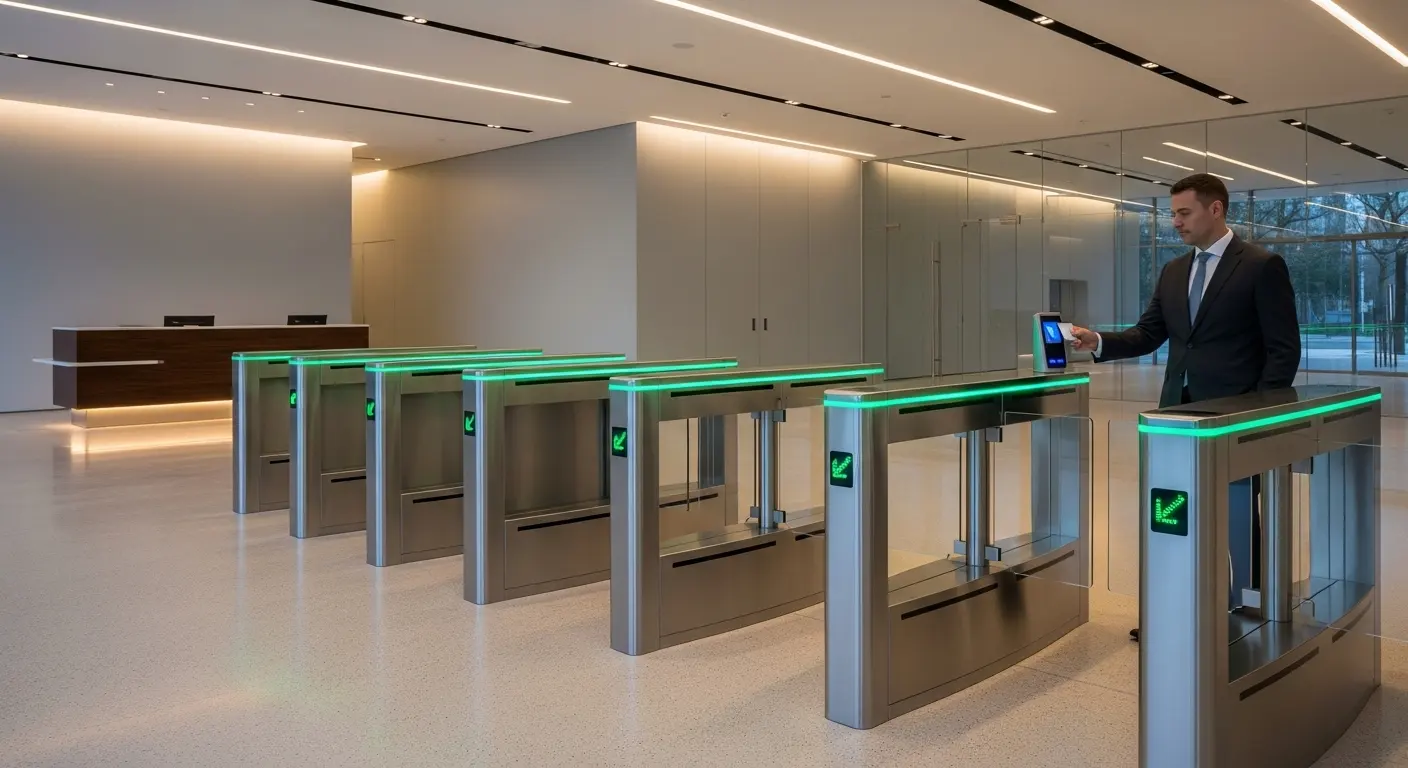
A turnstile gate access control system is a combination of physical gate hardware and electronic verification technology that manages who can enter or exit a secured area. It's not just a barrier — it's a connected system that includes a credential reader, a controller that processes the verification, and a physical gate that responds to the result.
The system works in a clear three-step sequence. First, a person presents a credential at the reader. Next, the controller checks that credential against an authorized list. Finally, if valid, the gate opens. If not, it stays closed and an alert fires.
Modern versions go far beyond that basic sequence. They connect with HR software, attendance platforms, building management systems, and cloud dashboards in real time. That makes them far more than a physical barrier. They act as active data points for security, attendance tracking, and operational reporting — all running off the same hardware that opens and closes a door.
Browse the full range of turnstile gate models to see how hardware types map to different entry environments.
Core Components of a Turnstile Gate Access Control System
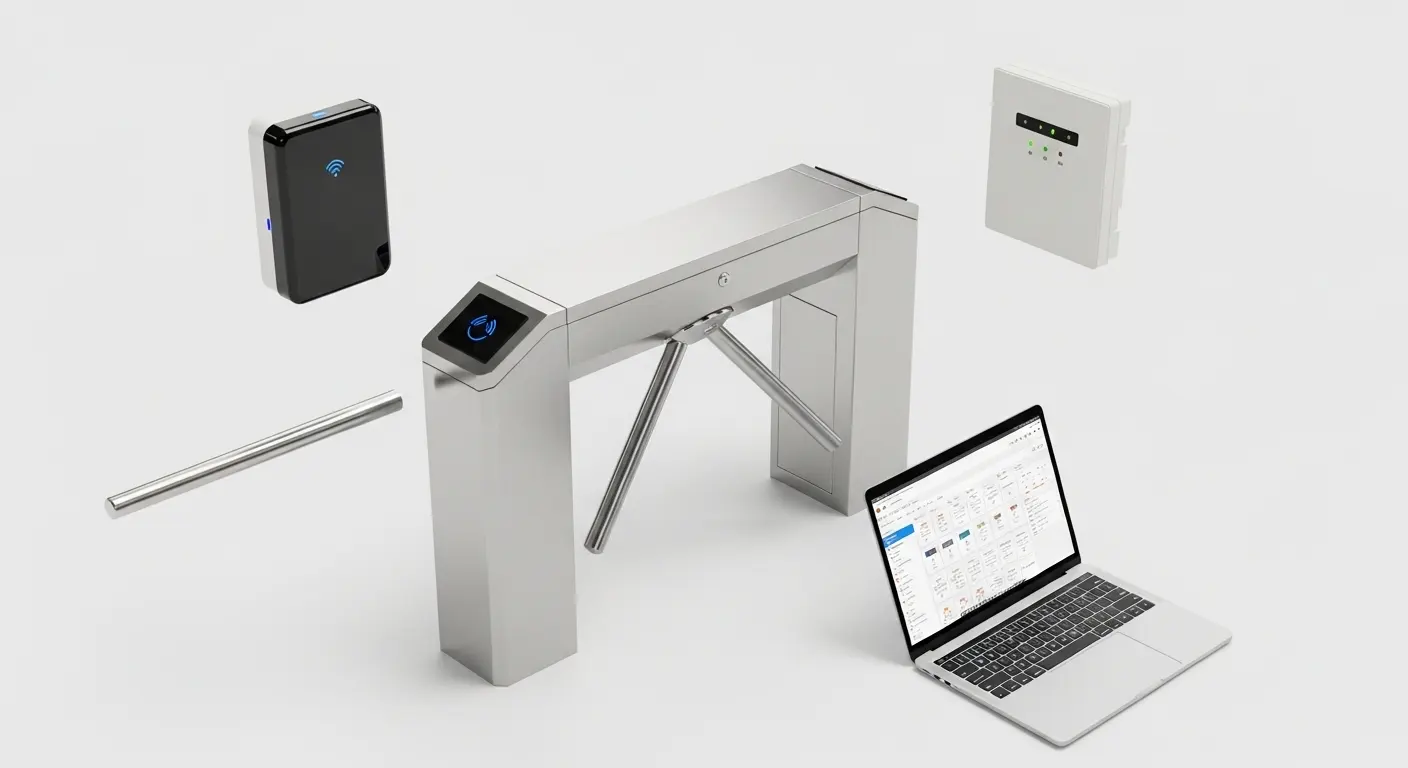
Understanding the four core components helps you spec the right setup and avoid costly compatibility problems after installation.
Gate Hardware
This is the physical barrier — flap panel, tripod arm, full-height rotor, or sliding glass panel. Gate hardware is responsible for physical access control, anti-tailgating enforcement, fail-safe operation during power outages, and passage width. Gate quality directly determines how long the system survives in high-traffic environments running 24 hours a day.
Credential Reader
Readers accept the signal — RFID card swipe, QR code scan, fingerprint, face recognition, or mobile credential. The reader type defines how fast and how accurately each person clears the gate. For example, a barcode turnstile gate reader processes QR boarding passes in under two seconds, while a fingerprint reader takes slightly longer but eliminates credential sharing entirely.
Access Controller
The controller is the brain of the setup. It receives the credential signal, checks it against an access permission list, and sends an open or deny command to the gate. Controllers can be standalone, meaning permission lists are stored on the device itself, or networked, meaning a central server or cloud platform manages permissions across multiple lanes and locations.
Management Software
This is where all administration happens. Managers add or remove users, set time-based permissions, pull entry reports, and receive real-time alerts. A cloud-based turnstile gate setup moves all of these functions to a web dashboard, making remote management possible from any location without on-site servers or IT overhead.
Types of Turnstile Gates Used in Access Control Systems
Each gate type serves a different security level, traffic volume, and physical environment. Here's how they map to real deployment scenarios.
Tripod Turnstile
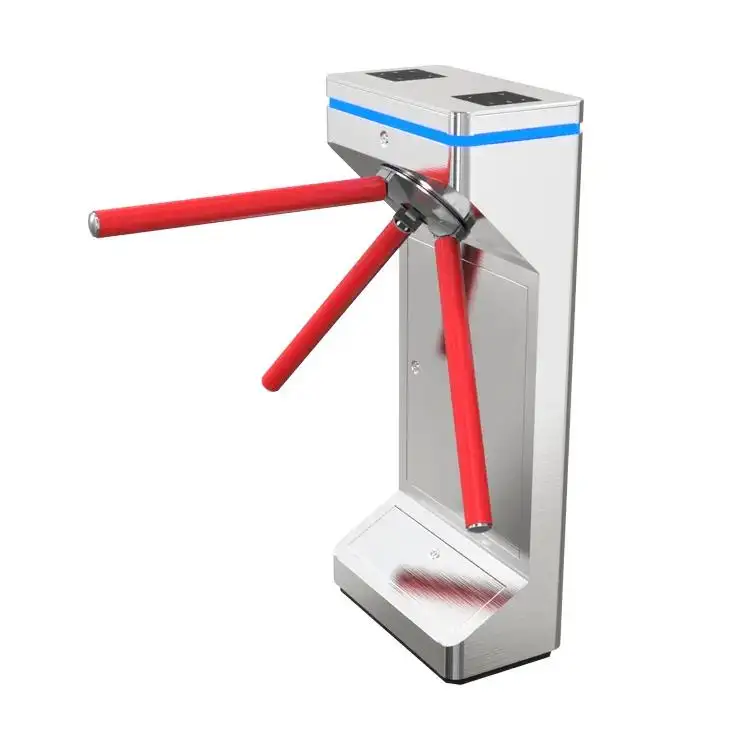
The tripod is the entry-level option in most turnstile gate access control system setups. Three rotating arms provide waist-height access control at a practical cost. Tripods work well for medium-traffic environments: factory entrance points, community sports facilities, and general office lobbies handling under 20 persons per minute.
They're not built for high-volume transit environments where throughput speed is critical, but for the right applications they are reliable, low-maintenance, and easy to integrate with basic RFID readers.
Flap Barrier Gate
The flap barrier is the most widely deployed gate type in corporate and commercial turnstile gate access control system setups. Its retractable panels open in under half a second and support throughput rates of up to 45 persons per minute per lane. Wider lane options, typically 600mm to 800mm, accommodate people carrying bags or using mobility aids.
Flap barriers also carry the strongest aesthetic profile for office building lobbies. Most models support RFID, QR code, biometric, and mobile credential readers mounted directly on the gate cabinet.
Speed Gate / Optical Turnstile
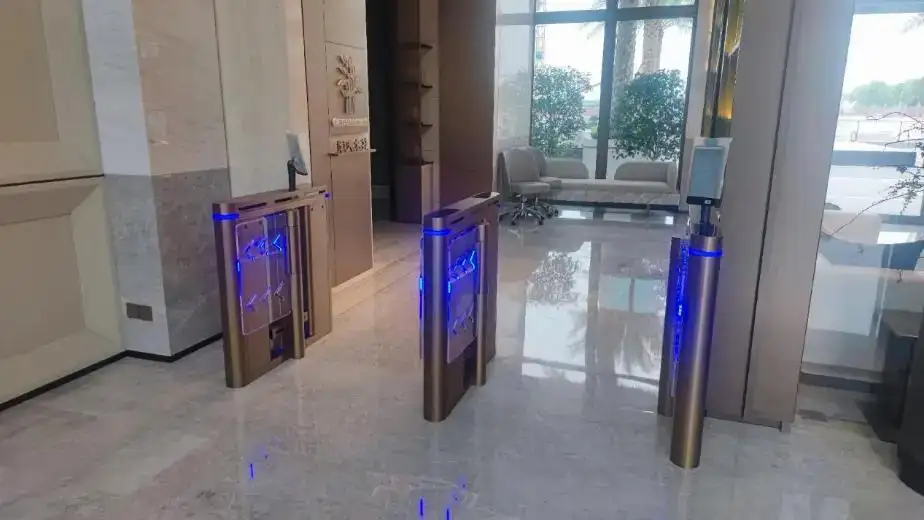
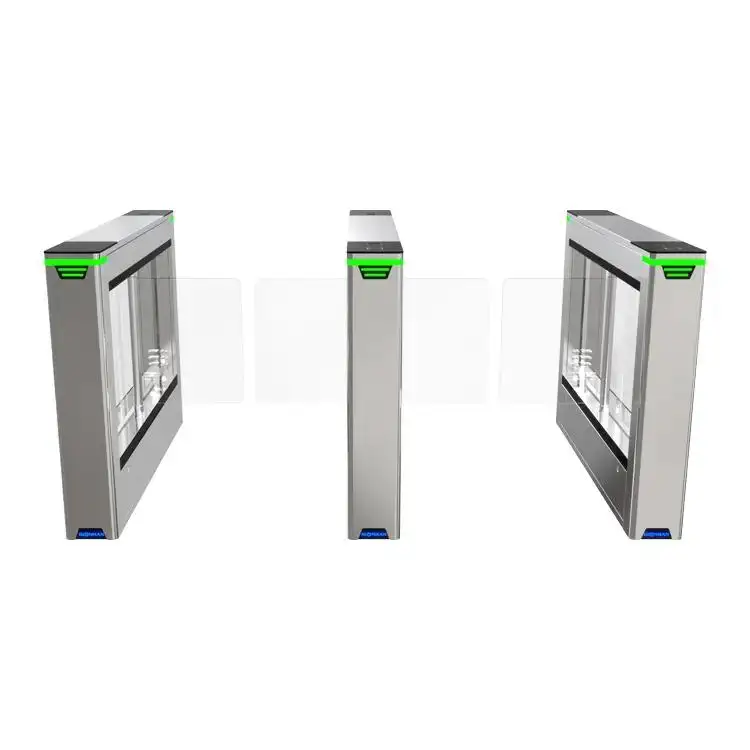
Speed gates use retractable glass or acrylic panels and run at the highest throughput rates in any turnstile gate access control system product lineup. They fit premium environments: financial offices, VIP terminal areas, and institutional lobbies where both clean design and fast pedestrian flow matter.
The UK speed gate turnstile access control range combines bi-directional authorization, up to 914mm lane widths, and multi-credential reader support in a single cabinet built for high-traffic commercial use.
Full-Height Turnstile
For high-security environments where physical prevention matters as much as electronic control, the full-height turnstile is the only option. In a turnstile gate access control system context, this is the highest physical security gate type available. Its floor-to-ceiling design prevents climbing over, crawling under, or forcing through.
The access control turnstile full-height model supports both RFID and biometric readers, with electronic locking and fail-secure configurations built in. Data centers, server rooms, cargo facilities, and restricted government corridors are the primary environments for this gate type.
Swing Gate
Swing gates offer the widest passage lane and serve as ADA-compliant options within a multi-lane gate row. In campus or corporate setups, a swing gate is typically installed alongside flap barrier lanes to handle wheelchair users, equipment trolleys, and stroller-carrying visitors.
Credential Options for Your Turnstile Gate Access Control System
The credential type you choose has more real-world impact than most buyers expect. It defines how fast, how secure, and how convenient the whole setup feels to users every single day.
RFID Card / Smart Card
The most widely used credential in any turnstile gate access control system. Cards are fast (under 0.5 seconds per read), cost-effective at scale, and easy to manage. The limitation is that cards can be shared, lost, or stolen, which is why many sites pair them with a secondary factor like PIN or biometric.
Biometric Verification
Face recognition, fingerprint, iris, and palm vein readers eliminate credential sharing completely. They require slightly more processing time per person but deliver identity-level confirmation. For high-security zones, biometrics are the recommended standard — not an optional upgrade.
Barcode and QR Code
Best for rotating visitor populations: stadiums, airports, events, and transit hubs. The barcode turnstile gate handles both 1D barcodes and 2D QR codes, validating tickets, boarding passes, and temporary visitor credentials in real time without requiring pre-enrollment.
Mobile Credentials (BLE/NFC)
Smartphones replace physical cards using Bluetooth Low Energy or Near Field Communication. Corporate adoption is growing fast because there's no physical card to issue, track, or replace. A lost phone means the credential gets revoked in seconds from the management dashboard — no physical deactivation step needed.
PIN Code
The simplest credential type, used in low-security or backup scenarios. PIN-only access is rarely recommended as the primary method in any turnstile gate access control system because PINs are easily shared and not tied to a specific individual.
Where Turnstile Gate Access Control Systems Are Used
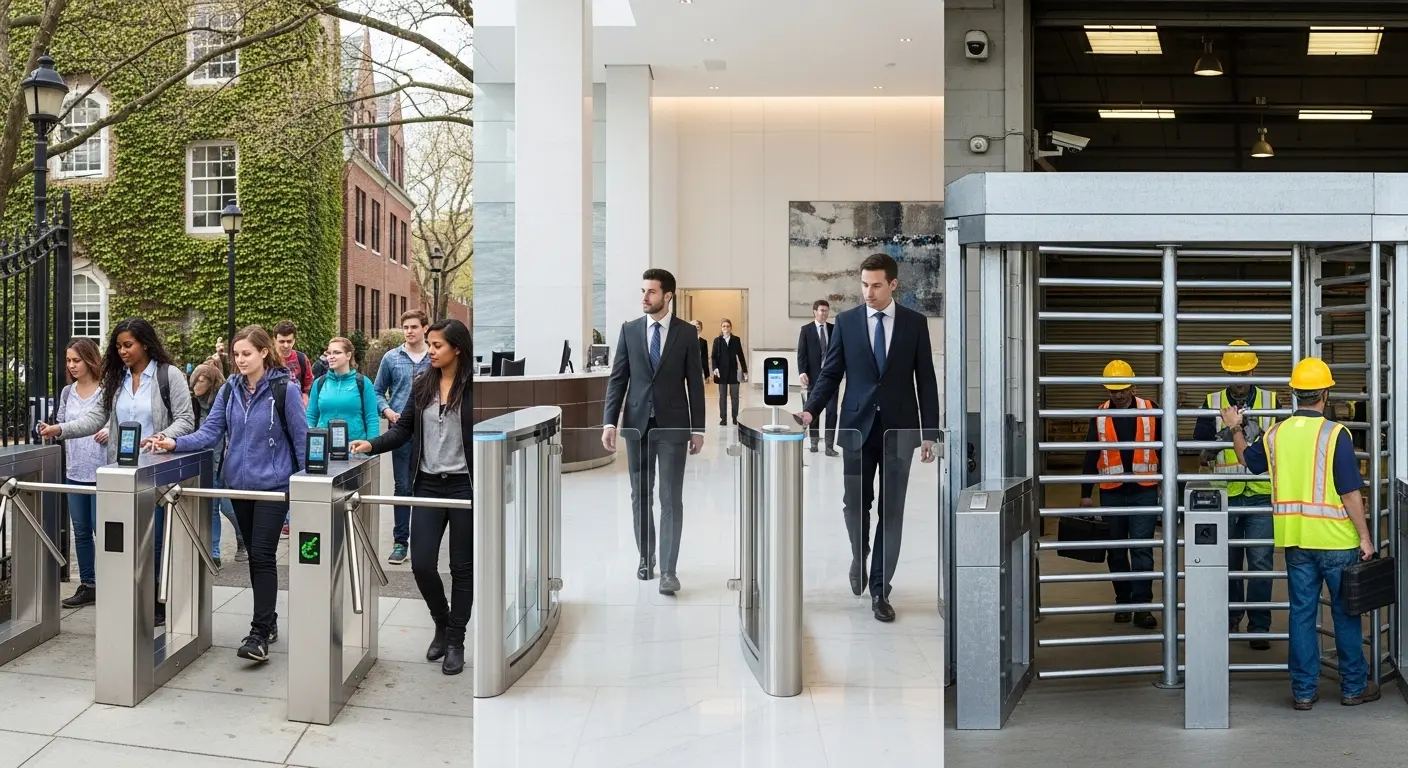
The range of deployment environments is wider than most people expect.
| Environment | Gate Type | Primary Credential |
|---|---|---|
| Corporate offices | Flap barrier or speed gate | RFID card or face recognition |
| University campuses | Flap barrier or tripod | Student card or QR code |
| Government buildings | Full-height or flap barrier | Biometric plus card (dual factor) |
| Transit hubs and airports | Speed gate or flap barrier | Barcode or QR boarding pass |
| Gyms and fitness centers | Tripod or swing gate | Membership QR or RFID |
| Residential complexes | Swing gate or flap barrier | Resident RFID or visitor QR |
| Data centers | Full-height | Biometric plus PIN |
| Industrial and manufacturing | Full-height or tripod | RFID card |
For campus-specific setups, the campus access control gate solution covers student ID card support, visitor QR management, and real-time entry logging in one configuration. Ironman's turnstile gate solutions span all of these environments, with specific configurations for fitness centers, government buildings, residential communities, and corporate campuses.
How to Choose the Right Turnstile Gate Access Control System
Five factors should drive your decision. Work through each one before comparing product specs.
1. Traffic Volume
Start with your peak-hour throughput requirement. Tripod turnstiles handle around 20 persons per minute. Flap barriers reach 40 to 45. Speed gates exceed that. Choose based on your busiest 15-minute window, not your daily average.
2. Security Level Required
Define the physical security need before choosing a gate type. A corporate lobby needs deterrence and audit trails. A data center perimeter needs physical prevention. That difference alone determines whether a waist-height gate is sufficient or a full-height model is necessary.
3. Credential Type
Match the credential to the actual user population. Employees who badge in daily fit RFID well. Rotating visitor or event populations need barcode or QR. High-security identity verification zones need biometrics. Mixing credential types across lanes is common in large facilities.
4. System Connectivity
Ask what platforms the gate needs to connect with. Does your site run an HR system, attendance software, or a Building Management System? A turnstile gate access control system that cannot connect to those platforms forces manual workarounds that reduce the return on the entire investment.
5. Physical Space and Lane Width
Measure your entry corridor before reviewing gate specifications. Standard lane widths range from 550mm to 900mm. ADA compliance in most commercial environments requires at least one lane at 900mm or wider.
Common Mistakes When Setting Up a Turnstile Gate Access Control System
Buying hardware before confirming software compatibility. The gate is only as useful as the platform it connects to. Always verify that the controller software supports your existing HR or access management platform before placing an order. Retrofitting compatibility later costs more than getting it right the first time.
Underspecifying anti-tailgating detection. Single-beam infrared sensors come standard on basic models but aren't sufficient for high-traffic deployments. In any environment where tailgating is a real risk, specify multi-beam or dual-zone detection as a minimum requirement.
Treating unit price as the main cost metric. Modular gates with replaceable arms, motors, and control boards cost less to maintain over five years than cheaper non-modular units. In 24/7 environments, the gap between a quality gate and a budget unit becomes obvious within the first year of operation.
Skipping a proper site survey. Lane width, floor leveling, cable routing, and power supply position all affect how clean and reliable the final installation is. A pre-installation survey prevents the most common rework issues and eliminates surprise costs.
FAQ: Turnstile Gate Access Control Systems
What is a turnstile gate access control system?
A turnstile gate access control system is a physical gate combined with electronic credential verification that controls pedestrian entry and exit at secured locations. It reads a credential — card, biometric, or QR code — checks it against an authorized user list, and opens or denies the barrier accordingly. Most systems also log every entry event for audit and reporting purposes.
What credential types work with a turnstile gate access control system?
Most modern systems support RFID cards, QR codes, barcodes, fingerprint readers, face recognition, iris scanners, palm vein readers, and mobile credentials via Bluetooth or NFC. The right choice depends on your security requirements, user population type, and passage speed needs.
What is the best gate type for a corporate office access control system?
Flap barrier turnstiles are the most common choice for corporate building lobbies. They offer high throughput (up to 45 persons per minute), a clean visual profile, and full support for RFID and biometric readers. Speed gates are the premium option for architecturally demanding or very high-traffic entrances.
Can a turnstile gate access control system connect with HR software?
Yes. Modern controllers and cloud management platforms connect with HR systems via API. New employees get access automatically when onboarded, and departing employees lose access the moment they exit the system. No manual card deactivation step is required.
How much does a turnstile gate access control system cost?
System cost varies by gate type, credential technology, lane quantity, and software requirements. Tripod-based RFID setups represent the lower end of the investment range. Enterprise flap barrier or speed gate deployments with cloud management and biometric readers require significantly higher budgets. Contact Ironman Turnstile directly for a configuration-specific quote based on your actual site requirements.
