


Torniquete del vestíbulo del edificio: ¿Qué tipo de puerta encaja con tu lobby, Clase de Construcción, y Tráfico Diario
2026-03-30


El torniquete derecho del vestíbulo depende de cuatro factores: Tu clase de construcción, Recuento diario, Dimensiones del vestíbulo, y el briefing del arquitecto. Las compuertas de velocidad son el estándar para los vestíbulos de edificios comerciales de Clase A. Barreras de solapas y compuertas batentes compactas sirven para el estándar comercial, Uso mixto, y gestionó las entradas de edificios. Every primary lobby entrance also requires at least one ADA-accessible lane at 900mm or wider.
This guide gives commercial building managers, Promotores inmobiliarios, and facilities directors a lobby-class matching table, a gate type comparison for lobby-specific criteria, architectural integration guidance, Flujo de trabajo de gestión de visitantes, and links to real Ironman lobby deployments across four continents. For the full pedestrian-specific gate configuration used in office building lobbies, empieza con eloffice building pedestrian turnstile overview.
Building Lobby Turnstile Types — What Each Gate Delivers in a Lobby Context
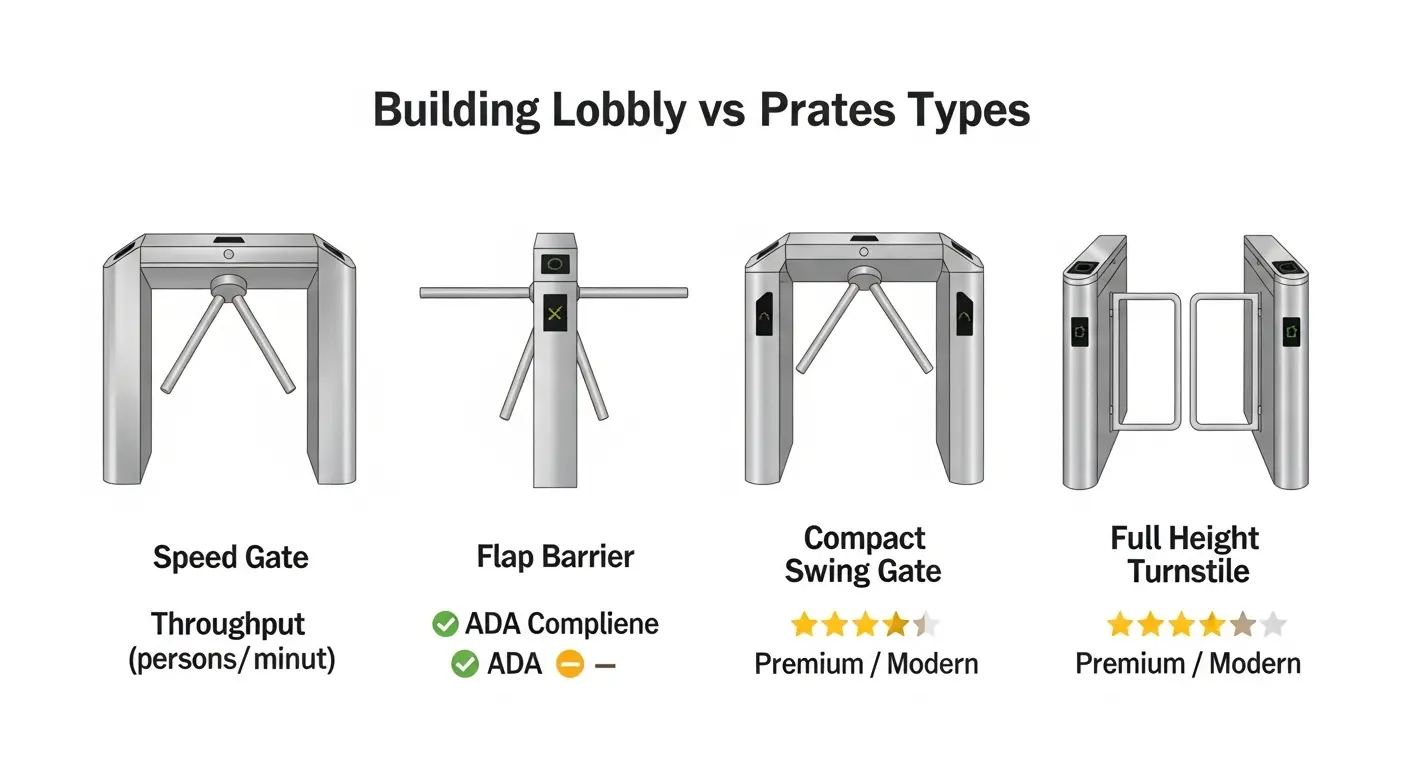
Four gate types appear in commercial building lobbies. The right choice depends on your lobby class, aesthetic brief, and daily throughput — not generic security level. The table below compares them on the criteria that matter for a lobby specification.
| Tipo de puerta | Rendimiento | Lobby Aesthetics | ADA Lane | Best Lobby Use | Alcance de la unidad |
|---|---|---|---|---|---|
| Puerta de Velocidad | 50–80 ppm | Premium — paneles de cristal, slim SS304 | Best — 900mm wide lane | Class A, premium hotel, Edificio multiinquilino de gran altura | $1,300–8.000 dólares |
| Barrera de solapas | 40–60 ppm | Moderno, low-profile | Moderado | Comercial estándar, mid-range managed building | $450–6.500 dólares |
| Compuerta compacta giratoria | 30–50 ppm | Flexible, personalizable | Bien | LO ESTAMOS, secondary lobby entrances, Coworking | $400–2.500 dólares |
| Torniquete de altura completa | 25–40 ppm | Industrial, institucional | Limitado | Government security lobbies, high-security facilities | $600–4.000 dólares |
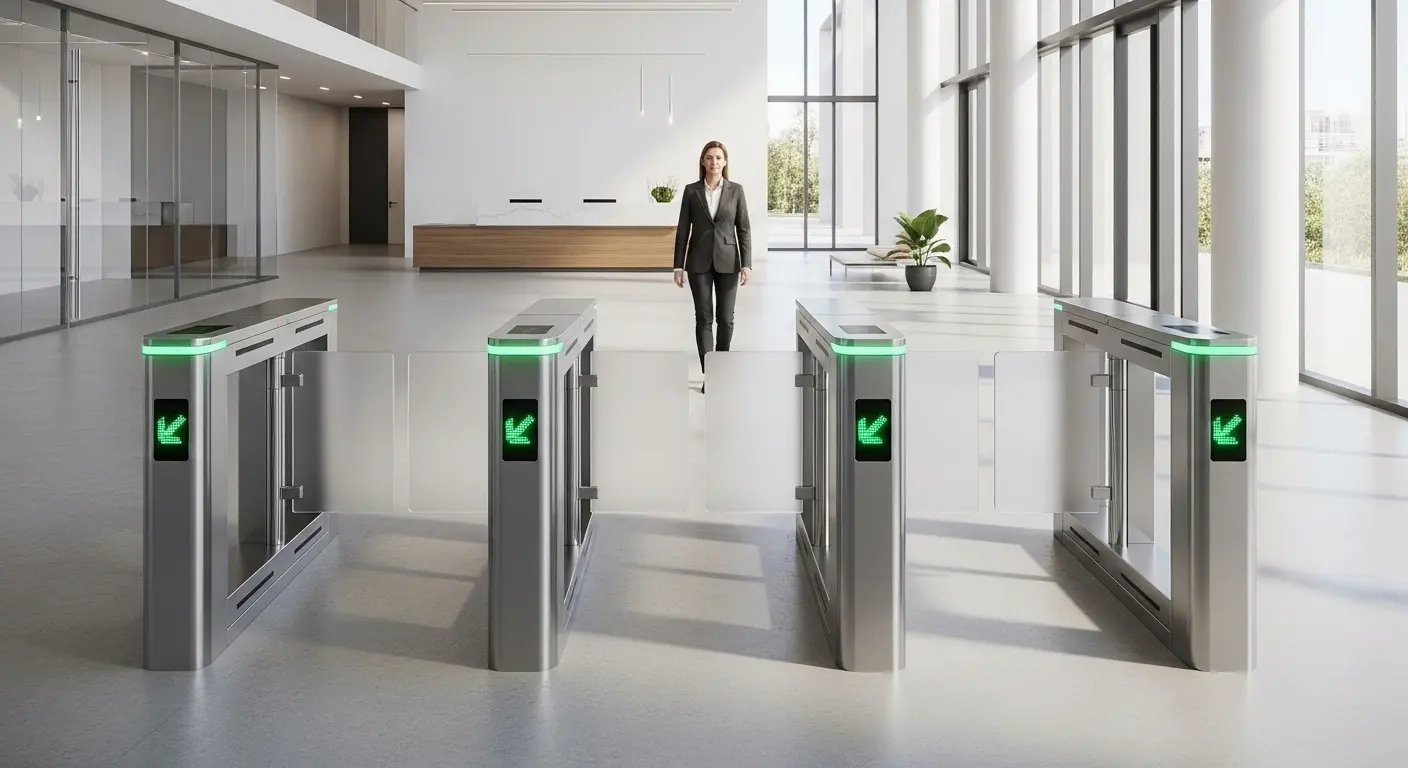
Las compuertas de velocidad son el estándar para los vestíbulos de edificios comerciales de Clase A. Tempered glass wing panels and stainless steel 304 cabinets match premium lobby interiors. Their 50–80 ppm throughput handles high-rise morning peak flow without congestion.
Full height turnstiles do not belong in a primary commercial building lobby where clients and visitors enter. They suit secondary, Alta seguridad, or government facility entrances where aesthetics are not a design criterion.
Flap barriers offer a practical middle ground for standard commercial lobbies. Their lower per-lane cost and low-profile cabinet suit buildings with height constraints or a tighter budget without sacrificing throughput.
Match Your Building Lobby Turnstile to Your Building Class
Lobby turnstile selection follows building class — not headcount alone. The table below gives a direct recommendation per building type.
| Clase de Construcción | Puerta recomendada | Calles | Key Lobby Criterion |
|---|---|---|---|
| Class A premium office tower | Puerta de velocidad | 3–8+ | Architect-matched finish, Rendimiento máximo, ADA |
| Standard commercial building | Barrera de solapas o puerta de velocidad de entrada | 2–4 | Throughput/cost balance, visitor QR credential |
| Mixed-use development | Puerta de velocidad (tierra) + swing gate (upper) | 3–6 | Gestión de visitantes con varios inquilinos |
| Hotel lobby | Puerta de velocidad (slim glass variant) | 2–4 | Guest experience, touchless credential, 24/7 |
| Government building lobby | Barrera de solapas + Lector biométrico | 2–4 | Audit trail, Anti-tailgating, credential-only entry |
Class A Premium Office Tower
A Class A building lobby turnstile specification starts with the architect's brief. Cabinet finish, glass panel design, and gate row alignment with the reception desk are confirmed before any technical specification begins. Speed gates accommodate custom cabinet finishes and custom wing panel shapes within the same OEM product family — making the gate row a design feature, not a security fixture.
Based on our New York commercial building deployment, the client approved the cabinet finish and glass panel design before production. The gate row was specified as an architectural element. For the full configuration detail, véase elNew York speed gate turnstile system case study.
Multi-Tenant Commercial and Mixed-Use Buildings
Multi-tenant buildings require visitor management at the lobby level. Employees use RFID cards. Visitors receive a QR code credential by email from the front-desk visitor management platform. The gate reads the QR code on arrival — no card issued or collected.
In our Netherlands deployment for a 20-floor multi-tenant office tower, a 4-lane speed gate system handled 2,400 daily entries across all tenants. The full layout is documented in the Netherlands speed gate building lobby case study.
Government and High-Security Building Lobbies
Government facility lobbies require credential-only access with a full entry and exit audit trail. Biometric readers — fingerprint, iris, or facial recognition — are standard at this level. Anti-tailgating alarm output connects to a security workstation in real time. For the deployment configuration used in government facility lobbies, véase elIronman government facility access gate page.
Lobby Architecture and Aesthetic Integration
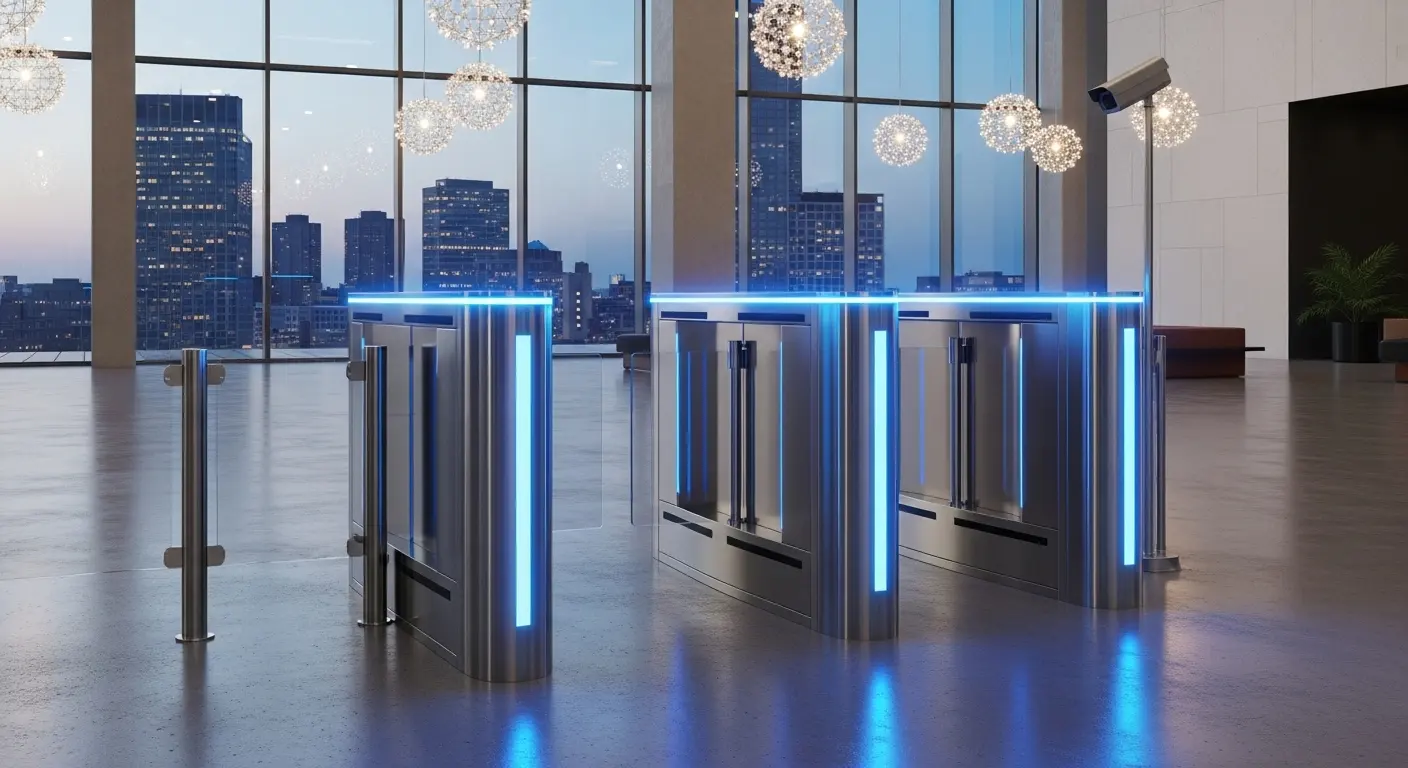
In a Class A commercial lobby, the turnstile row faces the reception desk, the entrance atrium, and every arriving visitor. Cabinet finish and glass panel design must coordinate with the interior specification. Aesthetics are a specification criterion — not an afterthought.
Cabinet Finish Options
| Finish Type | Best Lobby Style |
|---|---|
| Brushed stainless SS304 | Contemporary, minimalist Class A |
| Mirror-polish stainless | Luxury hotel lobby, flagship office |
| Matte black powder coat | Industrial-modern, tech company lobby |
| RAL custom color | Brand-matched lobbies |
| Custom paint match | Architect-specified exact color |
Glass panel options include clear tempered 10mm, frosted tempered, arched-top custom-shaped panels, and laser-engraved company logo or pattern. Cabinet height runs from standard 990mm to tall 1100mm and custom — coordinated with lobby ceiling height and sightlines from the reception desk.
After commissioning lobby turnstile systems in Class A buildings across the Netherlands, New York, Dubai, and Europe, our team consistently finds that architects require a physical sample panel before production sign-off. Our OEM process includes a finish sample approval stage before manufacturing begins — this prevents costly post-production change requests and keeps your project on schedule.
Building Lobby Turnstile with Elevator Access Integration
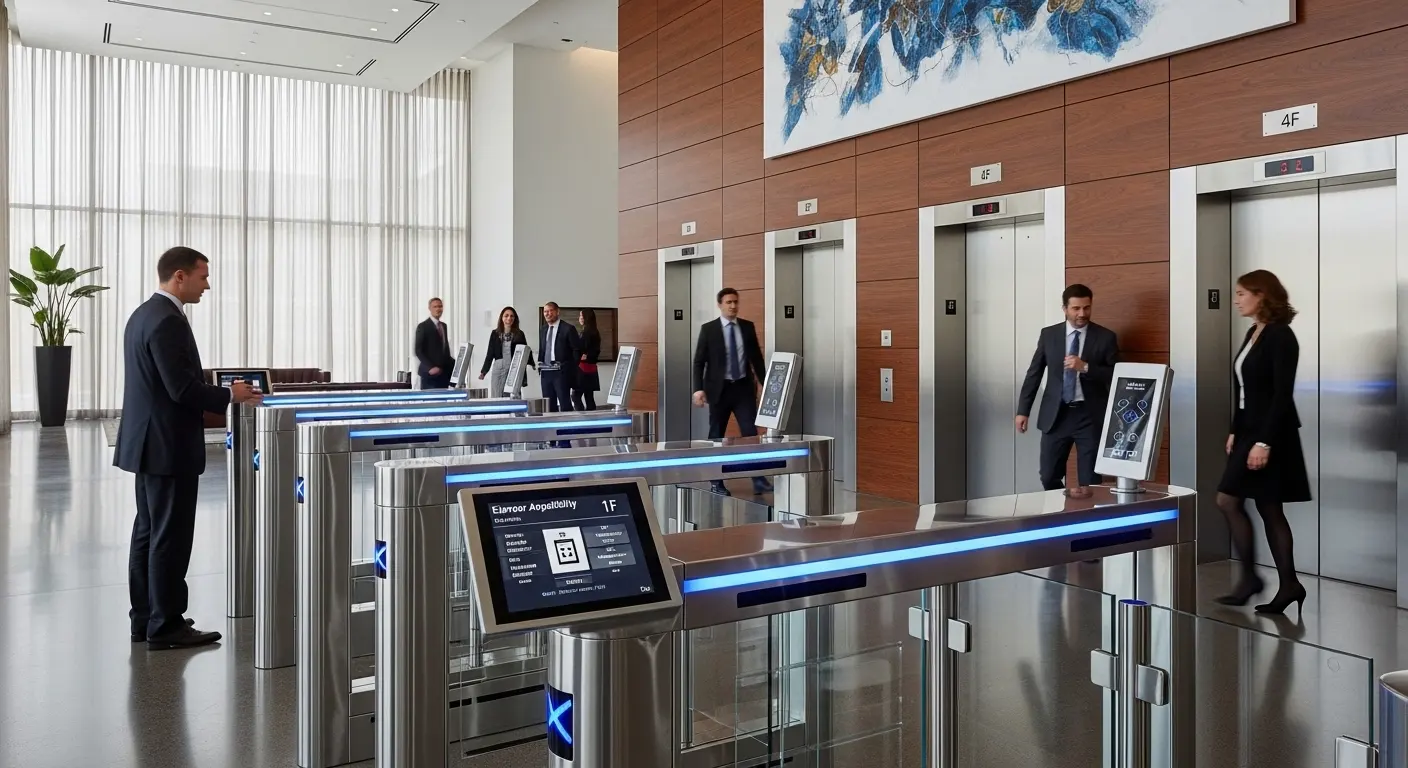
Building lobby turnstiles can connect directly to elevator access control — the turnstile validates the credential at lobby level, and the elevator dispatch system calls the authorized floor automatically. No second credential tap is needed at the elevator panel.
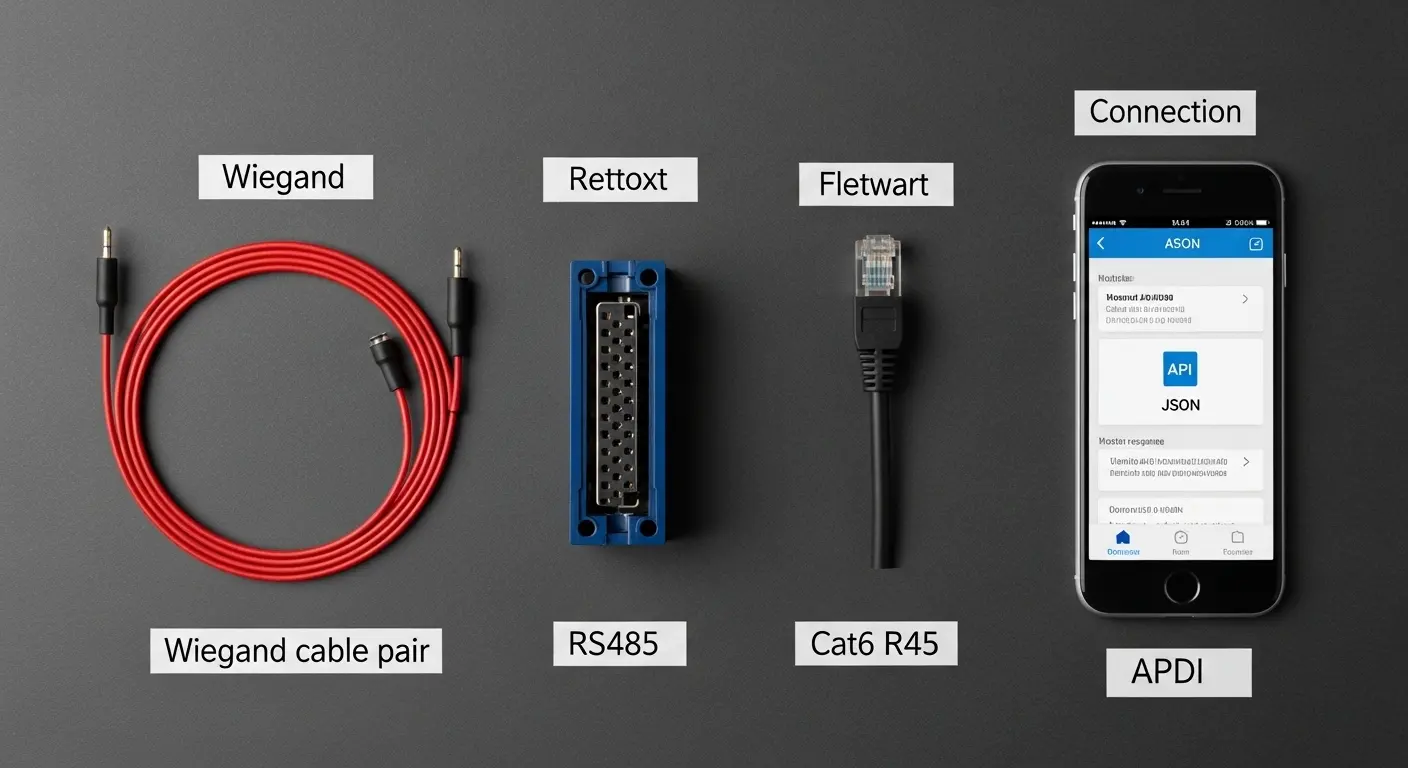
| Tipo de integración | Protocolo | Mejor para |
|---|---|---|
| Standard ACP panel | Wiegand 26/34 bits | Most commercial buildings |
| Cloud ACP / OSDP | TCP/IP / Ethernet | New builds, multi-site managed |
| On-premise BMS | RS485 | Gobierno, legacy systems |
| Elevator floor interlock | Relé de contacto seco | Multi-tenant, floor-restricted access |
The elevator interlock works via a dry contact relay output from the turnstile controller. On credential verification, the relay signals the elevator access controller to enable travel to the cardholder's authorized floor for a defined time window — typically 30 sobras.
This configuration removes the need for a second access credential point at the elevator bank. For tenants in a multi-floor building, it also prevents unauthorized floor access by anyone who follows an employee through the lobby gate without their own valid credential.
ADA Compliance for Building Lobby Turnstiles
Every public commercial building entrance must provide at least one ADA-accessible lane. Bajo los estándares ADA para el diseño accesible (EE. UU.), the minimum clear width is 32 Pulgadas (813mm) para el paso y 36 Pulgadas (914mm) for standard approach. Ironman's ADA speed gate lane is specced at 900mm — meeting both requirements.
| ADA Criterion | Carril estándar (550–600 mm) | ADA Wide Lane (900mm ) |
|---|---|---|
| 32" (813mm) passing width | ❌ | ✅ |
| 36" (914mm) approach width | ❌ | ✅ |
| Modo de salida de seguridad | Obligatorio | Obligatorio |
| Wheelchair clearance | ❌ | ✅ |
Under NFPA 101 Código de Seguridad Vital, any ADA-accessible lane on an egress route must be configured in fail-safe mode. The barriers retract and stay open during a power failure or fire alarm. This keeps the egress route clear for evacuation.
Speed gates deliver the cleanest ADA solution in a premium lobby. The 900mm wide-lane variant uses the same cabinet, Fin, and controller as the standard lanes. The result is architectural consistency across the full gate row — no visual difference between standard and accessible lanes except in width.
For UK commercial buildings, Approved Document M of the Building Regulations sets equivalent requirements. A 900mm clear width lane satisfies both US ADA and UK Approved Document M in a single specification.
Visitor Management and Credential Options
El tipo de credencial determina el hardware del lector, La integración del control de acceso, and the visitor management workflow at the lobby reception desk. Confirm the credential types before finalizing the gate specification.
| Tipo de credencial | Lobby Use Case | Integration Protocol |
|---|---|---|
| Tarjeta RFID (Wiegand 34 bits) | Tenant employees | ACP panel — widest compatibility |
| NFC móvil | BYOD corporate buildings | TCP/IP with NFC reader |
| Código QR / código de barras | Gestión de visitantes, Contratistas | Software de visitante en la nube + TCP/IP |
| Reconocimiento facial | Vestíbulos premium, Touchless | TCP/IP, En la nube o en las instalaciones |
| Biométrico (Huellas/Iris) | Gobierno, finanzas | Wiegand or RS485 |
QR code visitor credentials are now standard in Class A and multi-tenant lobbies. The building management platform generates a single-use QR code, emails it to the visitor before arrival, and the gate validates it on-site — no card issued, no staff involvement at the gate.
Facial recognition at lobby level is growing in premium Class A buildings. The gate reads a live scan against the tenant's employee directory and opens in under 0.5 seconds — no badge tap required at peak flow. For the credential configuration used across Ironman's lobby deployments, véase elPágina de la puerta de velocidad peatonal for the reader integration options available.
Real Building Lobby Turnstile Deployments from Ironman
Four completed Ironman lobby deployments cover the main building classes and lobby scenarios a specifier will encounter.
| Despliegue | Building Type | Gate Specification | Key Result |
|---|---|---|---|
| Países Bajos | Class A 20-floor multi-tenant tower | 4-Puerta de velocidad de carril, Carril ancho ADA, QR visitor management | 2,400 Entradas diarias, zero morning congestion |
| New York | Class A corporate building | Custom finish speed gate, architect-approved panel design | Architectural sign-off before production |
| Dubai | Premium high-traffic commercial | High-speed speed gate, 0.4s cycle | 400 entries in 8-minute peak window |
| Europa | Standard commercial building | Multi-lane commercial speed gate, CE-certified | Full EU regulatory compliance |
ElDespliegue en vestíbulos de edificios en los Países Bajos is the most relevant reference for multi-tenant Class A office towers. ElDubai high-speed deployment is the reference case for buildings with extreme peak flow requirements — the 0.4-second cycle time was the primary specification criterion. ElEurope commercial building deployment covers CE-certified regulatory compliance for European project buyers.
How to Get a Building Lobby Turnstile Quote
Four items are enough for an itemized factory-direct quote within 12 Horario de atención.
- Building class and lobby brief: Class A / standard commercial / Uso mixto / gobierno, Recuento diario, Dimensiones del vestíbulo, ADA lane count, finish preference or architect's brief
- Credential and visitor management workflow: employee credential type, Software de gestión de visitantes, elevator integration requirement
- Reference deployment: identify the Ironman case study closest to your building type — use its configuration as your baseline specification brief
- Submit your brief: contact the Ironman team via the commercial speed gate product page and receive your factory-direct quote within 12 Horario de atención
Preguntas frecuentes
Q1: What type of turnstile is best for a building lobby?
The best building lobby turnstile depends on your building class. Speed gates are the standard for Class A commercial buildings and premium lobbies — they offer 50–80 ppm throughput, Estética premium (Paneles de vidrio templado, Acero inoxidable 304 Gabinete), and a 900mm ADA-accessible wide-lane option within the same product family. Flap barriers suit standard commercial and mid-range managed buildings where budget is a primary factor. Compact swing gates serve SME and secondary lobby entrances with lower daily traffic. Full height turnstiles are not appropriate for a primary commercial lobby where client and visitor access occurs.
P2: How do building lobby turnstiles integrate with elevator access control?
Elevator integration connects the turnstile controller to the elevator access control system via a dry contact relay output. When a cardholder's credential is verified at the turnstile, the relay signals the elevator controller to enable travel to that cardholder's authorized floor for a defined time window — typically 30 sobras. Common integration protocols are Wiegand 26/34-bit for standard ACP panels, TCP/IP for cloud-based and OSDP-compatible systems, and RS485 for on-premise building management systems. This removes the need for a second credential scan at the elevator bank and prevents unauthorized floor access in multi-tenant buildings.
P3: Do building lobby turnstiles need to be ADA compliant?
Sí. Bajo los estándares ADA para el diseño accesible (EE. UU.), every public building entrance must include at least one accessible lane with a minimum 32-inch (813mm) clear passing width and 36-inch (914mm) standard approach width. Any accessible lane on an egress route must also operate in fail-safe mode — barriers retract and stay open during a power failure or fire alarm, per NFPA 101. Speed gates provide the most architecturally consistent ADA solution — the 900mm wide-lane variant uses the same cabinet, Fin, and controller as standard lanes in the same gate row.
P4: Can a building lobby turnstile work with visitor management software?
Sí. Modern building lobby turnstiles support QR code and barcode credential readers that integrate directly with cloud-based visitor management platforms. The visitor management software generates a single-use QR code, emails it to the visitor before arrival, and the gate validates it on-site without card issuance or staff involvement. This is now standard practice in Class A and multi-tenant commercial building lobbies. Integration uses TCP/IP or a local API connection between the gate controller and the visitor management platform.
P5: How many turnstile lanes does a commercial building lobby need?
Calculate lane count using the peak-window method: take total daily entries, dividir por 15 (the peak arrival window in minutes), luego divide por el rendimiento de la puerta por minuto (50–60 ppm para una puerta de velocidad). Add one lane for redundancy and one ADA-accessible lane per entrance. As a minimum, two lanes per direction — or one bidirectional lane — is the standard recommendation per entrance, per the Jaydagate 2026 Buyer's Guide. For a 600-person building, this typically gives a 3-lane configuration: 2 Carriles estándar más 1 ADA-accessible lane.
P6: Can a building lobby turnstile be customized to match lobby architecture?
Sí. Ironman speed gates offer full cabinet finish customization — brushed stainless SS304, mirror-polish stainless, matte black powder coat, RAL custom color, or custom paint match — along with custom glass wing panel shapes (arched, slanted, escarchado, laser-engraved). Cabinet height is available in standard 990mm, tall 1100mm, and custom dimensions to match lobby ceiling height and architectural sightlines. An architect's finish approval stage is built into the OEM production process, with a physical sample panel provided before manufacturing begins.
Three Decisions That Define Your Building Lobby Entry System
Building class matching, Configuración de carriles ADA, and elevator integration setup — these three decisions determine whether your lobby turnstile system works as a security asset and an architectural element. Choosing the wrong gate type for a Class A lobby creates a problem that credential configuration cannot fix.
Ironman supplies factory-direct building lobby turnstile systems to Class A offices, Torres multiinquilino, Hoteles, Edificios gubernamentales, and commercial developments across 50+ Países. Submit your lobby brief via the commercial speed gate product page y recibir un presupuesto completo y detallado directamente de fábrica dentro de 12 Horario de atención.
