



Campus Access Control Gates: Safe Entry for Educational Institutions
2025-10-27


University and college campuses are unique environments. They are vibrant communities designed for learning, collaboration, and exploration – inherently open and welcoming by nature. Yet, beneath this surface of openness lies a complex reality: campuses are small cities unto themselves, housing thousands of students, faculty, staff, and visitors, along with valuable research labs, expensive equipment, and sensitive data. Ensuring the safety and security of this diverse population and its assets, without sacrificing the essential spirit of academic freedom and accessibility, is one of the most significant challenges facing educational institutions today.
Traditional methods – relying solely on campus police patrols, basic door locks, or manual ID checks at building entrances – are no longer sufficient to meet the demands of the modern campus. They are inefficient, inconsistent, and often fail to provide the necessary level of granular control needed to protect specific areas while keeping common spaces accessible.
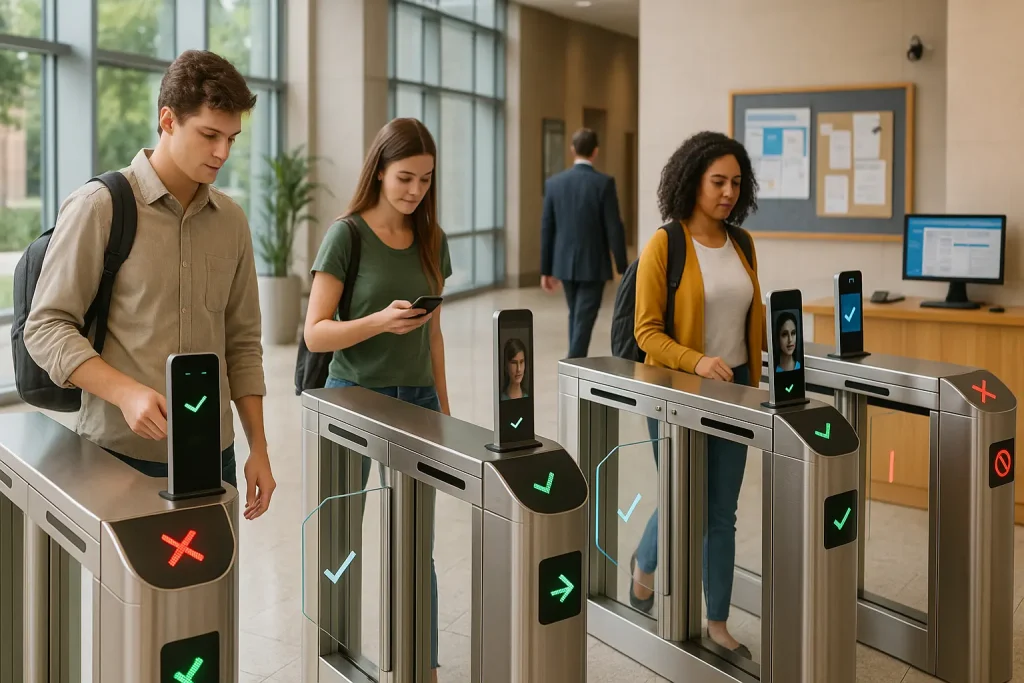
This is where the campus access control gate becomes an indispensable tool. More than just a simple turnstile, it represents an intelligent, automated system specifically adapted for the unique rhythm and requirements of an educational setting. It's a key component in a layered security strategy, designed to manage the flow of people, restrict access to sensitive areas, and provide critical data, all while striving to maintain that crucial balance between security and openness. This guide offers an expert, in-depth look at campus access control gates, exploring their specific role, the technologies involved, implementation best practices, and their future in shaping safer educational environments.
What Is a Campus Access Control Gate?
A campus access control gate is a physical barrier, typically a turnstile or speed gate, integrated with the institution's electronic access control system to manage entry into specific buildings or areas on campus. It uses student/faculty ID cards, mobile credentials, or other identifiers to automatically grant or deny passage based on pre-defined permissions.
Unlike the systems designed purely for speed, like an airport speed gate system, or those focused solely on high security, such as a government facility access gate, a campus access control gate must be uniquely versatile. It needs to handle extremely high traffic volumes during class changes, operate reliably 24/7 for locations like dormitories, integrate seamlessly with diverse campus IT systems, and be robust enough to withstand heavy use, all while fitting within often tight institutional budgets. It's a critical element of the overall access control for buildings strategy tailored for the educational landscape.
Why Are Access Gates Crucial for Modern Campuses?
Access gates are crucial because they provide a scalable, automated way to enforce access policies across diverse campus facilities. They enhance safety by restricting unauthorized entry into sensitive areas (like dorms, labs, athletic facilities), manage high traffic flow efficiently, provide auditable entry logs, and support emergency response protocols like lockdowns.
The "open campus" model, while desirable, presents inherent security vulnerabilities. Gates help mitigate these risks in several key ways:
- Securing Residential Halls (Dorms): This is often the primary driver. Gates provide a critical layer ensuring only residents and authorized guests can enter student housing, significantly enhancing student safety, especially after hours.
- Protecting High-Value Assets: Research labs, IT data centers, libraries with special collections, and athletic equipment rooms require restricted access. Gates provide an automated, auditable way to enforce these restrictions.
- Managing Event Access: Controlling entry to sporting events, concerts, or paid lectures held in campus venues often utilizes turnstiles integrated with ticketing or ID systems.
- Improving Efficiency During Peak Times: Automating entry validation at high-traffic locations like dining halls or libraries during peak hours significantly reduces queues compared to manual ID checks.
- Creating Auditable Records: Gate systems automatically log every entry attempt (successful or denied), providing invaluable data for security investigations, usage analysis, and potentially aiding compliance with regulations like the Clery Act (related to campus safety reporting).
- Supporting Emergency Protocols: Integrated gates can be centrally controlled during emergencies – locked down to prevent intruders from entering buildings or opened freely to facilitate rapid evacuation.
How Do These Gates Work Within the Campus Ecosystem?
Campus gates function as enforcement points for a central access control system, typically linked to the university's primary ID card database or Student Information System (SIS). When a student or staff member presents their ID, the gate reader communicates with the central system to verify permissions before granting or denying access.
The integration is key. A campus access control gate doesn't operate in a vacuum.
- The Credential (Usually the ID Card): Most campuses issue multifunctional ID cards (often using secure 13.56 MHz smart card technology) that serve as identification, access key, library card, meal plan card, and sometimes even a payment method. Mobile credentials on smartphones are also rapidly gaining popularity.
- The Reader: Integrated into the gate, this device reads the ID card or mobile credential.
- The Connection: The reader sends the credential data (often over a secure network) to the campus's central access control server or platform.
- The "Brain" (The Central System): This server cross-references the credential ID with its database, which is often dynamically linked to the Student Information System (SIS) and Human Resources (HR) databases. It checks:
- Is this a valid ID?
- Is this person currently enrolled/employed?
- Does this person have permission to enter this specific building/area at this specific time? (e.g., Is this student assigned to this dorm? Is this faculty member authorized for this lab after hours?).
- The Command: The central system sends an "Allow" or "Deny" command back to the gate controller.
- The Action: The gate's physical barrier opens or remains closed. The event is logged.
This integration allows for automated permission updates. When a student graduates or an employee leaves, their access can be automatically revoked centrally, eliminating the security risk of unreturned keys or cards.
Unique Challenges of Access Control on Campuses
Campus environments present unique challenges compared to typical corporate settings. These include managing an extremely large and constantly changing user base, securing diverse facility types with varying needs, accommodating 24/7 access requirements, handling frequent visitors, and balancing security with an open, welcoming culture.
- Massive User Volume & Turnover: A large university might have 50,000+ active cardholders. Each year, thousands graduate and leave, while thousands more arrive. The system must handle this scale and constant churn efficiently. Manual management is impossible.
- Diverse Facility Needs: A single campus has dorms (needing 24/7 resident access), research labs (needing high security, maybe biometrics), libraries (needing general student/faculty access during specific hours), athletic facilities (needing controlled access for athletes, staff, and event attendees), and administrative offices (similar to a standard office building pedestrian turnstile). The access system must support vastly different rule sets.
- 24/7 Operations: Unlike offices, many campus facilities (especially dorms and some labs or study areas) require secure access around the clock. The hardware must be robust enough for continuous operation.
- High Visitor Traffic: Campuses host prospective students, visiting parents, guest lecturers, conference attendees, and event spectators. Managing this diverse visitor population securely and efficiently requires a well-defined strategy, often integrating gates with visitor pre-registration or temporary credential issuance.
- Balancing Security with Openness: This is the cultural tightrope. Campuses thrive on collaboration and accessibility. Implementing overly restrictive or visually imposing security measures (like too many full-height turnstiles) can create a "fortress" atmosphere that clashes with the academic mission. The "character" of the chosen solution matters greatly.
Types of Gates Suitable for Campus Environments
The choice of gate depends heavily on the specific location's function, required security level, and traffic volume. Campuses often utilize a mix of tripod turnstiles, optical/speed gates, full-height turnstiles, and ADA-compliant gates.
1. Tripod Turnstiles (The Cost-Effective Controller)
- Description: Three rotating arms that allow one person to pass per rotation after authorization.
- Pros: Lower cost, simple mechanical operation, effective at ensuring single-file passage.
- Cons: Slower throughput, industrial aesthetic, requires physical push, can be easily jumped over (lower security).
- Campus Uses: Very common for controlling access to recreation centers, dining halls, or sometimes library entrances where basic traffic control and usage counting are the main goals, and aesthetics are less critical.
2. Speed Gates / Optical Turnstiles (The Modern Flow Manager)
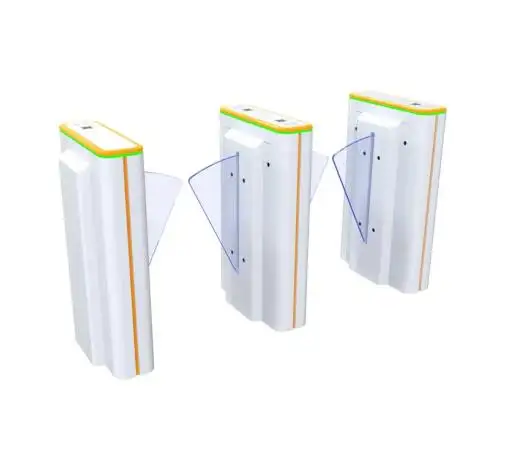
- Description: Sleek pedestals with motorized glass barriers (swing or flap) or sometimes no barriers at all (optical). Use sensors for security.
- Pros: High throughput (fast), modern aesthetics, enhanced security (anti-tailgating sensors), touchless operation.
- Cons: Higher cost, require more maintenance than tripods. Optical-only versions provide no physical barrier.
- Campus Uses: Increasingly popular for main entrances to newer dormitories, libraries, student unions, and administrative buildings where balancing speed, security, and a modern appearance is important. They offer a significant upgrade in user experience compared to tripods.
3. Full-Height Turnstiles (The High-Security Guardian)
- Description: Floor-to-ceiling rotating barriers, often in a "cage" style.
- Pros: Highest level of physical security against unauthorized entry (climbing/crawling is impossible). Durable for outdoor use.
- Cons: Lowest throughput (slowest), visually imposing ("prison-like"), highest cost for installation.
- Campus Uses: Reserved for specific high-security locations like entrances to sensitive research labs, data centers, potentially athletic facility perimeters, or unmanned remote access points. They are generally avoided for main building entrances due to their aesthetic impact.
4. ADA Accessible Gates (The Essential Passageway)
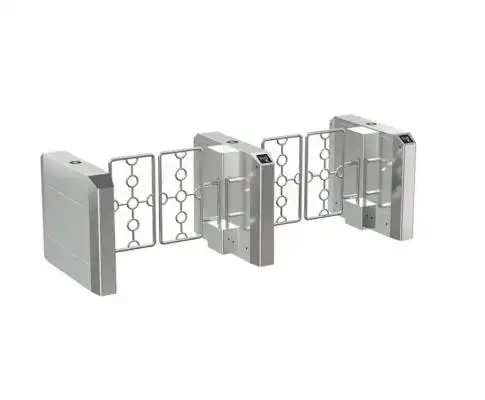
- Description: Wider lanes (typically 32-36 inches) designed to accommodate wheelchairs, strollers, and equipment deliveries. Usually employ swing-style barriers.
- Pros: Ensures compliance with accessibility regulations. Provides a necessary passage for all users and equipment. Often configured as bidirectional.
- Cons: Takes up more space than a standard lane.
- Campus Uses: Mandatory alongside any bank of standard turnstiles or speed gates. These are essential at all controlled entrances.
The specific mix and placement require careful planning based on a thorough site assessment. What works for a bustling student union is different from what's needed for a secure research facility – a contrast similar to that between a busy commercial building entrance gate and a high-security government facility access gate.
Credential Technologies Commonly Used on Campuses
The campus ID card is the traditional cornerstone, often evolving into a multi-functional smart card. Mobile credentials are rapidly gaining traction due to student preferences. Biometrics are typically limited to specialized high-security areas.
- Campus ID Cards:
- Magnetic Stripe (Old): Insecure, easily worn out. Being phased out.
- 125 kHz Prox (Legacy): Still common but insecure and easily cloned. Campuses should actively plan to migrate away from this technology.
- 13.56 MHz Smart Cards (Modern Standard): Secure (encrypted), reliable, and can support multiple applications (access, meals, library, payments) on one card. MIFARE DESFire is a common, secure choice.
- Mobile Credentials:
- Why Campuses Love Them: Students always have their phones. It eliminates the lost/forgotten card problem. Highly convenient. Can be issued/revoked instantly and remotely.
- Technology: Uses Bluetooth (BLE) for longer-range "hands-free" access or NFC to "tap" the phone like a card.
- Adoption: Rapidly increasing, often offered alongside or replacing physical cards.
- Biometrics:
- Usage: Typically limited to very specific high-security areas like research labs handling controlled substances or critical data centers, often as a second factor (card + fingerprint).
- Challenges: Cost, enrollment logistics for thousands of students, and significant privacy concerns make widespread adoption difficult on most campuses.
- Visitor Credentials:
- Temporary Cards: Issued at a check-in desk for registered guests.
- QR Codes: Sent via email to pre-registered visitors (e.g., conference attendees, prospective student tours) for self-service scanning at designated gates.
Integrating Gates with Key Campus IT Systems
Effective campus access control relies heavily on deep integration between the physical gates and various campus software platforms, primarily the Student Information System (SIS) and HR systems, to automate permissions based on real-time enrollment and employment status.
- Student Information System (SIS): This is the master database for student enrollment, housing assignments, course registrations, and status (active, withdrawn, graduated). The access control system must continuously sync with the SIS to:
- Automatically grant dorm access when a student moves in.
- Automatically revoke access when a student withdraws or graduates.
- Grant access to specific academic buildings based on course enrollment. My Experience: "Manual provisioning is a non-starter on a campus. Without tight SIS integration, you'd need an army of administrators just to keep up with student turnover. The automation is essential."
- Human Resources (HR) System: Similarly, integration with the HR system automates access for faculty and staff based on their employment status, department, and assigned roles. Access is automatically revoked upon termination.
- Housing Management Systems: Specific integration may be needed to manage guest policies, roommate assignments, and floor-level access within dormitories.
- Emergency Notification Systems: Critical for safety. The access control system should be able to receive commands from the campus mass notification system to trigger lockdowns (locking exterior gates) or unlock specific doors for evacuation routes.
- Video Surveillance (VMS): Linking gate alarms (e.g., tailgating, forced open) to nearby cameras provides immediate visual context for security responders.
This level of integration requires open architecture (APIs) in the access control platform and significant collaboration between campus IT, security, housing, and administrative departments.
Best Practices for Implementing Campus Access Control Gates
Successful implementation requires a holistic approach, starting with a comprehensive needs assessment and considering scalability, durability, user experience, compliance, and ongoing maintenance.
- Conduct a Thorough Needs Assessment: Don't just install gates everywhere. Identify which buildings/areas genuinely require controlled access based on risk, function, and traffic patterns. Where are your vulnerabilities? Where are the bottlenecks?
- Choose a Scalable & Flexible Platform: Campuses evolve. Choose an access control system (likely cloud-based or a robust enterprise solution) that can easily scale to accommodate new buildings, changing user populations, and future technologies. Prioritize open platforms with strong integration capabilities.
- Prioritize Durability & Reliability: Campus gates see heavy use, far more than a typical office. Choose robust hardware designed for high-cycle environments. Factor in weather resistance for any outdoor gates. Downtime is not just inconvenient; it can be a major security issue (e.g., if a dorm gate fails).
- Focus on User Experience & Communication: Students and faculty need to understand why gates are being installed and how to use them. Clear signage, intuitive reader placement, and proactive communication campaigns are essential for smooth adoption and minimizing frustration. Avoid creating an overly restrictive or confusing environment.
- Develop a Robust Visitor Management Strategy: How will prospective students, parents, guest lecturers, delivery personnel, and event attendees gain access? This must be clearly defined and integrated with the gate system.
- Ensure Compliance: Primarily ADA accessibility (mandatory wide lanes). Also consider how access logs might support Clery Act reporting requirements. Ensure data privacy policies (especially if considering biometrics) comply with relevant regulations (FERPA, GDPR, etc.).
- Implement a Proactive Maintenance Plan: Don't wait for gates to break. Schedule regular preventive maintenance (sensor cleaning, motor checks, firmware updates) to ensure reliability and longevity, especially given the high usage rates on campus.
Balancing Security with the Essential Openness of Campus Culture
This is perhaps the most unique and challenging aspect. A campus is not a fortress. Implementing security gates must be done thoughtfully to enhance safety without destroying the collaborative, open atmosphere essential to learning and research.
- Avoid the "Fortress" Look: Use aesthetically appropriate hardware. Sleek speed gates are often better received in main areas than imposing full-height turnstiles. Blend security into the environment rather than making it overtly intrusive.
- Communicate the "Why": Explain the safety benefits to the campus community. Frame it as a tool to protect them and the resources they rely on, not just to restrict them.
- Focus on High-Risk Areas: Concentrate gate installations where they provide the most significant security benefit (dorms, labs, sensitive data areas) rather than blanket-installing them everywhere.
- Ensure Reliability: Nothing damages user acceptance faster than a gate that frequently malfunctions, causing delays and frustration. Invest in quality hardware and maintenance.
The Future of Campus Access Control Gates
The future lies in leveraging "smarter" technologies for a more seamless, data-driven, and predictive campus environment. AI-powered analytics, truly frictionless credentials, and deeper integration with overall smart campus initiatives will be key.
- AI-Powered Analytics: Systems will analyze gate traffic patterns not just for security anomalies but also for operational insights – predicting queue build-up at dining halls, optimizing library staffing based on entry counts, or even identifying underutilized study spaces.
- Frictionless Access: Mobile credentials using long-range Bluetooth or UWB, combined with advanced facial recognition, will allow students and staff to move through controlled points without needing to physically present a card, enhancing convenience and throughput.
- Integration with Smart Campus Platforms: The
campus access control gatewill become a key sensor in a broader "smart campus" ecosystem, sharing data with systems managing everything from classroom scheduling and energy management to parking and emergency response, creating a truly connected and responsive environment.
Final Verdict
The campus access control gate is an essential component of modern educational facility management. When implemented thoughtfully and strategically, it provides a powerful solution for enhancing safety and security across diverse campus environments – from dormitories and labs to libraries and recreation centers.
By automating access, managing high traffic volumes, integrating with critical campus systems, and providing invaluable data, these gates help institutions strike that difficult but crucial balance: maintaining a secure and orderly environment while preserving the open, collaborative spirit essential to learning and discovery. They are not just barriers; they are intelligent enablers of a safer, smarter campus community.
