



Fire Alarm Integration Turnstile: Legal Requirements, Wiring Methods, and Gate Behavior Explained
2026-03-18


Fire alarm integration turnstile requirements aren't optional — they're mandated by building codes in most jurisdictions worldwide. When a fire alarm activates, every automatic turnstile gate in a building must release to its full open position immediately, without requiring manual intervention, to allow unrestricted evacuation. Getting this wrong isn't just a compliance failure — it's a life safety failure.
This guide covers the exact legal requirements, the technical wiring methods, the different gate behaviors across product types, and what to check before commissioning any fire alarm integration turnstile installation.
Why Fire Alarm Integration Is Mandatory for Turnstile Gates
The legal basis is clear and consistent across major building codes.
New York City Building Code §1010.3 states directly: "Each automatic turnstile shall be connected to the building fire alarm system. Activation of the building fire alarm system shall automatically release each such turnstile to its full, clear opening width, and each such turnstile shall remain in its open position until the fire alarm system has been reset."
The same requirement exists in the UK under BS:9999 (Code of Practice for Fire Safety in the Design of Buildings), which requires that turnstiles on escape routes either fail open on power loss or are connected to the fire alarm to release automatically.
The EU's EN 13637 (electrically controlled exit systems for escape routes) requires that any electrically controlled barrier on an emergency egress path releases automatically on fire alarm activation, power failure, or manual break-glass activation.
In practice, the requirement is the same across all jurisdictions: a fire alarm integration turnstile must open its lanes completely — no partial opening, no manual override required by the occupant — the moment the fire alarm activates.
Fail-Safe vs. Fail-Secure: The Core Technical Distinction
Every fire alarm integration turnstile discussion starts with this distinction, and getting it wrong at the specification stage creates a non-compliant installation:
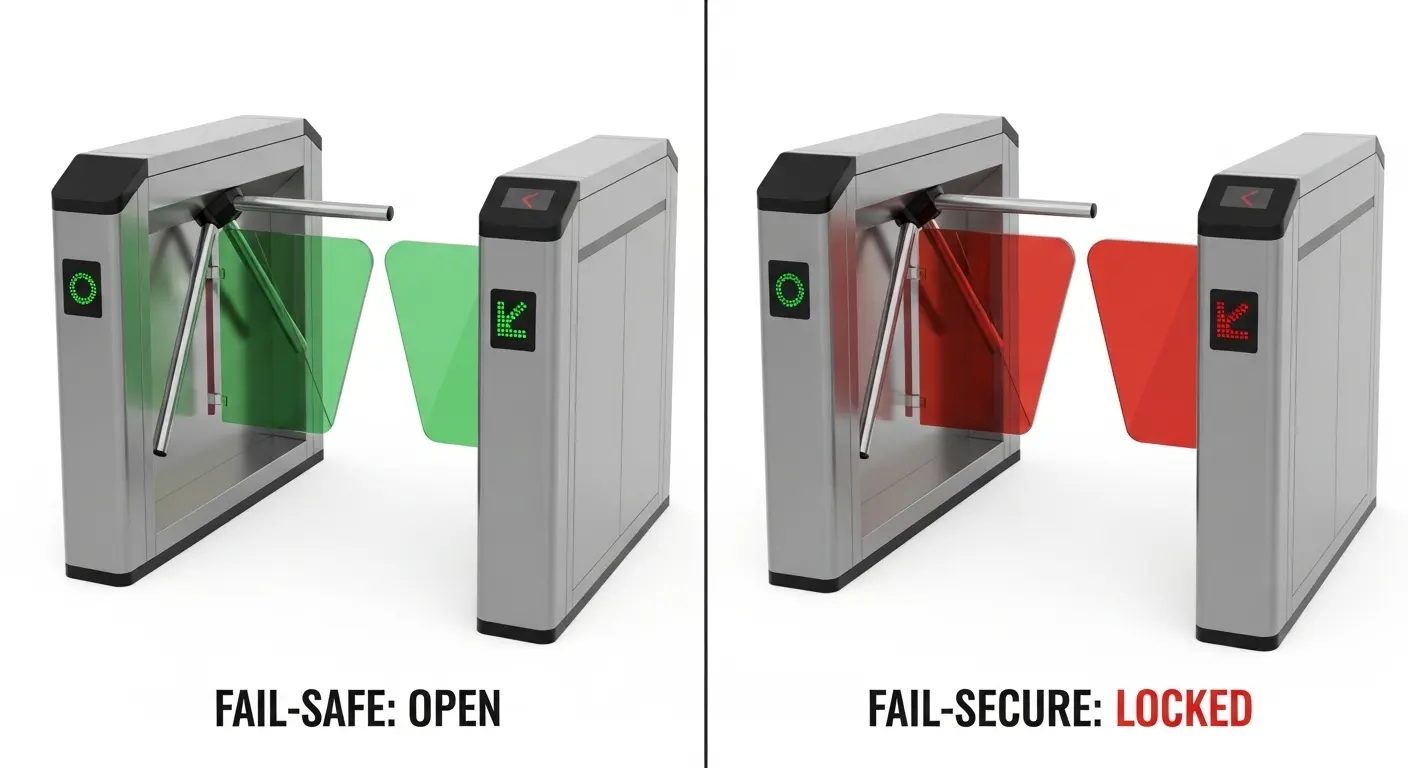
Fail-Safe Mode
The gate defaults to the open position on any of these events:
- Power failure (mains power cut)
- Fire alarm dry contact relay activation
- Emergency stop signal from the building management system
In fail-safe mode, the panel retracts, arms drop, or wings open automatically — requiring no power to hold the gate open. The gate stays open until normal power is restored and the fire alarm is reset. This is the legally required mode for any turnstile gate positioned on an emergency egress path.
Fail-Secure Mode
The gate defaults to the locked/closed position on power failure. This mode is never appropriate for an egress path. Fail-secure is only used in specific non-egress restricted zones — server rooms, vault corridors, or airside access points — where preventing unauthorized access during a power outage outweighs evacuation flow concerns.
The default mode from the manufacturer matters. A full height turnstile gate configured for a perimeter security deployment may ship with fail-secure as the default — correct for that use case. The same unit installed on an office building egress path must be reconfigured to fail-safe before commissioning. Always confirm the configured mode, not just the available modes.
How Fire Alarm Integration Turnstile Wiring Works
The wiring method for a fire alarm integration turnstile is straightforward and uses a dry contact relay interface — the same interface most access control systems use for door release:
Step 1 — Dry Contact Relay Output on the Fire Alarm Panel
The fire alarm control panel (FACP) includes relay outputs — volt-free contacts that open or close when the alarm activates. A normally closed (NC) relay is the standard choice for fire alarm integration turnstile wiring.
Step 2 — Dry Contact Input on the Turnstile Control Board
The turnstile gate's PCB includes a dedicated fire alarm dry contact input terminal. This input monitors the state of the relay. Under normal conditions (alarm inactive), the relay is closed and the gate operates normally.
Step 3 — Alarm Activation Logic
When the fire alarm activates, the FACP relay opens (breaks the circuit). The turnstile control board detects the open circuit on its fire alarm input — and immediately triggers the fail-safe open sequence. All lane barriers release to their full open position.
Step 4 — Override Priority
The fire alarm input must have the highest priority override in the control board's logic chain — overriding the access control reader, the anti-tailgating sensor output, and the manual lock command. On alarm activation, no other signal can hold the gate closed.
Step 5 — Reset Behavior
The gate remains open until the fire alarm is reset at the FACP and normal power is confirmed. Most installations use an automatic reset — the gate returns to normal controlled access mode when the relay closes again on alarm reset.
For cloud-connected installations, a cloud-based turnstile gate management system logs the fire alarm activation event with a timestamp, records which gates opened and when, and sends an alert to facility management — creating an auditable evacuation record that supports post-incident reporting.
Fire Alarm Integration Behavior by Gate Type
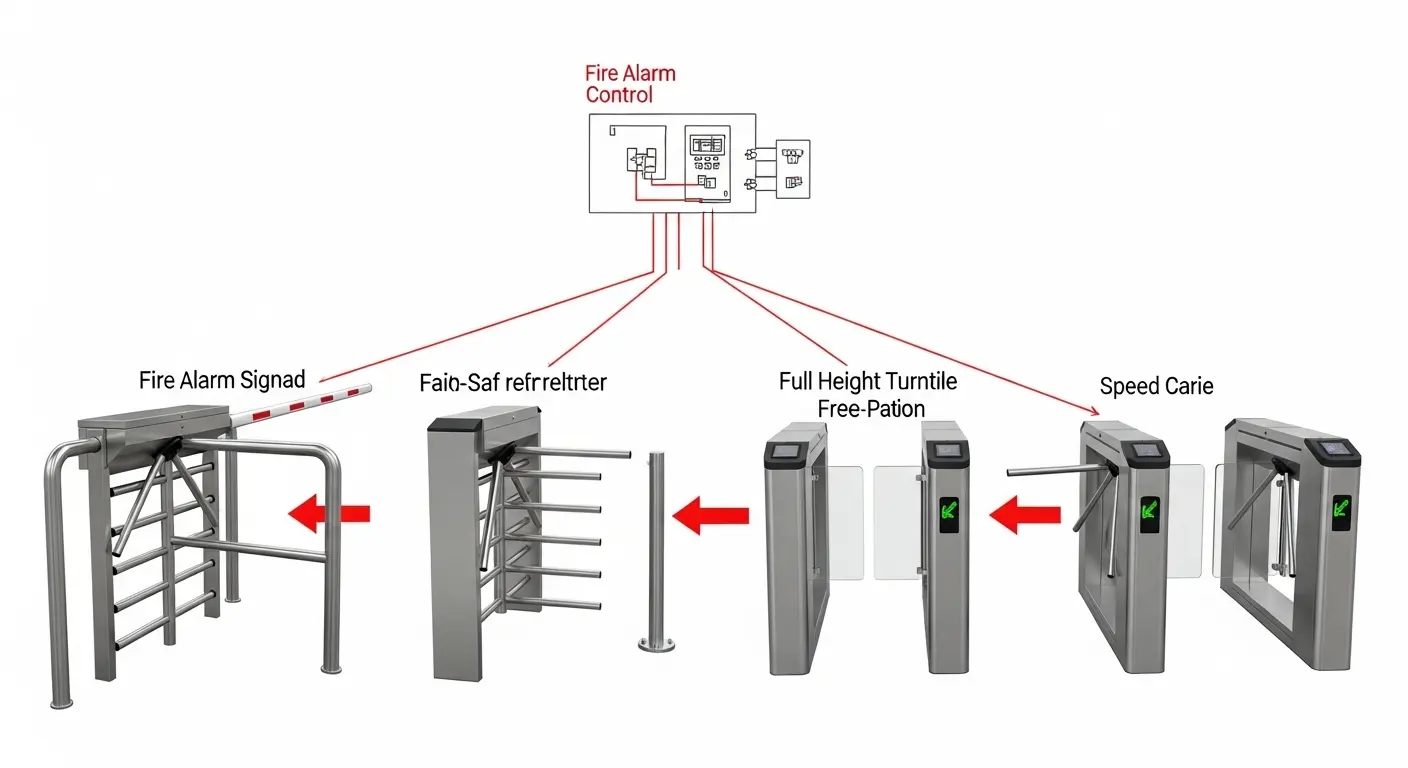
Different turnstile gate types release their barriers differently on fire alarm activation. Specifiers need to understand this at the project design stage:
Tripod Turnstile
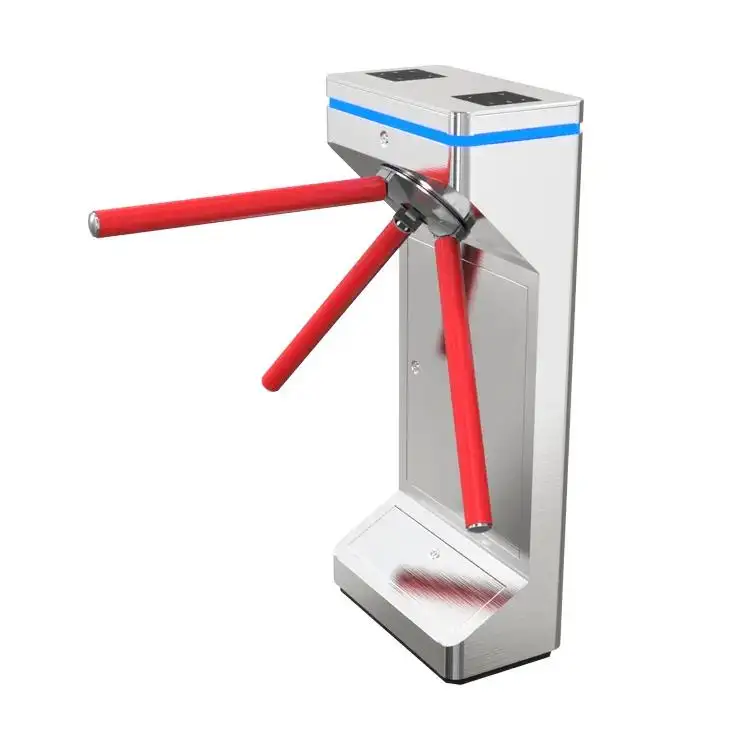
Arms drop to horizontal on fire alarm activation in fail-safe mode. The passage lane width equals the arm length — typically 500mm. Some tripod models with full horizontal arm drop achieve a 600mm clear opening. For an inclined design that completes arm drop cleanly without catching on the cabinet, an inclined arc tripod turnstile positions the arm geometry to fall clear of the cabinet profile — providing an unobstructed passage on fail-safe activation. Similarly, an automatic tripod turnstile uses a motorized drive to retract arms actively on alarm signal — faster than a gravity-drop semi-automatic model and more consistent in heavily loaded conditions.
Flap Barrier and Swing Barrier Gate
Wings and panels retract fully into the cabinet on fire alarm activation — achieving the full rated lane width as the clear opening. For flap and swing barrier installations, the lane width on fail-safe release matches the installed lane width (typically 550–900mm). For ADA egress compliance alongside standard lanes, a compact swing gate turnstile provides a wide-lane fail-safe release in a space-efficient footprint — covering the accessible egress requirement without requiring a full-width swing barrier cabinet.
Full Height Turnstile
This is where fire alarm integration becomes most critical — and most commonly misconfigured. A full height access control turnstile on an egress path must be configured to fail-safe open, which in a full height model means the rotating arm assembly releases completely to allow free passage. Some full height models achieve this by dropping to a free-rotation mode (arms spin freely without resistance). Others use a motorized release to rotate arms to a clear position. Confirm the specific fail-safe mechanism in the product specification — "fail-safe capable" and "fail-safe configured" are not the same thing.
Speed Gate
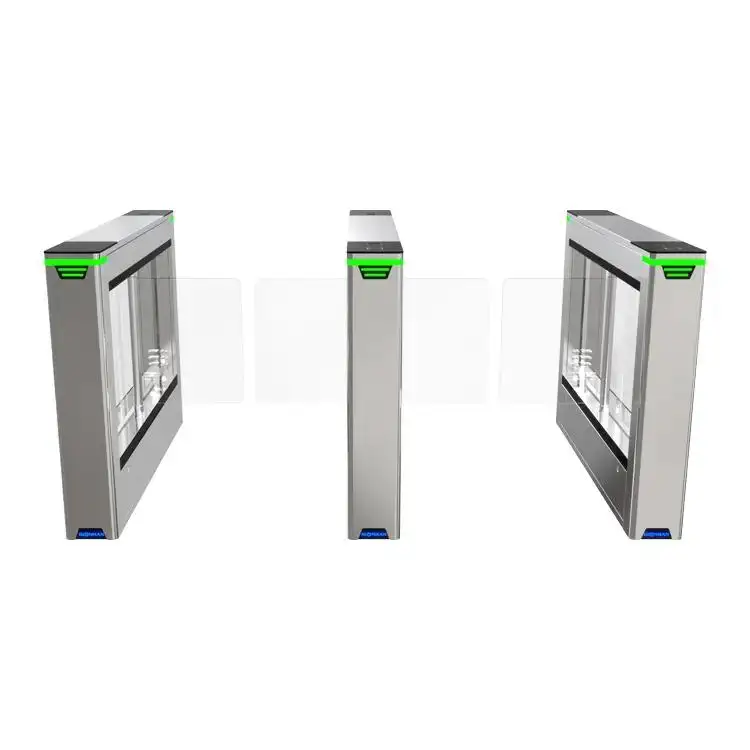
Speed gates retract glass panels fully into the pedestrian column housing on fail-safe activation — leaving a clear open lane. Speed gate fire alarm integration typically uses the same dry contact relay input as other gate types, but the panel retraction speed is faster (0.2–0.3 seconds) due to the servo motor drive. For a premium lobby installation, a UK-deployed speed gate turnstile access control installation confirms fail-safe panel retraction is factory-tested before shipment.
Building Code Compliance Checklist for Fire Alarm Integration Turnstile Installations

Before signing off any fire alarm integration turnstile installation, verify all of these compliance points:
Legal and Design Requirements
- Turnstile gates on egress paths are connected to the fire alarm system
- Fail-safe open mode is the configured (not just available) default for all egress-path gates
- Gate release achieves full clear opening width on alarm activation
- No key, code, or physical effort is required for a building occupant to exit during alarm activation
Wiring and Control
- Fire alarm dry contact relay is wired to the dedicated fire alarm input terminal on each gate control board
- NC (normally closed) relay configuration confirmed — open circuit on alarm activation
- Fire alarm input has the highest priority in the control board logic (overrides all other inputs)
- Cable run is protected against fire damage for a minimum fire-resistance period matching local code requirements
Operational Confirmation
- Fire alarm activation test performed: all linked gates release simultaneously on simulated alarm signal
- Gate remains open during the test until alarm reset
- Gate returns to normal controlled access mode after alarm reset
- Battery backup or UPS confirmed — if mains power fails simultaneously with fire alarm activation, the gate must still release on fail-safe default (not remain locked due to power loss overriding alarm signal logic)
Documentation
- Wiring diagram specific to the installation provided to the building owner
- Commissioning test record signed by the installing engineer
- Maintenance schedule covering annual fire alarm integration test confirmed with the facility team
For the Netherlands building lobby speed gate installation as a reference deployment, fire alarm integration was confirmed via a dry contact relay connected to the building fire alarm panel — with simultaneous release across all lane gates on a single FACP relay output, verified during commissioning.
Anti-Tailgating and Fire Alarm Mode: How They Interact
One question that comes up frequently in fire alarm integration turnstile commissioning is: what happens to anti-tailgating detection during a fire alarm evacuation?
The answer is straightforward. Fire alarm activation overrides anti-tailgating sensor logic completely. The gate opens and stays open — anti-tailgating detection is suspended because the entire purpose of the alarm mode is unrestricted evacuation. Multiple people passing simultaneously through an open lane in an evacuation is the intended behavior.
In addition, the alarm event is logged as a system-level override — not as a tailgating alarm event. This keeps the access control audit log clean and distinguishes genuine tailgating attempts during normal operation from the controlled multi-person flow of an evacuation.
For standard-operation anti-tailgating, an anti-tailgating AB turnstile gate uses dual optical sensors to detect and alarm on tailgating attempts — but suspends this logic immediately on fire alarm input activation, switching to full fail-safe open mode without requiring a separate configuration step.
Frequently Asked Questions About Fire Alarm Integration Turnstile
Q: Is it legally required to connect turnstile gates to the fire alarm system?
A: Yes, in most jurisdictions. New York City Building Code §1010.3 states explicitly that every automatic turnstile must be connected to the building fire alarm system and must release to its full open width on alarm activation. The UK's BS:9999 and the EU's EN 13637 contain equivalent requirements for turnstiles on escape routes. Check your local authority's version of these codes — the requirement is near-universal in commercial building regulations.
Q: What is fail-safe mode in a turnstile gate?
A: Fail-safe mode means the gate defaults to the open position when power is lost or a fire alarm signal is received. The barrier panels retract, arms drop, or wings open automatically — no power is required to hold the gate open. The gate stays open until power is restored and the alarm is reset. This is the mandatory mode for any turnstile gate on an emergency egress path.
Q: How is a turnstile gate connected to a fire alarm system?
A: Through a dry contact relay interface. The fire alarm control panel (FACP) has relay outputs — volt-free contacts that open when the alarm activates. The turnstile control board has a dedicated fire alarm dry contact input terminal. When the alarm activates, the FACP relay opens, the turnstile control board detects the open circuit, and triggers the fail-safe open sequence immediately — releasing all connected gates to their full open position.
Q: Can a full height turnstile be used on an emergency egress path?
A: Yes, but only if it is specifically configured for fail-safe open mode — meaning the rotating arm assembly releases to free passage on alarm activation. Not all full height turnstile models achieve this identically. Some use gravity-drop arm release; others use motorized arm retraction. Confirm the exact fail-safe mechanism in the product specification and verify it during commissioning testing before the installation is signed off.
Q: What happens to anti-tailgating sensors during a fire alarm activation?
A: Fire alarm activation overrides anti-tailgating sensor logic completely. The gate opens and holds open — multi-person simultaneous passage is the intended evacuation behavior. Anti-tailgating detection resumes only after the alarm is reset and the gate returns to normal controlled access mode. The alarm event is logged as a system override, keeping the access control audit log separate from normal tailgating alert events.
