


Office Turnstile Gate Guide: Which Type Fits Your Building, Lobby, and Headcount
2026-03-30


The right office turnstile gate depends on three things: your daily headcount, your lobby dimensions, and your security level. Portails de vitesse, Portes à swing, Barrières à volets, and tripod turnstiles all appear in office buildings — but each fits a specific scenario, and choosing the wrong type creates lobby congestion, ADA compliance gaps, or unnecessary cost.
This guide gives facilities managers and office building specifiers a direct scenario-matched framework. You will find a gate type comparison table by office-specific criteria, a building scenario matching section, ADA compliance figures, a lobby space planning formula, et un chemin direct vers un devis direct d’usine. For the full Ironman gate product range, Visitez leturnstile gate overview page before proceeding.
Office Turnstile Gate Types — Compared by What Offices Actually Need
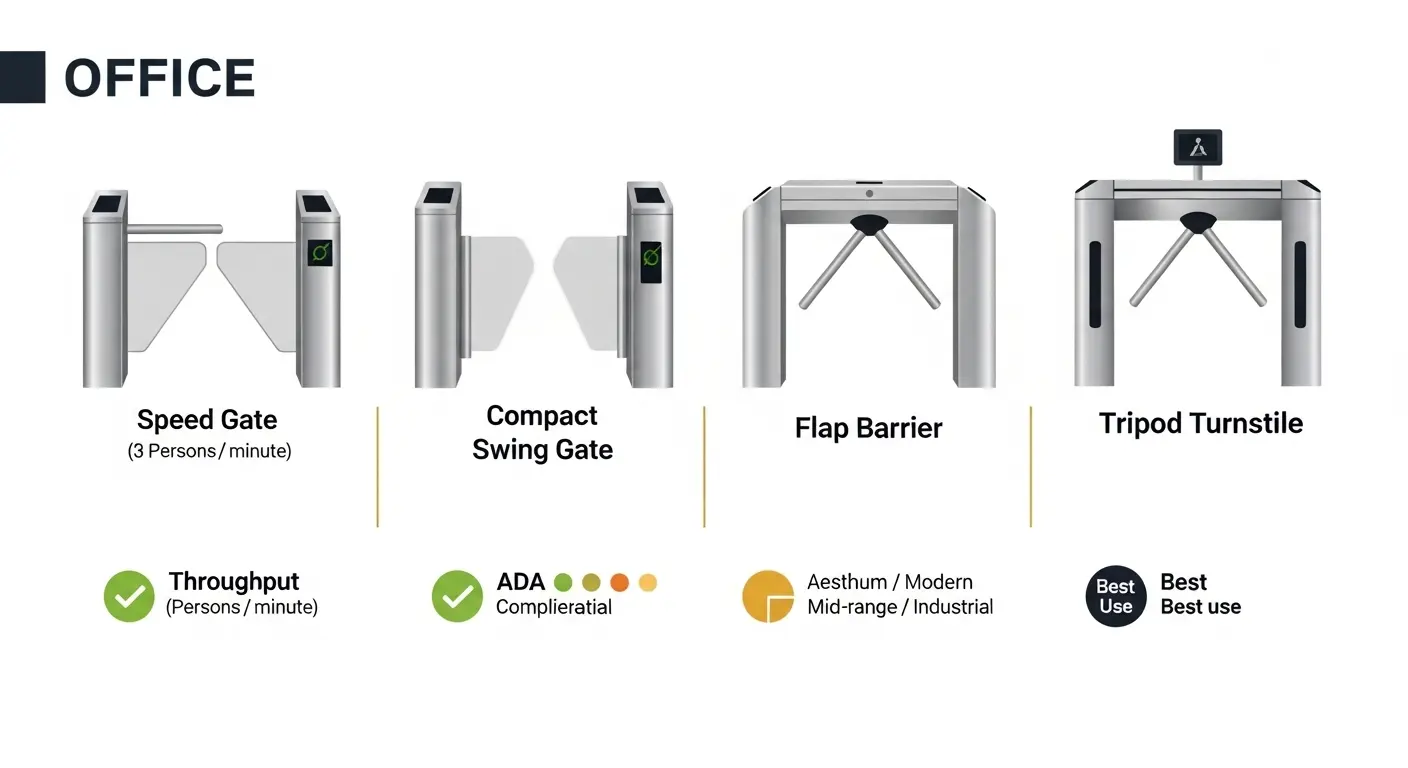
Four gate types appear in office deployments. Each has a distinct throughput, footprint, esthétique, and price range. The table below compares them on the criteria that matter in an office context.
| Type de porte | Débit | Esthétique | ADA Lane | Best Office Use | Portée de l’unité |
|---|---|---|---|---|---|
| Porte de vitesse | 50–80 ppm | Premium — glass panels, slim stainless cabinet | Best — 900mm+ wide-lane option | Siège social, Halls premium, high-rise multi-tenant | $1,300–8 000 $ |
| Porte pivotant compacte | 30–50 ppm | Moderne, personnalisable | Good — wide variant available | SME offices, Entrées secondaires, co-working | $400–2 500 $ |
| Barrière de volets | 40–60 ppm | Médiums, trim profile | Modéré | Bureaux de taille moyenne, 200–800 staff | $450–6 500 $ |
| Tourniquet trépied | 25–50 ppm | Industriel, utilitarian | Limité | Staff-only secondary entrances, non-ADA zones | $150–1 400 $ |
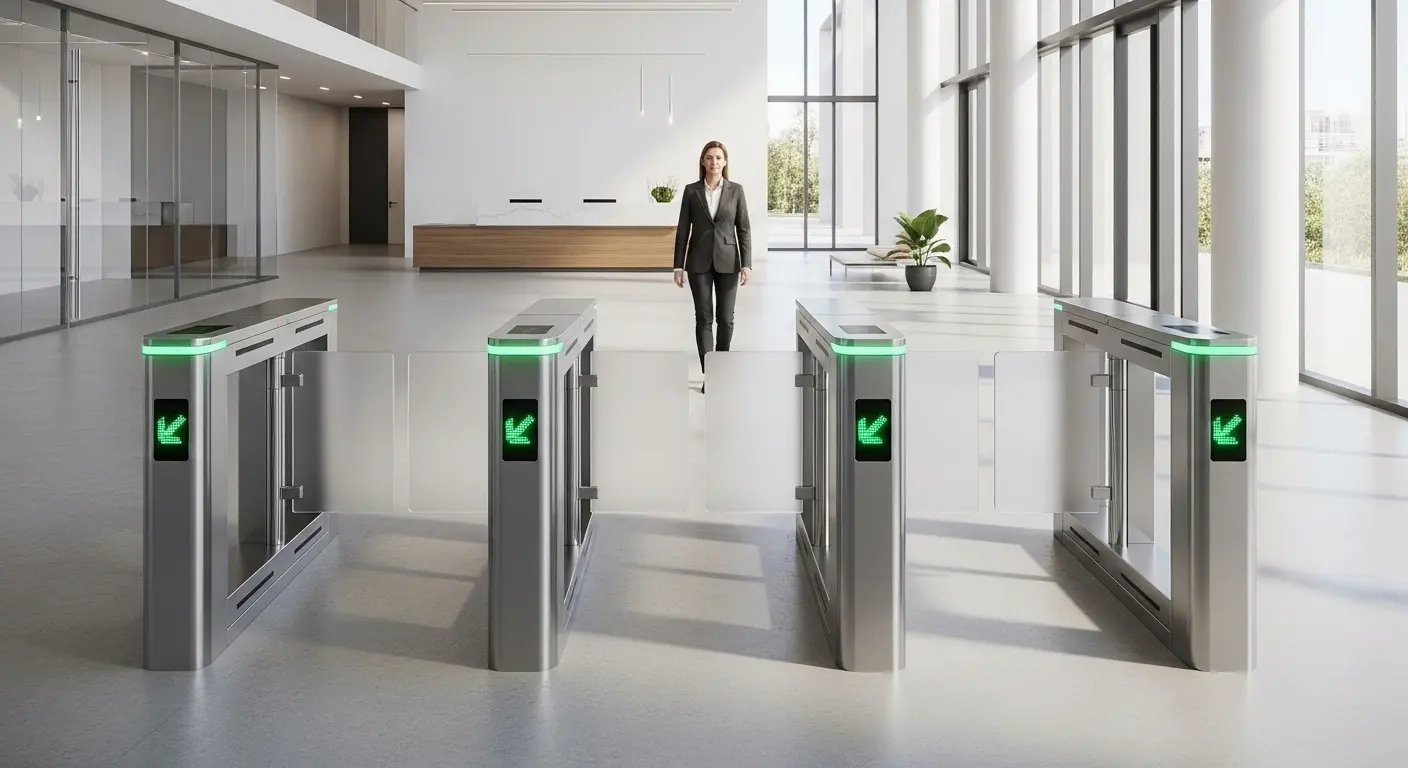
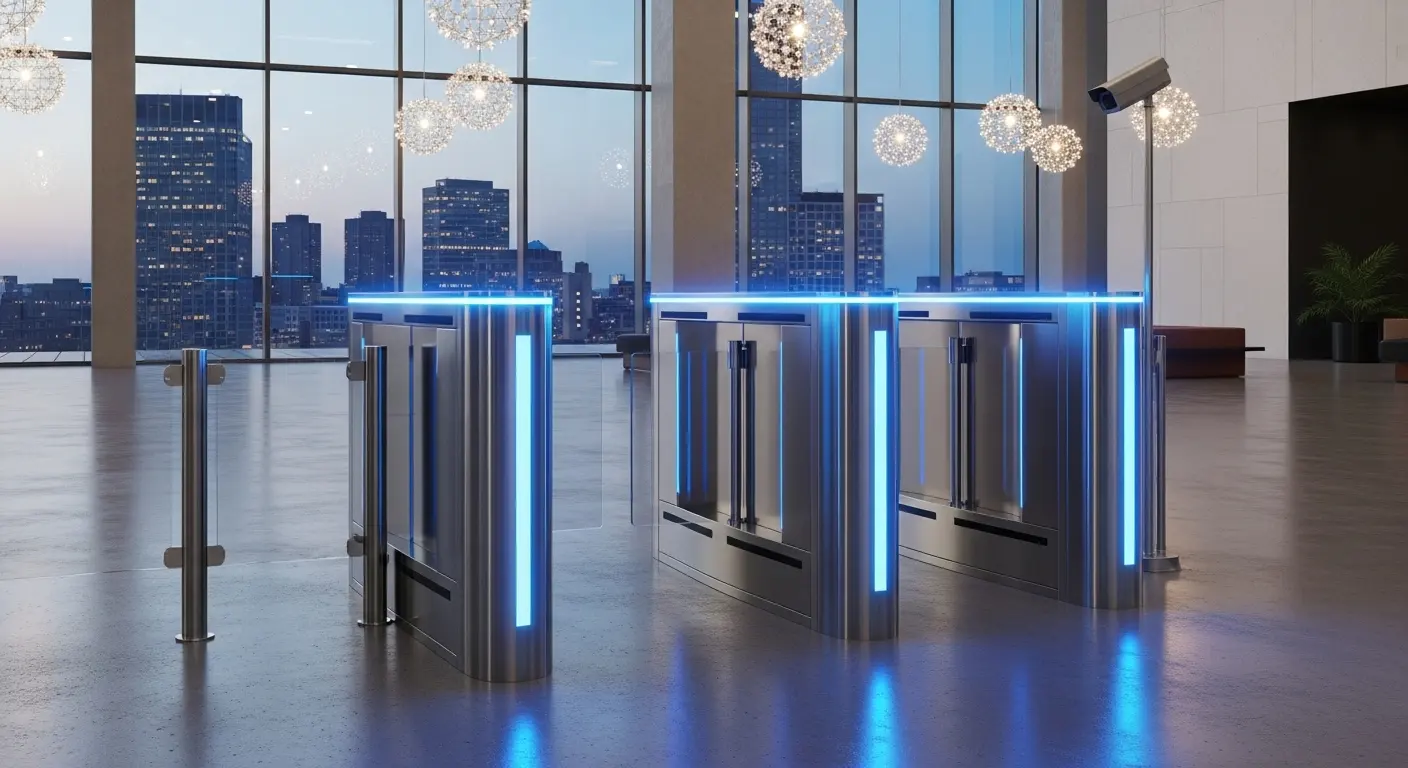
Speed gates lead on three criteria simultaneously: débit, esthétique, and ADA accessibility. This makes them the default specification for corporate headquarters and any office where client or visitor access occurs at the primary entrance.
Compact swing gates are the correct choice for small offices with lobby widths under 3 meters or daily traffic under 300 Entrées. They cost 60–70% less per lane than speed gates and require less floor depth.
Tripod turnstiles belong at secondary entrances — staff-only side doors, loading areas, or non-client-facing entry points — where aesthetics are not a criterion. They are not appropriate for any office entrance where visitors and external clients pass through.
Match Your Gate Type to Your Office Scenario
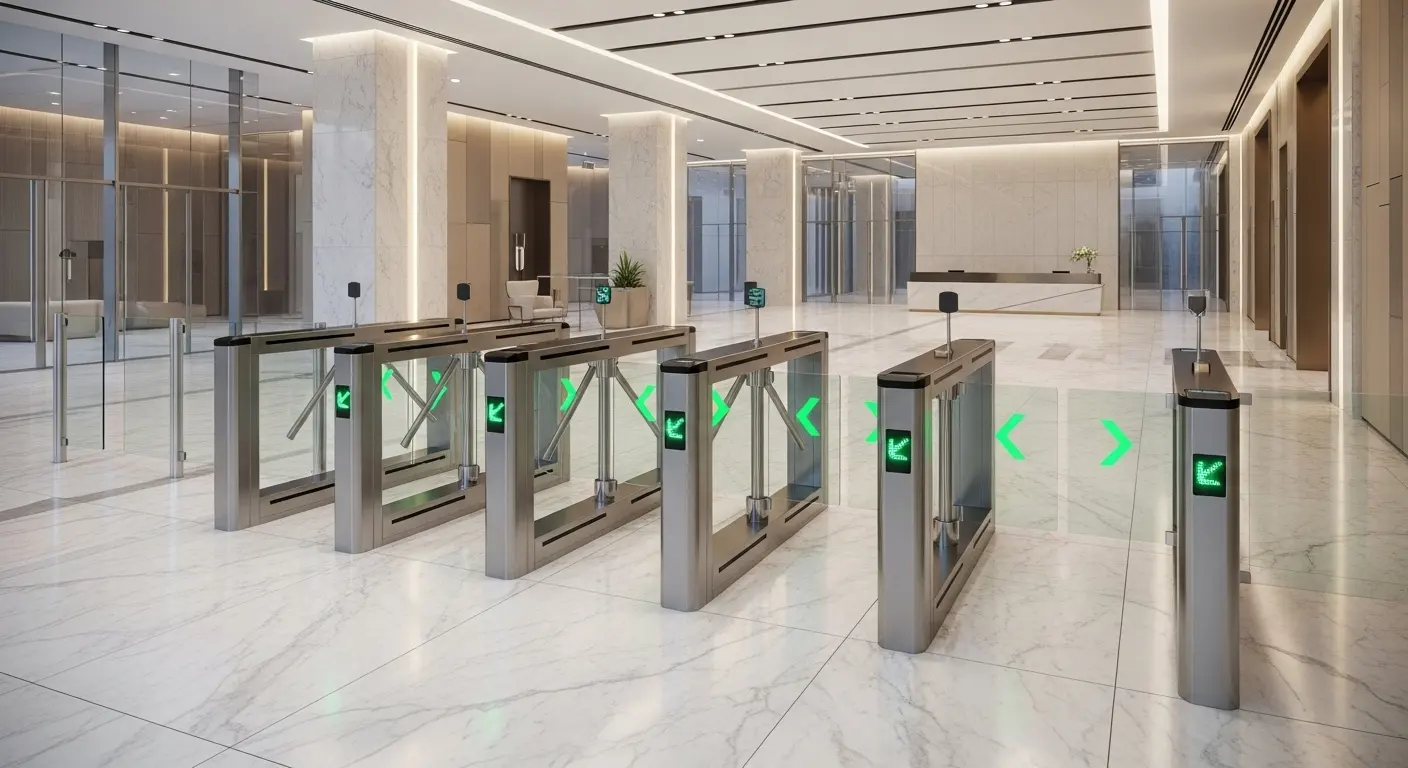
One decision framework applies across every office type: match the gate to your headcount, lobby dimensions, et niveau de sécurité. The table below gives a direct recommendation per scenario.
| Office Type | Porte recommandé | Voies | Raison principale |
|---|---|---|---|
| Petit bureau (sous 200 personnel) | Compact swing gate | 1–2 | Compact footprint, Coût réduit, adequate throughput |
| Mid-size office (200–800 staff) | Barrière de volets ou porte d’entrée | 2–4 | Throughput/aesthetics balance, ADA lane included |
| Siège social (800+ personnel) | Porte de vitesse | 3–6+ | Peak throughput, premium aesthetics, ADA-accessible wide lane |
| Multi-tenant high-rise | Porte de vitesse (multi-lane modular) | 4–10+ | Multi-tenant visitor management, facial recognition option |
| High-security office (gouvernement, finance) | Porte de vitesse + Lecteur biométrique | 2–4 | Anti-pêche au collage, dual-factor credential, Trace d’audit |
Small Office — Under 200 Personnel
A compact swing gate requires as little as 600mm of cabinet depth and 900mm of clear lane width for the ADA lane. RFID card or barcode credential works at this scale — no cloud software is required for basic deployments. For the standard specification used in SME office entries, voir lecompact swing gate turnstile page.
Mid-Size Corporate Office — 200 à 800 Personnel
À 500 Entrées quotidiennes, a 2-lane entry-level speed gate clears the morning peak within 10 minutes at 50 ppm per lane. One lane is standard width; one is ADA-accessible at 900mm. Flap barriers are the alternative when lobby width restricts speed gate cabinet depth — their shorter depth profile maintains similar throughput in a tighter footprint.
Cloud-based access control becomes relevant at this scale for multi-site management. LePage de porte de tourniquet basée sur le cloud covers the configuration used in mid-size corporate deployments.
Corporate HQ and Multi-Tenant Buildings
Corporate headquarters with 800+ daily entries need a speed gate multi-lane system to process the 15-minute morning peak without lobby congestion. Multi-tenant buildings benefit from visitor management software — the gate reads a QR code credential generated by the front-desk visitor management platform, requiring no physical card for visitors.
Based on our Netherlands speed gate deployment for a 20-floor multi-tenant office building, a 4-lane system handled 2,400 daily entries and visitors across all tenants without lobby congestion at any point in the morning peak. Voir leNetherlands office building speed gate case study for the full configuration details.
ADA Compliance for Office Turnstile Gates
Every office entrance requires at least one ADA-accessible lane per the ADA Standards for Accessible Design (États-Unis). The minimum clear width is 32 Pouces (813mm) pour le passage et 36 Pouces (914mm) for standard approach — Ironman's ADA speed gate lane is specced at 900mm (35.4 Pouces), meeting both requirements.
| Exigence de l’ADA | Voie standard (550–600 mm) | ADA-Accessible Lane (900mm ) |
|---|---|---|
| 32" (813mm) Largeur minimale de passe | ❌ Does not meet | ✅ Meets |
| 36" (914mm) standard width | ❌ Does not meet | ✅ Meets |
| Mode de sortie de sécurité | Required on egress lanes | Obligatoire |
| Compliant gate types | Standard lane traffic only | Speed gate wide-lane, swing gate wide |
Speed gates make ADA compliance practical. They offer a wide-lane variant within the same product family — the same cabinet, contrôleur, and aesthetic as the standard lanes, just at 900mm width. This means your lobby has a consistent look across all lanes, with the ADA-accessible lane indistinguishable from standard lanes except in width.
Fail-safe mode is required on any ADA-accessible lane that forms part of an egress route. Selon la NFPA 101 Code de sécurité de la vie, the barriers must retract and stay open during a fire alarm or power loss — keeping the exit clear for evacuation. Confirm the fail-safe configuration for each lane at the specification stage, not after delivery.
For UK office buildings, Approved Document M of the Building Regulations sets similar accessible width requirements. A 900mm clear width lane satisfies both the US ADA standard and the UK Approved Document M standard in a single specification.
Lobby Space Planning — What Your Office Entry Needs
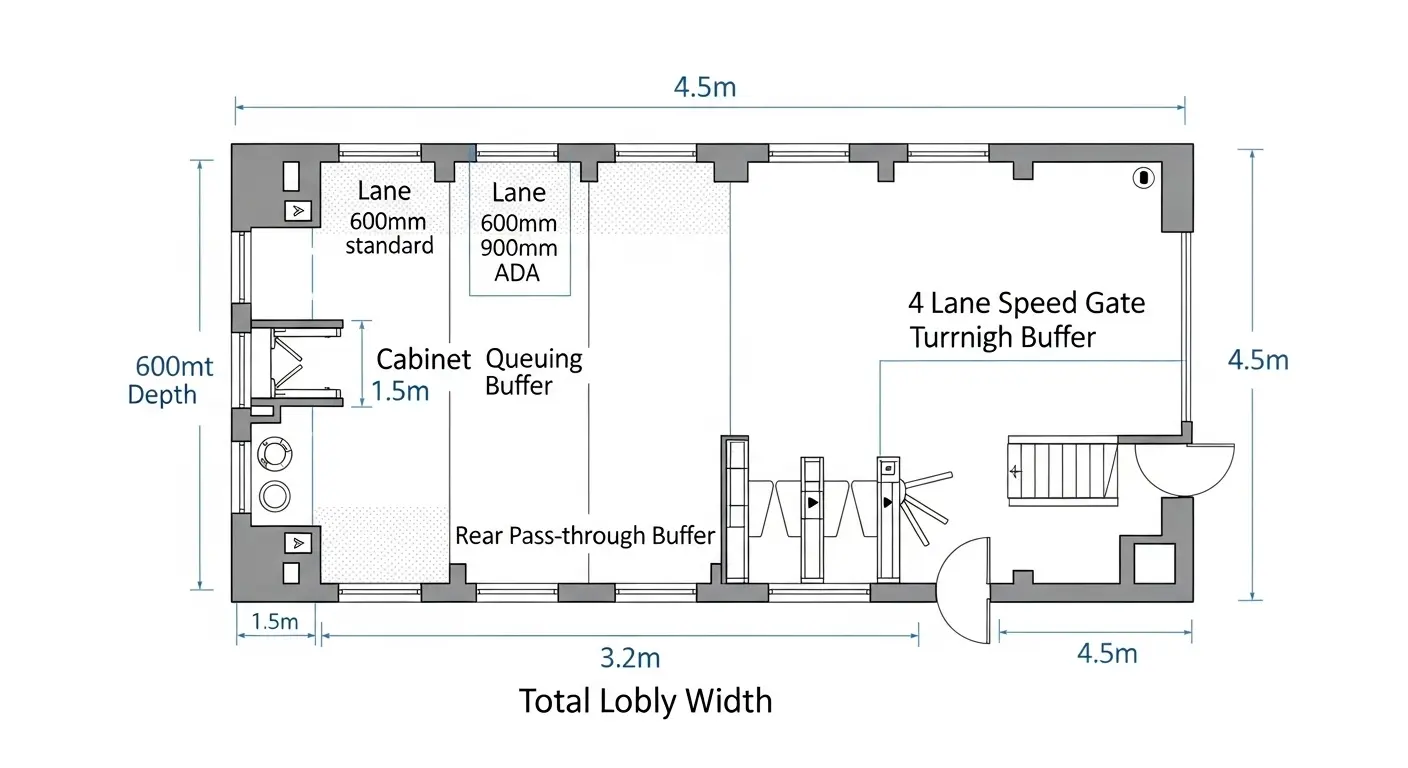
Lobby dimensions determine how many lanes fit, where the gate row sits, and whether morning peak flow moves without congestion. Two measurements matter: the lane width budget and the front/rear clearance.
Minimum Clearance Requirements
- Queuing zone (in front of gate row): 1.5m minimum from gate face to reception desk, wall, or obstruction — this is the credential-presentation buffer where staff swipe cards without blocking arriving foot traffic
- Pass-through zone (behind gate row): 1.5m minimum clear between gate exit and the next obstruction (elevator bank, stairwell, or reception desk)
- Multi-lane footprint example (4-lane speed gate): approximately 3.2m width × 1.5m depth — plus front and rear buffer zones
- Total lobby depth required for 4-lane system: 3.2m wide × 4.5m front-to-back minimum (1.5m queue + 1.5m gate depth + 1.5m pass-through)
How to Calculate How Many Lanes You Need
The peak-window method gives a more accurate lane count than daily average calculations alone.
- Set your peak window: for most offices, 85–90% of staff arrive within a 15-minute window at start of business
- Calculate peak entries per minute: total daily entries ÷ 15 = required throughput per minute (Par exemple,, 600 staff ÷ 15 = 40 entrées/minute)
- Divide by gate ppm: 40 ÷ 55 ppm (standard speed gate) = 0.73 — round up to 1 lane minimum; spec 2 lanes for redundancy and fail-safe resilience
- Add the ADA lane: required regardless of throughput calculation — total lanes = throughput lanes + 1 Voie ADA
Based on our experience planning office lobby access systems, the most common sizing error is using daily average flow instead of the peak window. A 600-person office is not 600 ÷ 480 minutes = 1.25 entries/minute average. It is 40 entries/minute between 8:45 et 9:00 am. Specifying for the average produces a congested lobby every morning.
Credential Options for Office Turnstile Gates
Le type de crédential détermine le matériel du lecteur, L’intégration du contrôle d’accès, and the visitor management workflow. Match the credential to your office's security policy and technology stack before finalizing the gate specification.
| Type de crédential | Mieux pour | Intégration |
|---|---|---|
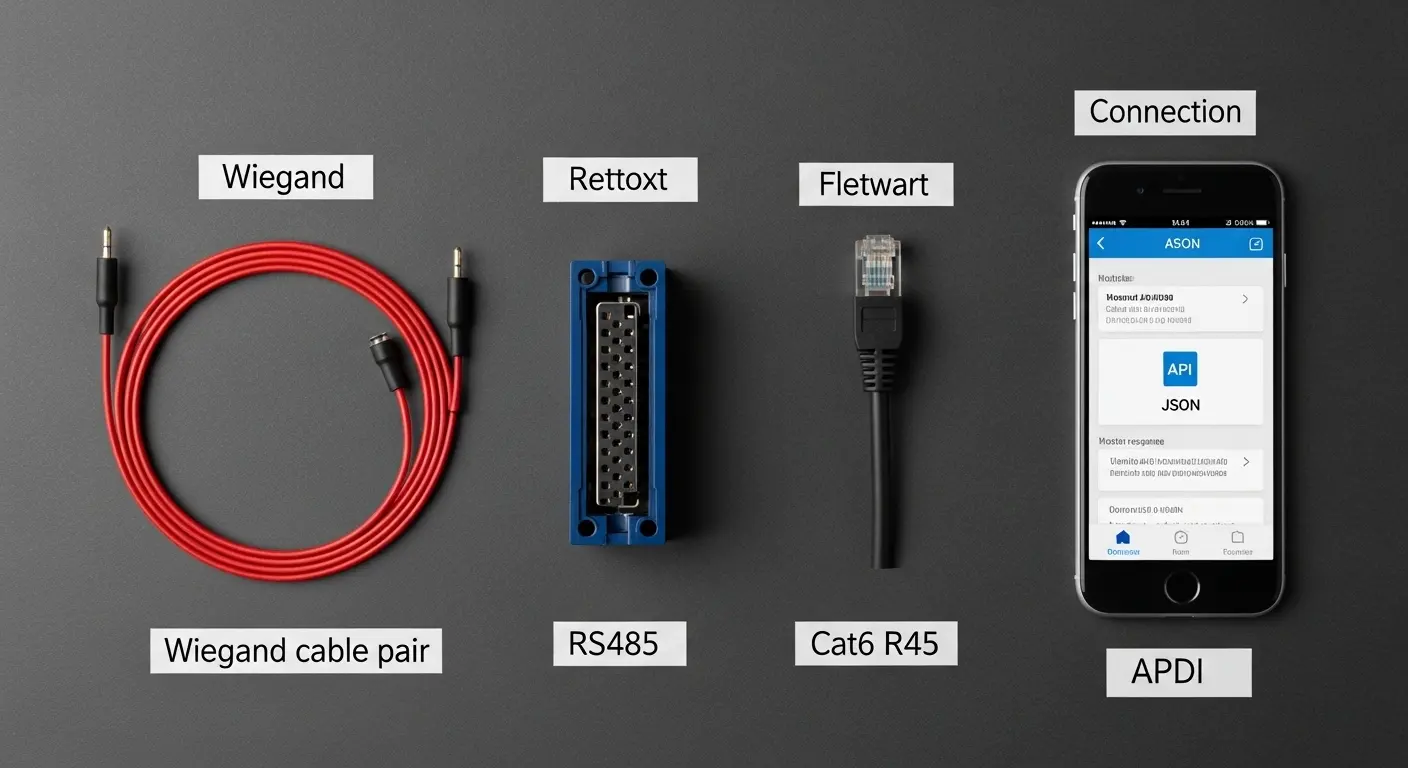
| Carte RFID (Wiegand 26/34) | Accès standard des entreprises | Panel ACP |
| Mobile NFC | BYOD corporate policy | TCP/IP or Wiegand |
| Code QR / code-barres | Gestion des visiteurs | Cloud visitor software |
| Reconnaissance faciale | Haute sécurité, sans contact | TCP/IP, Cloud/Sur site |
| PIN keypad | Secondary verification | Wiegand or standalone |
For most offices, RFID card via Wiegand 34-bit is the practical baseline. It offers the widest ACP compatibility, lowest per-credential cost, and proven reliability across millions of daily cycles.
Visitor QR code credentials are now standard in managed office buildings. The visitor receives a QR code by email and scans it at the gate on arrival — no physical card issued or collected. For the full barcode configuration used in office visitor management deployments, voir lePage de la porte du tourniquet à code-barres.
Facial recognition via TCP/IP suits high-security offices where touchless dual-factor verification is required — financial services, légal, or government offices are the typical deployment contexts. The gate reads a live facial scan against an identity database and opens in under 0.5 Secondes.
Anti-Tailgating in Office Environments
Anti-tailgating detects a second person entering the gate lane before it resets after an authorized passage. It is the most underspecified feature at purchase and the most frequently requested addition after installation. Based on our experience across 50+ corporate office deployments, clients who did not specify it in the initial order typically add it at the first annual maintenance review.
A standard infrared sensor matrix creates a detection grid across the full lane length. Any second body entering the detection zone before the gate resets triggers a visual alarm, une alerte sonore, and an automatic re-close. The alarm output connects to a security workstation or cloud monitoring platform in real time.
For open-plan office buildings with shared entry floors, the alarm relay output to the reception desk is standard practice — staff receive a real-time lane number and timestamp alert without needing a dedicated security monitor. For the technical configuration of Ironman's anti-tailgating system used in corporate offices, voir lePage de la porte de tourniquet AB anti-tailgating.
Getting a Quote for Your Office Turnstile Gate
Four items are enough to receive a full factory-direct itemized quote within 12 Heures d’ouverture. Prepare these before submitting.
- Office type and headcount: building category (SME / QG / multi-tenant / Haute sécurité) and daily entry count
- Lobby dimensions: available width, front and rear clearance, number of entrances
- ADA requirement: how many ADA-accessible lanes per entrance
- Credential preference: Carte RFID, Visiteur QR, Reconnaissance faciale, or gate hardware only
Submit your brief via the Ironman solutions page ou parcourir l’intégralitéPlage de portails à tourniquets to match your scenario to a specific model before reaching out.
Questions fréquemment posées
Q1: What type of turnstile gate is best for an office?
The best office turnstile gate depends on your building type and daily headcount. Speed gates are best for corporate headquarters, Halls premium, and multi-tenant buildings — they offer the highest throughput (50–80 ppm), the best aesthetics, and the clearest ADA-accessible lane options. Compact swing gates suit small offices with daily traffic under 300 entries and compact lobby space. Flap barriers balance throughput and aesthetics for mid-size offices with 200–800 staff. Tripod turnstiles suit secondary staff-only entrances where aesthetics are not required.
Q2: Do office turnstile gates need to be ADA compliant?
Oui. Selon les normes ADA pour la conception accessible (États-Unis), every office entrance must provide at least one accessible lane with a minimum 32-inch (813mm) clear width for passage and 36-inch (914mm) standard width for approach. Any ADA-accessible lane that forms part of an egress route must be configured in fail-safe mode — barriers retract and stay open during a power failure or fire alarm. Speed gates offer a 900mm wide-lane variant in the same product family as standard lanes, making compliance straightforward within a uniform-looking gate row.
Q3: How much space does an office turnstile gate need in a lobby?
A 4-lane speed gate system requires approximately 3.2 meters of lobby width and 1.5 meters of cabinet depth. You also need at least 1.5 meters of clear space in front of the gate row (for credential presentation without blocking arriving traffic) et 1.5 meters behind it (between the gate exit and the elevator bank or reception desk). Total lobby depth required for a standard 4-lane configuration with front and rear clearance is approximately 4.5 Mètres. Compact swing gates require less depth — approximately 900mm cabinet depth — making them the practical option for lobbies under 3 meters wide.
Q4: How many turnstile lanes does an office building need?
Calculate your lane count using the peak-window method: take your total daily entries, Divisez par 15 (the number of minutes in the peak arrival window), puis divisez par le débit de la porte par minute (50–60 ppm for a speed gate). Round up and add one for redundancy, then add one ADA-accessible lane per entrance. For a 600-person office, this gives approximately 2 Voies standard plus 1 ADA lane — a 3-lane configuration. For offices above 800 Entrées quotidiennes, a 4-lane minimum is the standard recommendation to prevent congestion in the peak 15-minute window.
Q5: Can an office turnstile gate integrate with visitor management software?
Oui. Most modern office turnstile gates support QR code credential reading via a barcode scanner reader integrated into the gate frame. The visitor management software generates a single-use QR code and emails it to the visitor before arrival. The visitor scans the code at the gate on arrival — no physical card is issued, registered, or collected. This integrates directly with cloud-based visitor management platforms via TCP/IP or a local API connection. For the full configuration used in managed office buildings, see the barcode turnstile gate configuration page.
Q6: What credential options work with an office turnstile gate?
Office turnstile gates support RFID card (Wiegand 26/34 bits), NFC mobile, QR code or barcode, Reconnaissance faciale (via TCP/IP), PIN keypad, and biometric fingerprint or iris readers. RFID card via Wiegand 34-bit is the baseline for most corporate offices — it works with all major access control panels including HID, Honeywell, Lenel, and Genetec. Facial recognition requires TCP/IP integration and an identity database — either cloud-hosted or on-premise. Visitor QR code is now standard in managed buildings for contactless, card-free visitor access. Multiple credential types can operate on the same gate simultaneously for different user groups.
Three Decisions That Define Your Office Entry System
Sélection du type de porte, Configuration des voies ADA, and peak-window lane count — these three decisions determine whether your office entry system works well on day one and continues to work as your building grows. Choosing the wrong type for your lobby creates a problem that no amount of credential configuration can solve.
Ironman supplies factory-direct office turnstile gate systems to corporate, multi-tenant, gouvernement, and financial office buildings across 50+ pays. Our engineering team provides lobby layout review, Recommandations pour le nombre de voies, and itemized factory-direct quotes — within 12 business hours of receiving your project brief.
Submit your specification via the Ironman turnstile gate page and receive a full quote today.
