


Turnstile Gates Supplier: How to Reduce Risk Across the Whole Project
2026-07-17


You can't significantly change the risk if you don't have the entire project in view.Can't really decrease the degree of the risk if the view of the whole project is not available.
The decision to select a turnstile gates supplier is more complicated than just locating a vendor that offers sufficient models, available in their product catalogues. The supplier needs to assist in linking product selection and the ability to integrate access control, configure an entrance layout, test the product, ship internationally, provide installation guidance and warranty of replacement components.
This is important because an overall failed turnstile project could fail even if the turnstile gate itself is working. We need the correct channel width so as not to cause a traffic jam. The selection of the wrong reader bracket can impact on the turnaround time for commissioning. If any interface documents are missing, software provider/software installer may blame the other. If packaging isn't right, it can produce harm to a product before it even arrives on site.
For system integrators, distributors, contractors, consultants, property managers and procurement teams, the ideal supplier is one that will save them the uncertainty from the first drawing, through the build up to operating the system.
It is important to evaluate suppliers not just on project-specific grounds, but near the entire catalogue as well
Before making any recommendations of a gate, a supplier should know the property's entrance.
Some helpful information to get started is:
- Apply a project approach and country awareness.Embrace a project approach and country awareness.
- Installation either in indoor or outdoor conditions.
- Entrance dimensions
- Number of lanes
- User groups
- Peak pedestrian flow
- Required security level
- Credential types
- Accessible passage requirements
In the context of installing and commissioning the Perception Technology, an event which requires careful planning and execution.
The use of different products or operating logic is not required at a corporate lobby, factory entrance, school campus, stadium perimeter and transport station.
When comparing suppliers use real site data, pedestrian flow, risk level, integration requirements, accessibility, technical support, and spare-parts availability when comparing suppliers as outlined by the turnstile supplier guidance provided by Ironman. It is better to pick it for a range of uses than solely on the aspects of appearance or price per unit.
After the basic project conditions have been determined, buyers will be able to view the list of all available types of turnstile gated options.
Assign a separate gate per entrance zone
It's easier for a supplier to create a viable entrance for multiple product types, than to use the same one all the time.
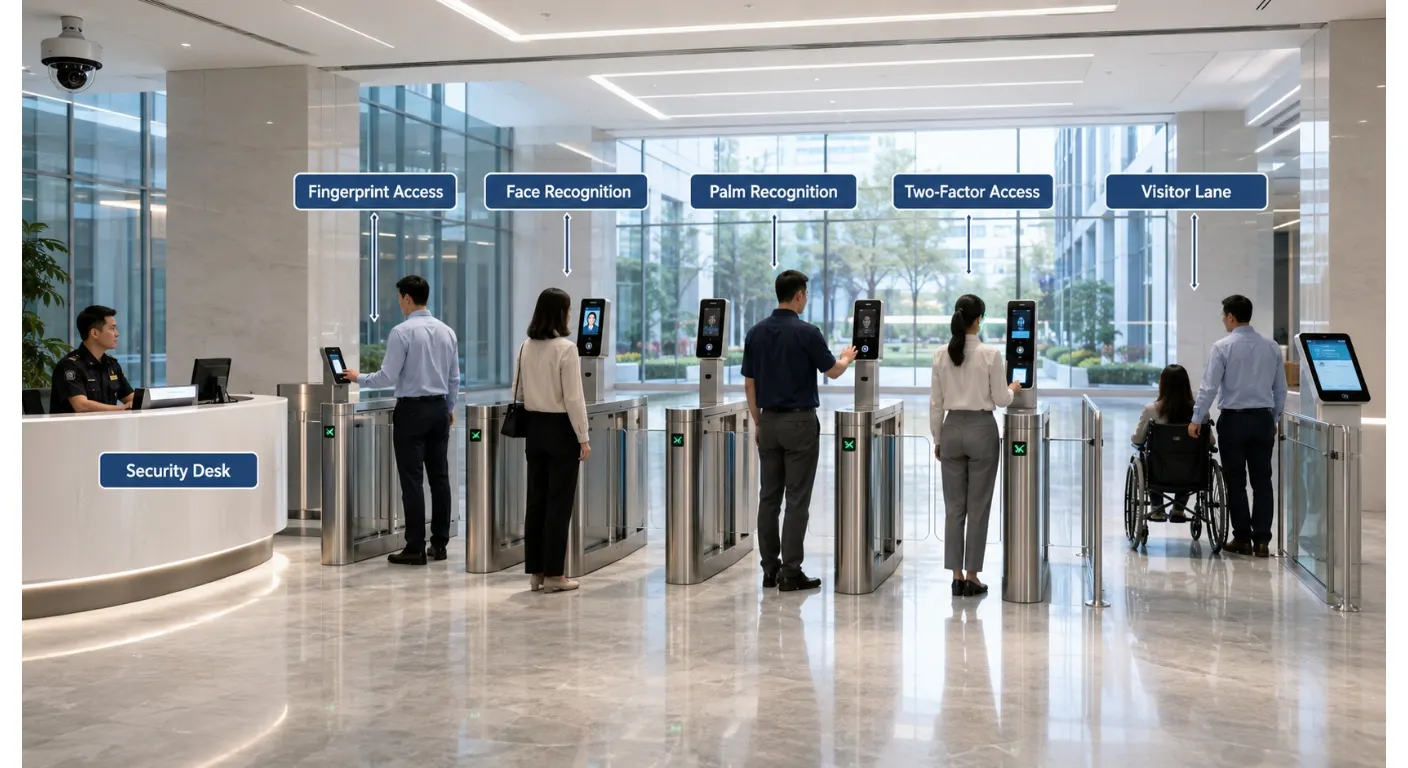
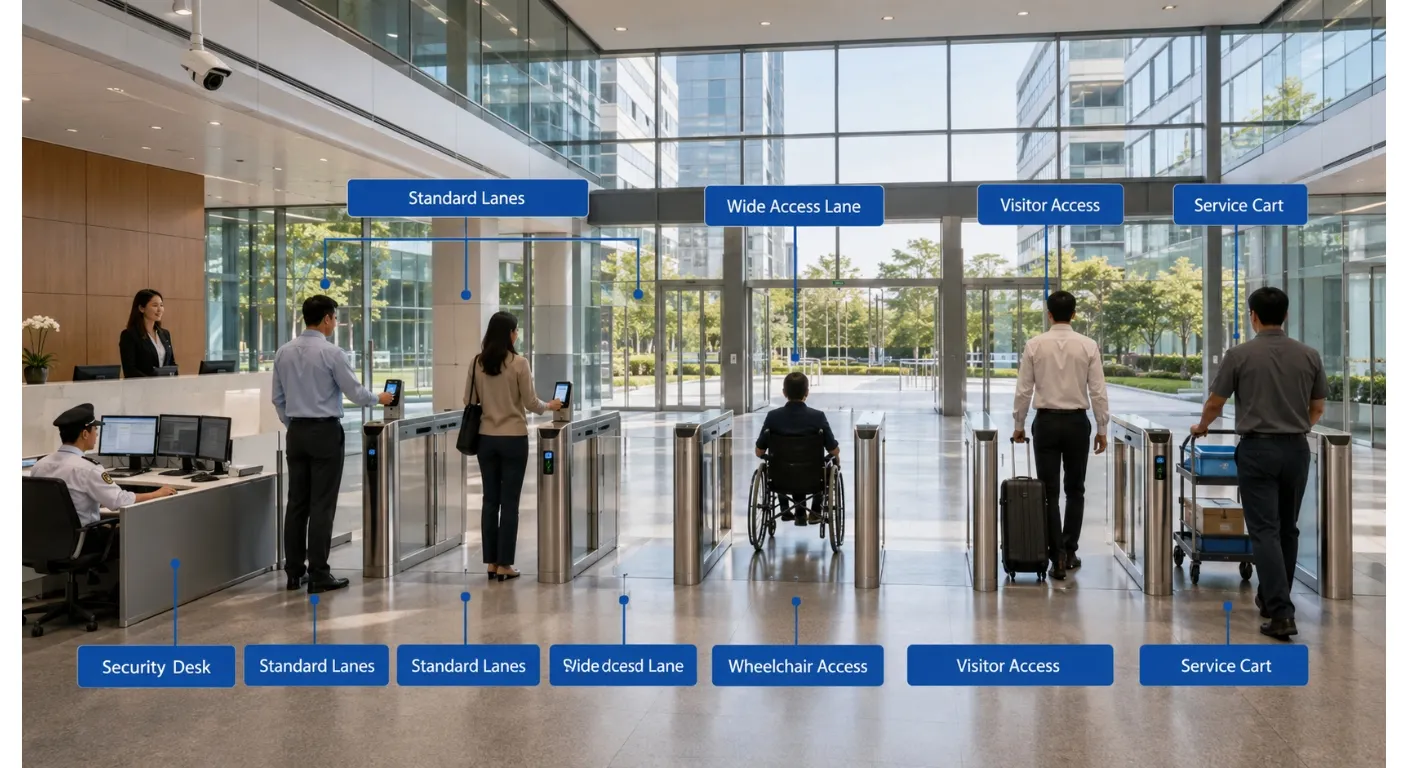
Compact employee/membership entries will normally be fitted with a Tripod turnstile. There are flap barriers to help with the high speed indoor flow. Swing barriers will allow for a broader access when it comes to mobility equipment, service trolleys, and luggage. Speed gates are ideal for today's corporate environment and full-height turnstiles for tight perimeters for greater physical control.
There are a number of models available, and the supplier should explain why their model is suited to what zone? Also, it should be able to voice its objections when a product is not appropriate.
For instance, it may be great for the employees, but it may be not so great for deliveries. A full-height turnstile is an added security and seems very suffocating in a reception. Add a wide swing swinging (rather than opened or closed) gate; requires more sophisticated sensor and closing logic.
It is desirable to have a mixed entrance instead of a uniform entrance.
Educate yourself on what the actual supplier is delivering
Supplier may be a manufacturer, exporter, distributor, project coordinator or catalogue reseller. It is necessary that a buyers should be aware of the actual extent before quoting a price.
Ask people who is responsible for:
- Product design
- Mechanical manufacturing
- Controller configuration
- Reader integration
- Software support
- Drawings and documents
- Factory testing
- Packaging
- Shipping
- Installation guidance
- Warranty
- Spare parts
The supplier is not required to do each job in house, it is just the need to be clear about the responsibility for each job.
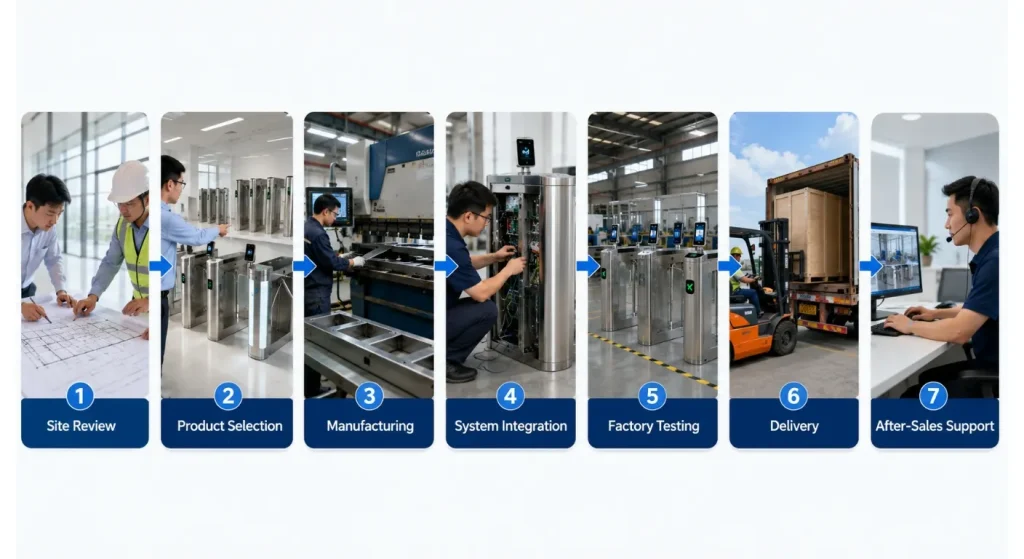
The best way to understand what OEM entails, says Ironman, is to think of the product platform that is proven to work on the factory line, tailored with custom branding, documentation, packaging, etc., or other commercial elements. Changes to other dimensions, electronics, mechanisms or firmware are deeper changes and typically require more review and testing and are closer to an engineering or ODM project.
It is important for buyers that intend to undertake resale and/or private-label programs to check the supplier's turnstile gate OEM process before assuming that all customisations are the same price or delivery date.
To ensure the system is working as expected, it is preferable to confirm integration prior to production
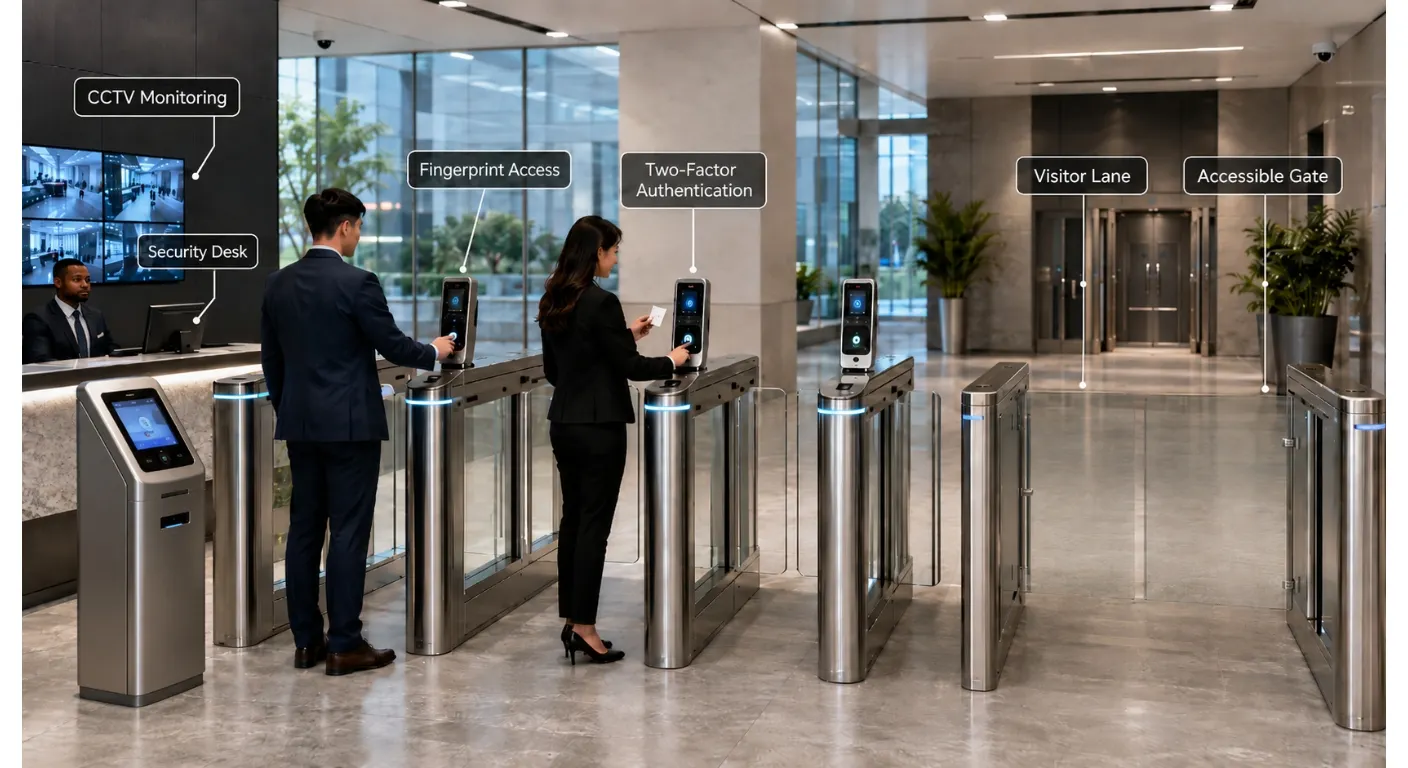
Typically, the vast majority of the modern gates are linked with different apparatus. RFID readers, QR scanners, facial recognition, fingerprint terminals, software for visitors, attendance systems, CCTV systems, elevator control, and inputs for fire alarms are all possible features for a project.
Comparable to access control doesn't give enough detail.
Before production, confirm:
- Reader model and dimensions
- Reader mounting position
- Opening signal
- Communication protocol
- Controller responsibility
- The direction of the bar's entry and exit.The bar's direction of entry/exit.
- Alarm outputs
- Event records
- Offline operation
- Software version
- Emergency inputs
Ironman's ironman access control system guide points out several key parameters which will impact the installation and performance, including lane width, floor condition, cable routing, power position, site surveys, and anti-tailgating sensor configuration.
| Project Task | Main Responsible Party |
|---|---|
| Gate hardware | Turnstile supplier |
| Credential validation | Access software provider |
| Network and cabling | System integrator |
| Entrance layout | Designer or contractor |
| Emergency approval | Project authority |
| Final acceptance | End user |
For projects that need software development, the software development kit (SDK) and API options that are available to use should be reviewed. This should then be followed by the approved reader, controller, software and gate being connected together and tested as one configuration.
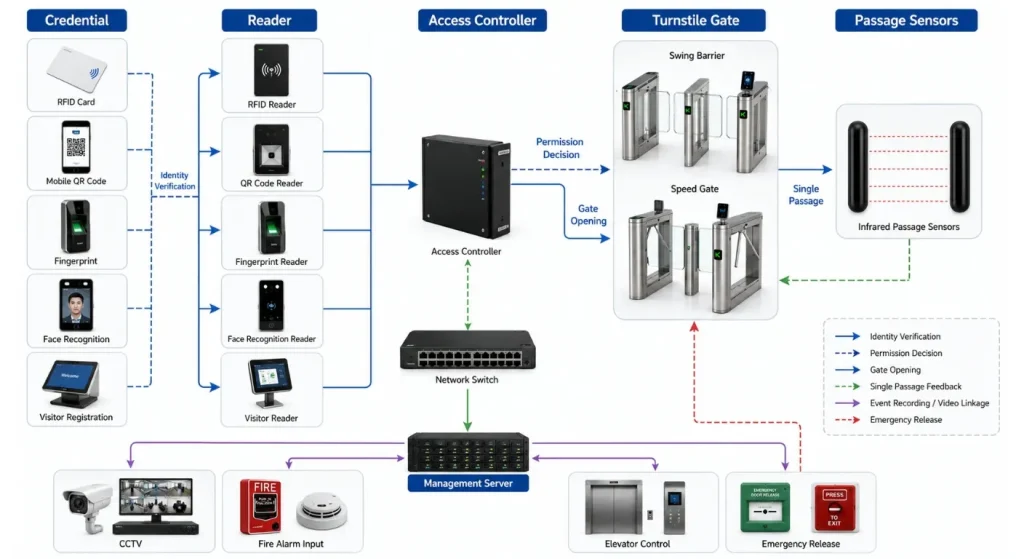
Closely tie all logical steps in order to make the passage clear
The access-control platform is how the decision is made as to whether a credential is valid or not. This change must be dovetailed into a change in the turnstile.
To detect: a good lane may need to do the following:
- Entry without authorization
- Tailgating
- Two-person passage
- Wrong-direction movement
- Individual who comes to a halt within the lane:
- An obstacle as the closing is in progress
- Passage timeout
- A user who returns the device to its authorized user.A person who returns to its authorized user.
Request a "sensors layout" and operating sequence from the supplier.
The buyer will want to be aware of what is triggering the barrier's close, what is triggering an alarm and if an event is required for the passage to remain open and how long it will remain open for after the event. It should go to a viable response area like a guard deck, access platform or cctv station.
The correct setting will vary, depending on the users. The time it takes for an entrance at a hospital may need to be longer to close and wider to pass the contents through than a controlled employee corridor.
Conduct a review of Accessibility and Emergency Movement early on.Consider a review of Accessibility and Emergency Movement early on.
An entrance layout needs to be accessible to people with wheelchairs, visitors carrying bulky items, carts for serving the food and visitors who cannot use a turnstile.
Turning this point into an accessible route can only be done by bypassing a turntable.A turntable may not be a part of an accessible route for projects regulated by accessibility requirements in the USA. There may then be a need for a second accessible gate or door adjacent which will have a similar pattern of use.
This should be determined in advance before deciding on the arrangement of your lanes by your supplier.
But there should also be an agreement in good faith prior to emergency behaviour. Explain what occurs when there is a loss of power, the fire alarm is sounded, the controller fails, there is a network failure or a manual release. The functions available on the gate should be explained by the supplier, and confirmed by the designer, integrator and operator of the system, in addition to their approval by the local authority.
Don't accept sweeping statements; request proof!
Documentation and/or testing should be used to support any supplier claim.
Test conditions must be in support of the “high throughput”. Identification of the components that need protection should be done by the "Outdoor suitable" term. Documents of the interface should be part of “Easy integration”. A maintenance schedule and spare parts list is a necessary part of “low maintenance.”
UL offers a testing and certification framework for access-control system units for U.S. access-control projects, UL explains. The buyer should check on the particular product or part to which the certificate applies rather than this certificate as a blanket endorsement for the full entrance.
| Evaluation Area | Evidence to Request |
|---|---|
| Product selection | Site-based recommendation |
| Integration | Interface documents |
| Manufacturing | Factory records |
| Quality control | Inspection reports |
| Factory testing | FAT records and videos |
| Delivery | Packaging plan |
| Support | Warranty and spare-parts list |
Following the same principle as mentioned before for audio protection, claims for the protection of materials, for cycle tests, or for software compatibility: Ask what has been tested, how it has been tested, and whether such test applied to the end user, specific configuration.
The Complete Commercial Scope needs to be consulted
2 excerpts can seem similar, but be for very different areas.
The final price of the product could include:
- Gate cabinets
- Barrier panels
- Readers
- Controllers
- Custom brackets
- Software support
- Factory testing
- Spare parts
- Packaging
- Freight
- Installation
- Training
- Commissioning
Turnstile cost depends on a number of factors and is outlined in Ironman's pricing guide, such as: Cost of products, material type, turnstile mechanism, turnstile integration and scope of supply. It also suggests suppliers' warranty, technical documents, certification records and named spares availability to be checked before comparing suppliers.
When shopping for an online casino in the UK, avoid making comparisons based on the headline casino price only – compare them line by line.
Bring the Project to a close by following Approved Documents
Before production a reliable supplier must be able to deliver a fully comprehensive document package.
This may include:
- Product drawing
- Lane layout
- Reader-mounting drawing
- Foundation details
- Wiring diagram
- Designed the input and output description.Developed input/output description.
- Emergency logic
- Any confirming evidence regarding the material and finish given.
- Test plan
- Packing list
- Spare-parts list
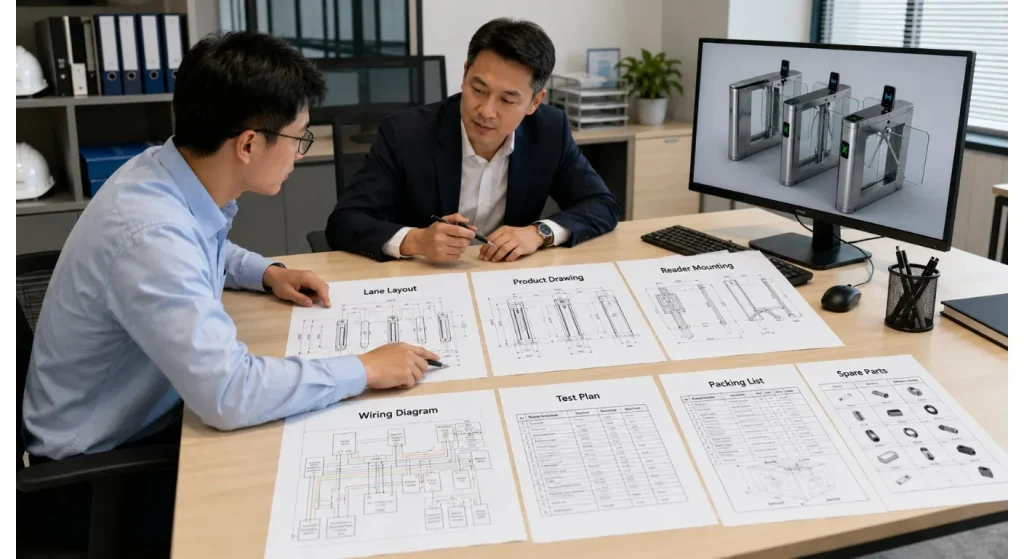
A revised drawing showing all changes in the custom should be created and include a verbose version number.
This avoids the issues that can be a huge problem; the salesman knows what he/she needs and the factory creates a different one and the installer finds out what he/she needs once its in place.
Before you ship it, check it for the Final Configuration
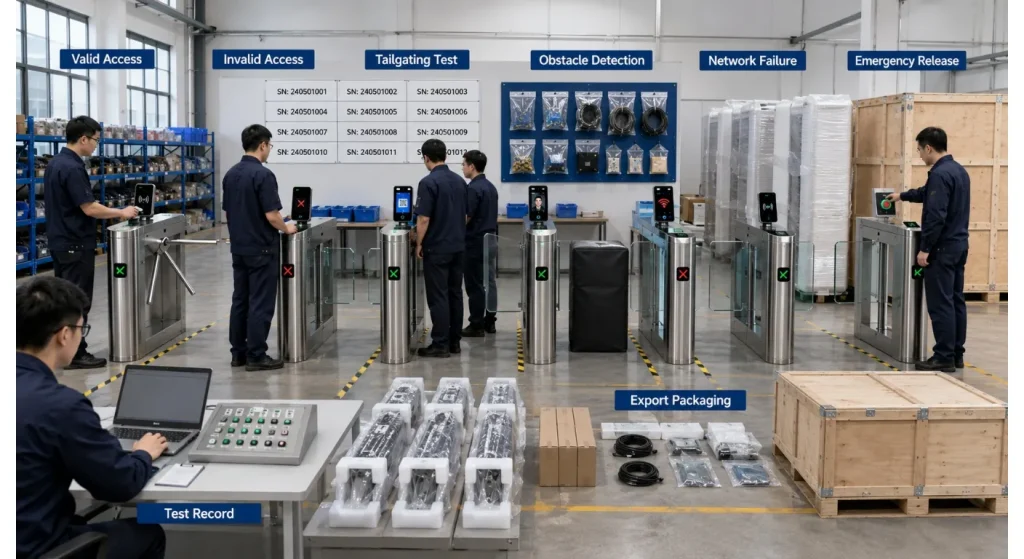
FAT is not just the title of the button to, push or pull the gate!
Test invalid credentials, one person through, tailgating, opposite direction movement, obstructions, timeout after entering a passage, network interruption, power recovery, emergency release, manual release, alarm and event recording.
If possible, make use of the last readers controller settings, the last sensor and barrier panel settings, the final settings.
Ask for any video/audio evidence, records, wiring diagrams, serials, photos of the process, and packaging evidence. Help from the supplier is the other component in the setup/troubleshooting process; in this instance, the supplier support videos can be used to help the local installer with troubleshooting and installation.
The cost of problems discovered in the factory are typically less expensive than problems discovered during commissioning.
Check Warranty and Spare-Parts Support
Warranty will only be of value if the claims process and supply of replacement parts is practical.
Ask:
- What parts of the soccer ball do you see?
- What is the delivery time of Motors and Control Boards?
- Does a doctor provide any sort of remote diagnosis?
- What kind of proof does it require for a statement to be true?
- (Carrying between countries) Who pays International freight?
- Does the area integrator offer replacement parts?
- Are recommended project spares available?
To initiate a warranty diagnosis, a good/fault report, a purchase record and photos / videos of the fault are required before Ironman dispatches remote diagnosis or returns guidance or any replacement parts.
This information the supplier should give before purchase NOT at first fault.
Create a complete RFQ
The following information can be included in a useful RFQ, which will vary depending on the project applied to and the country: project application, country, entrance drawing, quantity of lanes, peak traffic, security level, type of credentials, reader models, software interface, space for installation (indoor or outdoor), finishes, security logic (for emergencies), documents required, tests to be carried out in the factory, installation scope, supply of parts and delivery date.
Ironman's purchasing page requests the purchaser to provide more detailed information about the project, so that it can be prepared with a solution specific to the project.
Don't just ask for a product catalogue and unit price, send the whole recipe!
Conclusion
Unless you have adequate project definition, installation, testing, and maintenance, then it may be impossible to achieve reliability from a turnstile gates supplier.
No one supplier is always the best supplier based on the length of the catalogue, or price. It's the one that recommends appropriate products, clarifies all interface, reports personalized changes, performs the final configuration test, guards the shipment and assistants as post installation.
FAQs
Most people don't know the difference between turnstile supplier and manufacturer.The difference between a turnstile supplier and manufacturer is not something the average person can tell.
While a manufacturer oversees the production, a supplier can even coordinate product, integration, documentation, shipping and support. Ensure that you understand directly responsible tasks.
There is a possibility that one supplier might be able to supply the difference of the turnstile type.
Yes. Various types of entrance zones can have mixed tripod, swing, speed, full height gates.
Is it possible to integrate the use of turnstiles with existing access-control solutions?
Yes, if the reader, controller(s), interface and opening logic match. Prior to shipping test approved configuration.
What should be covered in Factory Testing?
Test credentials, passage detection, tailgating, obstacles, network failure, event records, alarm, emergency opening etc.
When providing a quote, what do you need to know about the as-of-yet-undefined item?
Include the entry diagram, traffic, width of lanes, credentials required for entry, software interface, environment, testing scope, who will be responsible for installation and the schedule.
