


Emergency Release Turnstile: Legal Requirements, Trigger Types, and Gate-by-Gate Behavior
2026-03-19


An emergency release turnstile is a gate configured to open its barriers immediately during an emergency — without requiring any occupant to present a credential, operate a key, or take any special action. Every building code that governs pedestrian access control on an egress path requires this capability. The exact mechanisms, trigger methods, and gate behaviors vary by product type and local jurisdiction — and getting the specification wrong creates a life safety compliance failure that doesn't show up until an actual emergency.
This guide covers the legal requirements, the three trigger methods, how emergency release works across different gate types, and what to verify during commissioning.
What Is an Emergency Release Turnstile?
An emergency release turnstile is a pedestrian access barrier with at least one — and typically three — automatic opening mechanisms that activate during emergencies without requiring any credential or occupant intervention.
The US International Building Code (IBC) and OSHA's 29 CFR 1910.36 both establish the same core principle: every employee or occupant must be able to exit through a turnstile on an egress path at all times, without a key, tool, or special knowledge. NYC Building Code §1010.3 extends this further — specifying that the breakaway force required to manually override a turnstile in an emergency must not exceed 13 pounds (57.8 N), that the gate must release to its full clear opening width, and that a manual release device must be positioned on the egress side of each lane.
The UK equivalent is BS:9999, which requires that turnstiles on escape routes either fail open on power loss or are connected to the fire alarm system for automatic release. The EU's EN 13637 covers electrically controlled exit systems on escape routes with equivalent requirements.
The Three Emergency Release Trigger Methods
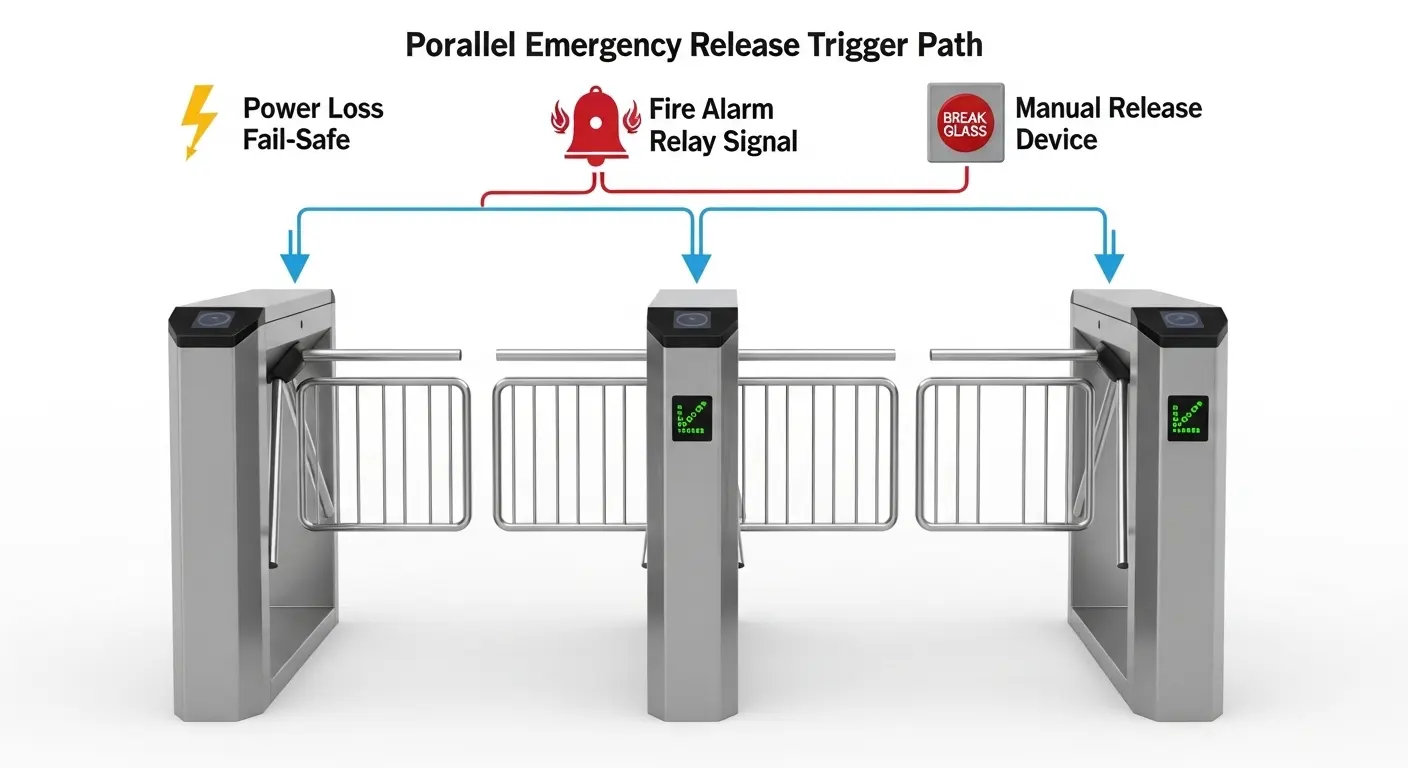
A compliant emergency release turnstile uses at least one of these three trigger mechanisms — and most commercial installations use all three in parallel:
Trigger 1 — Power Loss Fail-Safe (Automatic)
When mains power is lost, the gate's locking mechanism de-energizes and the barrier opens automatically to its full clear width. This requires no signal, no relay connection, and no occupant or employee action — the gate simply releases because the power holding it closed is gone.
This is the baseline emergency release mechanism and the one that requires the fewest installation components. For any gate on an egress path, this must work correctly by default. A gate that stays locked on power loss on an egress path is non-compliant with IBC, OSHA, NYC §1010.3, and virtually every equivalent jurisdiction code.
Trigger 2 — Fire Alarm Dry Contact Relay (Automatic)
The fire alarm control panel (FACP) sends a dry contact signal to the turnstile gate's fire alarm input terminal when the alarm activates. The gate receives the signal and releases all barriers to the full open position — remaining open until the alarm is manually reset at the FACP.
IBC and NYC §1010.3 both require this connection explicitly. The gate must stay open for the full duration of the alarm. Per NYC code, manual operation of a fire alarm box alone is not required to trigger this — the connection must respond to the alarm system's output relay, not a manual box signal.
Trigger 3 — Manual Release Device (Break-Glass or Key Switch)
A manual release device — most commonly a break-glass station or key-operated switch — provides a third independent trigger that an assigned employee activates in an emergency. The IBC requires that this device is:
- Clearly identified (labeled and visible without searching)
- Readily accessible on the egress side of each turnstile lane
- Operated by an employee assigned to the area at all times the building is occupied
- Capable of causing all barriers to remain open for at least 30 seconds after activation
The break-glass version works by changing a double-pole switch from normally closed (NC) to normally open (NO) contacts — directly interrupting power to the turnstile locking mechanism when the glass is broken. Each unit includes a key for resetting the glass and returning the device to armed status after an emergency.
Emergency Release Turnstile by Gate Type
How the barrier physically opens on emergency release varies by gate design. Specifiers must confirm the specific release mechanism for each gate type in their installation:
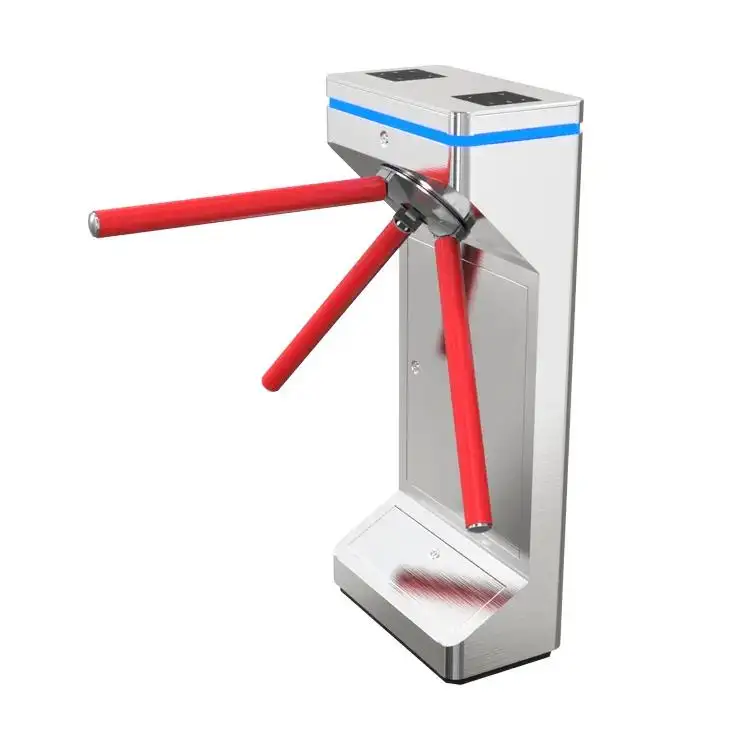
Tripod Turnstile — Drop-Arm Release
On emergency release, the solenoid de-energizes, and the three arms drop to a horizontal position under gravity. The arms rotate freely in the direction of egress — occupants push through without resistance. NYC §1010.3 specifies a maximum 13-pound breakaway force for manual override, meaning arms must drop or rotate with light push force from the egress side.
An inclined arc tripod turnstile positions the arm geometry on a descending arc — when the arm drops on emergency release, it clears the cabinet profile cleanly without catching, providing a consistent and unobstructed egress opening every time the fail-safe activates.
Flap Barrier — Panel Retraction Release
Flap panels retract fully into the cabinet on emergency release — typically by spring-return or active motor retraction. The lane opens to its full rated width (550–900mm) and holds open until reset. A high-performance flap barrier gate uses servo-motor retraction on emergency release, achieving full panel retraction in under 0.3 seconds — faster and more consistent than spring-return mechanisms under daily emergency-test cycling.
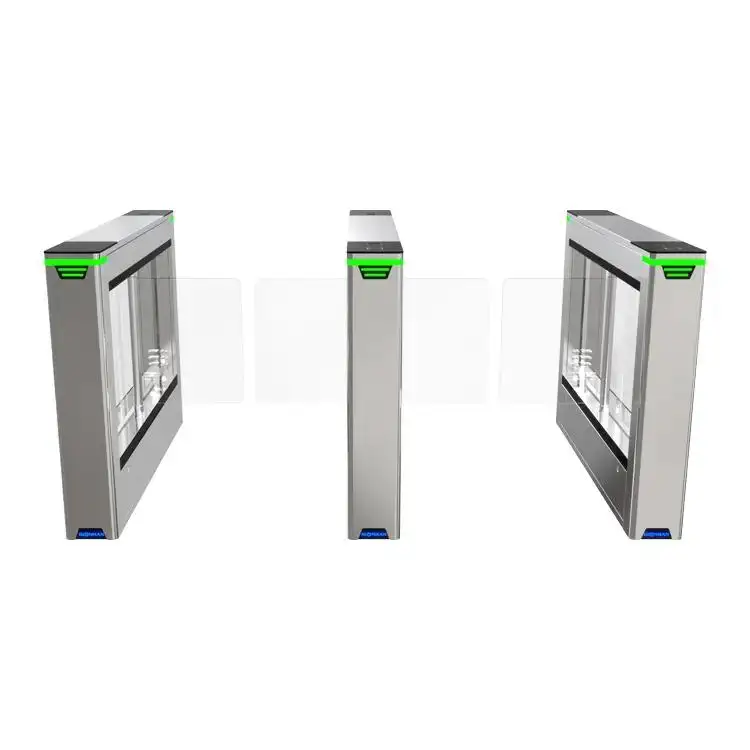
Speed Gate — Column Retraction Release
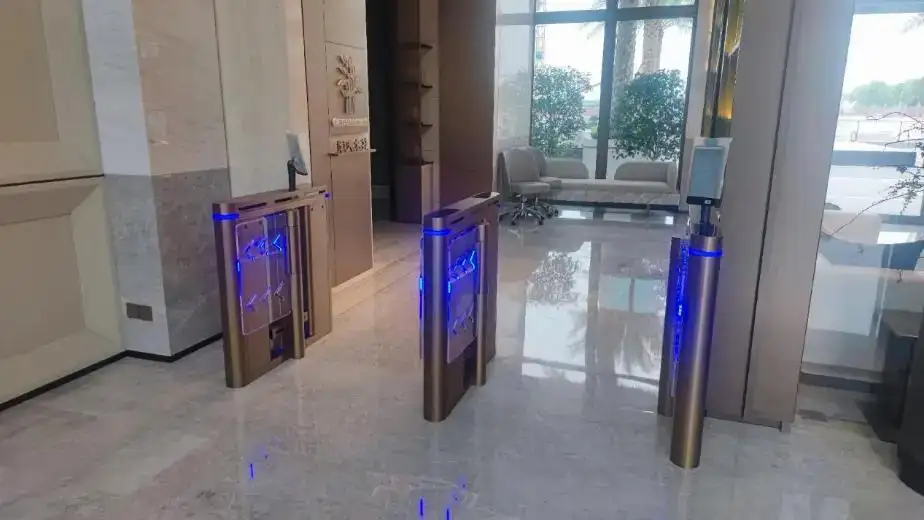
Glass panels retract fully into the pedestrian column housing on emergency release. A smart speed gate turnstile uses controlled motor retraction rather than spring-return — producing a smooth, quiet release that avoids startling occupants in a lobby emergency situation. An optical speed gate turnstile simultaneously logs the emergency release event in the system audit trail, providing a timestamped record of which gates opened at which time during the incident — useful for post-incident reporting.
Swing Barrier Gate — Panel Swing-Open Release
The swing panel releases and swings to its full open position on emergency release. A compact swing gate turnstile achieves this in a reduced footprint — important for ADA accessible egress lanes in tight lobby configurations where the swing arc must clear without contacting adjacent fixtures or walls during the release sequence.
Full Height Turnstile — Arm Free-Rotation Release
The most critical emergency release mechanism to verify. A full height turnstile gate on an egress path must release its arm assembly to free rotation on emergency trigger — allowing occupants to push through without resistance in either the pre-configured egress direction or, in breakaway-configured models, in any direction with under 13 pounds of force.
Boon Edam's published guidance notes that IBC and NFPA codes do not permit full height turnstiles to obstruct any means of egress — meaning a full height emergency release turnstile on an egress path must achieve a full, unobstructed clear opening on release, not merely reduce resistance.
AB Interlocking Turnstile Door — Dual-Release Requirement
A mantrap configuration with two sequential barriers presents a unique emergency release challenge. An AB interlocking turnstile door must release both barriers simultaneously on emergency trigger — overriding the sequential entry-exit interlocking logic that governs the mantrap under normal operation. A person trapped in the interlocking zone between both barriers during an emergency must be able to exit from either direction without obstruction. Confirm this dual-release behavior is factory-tested and documented in the commissioning package before deploying an interlocking system on any occupied building egress path.
What the Building Codes Actually Require: Key Rules in Plain Language
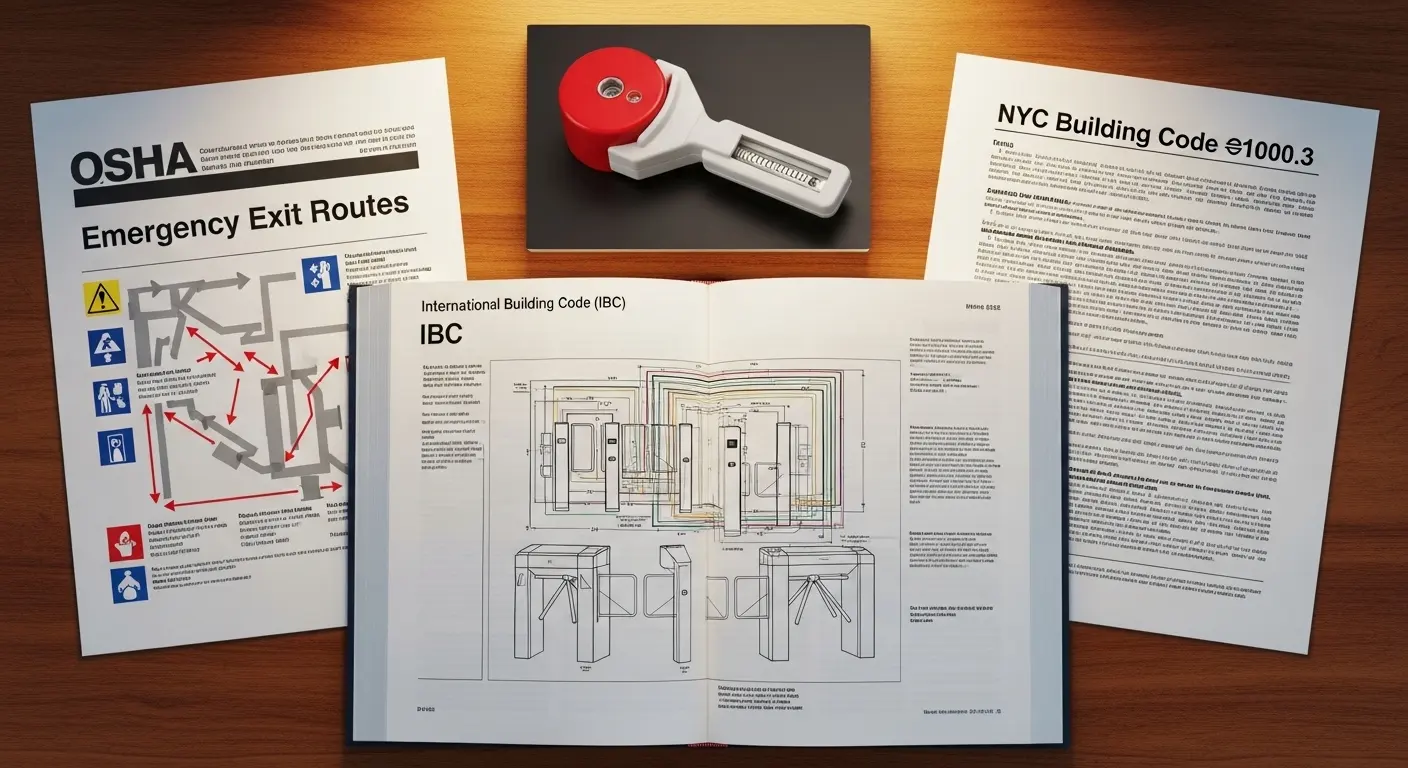
Here's the specific language from the major codes, translated into plain operational requirements:
IBC (International Building Code) — Key Requirements
- Building must have an approved automatic sprinkler system if turnstiles are on an egress path
- Minimum clear width of each turnstile lane: 22 inches
- Clear width under 32 inches: maximum 50 occupants credited for egress capacity
- Clear width 32 inches or more: egress capacity calculated same as doors and gates
- Barrier must automatically move to open on: power loss to turnstile or access control system; fire alarm or sprinkler activation; manual release device actuation
- Barriers must remain open at least 30 seconds after manual release device activation
- Manual release device must be on the egress side of each lane or in an employee-accessible location
NYC Building Code §1010.3 — Additional Requirements
- Maximum 13-pound force to manually breakaway turnstile from any position to full open width
- Gate must release in the direction of egress travel from any starting position
- Manual release device must be at the fire command center or near the building entrance
- Gate remains open until access control system is manually reset
OSHA 29 CFR 1910.36 — Workplace Requirement
- Employees must be able to open an exit route door from the inside at all times
- No keys, tools, or special knowledge permitted as a requirement for exiting
Commissioning and Testing an Emergency Release Turnstile

A compliant emergency release turnstile must be tested across all three trigger paths before the installation is signed off. Testing one path is not sufficient — each trigger operates through a different circuit, and a fault in one path doesn't affect the others:
Test 1 — Power Loss Fail-Safe
Cut the mains power supply to the turnstile gate panel. All barriers must release to their full open position in under 1.0 second without any fire alarm signal or manual device activation. Measure the opening time and document it.
Test 2 — Fire Alarm Relay
Activate the fire alarm relay at the FACP (or simulate the relay signal at the FA input terminal with a test relay). All connected gates must release simultaneously. Hold the test for 60 seconds — confirm all barriers remain open throughout. Reset the alarm and confirm all barriers return to controlled access mode.
Test 3 — Manual Release Device
Break or activate the manual release device at each turnstile lane. All barriers on that lane (or zone, if wired as a zone) must open immediately and remain open for a minimum of 30 seconds. Time the hold period. Reset the device using the key and confirm the gate returns to normal controlled operation.
Test 4 — Breakaway Force (if applicable)
For any gate type with a manual breakaway requirement (NYC §1010.3 — 13 pounds maximum), measure the force required to push the barrier to full open from the egress side using a push gauge. Document the reading per lane.
Test 5 — Reset Procedure
Confirm the reset procedure for each trigger type. Verify that after reset, each lane returns to normal credential-controlled access — not to a permanently open or permanently locked state without further operator input.
All test results — timestamps, opening times, hold durations, breakaway force readings, and reset confirmation — must be documented in a commissioning record signed by the installing engineer and retained by the facility manager for AHJ inspection and fire safety compliance records.
For a verified emergency release turnstile manufacturer with documented commissioning support, the turnstile gates manufacturer page covers product specifications, emergency release configurations, and the documentation package available for commercial and regulated building installations.
Frequently Asked Questions About Emergency Release Turnstiles
Q: What is an emergency release turnstile?
A: An emergency release turnstile is a pedestrian access barrier that opens its barriers automatically during an emergency — on power loss, fire alarm activation, or manual release device actuation — without requiring any occupant to present a credential or take special action. Building codes including IBC, OSHA 29 CFR 1910.36, and NYC §1010.3 mandate this capability for any turnstile gate positioned on a path of egress.
Q: What are the three ways an emergency release turnstile can be triggered?
A: The three trigger methods are: (1) power loss fail-safe — the gate opens automatically when mains power is cut; (2) fire alarm dry contact relay — the fire alarm control panel sends a relay signal to the gate's FA input terminal, triggering automatic opening; and (3) manual release device — a break-glass station or key switch on the egress side that an assigned employee activates, causing barriers to remain open for at least 30 seconds.
Q: What is the maximum force required to manually override an emergency release turnstile?
A: Under NYC Building Code §1010.3, the force required to manually breakaway a turnstile on an egress path must not exceed 13 pounds (57.8 N) applied from the egress side. The gate must be capable of moving from any position to its full clear opening width under this force. OSHA's requirement is consistent — no key, tool, or special knowledge can be required for an employee to open an exit route.
Q: How long must barriers stay open after a manual release device is activated?
A: The IBC requires barriers to remain open for at least 30 seconds after manual release device actuation — giving occupants time to clear the lane without the gate re-closing mid-evacuation. Under NYC §1010.3, gates triggered by the fire alarm system must remain open until the fire alarm system is manually reset at the FACP — not just for a timed period.
Q: Where must the manual release device be located?
A: The IBC requires the manual release device to be located on the egress side of each turnstile lane, or in an employee-accessible location approved by the code official. NYC §1010.3 specifies the device must be at the fire command center or near the building entrance where the turnstiles are located — and an employee must be assigned to the area at all times the building is occupied.
