


Fail Safe Turnstile Gate: What It Means, When It's Required, and How to Confirm Yours Is Configured Correctly
2026-03-18


A fail safe turnstile gate opens its barriers automatically when power is lost or a fire alarm activates — no manual intervention required, no key needed, no occupant action necessary. That one-sentence definition is the foundation of every building code requirement that governs turnstile gates on emergency egress paths.
Getting fail-safe configuration wrong doesn't show up during normal operation. It shows up during an evacuation — when it's too late to fix.
What "Fail Safe" Actually Means for a Turnstile Gate
The term comes from electrical control logic. A fail safe turnstile gate uses a power-to-lock mechanism — the barrier is held in the closed/locked position by an active power supply. When power is removed (by mains failure, fire alarm relay activation, or emergency stop signal), the barrier releases to the open position automatically.
Contrast this with fail-secure mode: power-to-unlock. In fail-secure, the barrier stays locked when power is removed. This is the correct mode for restricted non-egress zones — server rooms, vault corridors, airside access — where unauthorized entry during a power outage is a primary risk.
The distinction that confuses most buyers is egress. Both modes allow occupants to exit a building in an emergency — that's a separate legal requirement addressed by emergency exit hardware. But only a fail safe turnstile gate clears the lane automatically without any occupant action. A fail-secure gate on an egress path requires a manual override that occupants in an emergency may not know how to operate.
For any turnstile gate positioned on a path of egress — building exit, lobby, transit corridor, stadium gate — fail-safe is the mandatory configuration. This isn't a choice between security and safety. Building codes in most jurisdictions, including NYC §1010.3 and UK BS:9999, make it a legal requirement.
Fail Safe vs. Fail Secure: The Full Comparison
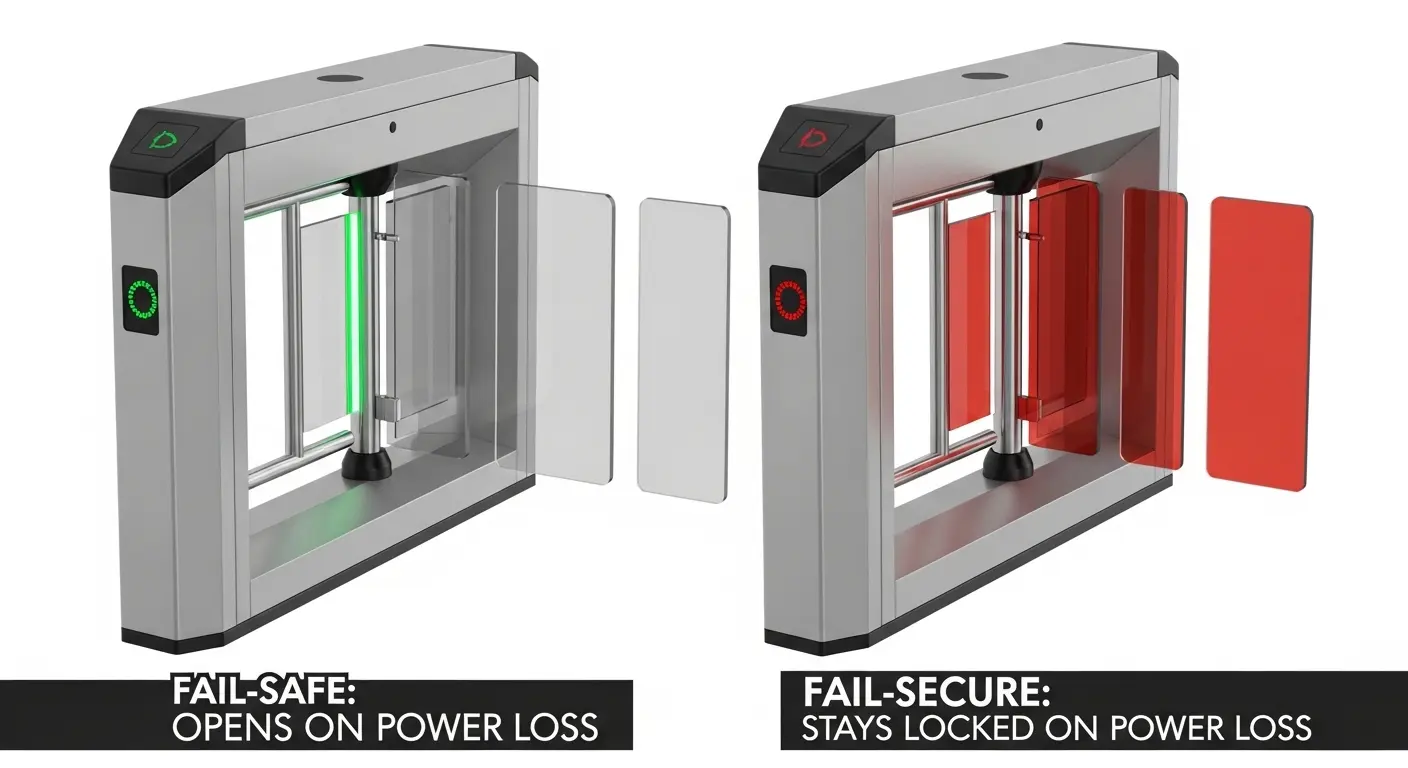
Here's how the two modes compare across the specifications that actually matter for turnstile gate installations:
| Feature | Fail Safe Turnstile Gate | Fail Secure Turnstile Gate |
|---|---|---|
| Behavior on power loss | Barrier opens automatically | Barrier stays locked |
| Behavior on fire alarm | Barrier opens (via relay) | Stays locked unless wired for override |
| Occupant action required to exit | None | Manual override needed |
| Building code status (egress paths) | Legally required | Prohibited on egress paths |
| Appropriate locations | Lobbies, transit, stadiums, schools | Server rooms, vaults, airside zones |
| Security risk on power loss | Lane unsecured | Lane remains physically secure |
| UPS/battery backup role | Extends controlled operation before fail-safe default | Powers locking mechanism without interruption |
The key takeaway: fail-safe is about what happens when the system loses power. A fail safe turnstile gate defaults to human safety first. A fail-secure gate defaults to access restriction first.
How Fail-Safe Works on Each Turnstile Gate Type
Different gate types achieve fail-safe open through different physical mechanisms. Specifiers need to understand which mechanism applies to their chosen product before signing off on a specification:
Tripod Turnstile Gate (Drop-Arm Fail-Safe)
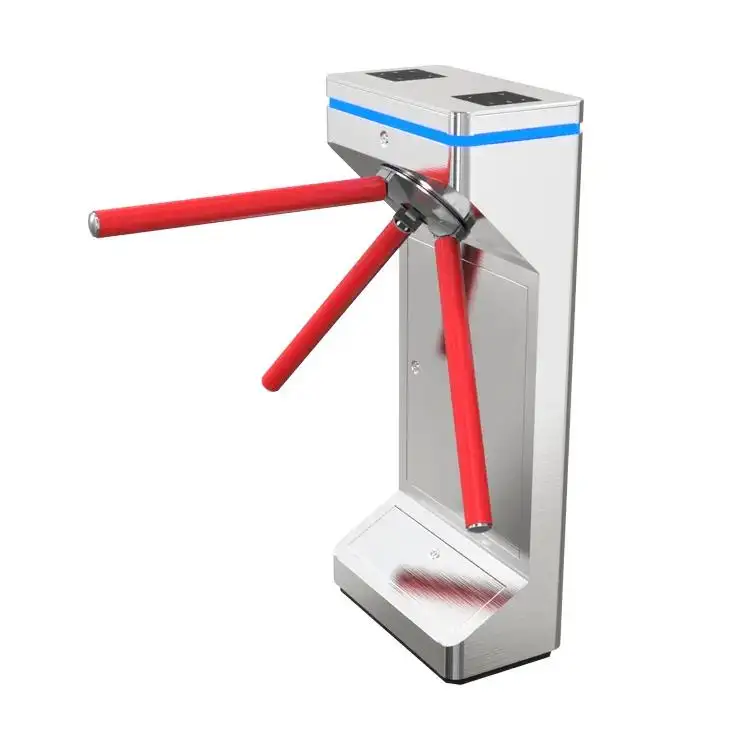
On power loss or fire alarm signal, the solenoid that holds the arm mechanism in the locked position de-energizes. Without the solenoid holding it, the arm assembly drops to horizontal — creating a flat, open passage. The drop happens by gravity in semi-automatic models and by active motor retraction in fully automatic brushless models. Drop-arm fail-safe in a stadium tripod turnstile on the exit gate lane is specifically required for emergency egress management at large-scale venues.
Flap Barrier (Panel Retraction Fail-Safe)
On power loss, the motor drive releases and a spring-return mechanism pulls the flap panels into the cabinet body. The lane opens to its full rated width — typically 550–900mm. A high-performance flap barrier gate with a servo motor drive achieves panel retraction in under 0.3 seconds on fail-safe activation — faster than a standard DC motor model and more consistent under a repeated daily cycle load.
Speed Gate (Column Retraction Fail-Safe)
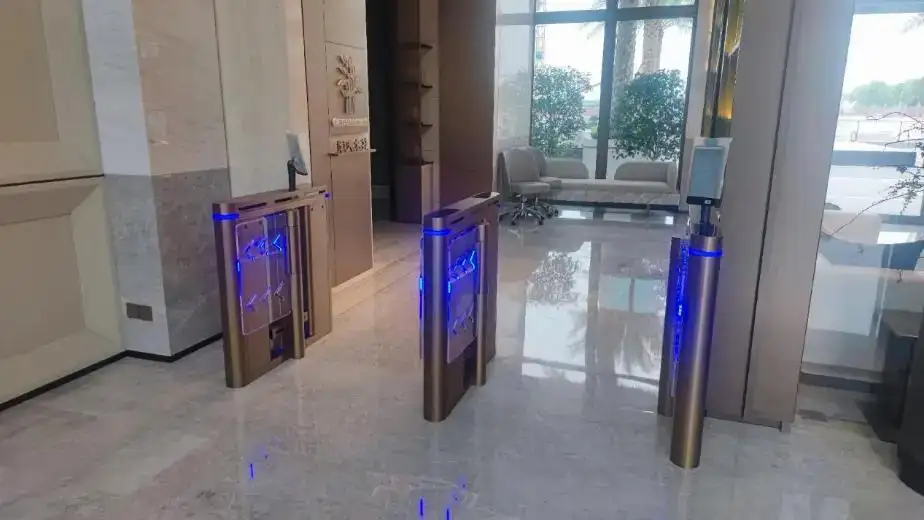
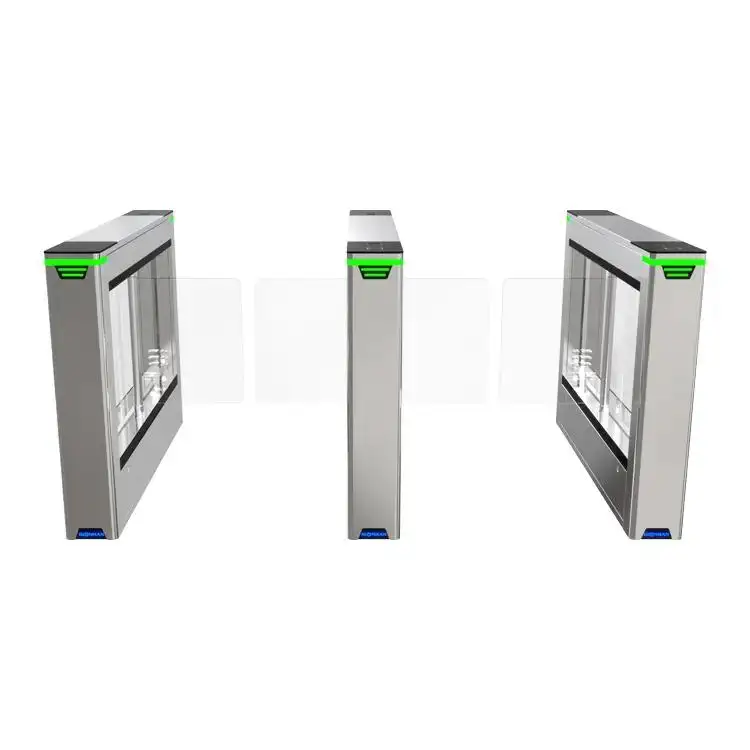
On power loss, glass panels retract fully into the pedestrian column housing — leaving a completely clear open lane. A smart speed gate turnstile uses controlled motor retraction rather than spring-return, giving a smoother and quieter fail-safe activation — important in premium lobby environments where the noise of a sudden spring-return retraction would cause alarm among occupants. An optical speed gate turnstile model uses the same controlled retraction on its optical sensor-monitored lane — with the additional feature of a simultaneous alarm-event log entry on fail-safe activation.
Swing Barrier Gate (Panel Swing-Open Fail-Safe)
The swing panel releases and swings to its full open position on fail-safe activation. A compact swing gate turnstile achieves this in a space-efficient footprint — critical for ADA accessible egress lanes in tight lobby configurations where the wider panel swing arc must clear without contacting adjacent fixtures or walls.
Full Height Turnstile Gate (Arm Release Fail-Safe)
This is the most critical and most varied fail-safe mechanism across the full height category. Some models drop arms to a free-rotation mode — arms spin freely without resistance, allowing passage. Others use a motorized arm retraction sequence triggered by the fire alarm relay. A commercial speed gate positioned alongside a full height gate in a multi-lane lobby receives the same fire alarm relay signal — both release simultaneously, clearing all lanes for evacuation.
For high-security environments using an AB interlocking turnstile door — a mantrap configuration with two sequential controlled barriers — fail-safe behavior requires both doors to release simultaneously on fire alarm activation, overriding the sequential entry-exit interlocking logic that normally governs the mantrap cycle. Confirm this dual-release behavior in the product specification before deployment on any occupied building egress path.
How to Configure Fail-Safe Mode on a Turnstile Gate Control Board
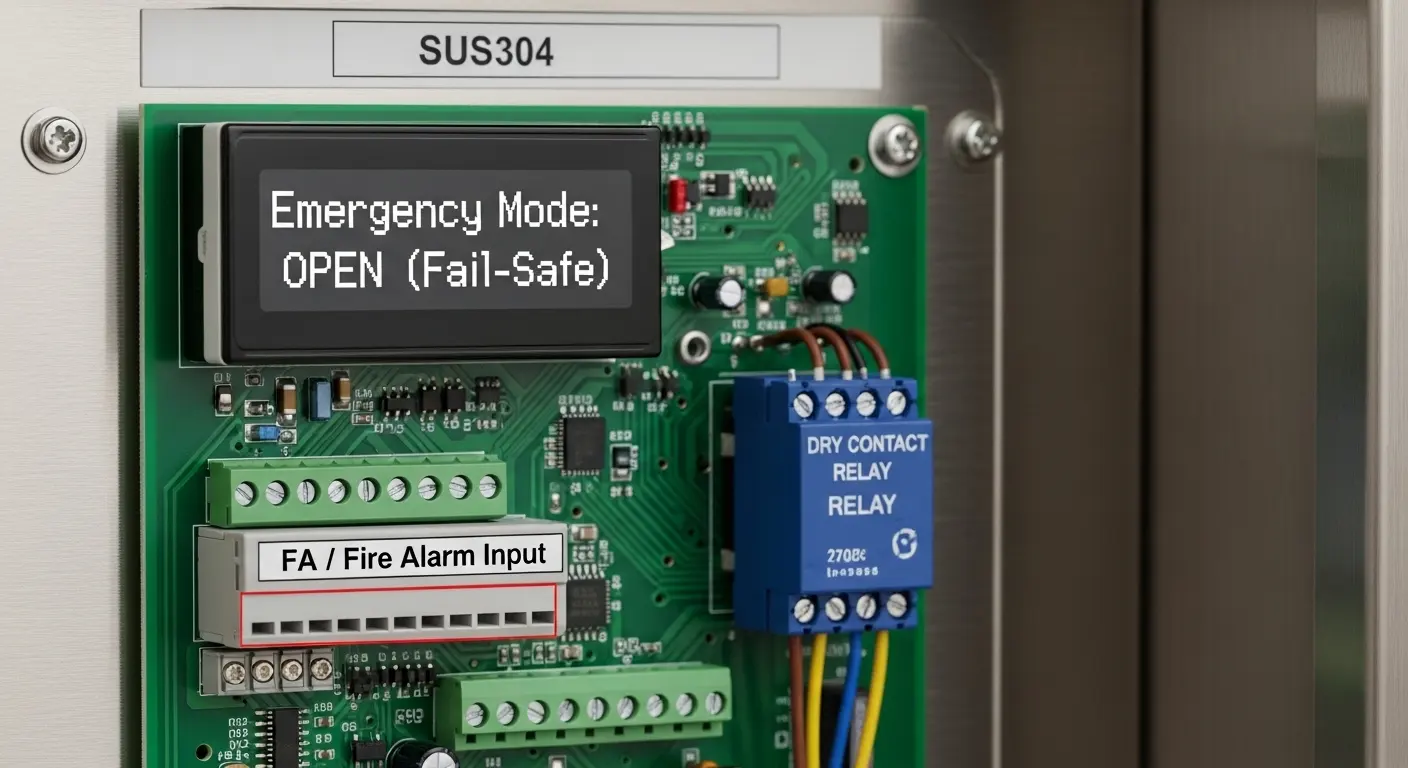
Fail-safe mode is a configuration — not just a hardware feature. A gate can be "fail-safe capable" from the factory but shipped with fail-secure as the default configuration. These are two different things, and confusing them creates a non-compliant installation.
Step 1 — Locate the Fire Alarm Input Terminal
The turnstile control board (PCB) has a dedicated terminal labeled "FA," "FI," or "Emergency Input" in the wiring diagram. This is where the fire alarm dry contact relay connects.
Step 2 — Confirm the Input Logic
A normally closed (NC) relay is the standard for fire alarm input. Under normal conditions, the circuit is closed. On fire alarm activation, the circuit opens — and the control board triggers fail-safe release. Confirm NC logic in the wiring diagram. Some boards support both NC and NO configurations with a jumper setting.
Step 3 — Set the Default Mode in Firmware
Most modern turnstile control boards have a firmware menu that sets the default barrier position on power loss. Navigate to the emergency mode or power-loss settings and confirm the selection is "open" (fail-safe), not "locked" (fail-secure).
Step 4 — Set Override Priority
The fire alarm input must override all other control signals — card reader access denial, anti-tailgating sensor lock, and manual security hold signals. Confirm the override hierarchy in the firmware or hardware manual.
Step 5 — Wire the UPS/Battery Backup
A cloud-based turnstile gate management system connected to a UPS battery backup extends controlled operation during a power outage — the gate continues operating normally on battery power until the battery is depleted. On battery depletion, the gate falls back to the physical fail-safe default. This two-stage behavior — controlled operation, then mechanical fail-safe — is the correct configuration for occupied commercial buildings.
Testing and Commissioning a Fail Safe Turnstile Gate
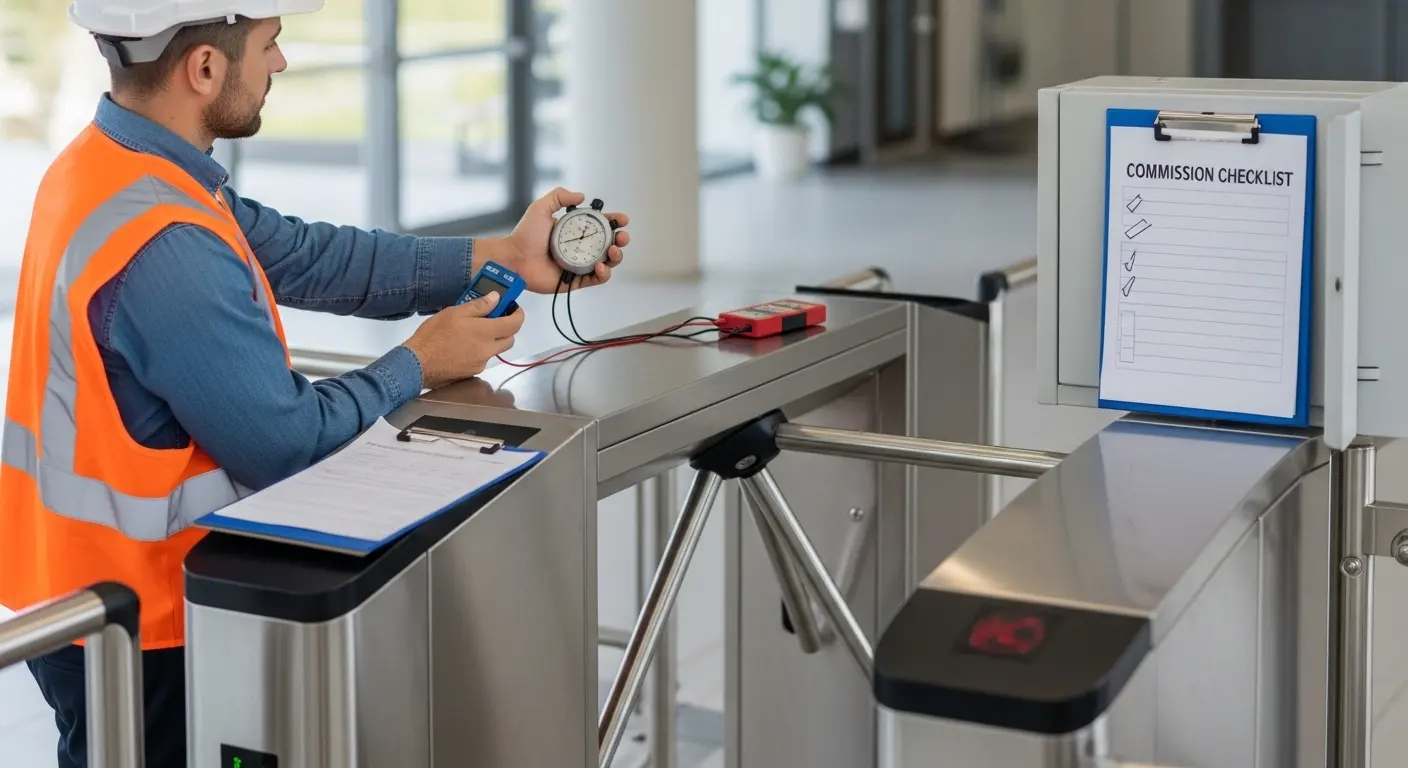
A fail safe turnstile gate that hasn't been tested is just a gate with settings. Commissioning testing confirms the configuration actually works under real conditions:
Test 1 — Fire Alarm Relay Simulation
Apply a fire alarm signal to the FA input terminal using a test relay or short the NC contacts. All connected gates must release to their full open position immediately. Measure the release time from signal application to full open — target under 1.0 second for all gate types.
Test 2 — Mains Power Interruption
Cut the mains power supply. Confirm that the gate releases to the fail-safe open position without requiring a fire alarm signal. This tests the power-loss fail-safe separately from the fire alarm relay path.
Test 3 — Open-State Hold Duration
Confirm the gate holds the open position during the test without re-closing. The gate must remain open until the fire alarm is reset or mains power is restored and the reset procedure is completed.
Test 4 — Normal Operation Return
Restore the fire alarm to cleared status (or restore mains power) and confirm the gate returns to normal credential-controlled access mode — not to locked mode without operator action.
Test 5 — UPS Backup Duration
Run the gate on UPS battery power and confirm normal controlled operation continues for the specified backup duration (typically 4–8 hours for commercial installations).
For anti-climb swing turnstile installations in higher-security environments, an automatic anti-climbing swing turnstile model also requires a specific fail-safe test for the extended-height panel — confirming the taller panel swings fully clear of the passage zone on fire alarm activation without binding against the cabinet profile.
For buildings in the UK where fail-safe configuration forms part of the fire strategy documentation, a UK speed gate turnstile access control supplier provides commissioning test records and wiring as-built drawings as part of the installation handover package — documents the building's fire safety team needs for ongoing compliance records.
Frequently Asked Questions About Fail Safe Turnstile Gates
Q: What is a fail safe turnstile gate?
A: A fail safe turnstile gate opens its barriers automatically when power is lost or a fire alarm activates. The gate uses a power-to-lock mechanism — electrical power holds the barrier closed during normal operation. When power is removed, the barrier releases to the open position by gravity, spring return, or active motor retraction, depending on the gate type. No occupant action is required to open the lane during a power failure or fire alarm event.
Q: What is the difference between fail-safe and fail-secure in a turnstile gate?
A: A fail safe turnstile gate opens automatically when power is lost — prioritizing human exit over access restriction. A fail-secure gate stays locked when power is lost — prioritizing access restriction over automatic egress. Fail-safe is legally required for any turnstile gate on an emergency egress path. Fail-secure is used only in restricted non-egress zones — server rooms, vaults, airside corridors — where unauthorized entry during a power outage is the primary risk.
Q: Is a fail safe turnstile gate required by building code?
A: Yes, in most jurisdictions. NYC Building Code §1010.3 explicitly mandates that every automatic turnstile on an egress path must release to its full open width on fire alarm activation and remain open until the alarm resets. UK BS:9999 and EU EN 13637 contain equivalent requirements. Any turnstile gate positioned on a path of egress — lobby, transit corridor, stadium exit lane — must be configured fail-safe.
Q: How do I test fail-safe mode on my turnstile gate?
A: Simulate a fire alarm signal at the FA input terminal on the control board, then separately test mains power interruption. In both cases, all connected gates must release to their full open position immediately — under 1.0 second from signal to full open. Confirm the gate holds the open position until the alarm is reset, then confirm it returns to normal controlled access mode automatically. Document the test with timestamps and gate-by-gate results for compliance records.
Q: Does fail-safe mode affect anti-tailgating detection?
A: Yes — fire alarm activation or power-loss fail-safe suspends anti-tailgating detection completely. The gate opens and stays open for unrestricted multi-person passage during evacuation. The system logs the fail-safe event as a system-level override — not as individual tailgating alarm events — keeping the access control audit log clean and distinguishing evacuation events from normal operational tailgating alerts.
