


Puerta de torniquetes de reconocimiento facial: Cómo funciona, Tipos de cámaras y cuál necesitas
2026-04-09


Afacial recognition turnstile gate identifies a person by their physical appearance — not by something they carry or remember. No hay tarjeta que emitir, sin PIN para olvidar, No hay credenciales para compartir o clonar. La persona se acerca a la puerta, La cámara lee su rostro, y la barrera se abre en menos de un segundo. Para la sede corporativa, Edificios gubernamentales, university campuses, and high-security facilities managing thousands of daily entries, afacial recognition turnstile gate delivers the highest combination of entry speed and identity security available in any access control product category.
This guide covers how the technology works at each step, which camera types perform best in different environments, what accuracy numbers actually mean at scale, and how to choose gate hardware that matches your specific deployment.
What Is a Facial Recognition Turnstile Gate?
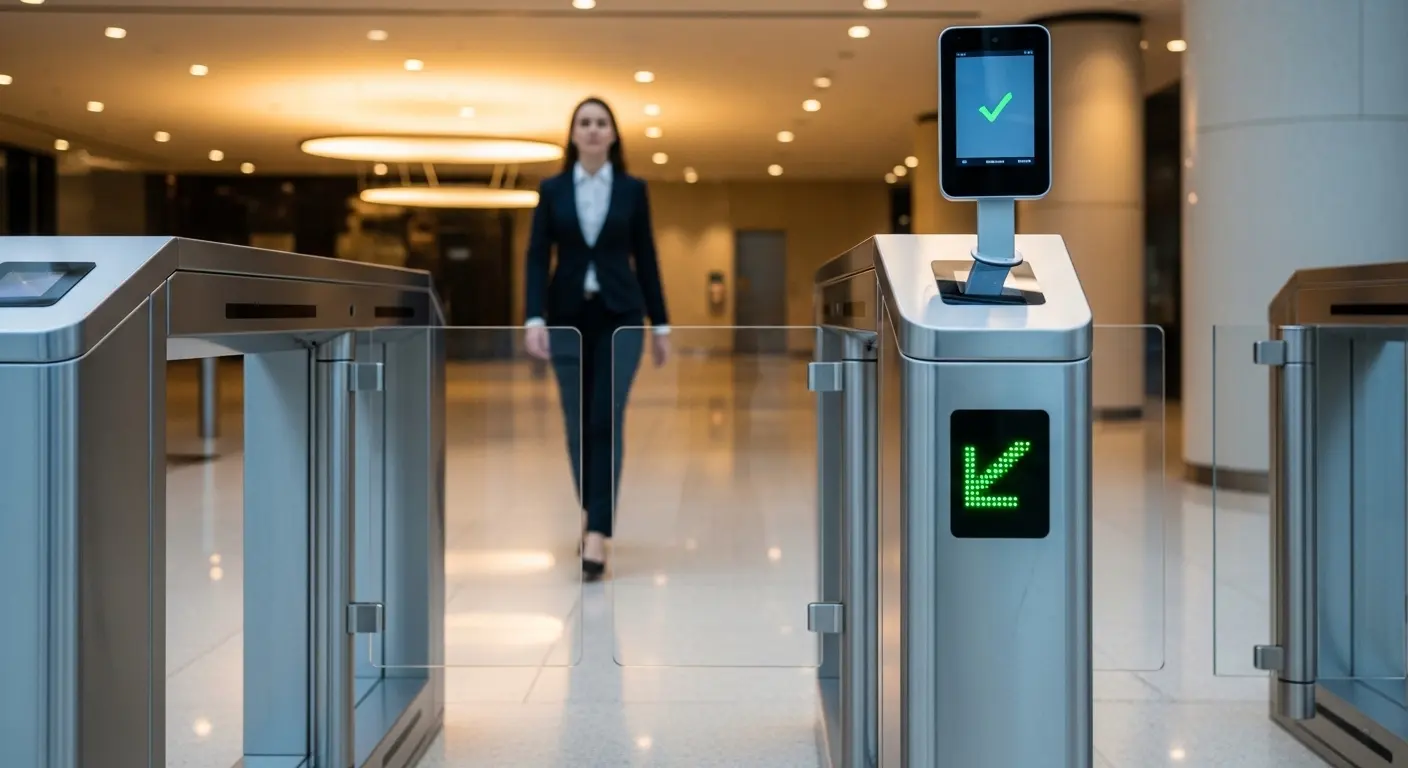
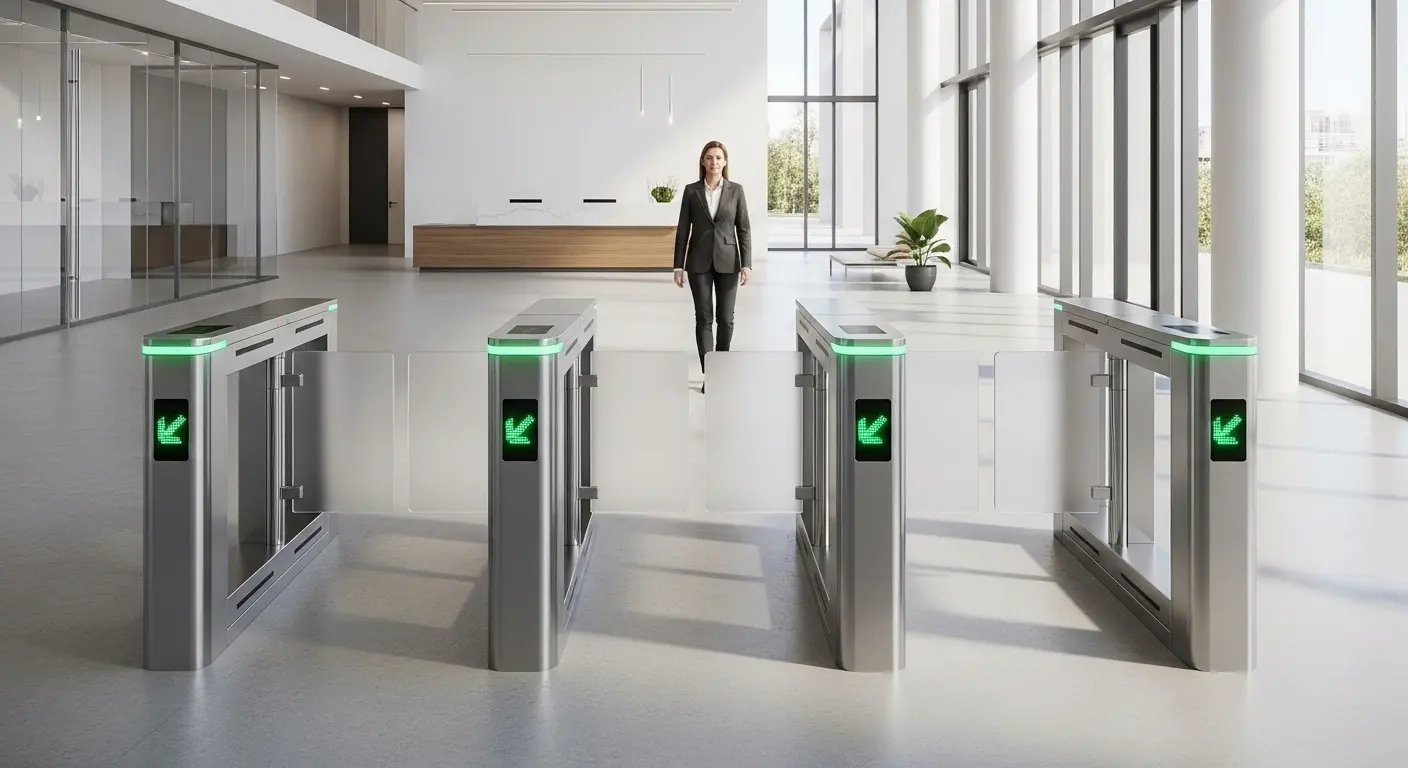
Afacial recognition turnstile gate is a motorized pedestrian barrier with a biometric camera module that captures a live face, compares it against enrolled identity templates in a database, and controls the gate based on the authentication result.
Unlike RFID or fingerprint systems, face recognition is contactless and requires no deliberate user action beyond walking toward the gate panel. Users who carry bags, push strollers, or enter hands-full complete the gate entry without stopping to tap a card or place a finger. In high-volume morning entry windows, that small time saving per person translates directly into shorter queues and faster lane clearance.
The system also creates a complete, identity-linked audit trail for every entry event — timestamp, ID de usuario, and gate location — without requiring any user interaction to generate it. In regulated environments where entry records carry compliance value, that passive logging is a significant operational advantage over manual sign-in systems.
For full product specifications, see the Ironman Torniquete de reconocimiento facial product page. Elfacial recognition turnstile gates manufacturer page covers available configurations and custom build options.
How a Facial Recognition Turnstile Gate Processes Entry
Every entry event runs through a defined five-step sequence. The full cycle from approach to gate opening completes in 0.3 Para 1.2 seconds under normal operating conditions.
Paso 1 — Matrícula. Before a user can pass the gate, their face is captured from multiple angles and processed into a mathematical template — a numerical representation of facial geometry, not a stored photograph. Enrollment quality directly affects long-term recognition accuracy. Multiple capture angles under varied lighting conditions produce more resilient templates. Rushed single-image enrollments create weak templates that generate elevated false rejections in daily use.
Paso 2 — Approach and capture. The user walks toward the gate. The camera activates and detects a face in the frame at a typical range of 0.5 Para 1.5 Metros. Most users are already in recognition position before they reach the physical barrier.
Paso 3 — Liveness detection. Before running the recognition algorithm, the system confirms the capture is a real, live face — not a photograph, printed mask, or screen display. This anti-spoofing check runs in parallel with face detection, adding no visible delay for real users.
Paso 4 — Coincidencia de plantillas. The live facial geometry is compared against stored enrollment templates. A match score above the defined threshold triggers an open command. A score below threshold holds the gate closed and logs the denial.
Paso 5 — Gate response. The barrier opens for confirmed users. For unrecognized or unauthorized faces, the gate stays locked and an alert reaches the management dashboard. El Hombre de Hierrofacial recognition turnstile gate solutions page covers full system architecture, including alert routing, blacklist warning configurations, and integration with existing access control platforms.
Camera and Algorithm Technology Types
The camera hardware determines how the facial recognition turnstile gate performs under actual site conditions — and this is the decision most buyers skip when reviewing product specs.
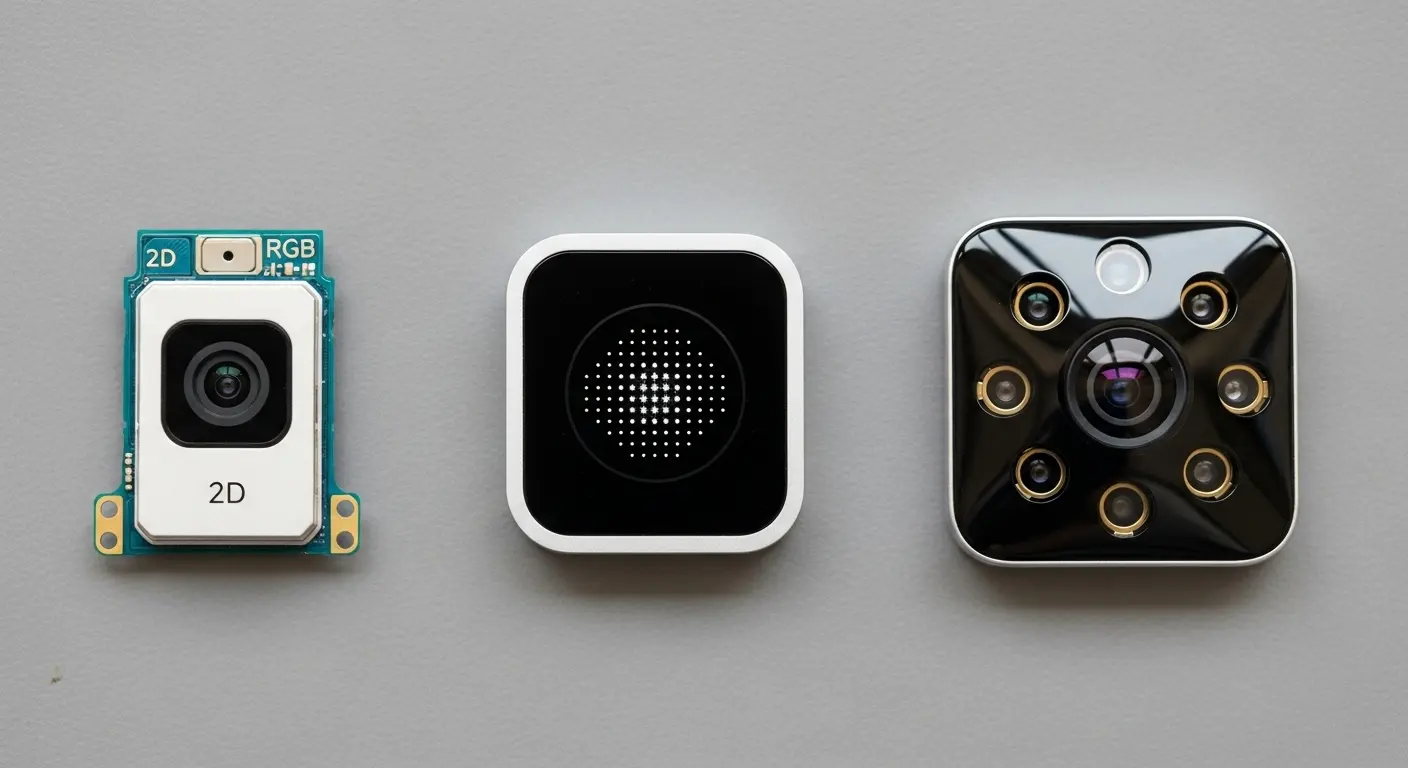
2D RGB Camera
Standard RGB cameras capture a flat, two-dimensional face image. They are the most cost-effective option and perform well in controlled indoor environments with consistent overhead lighting. Most entry-level face recognition gate systems ship with 2D RGB cameras.
The performance limitation is lighting sensitivity. A user walking toward the gate with a bright window behind them creates exposure problems that degrade recognition accuracy. Deep facial shadows from downlighting, direct sunlight at outdoor entry points, and rapid light changes between indoor and outdoor zones all challenge 2D RGB systems. For stable corporate office lobbies, 2D cameras are a practical starting point. For more complex environments, a better sensor specification is worth the cost difference.
3D Depth Camera (Structured Light / Time of Flight)
3D depth cameras capture a three-dimensional map of the face rather than a flat image. Structured light systems project an invisible pattern onto the face and measure the distortions to calculate depth. Tiempo de vuelo (Bien) sensors measure the time infrared light takes to return from facial surfaces.
Both produce a depth map that is significantly harder to spoof with a photograph or screen display. They also perform better across varying skin tones and partial shadow conditions than 2D RGB alternatives. Para entornos de alta seguridad, 3D depth cameras represent the current standard specification for any facial recognition turnstile gate deployment where spoofing resistance matters.
Infrared (Y) Cámara
IR cameras illuminate the face with near-infrared light — invisible to the human eye — and capture the reflected image. Because IR illumination is self-contained and consistent, these cameras maintain stable recognition performance regardless of ambient lighting levels. Dark entry corridors, bright outdoor exit lanes, and high-contrast mixed-lighting environments all produce consistent IR capture quality.
Para instalaciones exteriores, Centros de transporte público, and any gate position where lighting changes across the operational day, IR cameras deliver the most reliable real-world accuracy. El Hombre de HierroPuerta peatonal con reconocimiento facial inteligente uses dual-spectrum imaging — combining visible and IR capture — to maintain consistent performance across both controlled indoor and challenging outdoor environments.
Accuracy Metrics in Context: What the Numbers Actually Mean
Most product listings claim "99% exactitud" for their facial recognition turnstile gate Sistemas. That number sounds strong until you apply it to the actual scale of a real deployment.
A 99% accuracy rate means 1 en 100 recognition events produces an error — either a false acceptance (unauthorized person let through) or a false rejection (authorized user turned away).
For a small office with 200 staff making 2 gate passes each per day, 99% accuracy generates roughly 4 errors per day — manageable.
For a university campus with 8,000 students making 4 gate passes each per day, the same 99% accuracy produces over 320 errors per day. That is 320 false rejections, Anulaciones manuales, or potential false admissions happening every single day. At that scale, the difference between 99% y 99.9% accuracy is the operational difference between a smooth entry experience and a permanent guard-staffed gate problem.
When evaluating any facial recognition turnstile gate specification, ask for FAR (Tasa de Aceptación Falsa) and FRR (Tasa de falso rechazo) figures — not just a generic accuracy percentage. For deployments above 500 enrolled users, objetivo MUY BAJO 0.01% y FRR bajo 0.1%. Request these numbers under the specific lighting and distance conditions of your actual site, not generic laboratory conditions.
Liveness Detection and Anti-Spoofing
Afacial recognition turnstile gate without liveness detection is open to basic spoofing: a printed photograph, a phone screen displaying a face image, or a silicone mask. Liveness detection closes that gap and is a non-negotiable feature in any security-grade system.
Passive liveness detection analyzes subtle texture, Profundidad, and motion signals in the captured image to distinguish a real face from a flat or artificial reproduction. This runs automatically without requiring the user to blink, turn, or perform any visible action — adding no delay to the entry cycle.
Active liveness detection prompts the user to perform a specific action — blink, nod, or turn their head slightly. It delivers stronger spoofing resistance than passive detection but adds 1 Para 2 seconds to the verification cycle. For high-security zones with moderate throughput requirements, active liveness is worth the additional cycle time.
3D antisuplantación uses depth map analysis from a 3D camera to confirm that the captured image has three-dimensional geometry consistent with a real human face. It defeats all flat photograph and 2D screen attacks, regardless of image resolution. For any high-security facial recognition turnstile gate installation where targeted attacks are a realistic concern, 3D depth cameras with built-in anti-spoofing deliver the strongest available protection.
For entry points where physical anti-tailgating enforcement runs alongside face recognition, elCompuerta AB anti-tailgating combines dual-zone infrared detection with biometric credential verification in the same gate hardware.
Face Recognition in Challenging Conditions
Real-world deployments introduce performance variables that controlled lab testing rarely replicates. These are the factors most likely to surface in the first month of live operation.
Mask usage. Partial face covering removes lower-face features from the recognition algorithm's available data set. Systems trained specifically on partial-face recognition use upper-face geometry — eye region, brow ridges, forehead — as primary identity markers. Before specifying a system for any environment where face coverings are common, request documented accuracy figures for masked users specifically.
Eyewear and accessories. Standard prescription glasses produce minimal recognition impact in most modern systems. Heavily tinted sunglasses, thick-framed glasses, or face-covering headgear reduce the visible feature area and may increase false rejection rates for specific individuals. El Hombre de HierroControl de acceso por reconocimiento facial terminal accounts for common eyewear variations in both enrollment and live recognition processing.
Lighting conditions. The single most common cause of in-field accuracy problems. Backlighting from windows, direct sunlight at outdoor gates, and harsh downlighting that creates deep facial shadows all degrade 2D RGB camera performance. IR cameras address the majority of these scenarios. For any outdoor or partially covered gate position, IR or dual-spectrum cameras are the appropriate hardware specification.
Appearance changes over time. Facial recognition algorithms handle gradual aging well. Significant weight changes, substantial beard growth, or reconstructive procedures may require individual template re-enrollment for affected users. Building a re-enrollment process into your annual access review cycle keeps recognition accuracy stable across the user population over time.
Gate Types That Work with Facial Recognition
The camera module fits on almost any motorized gate cabinet. El tipo de puerta determina el rendimiento, Nivel de seguridad física, and environmental suitability for each specific deployment zone.
Puerta de barrera de solapas
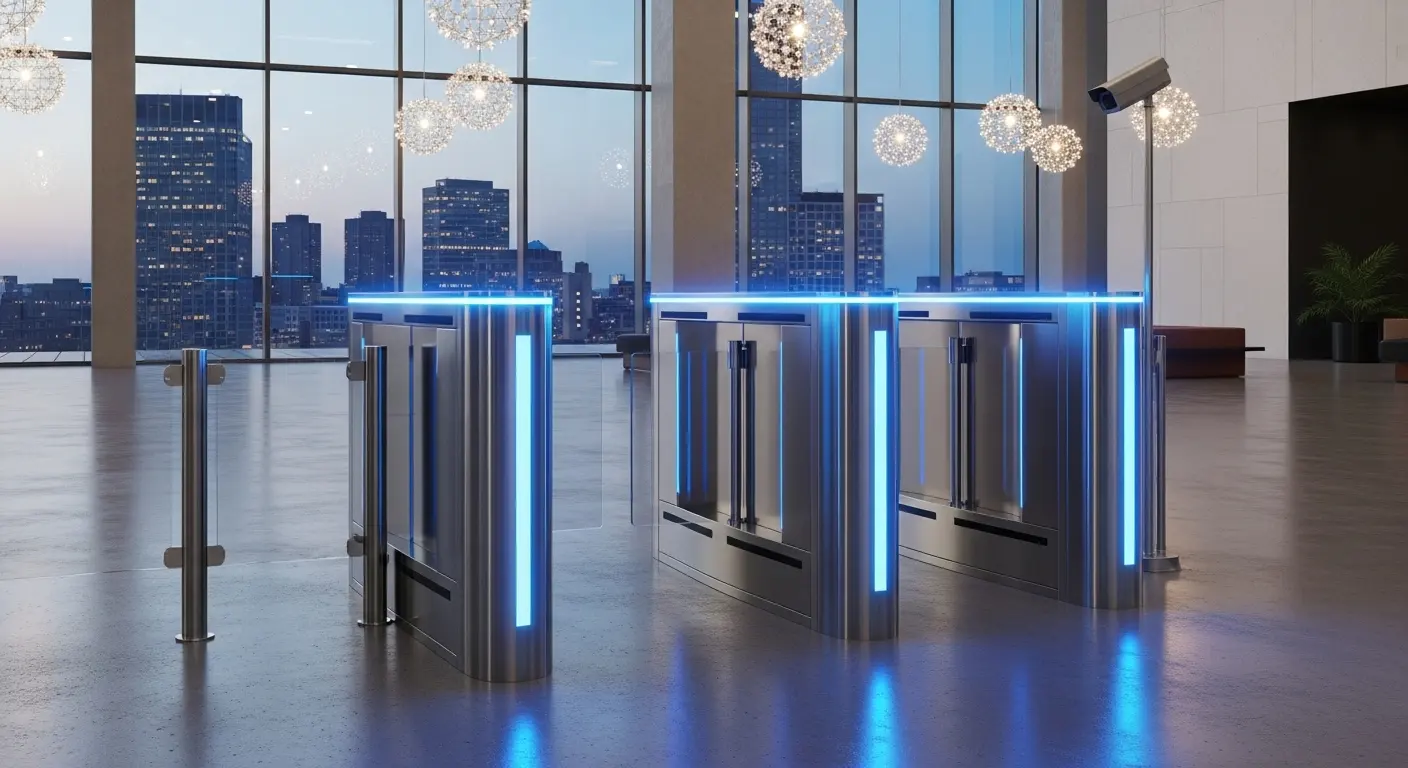
Los más ampliamente desplegadosfacial recognition turnstile gate configuration for corporate environments. The motorized flap panels handle throughput of up to 45 personas por minuto. Multi-beam infrared anti-tailgating detection runs simultaneously with face recognition — both layers enforced by the same gate unit. The camera mounts on the entry-side cabinet at standing height with an LED status display providing clear approach guidance for users.
Swing Gate with Face Recognition
Swing gates handle ADA-compliant lanes where the camera must accommodate users at different heights — wheelchair users, niños, and visitors with mobility aids. El Hombre de HierroPuerta giratoria por reconocimiento facial uses an adjustable camera position to maintain capture accuracy across the full passenger height range in public-facing and mixed-user environments.
Biometric Speed Gate
For high-volume environments where throughput is the primary constraint, elTorniquete biométrico de la puerta de velocidad delivers face recognition at up to 50 persons per minute alongside glass panel barriers and optical tailgating detection. Grandes campus corporativos, transit entries, and airport landside zones suit this configuration.
Puerta peatonal de reconocimiento facial inteligente
ElPuerta peatonal con reconocimiento facial inteligente combines dual-spectrum imaging, passive liveness detection, recognition, and real-time blacklist alert in a single integrated unit. It suits government facilities, sensitive commercial buildings, and any environment where identity verification carries compliance or regulatory obligation.
Comparación de tipos de compuertas
| Tipo de puerta | Face Rec Throughput | Seguridad física | Mejores entornos |
|---|---|---|---|
| Barrera de solapas | Hasta 45 ppm | Alto | Oficinas corporativas, Campus |
| Puerta de velocidad | Hasta 50 ppm | Alto | Tránsito, large campuses |
| Compuerta giratoria | Hasta 30 ppm | Alto | Carriles ADA, public facilities |
| Intelligent pedestrian gate | Hasta 40 ppm | Alto | Gobierno, compliance environments |
| Torniquete de altura completa | Hasta 20 ppm | Sumamente | Restricted zones, Perímetros |
For real-world deployment context, ellibrary turnstile gate case study shows how facial recognition connects with membership management systems in high-turnover public environments with diverse user populations.
Privacidad, GDPR and Data Protection
Facial recognition data qualifies as a special category biometric under GDPR Article 9. Any organization deploying a facial recognition turnstile gate within the EU — or any jurisdiction with equivalent biometric data laws — must address compliance before the first face is enrolled. Esto no es opcional, and the documentation must exist before the system goes live.
Legal basis for processing. The two most common legal bases for workplace face recognition are explicit consent and legitimate interest. Consent requires a freely given, specific, informed, and unambiguous opt-in from each enrolled person. Legitimate interest requires a documented balancing test demonstrating that the security purpose outweighs the privacy impact on individuals.
Data Protection Impact Assessment. Artículo del RGPD 35 requires a DPIA before systematically processing biometric data. This is a documented risk assessment covering the processing purpose, necesidad, proportionality, and mitigation measures — not a checkbox form.
Template storage location. On-device storage keeps biometric templates within the physical installation and reduces centralized data exposure. On-card storage gives users personal control over their own template — the cleanest compliance model. Centralized server storage requires the most rigorous documentation and security measures. Choose storage architecture during specification, not after installation.
Retention and deletion. Define how long facial templates are retained and how deletion is confirmed when an employee leaves or a membership expires. Deletion must be auditable and cover all storage locations where the template exists.
Common Mistakes When Specifying a Facial Recognition Turnstile Gate
Choosing camera type based on unit price. 2D RGB cameras cost less but perform poorly in variable lighting, outdoor exposure, or high-contrast entry environments. Camera type must match actual site lighting conditions — not the lowest available cost on the specification sheet.
Acelerar el proceso de inscripción. Template quality at enrollment determines system accuracy for the entire operational life of the gate. Rushed enrollments using a single image under poor lighting create weak templates that produce elevated false rejections from day one. Budget enrollment time properly, capture multiple angles per user, and quality-check each template against the system's internal scoring before the gate goes live.
Specifying no fallback credential. Cadafacial recognition turnstile gate deployment needs a documented fallback process for false rejections — whether an RFID card backup, a security desk override, or a manual verification procedure. Without it, each false rejection becomes an operational incident that disrupts both the affected user and the lane behind them.
Skipping GDPR and privacy planning. Deploying facial recognition without a documented legal basis, DPIA, and consent process creates direct regulatory exposure in GDPR-subject jurisdictions. This compliance work must be completed before the first enrollment — not after the system is live and subject to a regulatory inquiry.
Underestimating throughput impact. Face recognition adds 0.3 Para 1 second to each gate cycle compared to RFID tap. In most office environments, that margin is invisible. In a transit hub or event venue where thousands of people need to pass multiple lanes in a short window, that margin multiplied by volume creates visible queue formation. Calculate your peak-hour throughput requirement before confirming gate type and camera configuration.
Preguntas más frecuentes: Puerta de torniquetes de reconocimiento facial
What is a facial recognition turnstile gate?
Afacial recognition turnstile gate is a motorized pedestrian barrier with a biometric camera that identifies individuals by their facial geometry rather than a physical credential. The camera captures a live face as the user approaches, compares it against enrolled templates, confirms liveness, and opens the gate for authorized individuals — all in under 1.2 sobras. No card, ANCLAR, or phone is required.
How accurate is a facial recognition turnstile gate?
Accuracy depends on camera technology, enrollment quality, y condiciones de iluminación. Quality systems target FAR (Tasa de Aceptación Falsa) under 0.01% and FRR (Tasa de falso rechazo) under 0.1%. These figures must be evaluated against your specific enrolled user population size — a 99% accuracy rate that is acceptable for a 200-person office becomes a significant daily error source in a facility with 5,000 Usuarios. Always request FAR and FRR figures from vendors rather than relying on generic "exactitud" percentages.
Can a facial recognition turnstile gate work with masks or glasses?
Modern systems handle standard glasses well with minimal recognition impact. Partial face coverings reduce available facial features and can raise false rejection rates. Systems trained specifically on partial-face recognition maintain accuracy using upper-face geometry — eye region, brow ridges, and forehead. Before specifying a system for an environment where masks are common, request documented masked-user accuracy figures from the vendor.
What camera type is best for a facial recognition turnstile gate?
For stable indoor lighting environments, 2D RGB cameras deliver practical performance at lower cost. For outdoor, semi-outdoor, or variable-lighting installations, IR or dual-spectrum cameras maintain consistent accuracy regardless of ambient light levels. For high-security environments where spoofing attacks are a realistic concern, 3D depth cameras with built-in liveness detection provide the strongest available anti-spoofing protection.
Is a facial recognition turnstile gate GDPR compliant?
It can be, with the correct compliance preparation. Facial recognition data is a special category biometric under GDPR Article 9 and requires a documented legal basis, a Data Protection Impact Assessment, and an explicit enrollment consent process before any data is collected. On-card or on-device template storage reduces centralized data exposure and simplifies the compliance position. All compliance documentation must be in place before the first enrollment event — not after the system begins operating.
