


Tripod Turnstile Systems With RFID Card Reader – Multi-System Integration in Southeast Asia
2026-06-17


The Southeast Asian access control market is expanding, with an increasing preference for Tripod Turnstile Systems with RFID Card Readers. They must contend with tropical climates, high pedestrian flows, and the need for software integrations. This article outlines considerations for system deployment and the benefits of partnering with engineers from companies like IRONMAN Intelligent.
The Increasing Need for Integrated Access Control Solutions in Southeast Asia
Newer buildings in Singapore, Kuala Lumpur, Jakarta, and Bangkok are staffed by hundreds to thousands of employees, with more employees being hired as manufacturing and electronics assembly operations move to Vietnam, Thailand, Malaysia, and Indonesia. Construction and design of modern mixed-use office buildings with multiple functional spaces and an even more diverse visitor population has created an urgent need for integrated access control systems. Delivery of modern integrated access control systems requires a balance of operational control and design aesthetics.
Typical integration requirements of Southeast Asian facilities are listed below:
| Integration Objective | Integration Technology |
| Credential Management Systems (RFID Card Access Systems) | Management of employee and contractor credentials |
| Automated Time and Attendance Systems | Record shifts for payroll |
| Visitor Control Systems | Pre-authorization and control of temporary access |
| Centralized Security Systems | Real-time logging and reporting of system audits |
| Building Management Systems | Control and streamline operations of the facility. |
Multi-System Integration: The Value Proposition
The value of Tripod Turnstile Systems with RFID Card Readers is not in the physical barrier, but in the data. Access control systems generate a wealth of data: who, when, the lane used, and the credential used to gain access. This data becomes useful and valuable when integrated into the appropriate systems.
Every integration project begins with the foundation of communication protocols. One option of the protocol will impact the integration with current access control panels and the possible future extensibility.
1. RS485's Flexibility for Multi-Device Applications
RS485 offers great flexibility for large multi-site or multi-building access control installations. As an example, RS485 is the only communications option offered when the number of turnstiles specified exceeds the number of turnstiles that can be controlled by an individual RS485 controller.
Advantages of RS485 for Southeast Asian markets include:
•Reduced cabling for large installations due to daisy-chain topology
•Centralized control for access management across multiple access points
•Automatic attendance and visitor logging without manual intervention
•Bidirectional communication between gate controllers and software systems
2. TCP/IP and Cloud-Based Solutions
For sites needing access control systems that allow real time monitoring and management of systems and users from the cloud, the only option is direct LAN (local area network) connectivity via TCP/IP.
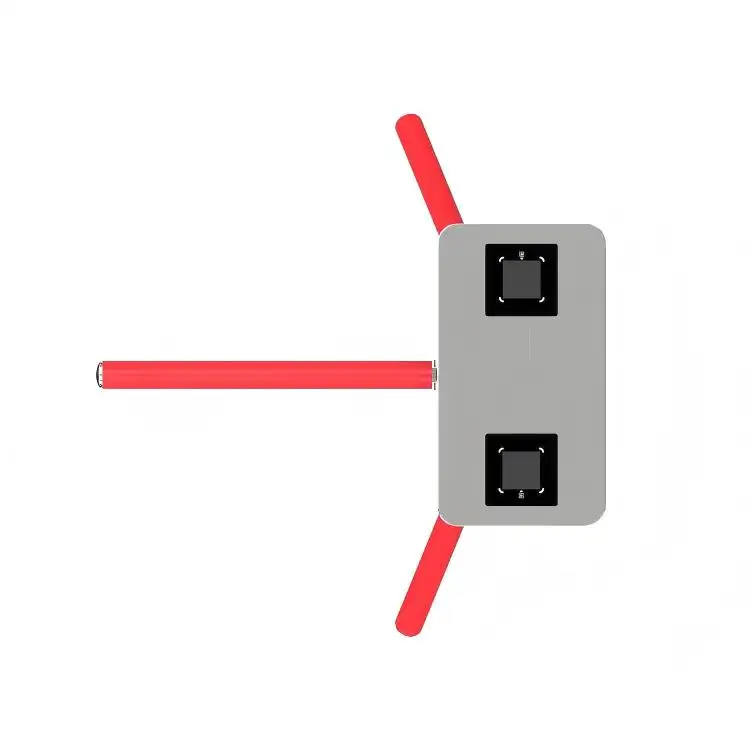
Integration options:
| Protocols | Best for | Key Benefit |
| Dry-Contact Relay | Legacy systems, straightforward retrofit | Works with any ACP system |
| Wiegand 26/34-bit | Basic RFID card systems | Supports HID, Honeywell, Lenel, Genetec |
| RS485 | Use in multi-lane lobbies, panel controlled systems | Greatest distance, greatest number of devices |
| TCP/IP | Cloud access control systems, remote management | Real-time data, remote management covering multiple sites |
Tropical Climate Engineering Adaptability
The high humidity, high heat, and constant rain of tropical climates like those found in Southeast Asia create situations that require the highest levels of design concern for electronic access control.
Critical environmental specifications for the region:
•Operating temperature: -10 to 70. Design accommodates conditioned interiors as well as semi-outdoor protected entry points.
•Relative humidity: 95% non-condensing, due to humidity present during most times of the year.
•Housing material: 1.5mm stainless steel. Protects against corrosion.
Material selection of housings is critical to the long-term reliability of the systems. Stainless steel housings, as compared to mild steel housings, of coastal and/or high salt concentration environments, have much less corrosion and therefore provide better long-term performance.
The Tripod Turnstile Systems with RFID Card Reader, from manufacturers, such as IRONMAN Intelligent, have reinforced stainless steel housings which protect the systems from:
•Constant contact of high-volume pedestrian traffic.
•High frequency of system use and the need for regular sanitization.
•Exposure to dirt and environmental contaminants.
•Repeated mechanical operations.
These systems are designed to provide predictable performance with an improved life cycle.
Physical Security: Anti-Tailgating and Flow Control
Entering a facility in groups using a single card authentication has become a common problem in several Southeast Asian countries. Most RFID Readers and open access security systems do not have the capability to physically enforce access control.
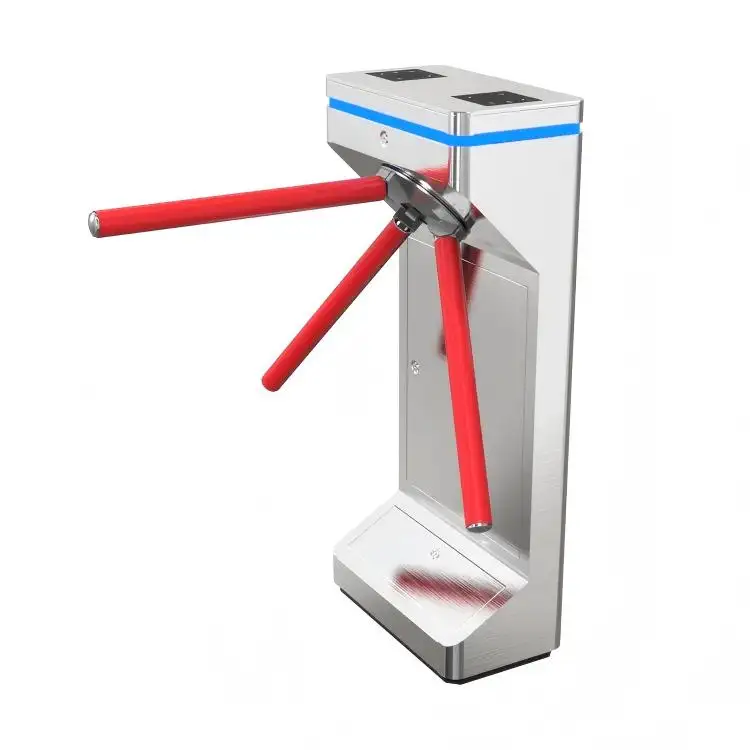
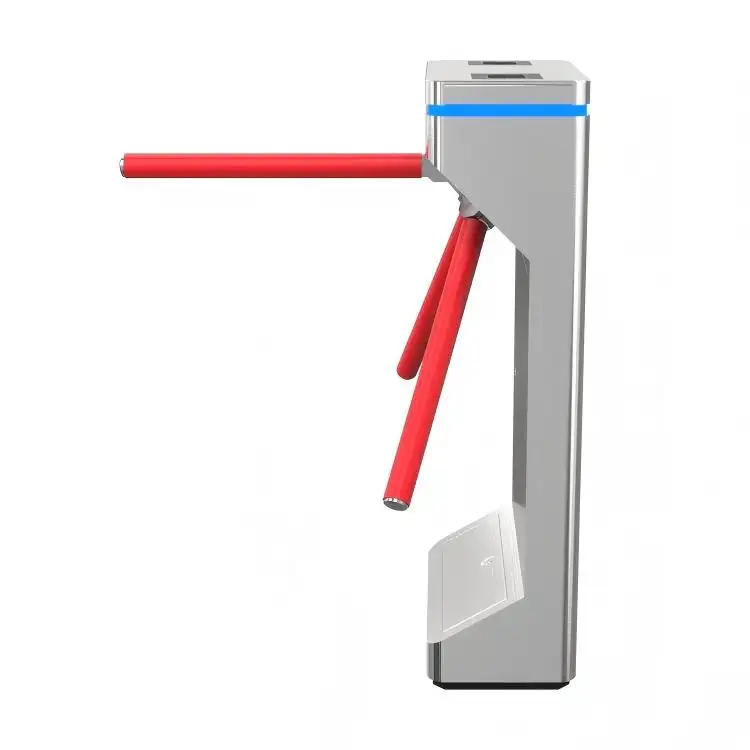
RFID Card Reader Integrated Tripod Turnstile Systems provide mechanical enforcement:
•Controlled single-person passage: A passage opening of about 550 mm facilitates entry for a single person.
•Three-armed turnstile: Allows the passage of one person with each turn of the arms.
•Automatic enforcement of anti-tailgating: The turnstile locks itself when a second person is detected entering the passage.
The system is designed with the following operational parameters in mind:
| Parameter | Specification |
| Throughput | 30 to 40 persons/min |
| Response time | ~0.2 sec |
| Mechanical reliability | MTBF up to 5,000,000 cycles |
Facility managers can use the parameters above to quantify lane needs and optimize queue management to minimize congestion during the predictable peak times (morning start of shifts, lunch breaks, and evening end of shifts).
Best Practices for Deployment and Maintenance
When deploying Tripod Turnstile Systems with RFID Card Reader in Southeast Asia, consideration of both technical and contextual factors is essential for successful deployment.
Consider the following during installation:
•Site assessment: Evaluate if the entry point is more exposed to the weather, how the system would integrate with the built infrastructure, and the patterns in foot traffic.
•Concrete foundation: Understand the requirements for the flooring so it supports the installation of systems that will be mounted on the flooring.
•Cable management: power cords and cables for the network and communications need to be contained to mitigate them being a hazard.
•Environmental Protection: For systems that will be installed in a semi-outdoor environment, assess how systems will mitigate risk if they are exposed to higher humidity and temperature levels.
Maintenance best practices:
•Regular inspection: Check the mechanical parts and wiring and the waterproofing on a routine basis.
•Surface cleaning: Use a cleaner that is stainless safe and non-abrasive so that the surface will be stainless and not corroded.
•Lubrication: Use the lubricating oil specified for the joints.
•Operational Testing: Systems should be properly tested for operations prior to the time when they are used the most.
IRONMAN Intelligent focuses on features that improve long-term system reliability instead of features that provide the lowest initial costs. Their tripod designs integrate features to support smooth walking and entry control, and maximize the return on investment. Some of the included design features are:
•Small footprint, designed for tighter installations.
•CE, FCC, ISO certified to comply with international standards.
•Bi-directional with independent logic control for customizable lane use.
•Support for a wide range of credential media from RFID, QR code, and fingerprint to facial recognition.
Conclusion
Tripod Turnstile Systems with RFID Card Reader offer a strategic investment for SE Asian facilities needing access discipline, simplicity, and durability. These systems are designed to integrate with a variety of established industrial systems and, as such, transform input points into quantifiable control nodes. Their mechanical reliability, suitability to a wide variety of environmental conditions, and multi-system compatibility suit a broad range of sites, e.g., corporate, industrial, government. Some important criteria include:
•Supported protocols (RS485, TCP/IP, Wiegand, dry contact)
•Environmental tolerances (temperature, humidity, corrosion)
•Mechanical durability (MTBF, cycle life)
•Throughput (persons/min, response times)
•Credential flexibility (RFID, QR, biometric, mobile)
These criteria enable a prioritized order to address current limitations and concerns, while allowing future flexibility and functionality to reduce the total cost of system ownership.
FAQ
Q1. Can I use my current access control software with these turnstiles?
Yes, they will work with most access control software as these turnstiles use standard protocols (RS485, TCP/IP, Wiegand, dry contact).
Q2. Can these turnstiles be used outside in hot, humid weather?
Yes, the turnstiles will be resistant to the corrosion and humidity when the enclosures are rated IP and the housings are 1.5mm stainless steel.
Q3. How do these turnstiles avoid tailgating?
The mechanical arms allow for one-person-per-rotation and tailgating can be avoided if infrared sensors are used to detect a person and lock the turnstile.
Q4. What are the turnstiles doing during a power shortage?
Depending on the level of security needed for the area, the turnstiles can enter a free rotation mode (fail-safe) or locked mode (fail-secure).
Q5. What are the supported credentials?
Optional modules can allow support for RFID cards, QR codes, fingerprints, facial recognition, and even mobile credentials.
