


Heavy Duty Turnstile Gate: What It Really Means, Which Types Qualify, and How to Specify Right
2026-03-19


A heavy duty turnstile gate isn't just a stronger-looking standard model. The term describes a specific set of measurable technical parameters — MCBF cycle life, IP ingress protection rating, cabinet material grade, drive mechanism type, and operating temperature range — that determine whether a gate survives a demanding deployment for 10–15 years or starts failing within two.
If you're specifying a heavy duty turnstile gate for a factory, construction site, stadium, prison, or outdoor industrial environment, this guide gives you the exact specifications to demand, the gate types that qualify, and the selection framework to match the right product to your environment.
What "Heavy Duty" Actually Means in Technical Terms
Suppliers use "heavy duty" loosely. Some apply it to any stainless steel gate. Others apply it only to gates with published cycle life ratings above 3 million. These are not the same thing — and the difference shows up in the field, not in a brochure.
A genuine heavy duty turnstile gate meets measurable thresholds across six specific parameters:
1. MCBF (Mean Cycles Between Failure)
Commercial standard: 1–2 million cycles. Heavy duty: 3–5 million cycles minimum. Industrial grade: 5 million cycles or above. At a factory gate processing 500 passes per day, a 5-million-cycle mechanism lasts 27+ years in theory. A 1-million-cycle mechanism lasts roughly 5 years before mechanism components begin requiring unscheduled replacement.
2. IP Rating
Standard indoor gates carry IP4X (no meaningful dust or water protection). A heavy duty turnstile gate for industrial or outdoor use carries IP54 at minimum — protecting against dust and directional water. For fully outdoor environments, coastal sites, or heavy industrial atmospheres, IP65 is required: total dust exclusion and protection against water jets from any direction.
3. Cabinet Material and Wall Thickness
SUS201 or powder-coated mild steel is the entry-level. SUS304 with 1.2mm minimum wall is the commercial standard. A heavy duty turnstile gate uses SUS304 full-weld construction at 1.5mm or above — or SUS316 for coastal and chemically aggressive environments. Full-weld means the cabinet is welded as a single unit, not assembled from panels with exposed joints that collect contamination and corrode at the seams.
4. Drive Mechanism
Standard DC motors use carbon brushes that wear over time. A heavy duty turnstile gate uses a brushless DC or servo motor — no brush wear, lower heat generation, longer service intervals, and a measurably higher cycle life per maintenance event.
5. Duty Cycle
A 100% duty cycle rating means the gate runs continuously without required cool-down between cycles. Most entry-level gates don't carry this rating. A heavy duty turnstile gate at a shift-change factory gate must process hundreds of passes in a 10-minute window without thermal shutdown or cycle-rate limitations.
6. Operating Temperature
Standard: 0°C to +50°C. Heavy duty: -20°C to +60°C minimum. For extreme environments — Northern European outdoor sites, Middle Eastern industrial facilities, or sub-zero winter deployments — -35°C to +70°C is appropriate.
Types of Heavy Duty Turnstile Gate and Where Each One Fits
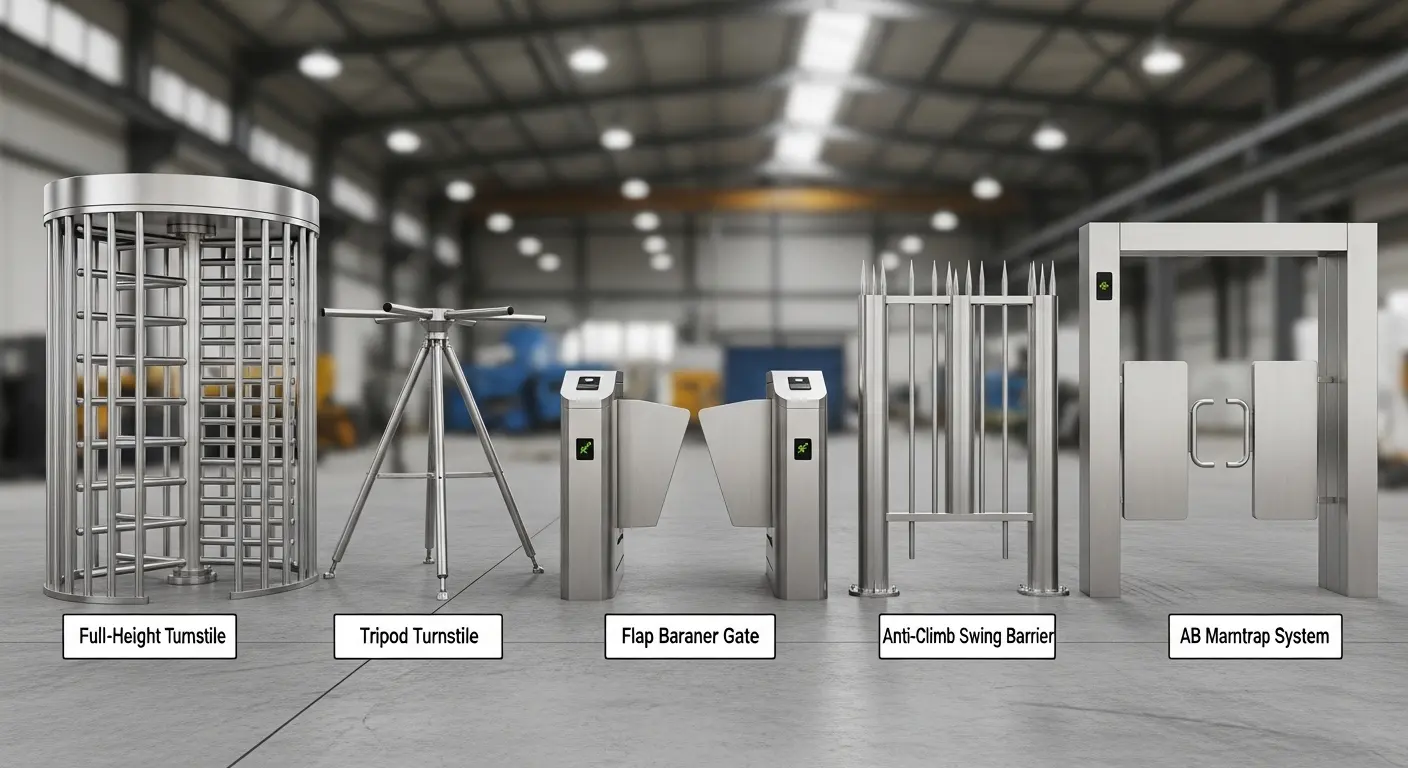
Not every gate type achieves heavy duty performance. Here's how each category maps to demanding environment requirements.
Heavy Duty Full Height Turnstile Gate
The highest physical security option in the heavy duty category. Floor-to-ceiling height (2,100–2,300mm) eliminates climb-over bypass. The rotating arm assembly requires arm release confirmation on fail-safe activation — and full-weld SUS304 or SUS316 construction handles the physical loads of outdoor industrial perimeter deployment.
For a site that combines factory worker access with maximum-security restricted zone access on the same facility, full height turnstile gates at restricted entry points alongside heavy duty tripod or flap barrier gates at general worker gates creates a tiered access architecture that matches security level to zone type without over-spending on full height hardware where it isn't needed.
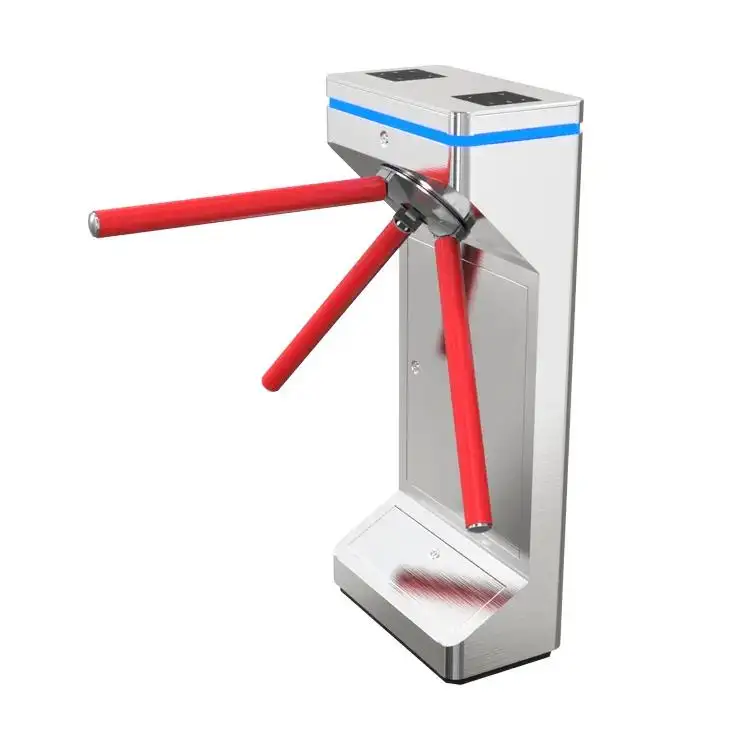
Heavy Duty Tripod Turnstile Gate
The workhorse of industrial deployments. Waist-height three-arm mechanism, IP54–IP65, SUS304 full-weld construction, brushless motor, and MCBF of 3–5 million cycles. The inclined octagonal tripod turnstile combines heavy duty mechanism specification with a premium multi-faceted cabinet profile — suitable for industrial facilities that also require a refined appearance at visitor entry points without compromising on the specification their environment demands.
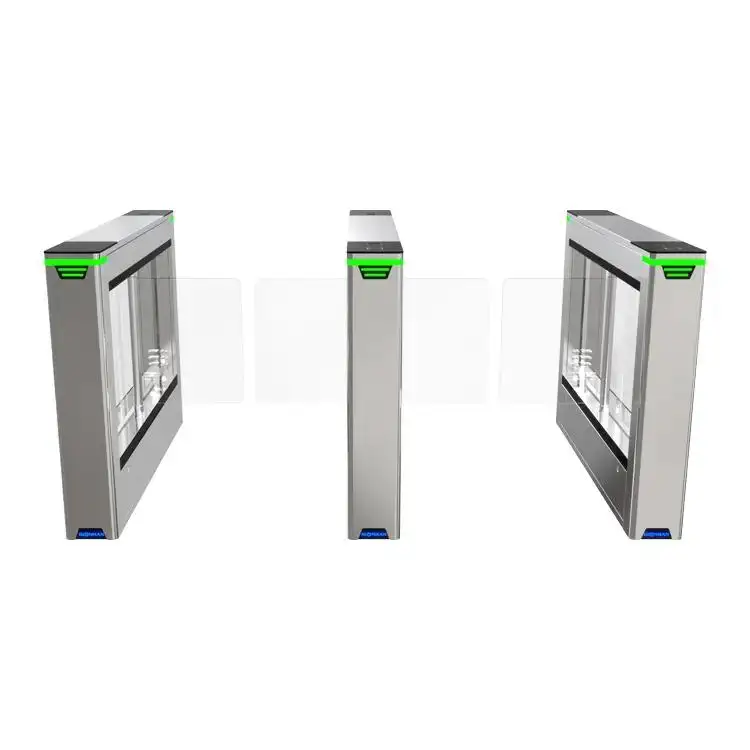
Heavy Duty Flap Barrier Gate
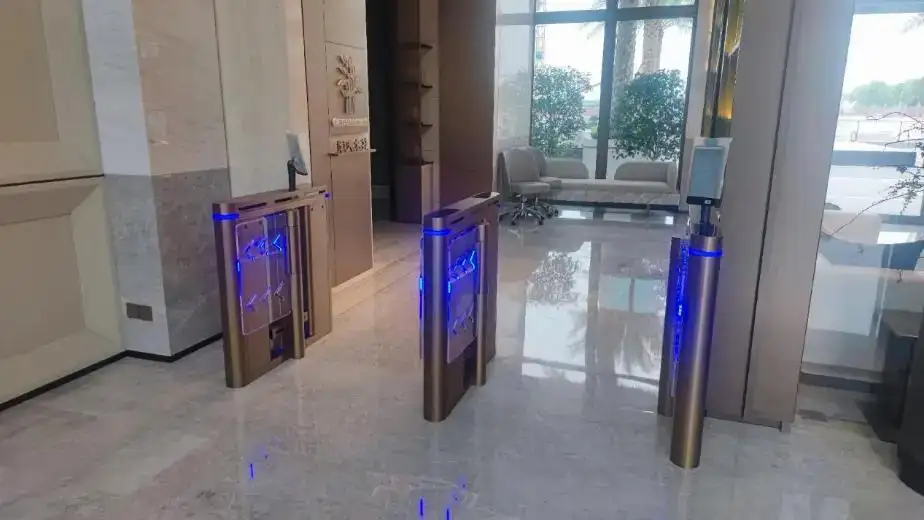
Waist-height with retractable glass or polycarbonate panels. In heavy duty configuration: SUS304 full-weld cabinet at 1.5mm+ wall thickness, servo motor drive, IP54 for semi-outdoor positioning, 8–12 infrared sensor pairs for anti-tailgating and anti-pinch, and MCBF of 5–8 million cycles. For corporate headquarters facilities that also have a manufacturing wing, a heavy duty flap barrier at the main lobby entry handles the aesthetic requirement while meeting the cycle life demands of a high-traffic building entry with 1,000+ daily passes.
Anti-Climb Swing Barrier Gate
For medium-security industrial perimeter deployments where waist-height gates create a climb-over risk, an anti-climb swing barrier gate extends barrier panel height to 1,800mm+ — eliminating the physical gap above a standard waist-height panel without adopting the full floor-to-ceiling profile of a full height model. This configuration is especially effective at industrial site secondary entrances, substation access points, and research facility perimeters where physical bypass prevention matters but full height hardware isn't in the project budget.
AB Entrance Gate System (Mantrap)
For the highest security industrial checkpoint — where individual identity verification combined with physical tailgating prevention is non-negotiable — an AB entrance gate system provides a two-barrier sequential entry channel. One person enters the first door, waits for identity verification, and only then does the second door open. No tailgating is physically possible because both barriers cannot be open simultaneously. This configuration suits pharmaceutical manufacturing, defense contractor facilities, nuclear power station perimeters, and data center access corridors.
Heavy Duty Turnstile Gate with RFID: The Right Credential for Industrial Deployments
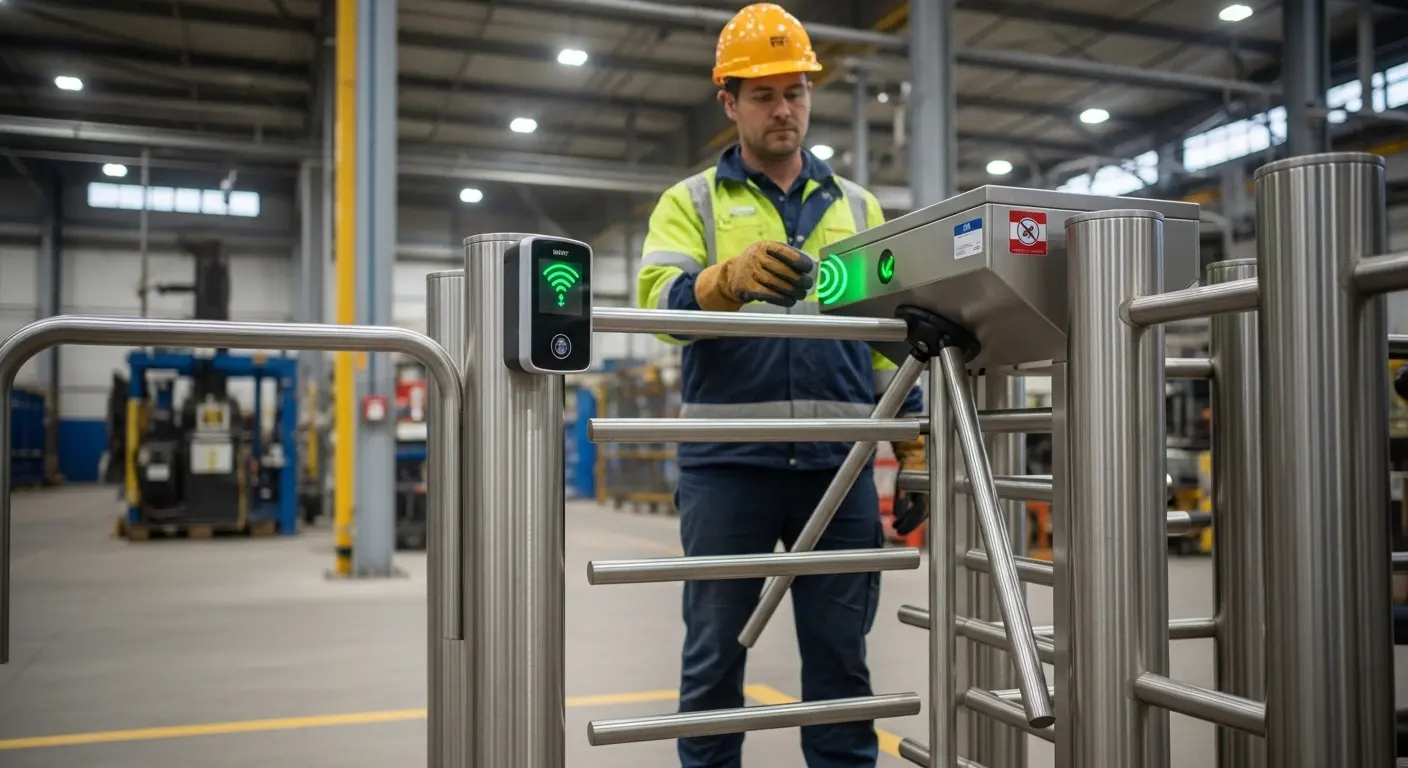
Standard RFID card readers work well in office lobbies. They don't work reliably when the credential holder is wearing full PPE — thick gloves, helmets with visors, high-visibility jackets, and steel-toe boots. Industrial environments create real credential presentation challenges that affect throughput and compliance.
A heavy duty turnstile gate with RFID designed for industrial deployment addresses this through:
- Long-range RFID readers: UHF RFID (860–960MHz) reads a card or tag at 0.5–2.0m — no physical card tap required. A worker walks through the lane with their helmet on and a UHF tag clipped to their hard hat. The reader validates from distance, the gate opens before they reach it, and throughput stays above 40 ppm even with PPE-equipped workers.
- Hands-free credentials: Wearable tags — wristbands, hard hat clips, jacket patches — eliminate the requirement to retrieve a card from a pocket while wearing gloves.
- Facial recognition in controlled environments: For indoor shift-entry checkpoints with consistent lighting, face recognition cameras eliminate credential handling entirely.
For a complete turnstile gate solution with RFID designed for industrial worker access, UHF RFID combined with heavy duty tripod or full height gate hardware gives you the physical durability and credential convenience that a factory or construction site deployment requires — without the throughput bottleneck of card-tap authentication at shift change.
Heavy Duty Turnstile Gate and Vehicle Access: Integrating Pedestrian and Parking Control
Many industrial sites need both pedestrian turnstile control and vehicle access management at the same perimeter. The two systems must work together — sharing credential databases, time-and-attendance records, and access event logs — without requiring separate management platforms.
A heavy duty parking barrier gate rated for industrial vehicle traffic — boom lengths from 3m to 6m, 300kg+ counterweight, IP54 housing, and cycle rates of up to 1,800 cycles per day — connects to the same access control platform as the pedestrian heavy duty turnstile gate lanes. One credential grants access to the correct gate type based on the person's role: vehicle boom gate for managers with vehicle access rights, pedestrian turnstile for workers on foot.
For facilities that need a dedicated vehicle barrier alongside a combined parking and pedestrian access system, a boom barrier and boom parking barrier gate solution provides the vehicle-side counterpart to pedestrian heavy duty turnstile gate lanes — covering the full perimeter access picture under one unified credential and access event management system.
Anti-Tailgating in Heavy Duty Industrial Deployments
Anti-tailgating is especially critical at industrial sites where worker headcount at restricted zones directly affects safety compliance. In a chemical plant, pharmaceutical facility, or secure storage area, knowing who is in a zone at any given time isn't just a security requirement — it's a regulatory one.
A heavy duty turnstile gate for industrial anti-tailgating deployments needs:
- 8–12 infrared sensor pairs across the passage zone (not 3–4 pairs as in basic commercial models)
- Sensor pair count per detection zone: Enough pairs to distinguish a single authorized worker from a following person even when the authorized person carries a wide load like a tool bag or safety equipment case
- Alarm output to security management platform: Real-time alarm event push to the site security control room, not just a local buzzer
The anti-tailgating AB turnstile gate uses dual optical sensor logic to distinguish legitimate single-person passage from tailgating attempts — even in scenarios where the authorized user is followed closely by a worker who has also recently scanned a valid credential but shouldn't be in the zone at that time. In addition, alarm events are logged individually with timestamps, gate ID, and credential ID for post-incident audit review.
Heavy Duty Turnstile Gate Specifications: What to Demand From Any Supplier
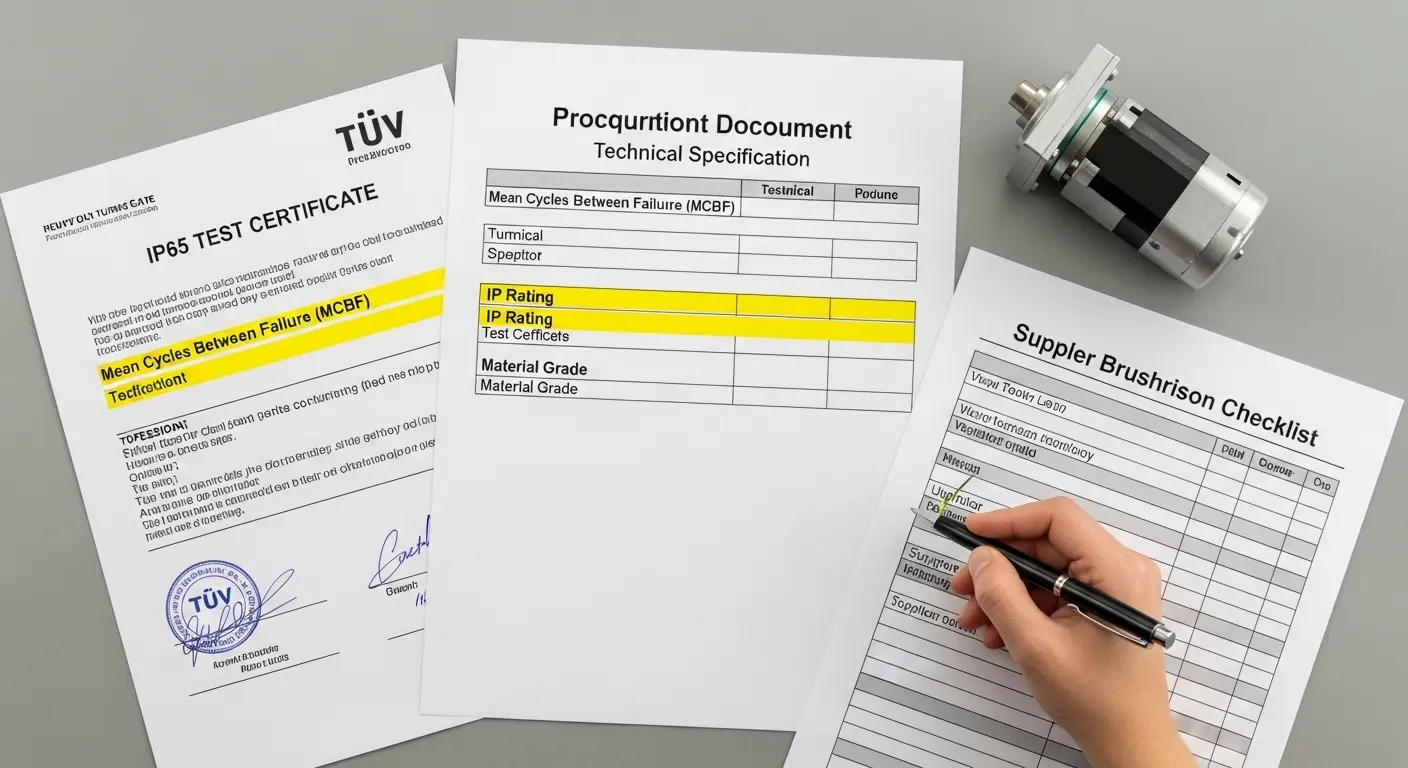
Use this reference table when comparing heavy duty turnstile gate products across any supplier:
| Specification | Commercial Standard | Heavy Duty Minimum | Industrial Grade |
|---|---|---|---|
| MCBF | 1–2M cycles | 3M cycles | 5M+ cycles |
| IP Rating | IP4X | IP54 | IP65 |
| Cabinet material | SUS304, 1.2mm | SUS304, 1.5mm | SUS316, 2.0mm full-weld |
| Drive mechanism | Basic DC motor | Brushless DC | Servo motor |
| Duty cycle | Intermittent | 80% | 100% continuous |
| Operating temp | 0°C to +50°C | -20°C to +60°C | -35°C to +70°C |
| Throughput | 20–25 ppm | 30–35 ppm | 35–50 ppm (auto) |
| Sensor pairs | 3–4 | 6–8 | 10–16 |
| Certifications | CE | CE + IP test report (independent lab) | CE + IP test + MCBF test report |
Three checkpoints to apply to any supplier claim:
1. Ask for the IP test report from an accredited independent lab
A spec sheet claim of IP54 or IP65 is not the same as an IP test report from an NABL, SGS, or TÜV accredited laboratory. Request the test report certificate number and verify it independently.
2. Ask for MCBF documentation
MCBF ratings should come from accelerated life testing — not estimates. A supplier who publishes a 5-million-cycle MCBF claim without a test report is providing a marketing number, not an engineering specification.
3. Confirm duty cycle
100% duty cycle means the gate runs continuously without rest. Ask the supplier to confirm the thermal test conditions — at what ambient temperature and cycle rate was the 100% duty cycle rating validated.
Frequently Asked Questions About Heavy Duty Turnstile Gates
Q: What makes a turnstile gate "heavy duty"?
A: A heavy duty turnstile gate carries measurable thresholds across six parameters: MCBF of 3–5 million cycles minimum, IP54–IP65 ingress protection rating, SUS304 or SUS316 stainless steel construction at 1.5mm+ wall thickness, brushless DC or servo motor drive, 100% duty cycle rating, and an operating temperature range of at minimum -20°C to +60°C. These are testable, verifiable specifications — not marketing descriptions.
Q: What IP rating does a heavy duty turnstile gate need for outdoor use?
A: IP54 for semi-outdoor or covered outdoor environments. IP65 for fully exposed outdoor environments — this rating provides total dust exclusion and protection against water jets from any direction. Always request an independent lab IP test report, not just a specification sheet claim. NABL, SGS, or TÜV certification is the standard for credible IP rating verification.
Q: What is the best heavy duty turnstile gate for a factory gate?
A: For a standard factory pedestrian gate: a heavy duty tripod turnstile with IP54, SUS304 full-weld construction, brushless motor, 3–5 million MCBF, and UHF RFID or face recognition for PPE-wearing workers. For restricted zone access within the factory: a full height turnstile gate with IP54 outdoor rating and anti-tailgating sensor array. The right choice depends on the security level required per zone, not just the environment classification.
Q: Can a heavy duty turnstile gate be used outdoors without a canopy?
A: Yes — if it carries IP65 certification and an operating temperature range matching your climate. IP65-rated SUS304 or SUS316 heavy duty turnstile gates are designed for direct outdoor exposure. IP54-rated models benefit significantly from a protective canopy, which extends control board service life by reducing water and condensation exposure to the internal electronics. Confirm the outdoor suitability for your specific climate with the manufacturer before specifying.
Q: How long does a heavy duty turnstile gate last in an industrial environment?
A: A heavy duty turnstile gate with a 5-million-cycle MCBF mechanism, operating at 500 passes per day with a proper maintenance schedule, provides 27+ years of theoretical mechanism life. Real-world service life at 1,000+ passes per day typically runs 10–15 years before mechanism overhaul is required. Factors that shorten service life: inadequate IP rating for the environment, lack of regular lubrication and sensor cleaning, and non-factory replacement parts used in repairs.
